“Hunting had ceased to be a diversion. It was a grim necessity.”
— Rainsford's realization as he is being hunted.

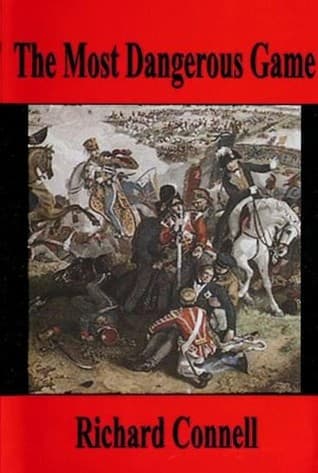
Richard Connell (1990)
Genre
Thriller
Reading Time
45 min
Key Themes
See below
Sign in to track this book
A renowned hunter becomes prey after being shipwrecked on an island and forced into a deadly game with a deranged aristocrat.
Sanger Rainsford, a famous hunter, is on a yacht to the Amazon for a jaguar hunt with his friend Whitney. They talk about hunting, and Whitney feels uneasy about 'Ship-Trap Island' and the idea that prey might feel fear. Rainsford dismisses this, believing animals do not understand. Later, while smoking on deck, Rainsford hears three gunshots. Leaning over the rail to investigate, his pipe slips, and he falls into the Caribbean Sea. Unable to swim back to the yacht, he swims towards the gunshots.
After a long swim, Rainsford reaches Ship-Trap Island's shore. Exhausted, he collapses but eventually finds his way through the jungle. He soon finds a large chateau, like a palace, on a bluff. He knocks on the door, which is opened by Ivan, a huge, deaf-mute Cossack with a black beard, who points a revolver at Rainsford. Before Rainsford is harmed, General Zaroff appears, recognizing Rainsford's name from his hunting books. Zaroff, a cultured Russian aristocrat, welcomes Rainsford into his home.
General Zaroff treats Rainsford to a luxurious dinner with fine wines and food. During their talk, Zaroff admires Rainsford's hunting skill. However, he also says he is bored with hunting regular animals, saying they no longer challenge him. He explains he is tired of beasts that lack reason. Zaroff then hints that he has found a 'new animal' to hunt on his island, one that provides the ultimate challenge because it can reason. Rainsford is curious but also disturbed by Zaroff's intensity and the look in his eyes.
As Rainsford asks Zaroff about this 'new animal,' the general reveals the truth: he hunts humans. He explains he 'helps' ships crash on the jagged rocks around the island using lights, giving him a steady supply of victims. He justifies his actions by claiming these men are 'scum of the earth' and that life is for the strong. Rainsford is horrified, calling Zaroff a murderer. Zaroff, however, sees himself as a sophisticated sportsman, offering his 'prey' a choice: be hunted, or be tortured by Ivan. He offers Rainsford a choice to join him, which Rainsford refuses.
After Rainsford refuses to participate or approve Zaroff's sport, the general tells him he will be the next prey. Zaroff explains the rules: Rainsford gets a hunting knife, a three-hour head start, and some food. If he can evade Zaroff and Ivan for three full days, he wins and is set free. If Zaroff finds him before then, Rainsford loses and dies. Zaroff warns him not to try to escape the island, as the jungle is vast and full of quicksand, and the sea is dangerous. Rainsford is terrified and determined to survive.
Rainsford immediately runs into the jungle, using his knowledge of tracking and evasion. He creates a complex trail, doubling back and climbing trees to confuse Zaroff. He builds his first trap, a 'Malay man-catcher,' by balancing a heavy log on a springy sapling. Zaroff, with his hounds, easily tracks Rainsford to the trap. The trap is sprung, but Zaroff dodges it, getting only a minor shoulder injury. He compliments Rainsford on his cleverness, but the encounter shows the general's superior tracking skills and unsettling confidence. Rainsford understands the real danger he faces.
On the second day, Rainsford continues his flight, building a second, more dangerous trap. He digs a 'Burmese tiger pit,' camouflaging it with branches and leaves, and sharp stakes at the bottom. Zaroff again tracks him to it. This time, one of Zaroff's prized hounds falls into the pit and dies. Zaroff expresses annoyance at losing his dog but stays calm, still enjoying the challenge. Rainsford then builds a 'Ugandan knife trap,' tying his hunting knife to a sapling that will spring back when triggered. This trap kills Ivan instantly when he steps into it while with Zaroff. Zaroff calls out to Rainsford, expressing mock regret for Ivan's death, but his desire to hunt Rainsford remains.
With Ivan dead and Zaroff closing in with his remaining hounds, Rainsford is driven to the edge of a cliff overlooking the sea. He has no more traps or escape options on land. Rather than face Zaroff directly or be torn apart by the hounds, Rainsford makes a desperate decision. He plunges into the water below, seemingly committing suicide to avoid capture. Zaroff, at the cliff's edge, is disappointed that his game ended without a clear kill. He assumes Rainsford is dead, swept away by the current, and returns to his chateau, believing he has won.
After returning to his chateau, Zaroff enjoys a meal and goes to his bedroom, thinking about the day's hunt. He is surprised, however, to find Rainsford waiting for him in the dark room. Rainsford had not drowned but had swum around the island, climbed the cliffs, and sneaked back into the chateau. Rainsford declares, 'I am still a beast at bay,' meaning the game is not over. He challenges Zaroff to a final duel, stating, 'The general, I see, is not in the least surprised. He is quite calm, quite at his ease.' Zaroff, though surprised, quickly regains composure and accepts the challenge.
Rainsford tells Zaroff that one of them will sleep in the comfortable bed, and the other will be fed to the hounds. The story implies a fierce struggle between the two hunters. The final line reveals the outcome: 'He had never slept in a better bed, Rainsford decided.' This suggests Rainsford killed Zaroff and fed his body to the general's hounds, becoming the new master of the chateau and the island, and winning the most dangerous game.
The Protagonist
Rainsford transforms from a detached hunter to a terrified prey, ultimately becoming a predator again, but with a new understanding of fear and survival.
The Antagonist
Zaroff remains consistently evil, driven by his twisted philosophy, until he is ultimately defeated by his own game.
The Supporting
Ivan remains a static, menacing figure, serving Zaroff until his death.
The Mentioned
Whitney's character does not develop within the story, as he disappears early on.
The story explores the ethics of hunting. Rainsford at first believes animals do not feel fear, seeing hunting as a sport for the strong. Becoming prey forces him to experience the terror of being hunted, challenging his earlier beliefs. Zaroff represents the extreme end of this, turning sport into murder, believing his intellect justifies his actions. The story asks where the line between sport and barbarity is, and if human life has more inherent value than animal life.
“'The world is made up of two classes—the hunters and the huntees. Luckily, you and I are hunters.'”
Connell contrasts General Zaroff's outward sophistication—his chateau, fine dining, and cultured manner—with his barbaric 'sport.' This contrast shows how a civilized appearance can hide deep savagery. Zaroff's reasons for hunting humans show a return to primal instincts, despite his intelligence and wealth. The isolated island is a place where societal rules break down, letting the dangerous parts of human nature appear, suggesting that savagery is always close to the surface, even in 'civilized' people.
“'We do our best to preserve the amenities of civilization here. Please forgive any lapses. We are, I beg you to remember, in a primitive jungle.'”
The story's main emotional arc is Rainsford's experience of fear. At first, he lacks empathy for his prey. But when he becomes the hunted, he experiences 'the most dreadful sound a hunter ever heard' and the 'cold dread' animals must feel. This direct experience of terror makes him empathize with the hunted, changing his detached view. The story suggests that true understanding often comes from experiencing a situation from another's point of view, especially when it involves suffering.
“'I've always thought, until now, that animals had no understanding.'”
General Zaroff states a philosophy of 'survival of the fittest,' believing the strong have the right to prey on the weak. He sees his human victims as 'scum' and himself as superior. Rainsford, by outsmarting and defeating Zaroff, shows a different 'fittest'—not just physical strength, but also adaptability, cunning, and a more practical intelligence. The ending suggests that while brutal strength matters, true survival often needs more than just force or a twisted ideology.
“'Life is for the strong, to be lived by the strong, and, if need be, taken by the strong.'”
Hints and clues that build suspense and predict future events.
The story uses extensive foreshadowing to build suspense. Whitney's unease about 'Ship-Trap Island' and the 'evil place' it has, along with Rainsford hearing gunshots, immediately sets an ominous tone. Zaroff's comments about being bored with hunting animals that lack 'reason' and his 'new animal' strongly hint at his human prey before the explicit reveal. Even the name 'Ship-Trap Island' itself foreshadows the fate of Rainsford and Zaroff's other victims, creating a sense of impending doom for the protagonist.
The contrast between expectation and reality, often used for dramatic effect.
The story is rich in irony. Rainsford, a celebrated hunter who believes animals feel no fear, becomes the hunted and experiences profound terror, a dramatic reversal of roles. Zaroff, a man of extreme wealth and culture living in a palatial chateau, engages in the most barbaric of 'sports.' The 'game' itself is ironic, presenting murder under the guise of an honorable sport with rules. The final irony is Rainsford sleeping in Zaroff's bed, implying he has fully embraced the role of the ultimate hunter, perhaps even becoming a version of what he once abhorred.
The isolated island acts as a key element shaping the plot and mood.
Ship-Trap Island is more than just a backdrop; it functions almost as a character itself. Its isolation, dense jungle, quicksand, jagged rocks, and treacherous waters are integral to Zaroff's ability to operate undetected and to the challenges Rainsford faces. The island embodies both the beauty and the danger of untamed nature, reflecting the primal struggle within the story. It is a place where civilization's rules are suspended, allowing Zaroff's dark desires to manifest and forcing Rainsford into a fight for his very existence.
The central struggle between Rainsford and Zaroff.
While there are elements of 'man vs. nature' (Rainsford battling the jungle) and 'man vs. self' (Rainsford grappling with fear), the core conflict is unequivocally 'man vs. man.' The entire plot is driven by the deadly cat-and-mouse game between Rainsford and Zaroff. Their clash is not merely physical but also a battle of wits, hunting skills, and conflicting moral philosophies. Zaroff represents the ultimate predator, and Rainsford, the ultimate prey turned predator, creating a high-stakes, personal struggle for survival and dominance.
“Hunting had ceased to be a diversion. It was a grim necessity.”
— Rainsford's realization as he is being hunted.
“The world is made up of two classes—the hunters and the huntees. Luckily, you and I are hunters.”
— General Zaroff's philosophy on life and his view of himself and Rainsford.
“An ancient instinct warned him of the approach of that thing he knew was coming.”
— Rainsford's primal fear and awareness of Zaroff's pursuit.
“I refuse to believe that so modern and civilized a man as you can harbor such a barbaric idea.”
— Rainsford's initial disbelief and moral objection to Zaroff's 'game'.
“He lived a year in a minute.”
— Describing Rainsford's intense experience of fear and the passage of time.
“I have electricity. We do our own cooking here. You are a guest, Mr. Rainsford.”
— Zaroff's attempt to present a veneer of civility despite his true nature.
“Life is for the strong, to be lived by the strong, and, if need be, taken by the strong.”
— Zaroff's brutal justification for his actions.
“The general was playing with him! The general was saving him for another day's sport!”
— Rainsford's terrifying realization of Zaroff's cruel cat-and-mouse game.
“There was a certain grim humor in it all.”
— Rainsford's dark reflection on his predicament.
“He knew that his quarry was a strong, wily, and resourceful man.”
— Zaroff's assessment of Rainsford as a worthy opponent.
“The Most Dangerous Game.”
— The title of the story, referring to hunting humans.
“He had never slept in a better bed, Rainsford decided.”
— Rainsford's final thought after defeating Zaroff, implying he took Zaroff's place.
“He had often wondered what it felt like to be hunted.”
— Rainsford's earlier thought before he becomes the prey.
“I can't believe you are serious, General Zaroff. This is a grisly joke.”
— Rainsford's initial denial of Zaroff's intentions.
Ready to see how well you understood this book? Take our interactive quiz with 10 questions.
Biography coming soon.







