“The world is a vast, beautiful, and terrifying place. You are not alone in it, and you are not the first to be afraid.”
— Dr. Warthrop's advice to Will Henry early in their adventures.

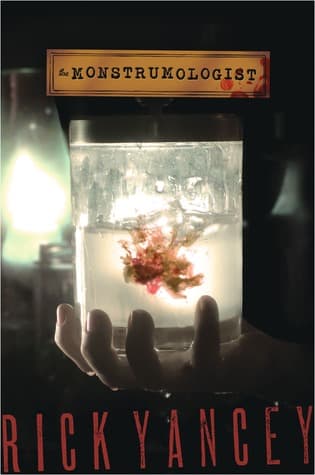
Rick Yancey (2009)
Genre
Fantasy / Historical Fiction / Mystery / Young Adult
Reading Time
580 min
Key Themes
See below
Sign in to track this book
In a gaslit 19th-century world, an orphaned assistant to a monstrumologist must confront the horrifying line between man and monster when a grave robber's find unleashes their most deadly and morally ambiguous case yet.
The story begins in 1888. Twelve-year-old orphan Will Henry tells about his life as the assistant to Dr. Pellinore Warthrop, a monstrumologist. Their secluded New England home is a place for unusual studies. One stormy night, the grave robber, Erasmus, arrives with a large, wrapped bundle. Inside is the decapitated body of a young girl. What truly frightens Will is the creature that killed her: an Anthropophagus, a man-eating monster with its mouth in its torso and eyes on its shoulders. Dr. Warthrop immediately recognizes the species, believed extinct, and is both horrified by the brutality and fascinated by the scientific implications. This discovery pushes Will and the doctor into a dangerous investigation.
Dr. Warthrop becomes engrossed in the Anthropophagus case, carefully dissecting the creature's head and body parts to understand its biology and habits. His scientific curiosity borders on obsession, often neglecting Will's needs and emotional state. Will, on the other hand, is terrified by the monster and what its presence means. He struggles with nightmares and the constant fear that more of these creatures might be nearby. He also deals with the doctor's detached, often cold, manner, wanting some comfort that Dr. Warthrop rarely gives, seeing Will more as an apprentice than a child.
Constable Chaney, the local law enforcement officer, arrives at the Warthrop estate. He is investigating recent disappearances and gruesome discoveries in the town of New Jerusalem. He suspects Dr. Warthrop's reclusive life and the strange rumors about his work. Chaney demands answers about the mutilated bodies found, pressing Dr. Warthrop to explain the unexplainable. The doctor, bound by his ethical code and the secret nature of monstrumology, is hesitant to reveal the truth about the Anthropophagi, fearing public panic and disbelief. This meeting further isolates Warthrop and Will from the community.
A new character, Mr. Kearns, a large and imposing man, arrives at the Warthrop residence. He is a fellow monstrumologist, but one with a more practical and ruthless approach to their profession. Kearns and Warthrop have a strained history, due to different ideas on how to handle monstrous threats. Kearns believes in immediate extermination, while Warthrop prefers study and understanding. Kearns brings news of a larger Anthropophagus presence, suggesting that the creature Erasmus found is not an isolated incident but part of a larger infestation, pushing Warthrop to consider more extreme measures.
With the growing threat, Dr. Warthrop, Will, Mr. Kearns, and Erasmus start a dangerous journey into the complex catacombs beneath New Jerusalem. They believe this underground network is where the Anthropophagi are nesting and breeding. The atmosphere is tense and claustrophobic as they navigate the dark, damp passages, searching for any sign of the creatures. Will's fear is clear, but he tries to be brave for the doctor. During their search, they find evidence of the monsters' recent activity and the gruesome remains of their victims, confirming their fears about how widespread the infestation is.
Deep within the catacombs, the team finally finds a nest of Anthropophagi. The creatures are far more numerous and aggressive than expected. A brutal battle follows, with Kearns showing his combat skill against the monsters. Erasmus, despite his initial fear, also fights bravely. Dr. Warthrop, though mainly a scholar, uses his knowledge to find weaknesses. Will, armed with a small pistol, must overcome his fear to help them survive. The scene is chaotic and bloody, resulting in casualties and leaving the survivors shaken, but they manage to destroy a large part of the nest.
After the fight, Dr. Warthrop, through more study of the captured Anthropophagi and his extensive knowledge, makes a chilling discovery: the creatures are not merely animals but a degenerate offshoot of humanity, once part of a forgotten civilization that retreated underground. They are not mindless beasts but have a primitive intelligence and a terrifying, instinctive drive. This revelation deeply affects Warthrop, blurring the lines between man and monster and making his moral dilemma about their extermination deeper. He realizes the Anthropophagi are not just a threat but a tragic biological anomaly.
With the Anthropophagi population still a significant threat, Dr. Warthrop creates a desperate and dangerous plan. He intends to lure the remaining creatures into a central location within the catacombs and then collapse the tunnels, burying them alive. This plan requires precise timing and coordination, and it puts Will and the others at immense risk. Warthrop struggles with the ethical implications of mass slaughter, even of monsters, but the growing danger to New Jerusalem outweighs his scholarly reservations. He begins preparations, gathering explosives and mapping the tunnels, driven by a grim determination.
The final confrontation takes place in the deepest parts of the catacombs. Dr. Warthrop, Will, and Kearns carry out the plan to collapse the tunnels. They face a massive horde of Anthropophagi, led by a particularly large and old specimen, likely the matriarch. The battle is brutal, with Kearns sacrificing himself to ensure the mission's success, holding off the creatures while Warthrop sets the charges. Will, despite his fear, plays a crucial role in distracting the monsters and assisting the doctor. The tunnels collapse, burying the remaining Anthropophagi, but the cost is high, leaving Will and Warthrop as the sole survivors.
In the aftermath, New Jerusalem is safe, but the experience leaves deep scars on Will Henry. He is haunted by the horrors he saw and the sacrifices made. Dr. Warthrop, though successful, is also profoundly changed, grappling with the moral weight of his actions and the loss of his colleague. The secrets of the Anthropophagi remain hidden from the world, a burden that Will will carry for the rest of his life. The novel ends with Will reflecting on the doctor's legacy and the deep impact of his time as a monstrumologist's assistant, understanding that some monsters are not easily defeated, even after death.
The Protagonist
Will transforms from a scared, dependent boy into a resilient young man, forced to confront the darkest aspects of existence and grapple with the moral ambiguities of his mentor's work.
The Supporting/Mentor
Warthrop is forced to confront the monstrous nature of humanity and the humanity of monsters, challenging his purely scientific worldview and forcing him to make morally ambiguous choices.
The Supporting
Erasmus transforms from a selfish grave robber into a reluctant but valuable ally, demonstrating a surprising capacity for bravery in the face of overwhelming odds.
The Supporting
Kearns remains steadfast in his pragmatic approach to monsters, ultimately sacrificing himself to protect humanity, solidifying his role as a tragic hero.
The Supporting
Chaney remains largely in the dark about the true nature of the threats, representing the limited understanding of the everyday world.
The Antagonists
The Anthropophagi are revealed to be more than just monsters, challenging the characters' preconceived notions and forcing a re-evaluation of what constitutes 'humanity'.
The novel constantly blurs the lines between being human and being a monster. The Anthropophagi, first seen as beasts, are revealed to be a degenerate form of humanity, making Dr. Warthrop question the morality of killing them. Conversely, Dr. Warthrop's own detached, almost inhumane scientific pursuit and willingness to sacrifice for knowledge make him seem monstrous at times, especially from Will's perspective. Will struggles with his own capacity for violence and fear, seeing the monstrous within himself. The book asks if true monstrosity is in appearance or in action, and if humanity can become the very thing it hunts, as seen when Warthrop orders the mass slaughter of the Anthropophagi, mirroring their own brutality.
“When does man become the very thing he hunts?”
The world of monstrumology is one of secrecy, protecting the general public from terrifying truths but also isolating those who hold this knowledge. Dr. Warthrop and Will carry the immense burden of knowing about monsters, which sets them apart from society. This secrecy prevents them from seeking help or sharing their trauma, leading to deep loneliness and psychological strain. Will Henry, as the narrator, reflects on the lifelong burden of the secrets he kept, even decades later. This theme is clear in Dr. Warthrop's hesitation to inform Constable Chaney, understanding that the truth would cause panic and misunderstanding, but also showing the doctor's solitary struggle.
“These are the secrets I have kept. This is the trust I never betrayed.”
Will Henry's journey is one of lost innocence. As a twelve-year-old orphan, he is forced to confront unimaginable horrors, seeing gruesome deaths and participating in violent struggles. His childhood is stolen by the demands of monstrumology, leaving him with deep psychological scars. The constant fear, the sight of mangled bodies, and the need to take lives fundamentally change how he sees the world. This trauma is not just immediate; it lasts for decades, as shown by the older Will Henry's narration. His nightmares and the emotional detachment he observes in Dr. Warthrop suggest the deep and lasting impact of such experiences.
“I had seen too much. I had seen the world's heart, and it was not good.”
Dr. Warthrop embodies the central conflict between the pursuit of scientific knowledge and ethical considerations. His constant curiosity often overrides empathy and caution, leading him to make morally ambiguous decisions, such as using Will as an assistant in dangerous situations or choosing to study rather than immediately exterminate. He struggles with the inherent contradiction of his profession: to understand monsters, he must often treat them as subjects, yet their actions demand a moral response. This conflict is especially clear when he discovers the Anthropophagi's human origins, forcing him to weigh the value of their lives against the safety of humanity. His ultimate decision to destroy them, despite their nature, highlights the painful choices inherent in his work.
“Knowledge is a deadly thing, and he who has it will forever be a stranger among men.”
The story is told by an older Will Henry looking back on his youth.
The novel is narrated by an adult Will Henry, recounting the events of his youth. This device allows for a layer of reflection and commentary on the past, providing insight into the lasting impact of the events and the psychological toll they took. The older Will's voice adds a somber, philosophical tone, foreshadowing tragedy and emphasizing the enduring burden of his experiences. It also creates a sense of reliability and intimacy, drawing the reader into his personal journey and the secrets he has kept for decades.
The use of dark, isolated, and decaying environments to enhance dread.
The story is steeped in a gothic atmosphere, characterized by its isolated New England setting, the decaying Warthrop estate, and the dark, labyrinthine catacombs beneath New Jerusalem. This setting creates a pervasive sense of dread, mystery, and claustrophobia, enhancing the horror of the monsters. The stormy nights, dimly lit rooms, and underground tunnels contribute to the oppressive mood, mirroring the dark themes of the story and the psychological torment experienced by Will Henry. The gothic elements emphasize the grotesque and the macabre, immersing the reader in a world of unsettling beauty and terror.
Hints and clues about future events or revelations.
Foreshadowing is used extensively, primarily through the older Will Henry's narration, which often alludes to future tragedies, the lasting impact of the events, or the ultimate fate of characters like Dr. Warthrop. Early descriptions of the doctor's obsession or the nature of the Anthropophagi hint at deeper, more disturbing truths. This device builds suspense and a sense of impending doom, keeping the reader engaged and anticipating the unfolding horrors. For example, Will's opening lines about the 'curse' placed upon him by the doctor immediately suggest a complex and difficult future.
Will Henry's youthful perspective shapes and filters the events.
While Will Henry is generally reliable in recounting facts, his youthful perspective and emotional state at the time of the events mean his interpretations and understanding are subjective. He is scared, confused, and often yearning for affection from Dr. Warthrop, which can color his portrayal of the doctor's actions and motivations. The older Will Henry, while reflecting, still processes these events through the lens of his younger self's trauma. This device adds depth to the characterization and allows for ambiguity in the reader's judgment of certain characters and their choices, particularly Dr. Warthrop.
“The world is a vast, beautiful, and terrifying place. You are not alone in it, and you are not the first to be afraid.”
— Dr. Warthrop's advice to Will Henry early in their adventures.
“Monsters are real. And ghosts are real, too. They live inside us, and sometimes, they win.”
— Will Henry's reflection on the true nature of evil and inner demons.
“Ignorance is not bliss. Ignorance is a disease, and it's contagious.”
— Dr. Warthrop expressing his disdain for those who refuse to seek knowledge.
“There are things in this world that are not meant to be understood, only endured.”
— Will Henry's somber realization about the limits of human comprehension in the face of horror.
“The truth is a terrible thing, Will Henry. But it is always better than a lie.”
— Dr. Warthrop emphasizing the importance of honesty, no matter how painful.
“Sometimes, the only way to defeat a monster is to become one yourself. But then, who is the monster?”
— A philosophical dilemma pondered by Will Henry regarding the morality of their work.
“We are all born with a monster inside us. The trick is to keep it chained.”
— Dr. Warthrop's cynical view on the inherent darkness within humanity.
“Hope is a dangerous thing, Will Henry. It can make a man do foolish things.”
— Dr. Warthrop cautioning against the perils of unfounded optimism.
“The greatest monster of all is the one that hides in plain sight, the one that looks just like us.”
— Will Henry reflecting on the human capacity for cruelty and deception.
“To understand a monster, you must first understand the fear it inspires.”
— Dr. Warthrop's methodological approach to monstrumology.
“There is no glory in hunting monsters, Will Henry. Only the grim satisfaction of a job done.”
— Dr. Warthrop dispelling any romantic notions about their profession.
“Every man has a weakness, Will Henry. Find it, and you've found the key to his destruction.”
— Dr. Warthrop's pragmatic and ruthless view on human nature and strategy.
“Sometimes, the hardest thing to kill is not the monster, but the lie that feeds it.”
— Will Henry contemplating the pervasive nature of misinformation and belief.
“The past is never truly dead. It is not even past.”
— A reflection on how historical events and past traumas continue to influence the present.
Ready to see how well you understood this book? Take our interactive quiz with 10 questions.

Biography coming soon.







