“Florence is a city of secrets, a city of shadows, a city where the past is never truly dead.”
— Early in the book, setting the atmosphere of Florence.

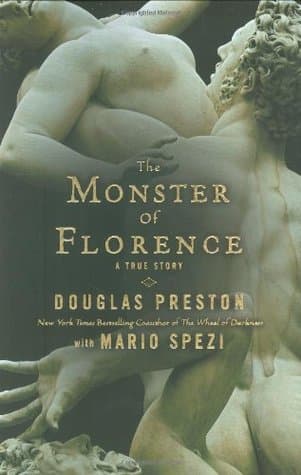
Douglas Preston (1996)
Genre
Thriller / History / Mystery
Reading Time
6-8 hours
Key Themes
See below
Sign in to track this book
An American author's dream move to a Tuscan farmhouse turns into a nightmarish true crime investigation when he unearths the chilling history of a serial killer in his own olive grove, only to become entangled as a suspect in a bizarre prosecutorial vendetta.
In 2000, American author Douglas Preston moves his family into a 14th-century farmhouse in Mercatale, a small village near Florence, Italy. He quickly learns from locals that the olive grove in front of his new home was the site of a brutal double murder in 1983, one of the notorious crimes attributed to the serial killer known as the Monster of Florence. This revelation deeply disturbs Preston, especially as he learns the victims, two young lovers, were found mutilated. Intrigued and unsettled by how close such a dark event was to his family's new life, Preston decides to investigate further, seeking to understand the history of the case that casts a shadow over his idyllic Italian dream.
Driven by his growing interest in the Monster of Florence case, Douglas Preston seeks out Mario Spezi, a veteran Italian investigative journalist who has covered the murders for decades and written a book on the subject. Spezi, initially wary of an American novelist, agrees to meet Preston. Their first encounter establishes a connection, as Spezi shares his deep knowledge and personal theories about the case, including his skepticism about the official police narrative and the convicted killer, Pietro Pacciani. Spezi's insights and access to old case files prove valuable, and the two decide to collaborate, with Preston aiming to write an article and Spezi eager to revisit the unsolved aspects.
Preston and Spezi review the history of the Monster of Florence murders, spanning from 1968 to 1985. They examine each of the eight double homicides, focusing on the consistent method of attacking young lovers in secluded areas, typically in cars, and the subsequent post-mortem mutilation of the female victims. Spezi guides Preston through the initial investigation failures, the botched forensic work, and the sensational media coverage. They discuss the various suspects who were pursued and later cleared, highlighting the immense pressure on the police to find a culprit and the public's terror that gripped the Tuscan region for nearly two decades.
Preston and Spezi examine the 'Sardinian connection,' a group of Sardinian immigrants initially suspected due to a 1968 murder that was later linked to the Monster. They then focus on Pietro Pacciani, a reclusive farmer with a violent past, who was eventually convicted as the Monster of Florence. Spezi details the flimsy evidence against Pacciani, including witness testimony that was often contradictory or coerced, and the lack of conclusive forensic links. They explore the 'compagni di merende' (snack buddies) theory, which suggested that Pacciani acted with accomplices, further complicating the official narrative and raising questions about the true nature of the crimes.
Mario Spezi reveals to Douglas Preston his long-held, controversial theory: the Monster of Florence murders were not the work of a lone, deranged individual like Pacciani, but a series of ritualistic killings orchestrated by a powerful satanic cult. Spezi explains that the specific mutilations, particularly the removal of body parts, point to occult practices. He suggests that the cult used a 'patsy' or a series of 'patsies' to carry out the murders, while the true masterminds remained hidden, manipulating the investigations and deflecting blame. This theory gives Preston a new, chilling way to view the entire case, moving beyond simple serial killer motives.
Embracing Spezi's cult theory, Preston and Spezi begin to piece together clues that suggest the involvement of high-ranking individuals connected to powerful Florentine families. They discuss the history of secret societies and occult practices in Italy. Spezi shares details about a specific 'Doctor' figure, whom he believes was a key orchestrator, and how this individual might have used his influence to manipulate police investigations and suppress evidence. Their investigation leads them to consider motives beyond simple lust or rage, pointing to a dark, ritualistic purpose behind the killings, possibly involving the acquisition of human organs for black magic or illicit trade.
Preston and Spezi arrange to meet a man they strongly suspect is the 'Doctor' and a central figure in the alleged cult, without directly accusing him. The interview is conducted for their book research. The man, a seemingly respectable individual, exhibits unsettling mannerisms and makes cryptic statements. His responses to their questions about the Monster case are evasive and unsettling, and he seems to possess an unusual depth of knowledge about the killings. The encounter leaves both Preston and Spezi convinced that they are very close to the heart of the conspiracy, solidifying their belief in the cult theory.
As Preston and Spezi look deeper into their investigation and grow closer to identifying potential cult members, they notice a shift. They discover that their phones are being tapped, and they are being followed. Italian police, particularly Prosecutor Paolo Canessa, begin to view their independent investigation not as helpful, but as an obstruction or even a conspiracy. The authorities seem determined to shut down their inquiries, hinting that Preston and Spezi are themselves becoming suspects in a new, fabricated narrative designed to protect the true perpetrators. This unexpected turn raises the stakes dramatically, transforming their journalistic pursuit into a personal ordeal.
Douglas Preston is called in for a rigorous interrogation by Prosecutor Canessa and the police. He is questioned about his motives, his relationship with Spezi, and his theories about the Monster case. The interrogators try to discredit his work and suggest he is involved in a cover-up or is being manipulated. Faced with veiled threats and accusations, Preston is eventually informed that he is an 'undesirable person' and is ordered to leave Italy, essentially expelled from the country. This official action forces Preston to return to the United States, leaving Spezi alone to continue their dangerous investigation.
After Preston's forced departure, Mario Spezi continues his investigation in Italy, but the police pressure intensifies. In a shocking development, Spezi is dramatically arrested and thrown into Capanne prison, accused of being the Monster of Florence himself, or at least an accomplice, and of obstructing justice. The charges are based on dubious evidence and a convoluted theory fabricated by the prosecution to discredit his work and silence him. Spezi's imprisonment shows the extreme lengths to which the Italian authorities are willing to go to suppress alternative theories and protect the official narrative, or perhaps, the true culprits.
From the United States, Douglas Preston tirelessly works to free Mario Spezi and expose the injustice of his arrest. He mobilizes legal support, contacts international media, and publicly denounces the actions of the Italian prosecution. Preston realizes that the authorities' vendetta against them is not just about silencing dissent, but potentially about protecting powerful individuals involved in the original crimes. He works to gather evidence that clears Spezi and further supports their cult theory, understanding that their personal ordeal has become linked to the unresolved mystery of the Monster of Florence.
After a period of harrowing imprisonment, Mario Spezi is eventually released from Capanne prison due to lack of credible evidence and mounting international pressure. Despite the trauma and the ongoing threat of further legal action, Spezi remains defiant and committed to uncovering the truth behind the Monster of Florence. He and Preston continue their collaboration, determined to publish their findings and expose the alleged cult and the prosecutorial misconduct that sought to silence them. Their ordeal strengthens their resolve to bring closure to the victims and their families, even as the official case remains full of controversy and unanswered questions.
The Protagonist
Transforms from an intrigued observer to a direct participant and victim of prosecutorial vendetta, solidifying his commitment to exposing truth.
The Protagonist
From a cautious expert, he becomes a direct target of the state, confirming his belief in the deep-seated conspiracy he's investigated.
The Antagonist
Remains steadfast in his pursuit of official narratives, escalating his efforts to silence and punish those who challenge him.
The Supporting
His conviction and subsequent appeals remain a central point of contention, symbolizing the flawed official investigation.
The Supporting
Remains an enigmatic, unpunished figure, representing the elusive nature of the true culprits.
The Supporting
Contributes to the legal pressure against Spezi and Preston, upholding the official, flawed narrative.
The Mentioned
Their tragic deaths are the unsolved mystery that fuels the entire narrative, inspiring the search for truth.
The book shows how truth and justice can be manipulated or hidden, especially when powerful interests are involved. The official investigation into the Monster of Florence case is full of errors, misdirection, and potential corruption, leading to the conviction of a man, Pietro Pacciani, whom the authors believe was at best a pawn, at worst innocent. Preston and Spezi's own ordeal—being targeted, interrogated, and imprisoned—demonstrates how the state can actively suppress dissenting narratives, even when those narratives are based on extensive research. The ultimate failure to definitively identify and punish the true Monster, or the alleged cult, shows how difficult it is to achieve true justice when facing systemic flaws and powerful, hidden forces.
“In Italy, the official truth is often more potent than the actual truth.”
The theme of power's corrupting influence is central to the narrative, appearing in several ways. The alleged satanic cult, if it exists, represents a network of powerful individuals who can commit heinous crimes without consequence, using their influence to evade detection and manipulate the justice system. Furthermore, the actions of the prosecutors, particularly Canessa and Mignini, show how state power can be abused to silence critics, protect official narratives, and even persecute innocent journalists like Mario Spezi. The book suggests that personal ambition or the desire to maintain control can lead to serious miscarriages of justice, highlighting deep corruption within certain institutions.
“The higher you go, the more dangerous it gets.”
Preston and Spezi's journey shows the dangers in investigative journalism, particularly when challenging powerful entities. Their relentless search for an alternative truth about the Monster of Florence leads them from being researchers to becoming targets of the very system they are investigating. Preston faces expulsion from Italy, while Spezi endures a traumatic arrest and imprisonment, accused of the very crimes he sought to solve. This theme highlights the personal sacrifices and risks journalists take, showing the importance of a free press while also exposing how easily it can be suppressed by those in authority who wish to control the narrative.
“It was like reporting on a murder while the murderer was sitting on the police force.”
The Monster of Florence case, as presented in the book, embodies the allure and horror of unsolved mysteries. The ambiguity surrounding the killer's identity, the ritualistic nature of the murders, and the decades of failed investigations create a compelling draw for both the authors and the reader. This allure, however, is deeply intertwined with the horror of the crimes themselves—the brutality, the mutilations, and the lasting terror inflicted upon the community. The book balances intellectual fascination with human tragedy, showing how an enduring mystery can captivate the mind while chilling the soul, urging a relentless pursuit of elusive answers.
“The Monster of Florence was not just a serial killer; he was a phantom, an absence that haunted the soul of Tuscany.”
The story is told from Douglas Preston's personal perspective.
The use of a first-person narrative, with Douglas Preston as the narrator, immerses the reader directly into his experiences, fears, and developing understanding of the case. This perspective lends authenticity to the events, particularly as Preston himself becomes a victim of the unfolding drama. It allows the reader to share his growing apprehension, his intellectual curiosity, and his eventual outrage, making the narrative more immediate and personal. The 'true story' aspect is reinforced by Preston's direct involvement and recounting of events.
Misleading clues and suspects that divert attention from the real culprits.
The entire official investigation into the Monster of Florence case is presented as a series of red herrings. The focus on the 'Sardinian connection' and particularly Pietro Pacciani serves to divert attention from what Preston and Spezi believe is the true orchestrator: a powerful, satanic cult. These misleading leads, whether intentional or accidental, highlight the failures of the police and the prosecution, and underscore the book's central argument that the official narrative was designed to protect the true perpetrators, making the real truth harder to uncover.
The reader knows more than the characters, or events unfold with unexpected reversals.
Dramatic irony is employed as Preston and Spezi, initially confident in their journalistic pursuit, unknowingly walk into a trap set by the authorities. The reader, aware of the book's premise (that the authors themselves become targets), anticipates the danger before the characters fully grasp it. This creates a sense of foreboding and tension as the authors delve deeper, adding a layer of suspense to their investigation. The eventual reversal of roles, where the investigators become the investigated, is a key manifestation of this device.
Hints and clues that suggest future events and dangers.
Throughout the narrative, subtle hints foreshadow the escalating danger faced by Preston and Spezi. Spezi's initial reluctance to fully reveal his theories, his warnings about the power of the cult, and the historical context of corruption in Italy all build a sense of impending peril. These early warnings prepare the reader for the shocking turn of events when the authorities target the authors, rather than assisting them, effectively escalating the stakes from a historical investigation to a personal thriller.
“Florence is a city of secrets, a city of shadows, a city where the past is never truly dead.”
— Early in the book, setting the atmosphere of Florence.
“The Monster of Florence was not just a killer; he was a symptom of a deeper malaise within Italian society.”
— The authors reflecting on the broader implications of the case.
“In Italy, the law is not always what it seems. Sometimes, it's just a suggestion.”
— Discussing the legal complexities and corruption encountered.
“The truth is often stranger, and far more terrifying, than fiction.”
— A recurring theme as the authors delve into the bizarre details of the case.
“We had stumbled into a world where logic was a foreign concept, and paranoia was a rational response.”
— As the authors face increasing pressure and suspicion from Italian authorities.
“Every secret has a shelf life. Eventually, it rots and reveals itself.”
— Reflecting on the persistence of unsolved mysteries.
“To understand the present, you must first understand the past, no matter how dark or disturbing it may be.”
— Emphasizing the historical context of the Monster of Florence case.
“The most dangerous lies are the ones we tell ourselves.”
— Pondering the self-deception that can hinder investigations.
“Sometimes, the biggest monsters are not the ones hiding in the shadows, but the ones we invite into our homes.”
— A metaphor for the insidious nature of certain aspects of the case.
“The silence in Florence was not peaceful; it was a heavy, watchful silence, pregnant with untold stories.”
— Describing the atmosphere of the city during their investigation.
“Justice, in Italy, often moved at its own inscrutable pace, driven by unseen forces.”
— Commentary on the slowness and opaqueness of the Italian legal system.
“We were no longer just writers; we were participants, caught in the very story we were trying to tell.”
— As the authors themselves become entangled in the investigation and legal troubles.
“The greatest evil often masquerades as the most mundane.”
— Reflecting on how ordinary people can commit horrific acts.
“To be innocent in Italy is not enough; you must also be perceived as innocent, and that is a different game entirely.”
— Highlighting the challenges faced by those accused in the Italian legal system.
Ready to see how well you understood this book? Take our interactive quiz with 10 questions.

Douglas Preston is a prolific author known for his suspenseful thrillers, often co-authored with Lincoln Child. Their collaborative works, including the popular Pendergast series featuring novels like 'Relic' and 'Blue Labyrinth,' have achieved international bestseller status. Preston also co-authored the non-fiction bestseller 'The Monster of Florence,' showcasing his versatility in both fictional and true crime narratives.







