“Do you know that you are very strong?”
— Grover addresses the reader directly, expressing concern about their ability to turn pages.

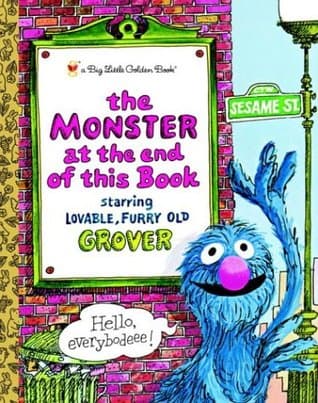
Jon Stone (1971)
Genre
Fantasy / Children's
Reading Time
5 min
Key Themes
See below
Sign in to track this book
Join the lovable, furry Grover on a hilariously self-aware adventure as he frantically tries to prevent you from reaching the inevitable, and surprisingly familiar, monster at the end of the book.
The story begins with lovable, furry old Grover directly addressing the reader. He greets them warmly but quickly shows deep anxiety: there's a monster at the end of this very book. Grover, with wide, worried eyes, urgently begs the reader not to turn the page. His voice shows he fears what will happen, making it clear that he believes turning the page will bring them closer to this terrifying creature. He emphasizes his fear, hoping to persuade the reader to stop reading immediately.
Despite Grover's initial plea, the reader continues to turn the page. Seeing his verbal warnings ignored, Grover decides to take more serious action. He scrambles to the next page and, with great effort, ties it down with a thick piece of rope. He hopes this physical barrier will be strong enough to prevent the reader from moving forward. He looks at the reader with desperation and determination, repeating his warning about the monster and expressing his hope that the rope will finally stop them.
The reader, undeterred by the rope, continues to turn the page. Grover is increasingly flustered and scared. On the next page, he quickly builds a sturdy brick wall, attempting to create a barrier. He stacks the bricks high, hoping to block the reader's view and access to the following pages. His fear is clear now, as he sweats and strains to complete his task, all while reminding the reader of the horrible monster that awaits them if they press on.
Even the brick wall does not stop the persistent reader. Grover's panic grows. He quickly gets a hammer and nails, with several pieces of wood, which he uses to nail the pages together. He hammers furiously, creating a wooden barrier across the pages, convinced that this will finally stop the reader from advancing. He pleads with the reader one last time, his voice trembling with fear, convinced that the monster is getting closer with every turn of the page.
Despite all of Grover's efforts—tying ropes, building walls, and nailing pages—the reader continues to turn the pages. Grover appears on the next page, completely exhausted and disheveled. He is slumped over, visibly defeated, and his fur is messy from all his strenuous work. He makes one last, weak plea, his voice barely a whisper, admitting that he has no more ideas to stop the reader. He is resigned to his fate, expecting to encounter the terrifying monster on the very next page, and he looks at the reader with despair.
The reader turns the very last page of the book. To Grover's astonishment and the reader's amusement, the 'monster' is Grover himself, staring out from the page with a sheepish, embarrassed expression. He is no longer terrified but rather red-faced and apologetic. He had been so convinced that a terrifying creature awaited them, but the monster he so desperately feared was his own reflection staring back from the final page of the story.
Upon realizing his mistake, Grover immediately becomes incredibly embarrassed. He puts his hands to his face, blushing deeply, and exclaims, 'Oh, I am so embarrassed!' He apologizes to the reader for all the fuss and for trying to stop them, admitting that he had been silly to be so afraid. He laughs at himself, relieved that there was no real monster, and happy that the reader stuck with him to the end, despite all his attempts to prevent them from doing so.
The Protagonist
Grover transforms from a fearful, anxious character trying to prevent progress to an embarrassed but relieved character who realizes his fears were unfounded.
The Implied Protagonist/Interactive Force
The Reader's 'arc' is one of persistent curiosity, leading to the playful revelation.
This theme is central to the entire story. Grover spends the entire book consumed by an irrational fear of an unknown 'monster' at the book's end. His attempts to prevent the reader from turning pages are all driven by this fear. The resolution, where the 'monster' is revealed to be Grover himself, shows how often our greatest fears are self-created or come from not understanding something. The book playfully teaches that facing the unknown, even when scary, can lead to a harmless or even amusing realization.
“''Oh, I am so embarrassed!'”
The climax of the book directly addresses self-perception. Grover is so afraid of an external 'monster' that he does not recognize that the 'monster' is actually himself. This humorous twist suggests that sometimes we are our own biggest obstacles or sources of fear. It comments on how one might misinterpret or project fears onto external things, only to find that the apprehension lies within, or is simply a misunderstanding of one's own identity.
“''You turned another page, you did! And you are closer to the monster at the end of this book!'”
The book is an example of an interactive story, where the reader's actions are part of the plot. Grover directly addresses and pleads with the reader, making turning pages a deliberate choice within the story. This shows how stories can draw participants in and how the 'story' is co-created by the characters and the audience. The persistent turning of pages by the reader, despite Grover's pleas, shows the strong pull of a story and the desire to see its conclusion.
“''Please do not turn the page!''”
Grover directly addresses and interacts with the reader.
The entire book is built upon Grover constantly breaking the fourth wall. He directly speaks to the reader, makes eye contact, and even attempts to physically interact with the pages to prevent the reader from turning them. This device makes the reader an active participant in the story, fostering a unique sense of engagement and making the narrative highly interactive. It's crucial for the book's humor and its ultimate meta-narrative twist.
The story is about the act of reading and the book itself.
The book is self-referential, with its plot revolving around the physical act of reading and turning pages. Grover's attempts to stop the reader from progressing through 'this book' make the book itself a central element of the story. The narrative acknowledges its own existence as a physical object, playing with the conventions of storytelling and the relationship between reader and text. This meta-narrative approach enhances the playful and self-aware nature of the story.
The character is unaware of what the reader might suspect or eventually realize.
While traditional dramatic irony often means the audience knows more than the character, this book uses a playful reversal. Grover is convinced of a monster, while the reader, especially upon repeat readings, might suspect or already know the twist. However, the initial experience for a child often mirrors Grover's uncertainty. The irony lies in Grover's intense fear of something that is ultimately himself, a revelation that is humorous and surprising for the first-time reader, and amusingly anticipated for repeat readers.
Grover's attempts to stop the reader become increasingly elaborate.
Grover's methods for preventing the reader from turning the page escalate in complexity and physical effort throughout the book. He starts with verbal pleas, then ties a rope, builds a brick wall, and finally nails the pages together. This escalating series of obstacles builds comedic tension and emphasizes Grover's growing panic and desperation, making the eventual reveal of the 'monster' even more impactful and humorous after such strenuous efforts.
“Do you know that you are very strong?”
— Grover addresses the reader directly, expressing concern about their ability to turn pages.
“Oh, I am so scared of monsters!”
— Grover confesses his fear, building suspense about the monster at the end.
“Please do not turn the page.”
— Grover repeatedly pleads with the reader to stop progressing through the book.
“You turned the page!”
— Grover reacts with dismay as the reader ignores his requests.
“I, Grover, am the monster at the end of this book.”
— The revelation at the climax, where Grover realizes he is the feared monster.
“And you were so scared!”
— Grover teases the reader after the reveal, highlighting the humorous twist.
“I told you and told you there was nothing to be afraid of.”
— Grover reassures the reader post-revelation, emphasizing the book's gentle message.
“What did you do that for?”
— Grover questions the reader's actions after they turn a page against his wishes.
“This is a very heavy book.”
— Grover comments as he tries to physically restrain the pages with ropes and boards.
“Maybe if you do not turn any more pages, we can avoid the monster.”
— Grover suggests a strategy to evade the monster, adding to the suspense.
“You are very brave to keep turning pages.”
— Grover acknowledges the reader's persistence, mixing praise with his anxious tone.
“Do not do it!”
— A direct, urgent plea from Grover as the reader approaches the end.
“Oh, I am so embarrassed.”
— Grover's reaction upon realizing he is the monster, showing his shy personality.
“There is nothing to be afraid of after all.”
— The concluding message, reinforcing the book's theme about facing fears.
Ready to see how well you understood this book? Take our interactive quiz with 10 questions.

Biography coming soon.







