“As I'm sure you know, there are many words in the English language, but I have a feeling that few words are as sad as 'unfortunately.'”
— The narrator's reflection on the word 'unfortunately' and its frequent appearance in the orphans' lives.

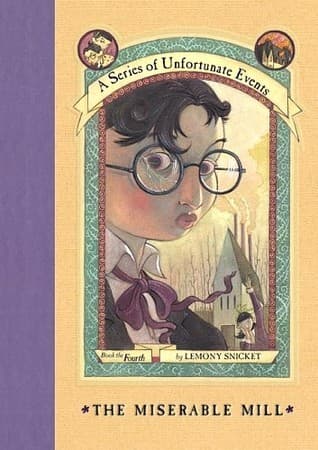
Lemony Snicket (2000)
Genre
Fantasy / Children's / Mystery / Young Adult
Reading Time
90 min
Key Themes
See below
Sign in to track this book
At the grim Paltryville lumber mill, the Baudelaire orphans encounter a giant pincher machine, a sinister hypnotist, and a man with a smoky head, proving that even coupons cannot sweeten their latest bitter misfortune.
After a short stay with their kind but ineffective Aunt Josephine, the Baudelaire orphans—Violet, Klaus, and Sunny—are sent to Paltryville. Mr. Poe, their bumbling banker, tells them their new guardian runs the Lucky Smells Lumbermill, but does not say who this person is. They travel by a dirty train, seeing Paltryville's grim, smoke-filled landscape, dominated by the huge, run-down lumbermill. A man whose head is hidden by a permanent cloud of smoke meets them. He introduces himself as Sir and tells them they will live and work at the mill to earn their keep.
The Baudelaires share a single, cramped bunk bed in the mill's bunkhouse, eat rubbery casserole daily, and start work immediately. Violet sorts lumber, Klaus works in the record-keeping office, and Sunny debarks logs with her sharp teeth. Sir, whose face is always hidden by smoke, and his cruel partner, Charles, run the mill. The children quickly realize the mill means endless, dangerous labor, meager pay (in coupons), and despair, far from any loving home.
Among the mill workers is a nasty foreman named Foreman Spike, who looks much like Count Olaf, despite a different haircut and no unibrow. While working, Foreman Spike trips Klaus, breaking his glasses. This worries the Baudelaires, as Klaus is nearly blind without them. Sir and Charles refuse to let Klaus leave for new glasses, insisting he keep working. This forces the children to find another solution for Klaus's vision, showing their new guardians' indifference.
Desperate for Klaus to see, Charles eventually takes him to Dr. Georgina Orwell, the town's optometrist, who works from a large, eye-shaped building. Dr. Orwell, a beautiful woman with a turban and a habit of saying 'marvelous,' examines Klaus. During the exam, she uses a swinging pendulum and speaks in a soothing, repetitive way that Klaus finds calming. Unknown to Klaus or Charles, Dr. Orwell is subtly hypnotizing him, planting commands to use against the orphans later, setting up Count Olaf's sinister plan.
After visiting Dr. Orwell, Klaus returns to the mill with new glasses but acts strangely. He is distant, speaks in a monotone, and works with unnatural, robotic speed. He seems to forget important details and dismisses concerns about Foreman Spike. Violet and Sunny quickly realize something is wrong with their brother. They suspect he has been hypnotized, recognizing the signs of mind control, and begin to investigate Dr. Orwell, fearing she is linked to Count Olaf.
The next day, the mill foreman assigns Klaus to operate the huge, dangerous log-peeling machine, a job needing extreme precision. This puts Klaus, and by extension, Violet and Sunny, in great danger. Violet and Sunny watch Klaus's movements, noting his vacant stare and mechanical actions, confirming he is under a hypnotic trance. They understand this new job is not a coincidence but part of a larger, sinister plan by Count Olaf and his associates to gain control of the Baudelaire fortune.
Violet and Sunny, determined to free Klaus, sneak into Dr. Orwell's office after hours. They find a secret passage connecting her office to the mill. Inside, they find proof: Dr. Orwell works with Count Olaf, disguised as Foreman Spike. They overhear Dr. Orwell and Olaf discussing their plan to use the hypnotized Klaus to sign away the Baudelaire fortune by causing an 'accident' that kills Sir, making Charles the sole guardian, whom they will then trick. The children realize their dire situation.
Knowing Dr. Orwell's plot, Violet and Sunny rush back to the mill, aware they must act fast to save Klaus and prevent Sir's murder. They recall that specific trigger words or phrases can break hypnotic trances. They try to remember what Dr. Orwell said to Klaus during his 'examination' and when they overheard her. Their immediate goal is to find the exact phrase to snap Klaus out of his trance before he carries out Count Olaf's terrible deed, all while avoiding Olaf and Dr. Orwell.
Back at the mill, the climax occurs. Count Olaf, still disguised as Foreman Spike, and Dr. Orwell confront the Baudelaires. Olaf orders the hypnotized Klaus to activate the giant log-peeling machine, sending a log toward Sir, who is tied in its path. Violet and Sunny frantically try to break Klaus's trance, shouting phrases they remember from Dr. Orwell's office. Tension builds as the log nears Sir; the children know they have moments before their guardian dies and their fortune is lost.
Just as the log is about to hit Sir, Violet remembers a specific phrase and shouts, 'Baudelaire!'—Dr. Orwell's trigger word. Klaus snaps out of his trance, horrified by what he almost did. In the chaos, Dr. Orwell swings her sword at Sunny, but Sunny bites the sword, deflecting it into the log-peeling machine's path. The machine breaks, sending a log directly into Dr. Orwell, killing her. Count Olaf, seeing his plan ruined and his accomplice dead, escapes again, leaving the Baudelaires to face the aftermath and the ongoing mystery of their fortune.
Afterward, Sir and Charles are shocked by Dr. Orwell's death and Count Olaf's betrayal. Mr. Poe arrives, as usual, too late to help, but in time to hear the children's story. Despite their terrifying experience and clear danger, Mr. Poe, ever oblivious, decides the Lucky Smells Lumbermill is no longer suitable. The Baudelaires, having thwarted another of Count Olaf's schemes but no closer to the truth about their parents or inheritance, are again sent to a new, unknown place, their future still uncertain.
The Protagonist
Violet consistently demonstrates her inventive genius under pressure, evolving into a more proactive leader in the face of relentless adversity.
The Protagonist
Klaus's arc involves overcoming a loss of agency due to hypnosis, reaffirming his intellectual strength and dependence on his siblings.
The Protagonist
Sunny continues to demonstrate surprising capabilities for her age, proving her invaluable role in the siblings' survival through her unique physical attributes.
The Antagonist
Count Olaf continues his pattern of elaborate disguises and manipulative schemes, consistently being foiled but always escaping to scheme again.
The Supporting
Sir remains an enigmatic and largely ineffectual guardian, serving primarily as a plot device for the orphans' placement.
The Supporting
Charles remains a sympathetic but ultimately powerless figure, unable to protect the orphans from the dangers around them.
The Antagonist
Dr. Orwell acts as a temporary, formidable antagonist who is ultimately defeated by the orphans' ingenuity and her own machinations.
The Supporting
Mr. Poe remains stubbornly oblivious and ineffectual, never learning from past mistakes and continuously failing to protect the Baudelaires.
This theme runs through the book, showing how adults fail to protect the Baudelaire orphans or even see the dangers they face. Mr. Poe consistently proves inept, unable to recognize Count Olaf's disguises or understand the severity of the children's situations. Sir and Charles, though not malicious, are indifferent or too timid to effectively intervene, leaving the children to rely on their own intelligence and resourcefulness. This highlights the loneliness of their struggle.
“It is a truth that is hard to learn but easy to forget, that what is marvelous in the eyes of the adult may not be marvelous in the eyes of the child.”
The Baudelaires' greatest assets are their individual intellectual strengths: Violet's inventiveness, Klaus's extensive reading, and Sunny's unique biting abilities (and later, her insightful babbling). In 'The Miserable Mill,' Klaus's knowledge of hypnotism, recalled after his trance, is essential. Violet's ability to quickly process information and invent solutions under pressure, such as remembering Dr. Orwell's trigger word, directly saves Sir's life and breaks Klaus's trance. This theme shows that despite their youth, their minds are their strongest weapons against danger.
“The only thing that can protect you from the horrible things in the world is to learn as much as possible.”
This theme is central to Count Olaf's methods and the series' overall mystery. Count Olaf, disguised as Foreman Spike, is a prime example, his true villainous nature hidden by a thin cover. Dr. Georgina Orwell, with her elegant manner and professional title, first seems like a helpful optometrist but is a sinister hypnotist and accomplice. The Lucky Smells Lumbermill itself, despite its name, is a miserable and dangerous place. This theme constantly reminds the reader and the orphans that things are rarely what they seem, and they must look beyond appearances to find the truth.
“It is a curious thing, but the more you look at someone, the more you see their true nature.”
The Baudelaires' time at the Lucky Smells Lumbermill vividly shows the harsh realities of child labor and exploitation. They are forced to work long hours, perform dangerous tasks, and are paid in worthless coupons instead of money. Their living conditions are squalid, and their basic needs are barely met. This experience highlights the callous disregard for human welfare when profit is the goal, and how the powerful (Sir, Count Olaf) can easily exploit the vulnerable (the orphans, other mill workers) when no one intervenes. The mill itself symbolizes a dehumanizing system.
“The children had no idea that a grown-up could be so cruel, so greedy, so completely without a shred of common decency.”
Count Olaf's primary method of deception and infiltration.
Count Olaf's use of disguise is a recurring plot device throughout the series, and in 'The Miserable Mill,' he appears as Foreman Spike. This device allows him to infiltrate the Baudelaires' lives repeatedly, always remaining just out of reach of Mr. Poe's recognition. The children, however, are almost always able to see through his thin disguises, often by noticing his distinctive unibrow or the tattoo of an eye on his ankle. This creates dramatic irony and highlights the incompetence of the adults around them.
A form of mind control used to manipulate a character.
Hypnosis is a crucial plot device in this book, employed by Dr. Georgina Orwell to control Klaus. This renders Klaus a temporary antagonist, forcing Violet and Sunny to find a way to break his trance. It introduces a new level of psychological manipulation beyond Olaf's typical physical threats and disguises. The device creates immediate peril, as Klaus is made to endanger Sir's life, and emphasizes the vulnerability of the children to sophisticated forms of villainy, requiring the other siblings to use their wits to free him.
The driving force behind Count Olaf's actions.
The Baudelaire fortune serves as the central MacGuffin of the entire series. It is the vast inheritance left to the Baudelaire orphans, which they cannot access until Violet comes of age. This fortune is the sole motivation for Count Olaf's relentless pursuit of the children and his elaborate schemes. In 'The Miserable Mill,' Olaf's plan involves using the hypnotized Klaus to sign away the fortune after Sir's death, ensuring the inheritance remains the constant, underlying threat driving the narrative.
The author's distinctive voice and commentary on the story.
Lemony Snicket acts as a highly opinionated and often unreliable narrator. He frequently breaks the fourth wall, directly addressing the reader with warnings, definitions, and personal anecdotes that both foreshadow events and comment on the bleakness of the story. While he reveals plot details, he also withholds information, adds dramatic flair, and injects his unique, melancholic worldview. This device shapes the reader's perception of the events, adding layers of meta-commentary and dark humor to the children's misfortunes.
“As I'm sure you know, there are many words in the English language, but I have a feeling that few words are as sad as 'unfortunately.'”
— The narrator's reflection on the word 'unfortunately' and its frequent appearance in the orphans' lives.
“It is a curious thing, the fate of a human being. It's often decided by a tiny, seemingly insignificant choice.”
— The narrator musing on the seemingly small choices that lead to significant consequences for the Baudelaires.
“The world is a vast and complicated place, and there are many things in it that are not fair.”
— The narrator's general observation about the unfairness of the world, a recurring theme.
“There are some things that cannot be fixed by words. Some things can only be fixed by a good swift kick in the pants.”
— Mr. Poe's ineffective attempts to help the children, contrasting with more direct action.
“It is a common error to believe that a person is more likely to tell the truth if they are speaking loudly.”
— The narrator observing Mr. Poe's loud, but often unhelpful, pronouncements.
“People aren't either good or bad. They're usually a little bit of both.”
— The narrator's nuanced view of human nature, even when describing villains.
“Reading is a gift. It's a gift that can change your life.”
— The Baudelaires' love for books and their ability to find solace and solutions in them.
“It is a sad but true fact that sometimes the most dangerous people are the ones who look the most harmless.”
— The seemingly benign appearance of Sir and the danger he represents.
“When you are in a difficult situation, it is always a good idea to keep your eyes open and your wits about you.”
— The Baudelaires constantly needing to be alert to the dangers around them.
“Even the most miserable of circumstances can sometimes offer a small ray of hope.”
— The children's ability to find small moments of comfort or potential escape amidst their hardships.
“It is often the case that the people who say they are trying to help you are actually making things worse.”
— Mr. Poe's well-intentioned but consistently unhelpful actions towards the orphans.
“The human mind is a wonderful and mysterious thing, but it is also very fragile.”
— The mental strain and distress experienced by the Baudelaires due to their continuous misfortunes.
“There is nothing quite so frustrating as being unable to prove something you know to be true.”
— The children's struggle to convince adults of Count Olaf's disguises and evil schemes.
Ready to see how well you understood this book? Take our interactive quiz with 10 questions.
Biography coming soon.







