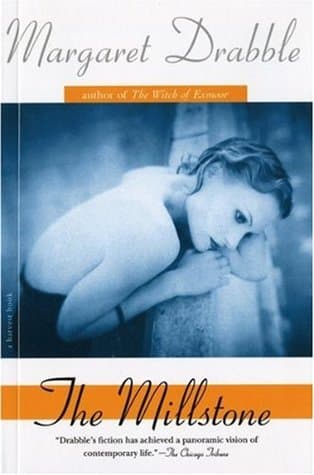
An Independent Life
Rosamund Stacey, a brilliant and independent postgraduate student living in a comfortable London flat, focuses on her academic work and literary interests. She has a detached, almost analytical view of relationships, observing her friends' romantic lives with curiosity and intellectual superiority. Despite the 1960s sexual revolution, Rosamund has little experience, having only a few awkward encounters. She values her freedom above all else, seeing emotional attachments as possible distractions from her studies. Her life is ordered, and she prides herself on being self-sufficient, often comparing herself to her more conventional female friends who seem focused on marriage and men.
The Fateful Party
At a party with her friend Lydia, Rosamund meets George Matthews, a BBC radio announcer. Their interaction is awkward and brief. Driven by a desire for experience and perhaps curiosity, Rosamund allows George to take her back to his flat. The encounter is passionless and mechanical, without emotional connection or romance. Rosamund feels detached throughout, as if she is observing the event rather than participating. She leaves his flat the next morning with no intention of seeing him again, seeing the experience as a minor, unimportant deviation from her carefully built independent life.
Unexplained Symptoms
In the weeks after meeting George, Rosamund notices changes in her body. She feels nausea, fatigue, and a general sense of unease. Being rational, she at first dismisses these symptoms, blaming stress, a change in diet, or a lingering cold. She tries to keep her usual routines, continuing her academic work and social life, but finds herself increasingly distracted and uncomfortable. Her intellectual detachment keeps her from at once considering the obvious explanation, reinforcing her self-perception as someone immune to such common biological occurrences.
The Pregnancy Test
While discussing her symptoms with her friend Sarah, Sarah jokingly suggests Rosamund might be pregnant. This remark startles Rosamund, forcing her to face a possibility she had actively suppressed. The realization comes with shock and a strange sense of inevitability. She gets a pregnancy test, and the positive result confirms her fears. The news is disorienting, shattering her carefully built image of herself as a self-sufficient, unattached individual. She grapples with the implications of this unplanned pregnancy, understanding that her life, as she knows it, is about to change completely.
A Difficult Decision
Facing an unplanned pregnancy in a society where single motherhood is still stigmatized and abortion is illegal, Rosamund considers her options. Her first thoughts are of abortion, but the practical difficulties and moral dilemmas of illegal procedures weigh on her. After much thought and a deep feeling that she cannot end the life within her, she makes the unconventional decision to keep the baby. This choice is a turning point, showing a shift from her purely intellectual existence to embracing a biological and emotional commitment. She resolves to face the challenges of single motherhood directly, determined to keep her independence.
Confronting George
Rosamund decides to tell George Matthews, the baby's father, about her pregnancy. She approaches him with a clear intention: to state the facts and assure him she expects nothing from him, especially not marriage. However, George, misunderstanding her intentions through social expectations, immediately assumes she is seeking a commitment. He reacts with awkwardness and a misguided sense of obligation, offering to marry her. Rosamund, appalled by his misunderstanding and patronizing tone, quickly corrects him, repeating her desire for independence and her sole responsibility for the child. The encounter strengthens her resolve to raise the baby on her own terms.
The Birth of Octavia
Rosamund has a difficult labor and gives birth to a daughter, whom she names Octavia. Childbirth is physically grueling and emotionally profound, marking a clear transition into motherhood. Despite the initial shock and the immense responsibility, Rosamund quickly develops a deep, instinctive bond with her baby. She finds herself unexpectedly fulfilled by the demands of caring for Octavia, discovering a new part of her existence that goes beyond her previous intellectual pursuits. Her life shifts, now centered around the needs of her infant, challenging her ideas of independence and self-sufficiency.
Octavia's Illness
Octavia, a few months old, suddenly becomes seriously ill with a congenital heart defect. This crisis throws Rosamund's world into chaos. Doctors explain that Octavia needs a delicate and risky heart operation. Rosamund, previously so detached, becomes consumed by fear and anxiety for her daughter's life. She spends hours at the hospital, her academic work and social life abandoned for constant vigilance and prayer. This period of vulnerability and fear for Octavia's survival removes any remaining intellectual aloofness, showing the depth of her maternal love and commitment.
The Operation and Recovery
Octavia undergoes the complex heart operation, and after an agonizing wait, the surgery is successful. Recovery is slow but steady, and Rosamund stays by her daughter's side, observing every improvement. The experience of nearly losing Octavia changes Rosamund. She emerges from this ordeal with a renewed sense of purpose and a strong bond with her daughter. Her previous life, focused on solitary intellectual pursuits, now seems distant and less meaningful. She understands that her independence has not been lost, but redefined by the responsibility and love she feels for Octavia.
A New Chapter
With Octavia fully recovered, Rosamund settles into her role as a single mother. She continues her academic work, but now with a different view, often bringing Octavia to lectures or study sessions. She finds contentment in her new life, managing the challenges of balancing motherhood with her intellectual ambitions. Her relationships with friends deepen as they see her resilience and devotion. Rosamund's journey ends with a deep understanding that true independence is not about isolation, but about making choices that align with one's deepest values, even if those choices defy social norms. She finds joy and strength in her bond with Octavia, recognizing it as the most fulfilling part of her existence.