“The Milagro Beanfield War is not a war of bullets and bombs, but a war of spirit and will.”
— Narrator's reflection on the nature of the conflict.

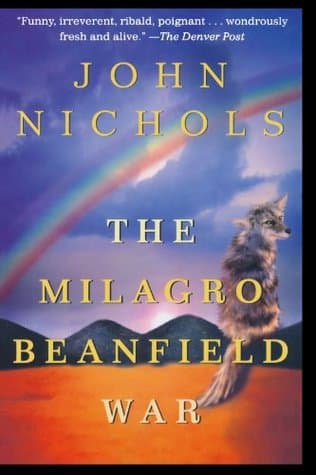
John Nichols (1978)
Genre
Historical Fiction
Reading Time
900 min
Key Themes
See below
Sign in to track this book
In the arid town of Milagro, a single, illegally irrigated beanfield ignites a hilariously chaotic and surprisingly deep war between dirt-poor farmers, powerful land developers, and a community's stubborn spirit.
The story begins in the small, poor Chicano village of Milagro, New Mexico, where water rights disputes have existed for a long time. Joe Mondragon, a young local, decides to plant a small beanfield on his inherited land. Despite a severe drought and the fact that the main irrigation ditch, the 'acequia madre,' is controlled by the Milagro Valley Recreation and Development Company (MVDRC) for their resort project, Joe illegally taps into the water supply. This act, driven by Joe's desire to grow beans for his mother, immediately puts him at odds with local law enforcement and the developers who see it as a direct threat to their plans for a 'cultural recreation area' and golf course.
Sheriff Bernabé Montoya, a Chicano lawman who understands his community but is bound by state duties, investigates Joe's water diversion. Bernabé tries to persuade Joe to stop, explaining the legal problems and political pressure he is getting from the Governor and the MVDRC. Joe remains stubborn, insisting on his right to the water. Bernabé is in a difficult position, torn between enforcing the law and his empathy for the villagers and their historical claims to the land and water. This first confrontation shows the clash between traditional communal values and corporate interests.
News of Joe's beanfield and his defiance spreads quickly through Milagro. Many villagers are initially cautious, fearing problems from the developers. However, Amarante Córdova, an elderly local who has long advocated for community rights, sees Joe's act as a symbol of resistance. Amarante starts to gather support, reminding people of their ancestral water rights, the injustices they have faced, and the slow loss of their traditional way of life. Slowly, others like Ruby Archuleta, the garage owner and community activist, and Nancy Mondragon, Joe's cousin, begin to support Joe, bringing him food and helping him tend the field, turning his personal act into a communal stand.
Ladd Devine III, the ambitious developer behind the Milagro Valley Recreation and Development Company, sees Joe's beanfield as a nuisance that threatens his project. He, along with his associate Charley Bloom, pressures Governor Wallace and other state officials to resolve the situation quickly. Devine's frustration grows as the villagers continue to support Joe and the legal channels are slow due to the complexities of water rights in New Mexico. He begins to plan more aggressive tactics, including sending state police to intimidate Joe and the community, and considering a forced removal of Joe from his land.
As the situation in Milagro grows, the state government, pressured by Ladd Devine, sends more state police officers, including Captain Stryker, to keep order and eventually remove Joe from his field. The increased police presence creates a tense atmosphere in the village, leading to minor skirmishes and acts of passive resistance from the villagers. Joe continues to stubbornly tend his field, often under police surveillance. Bernabé Montoya finds his authority undercut by the state police, who care less about local customs and more about enforcing the developers' agenda, further separating him from his superiors.
Inspired by Joe and Amarante, the people of Milagro begin to organize more formally. Ruby Archuleta uses her influence to get media attention and legal advice. The community uses various tactics, from staging protests and sit-ins to anonymously giving Joe supplies and protection. Even the local youth, like the 'gang' led by Seferino, find ways to help the resistance, often through mischievous acts that frustrate authorities without causing serious harm. The villagers' unity and resourcefulness make it difficult for the state police to simply remove Joe without causing a major public incident, further complicating Devine's plans.
Governor Wallace is in a difficult political position. He is invested in the success of Ladd Devine's resort project, which promises economic development and jobs. However, the Milagro situation is getting negative press and threatening to upset his Chicano voters. He tries to find a compromise, attempting to negotiate with Joe and the villagers through emissaries, but Joe's unwavering stance and the community's solidarity are hard to break. The Governor's efforts to seem fair while still pleasing Devine show the influence of money and power on state politics.
As the beans in Joe's field begin to ripen, showing his efforts' culmination, the tension in Milagro reaches a high point. Ladd Devine, desperate to clear the land before his investors lose patience, pushes for a decisive, forceful resolution. Governor Wallace, under extreme pressure, reluctantly authorizes a large police and National Guard deployment to remove Joe and his supporters. The villagers prepare for the confrontation, fortifying the beanfield, and planning to resist non-violently but firmly. Sheriff Bernabé Montoya, unable to align his duties with his conscience, begins to make choices that side him more closely with his community.
The day of the confrontation arrives with a massive deployment of state police and National Guard troops descending upon Milagro. The villagers, led by Amarante, Ruby, and Joe, stand their ground around the beanfield. What happens is a chaotic and darkly comic 'war' with strategic retreats, unexpected interventions, and the stubbornness of the Milagro residents. Animals, including goats and a pig named Pinky, play unexpected roles in disrupting the authorities. Bernabé Montoya, at a critical moment, chooses to side with his community, using his knowledge of the terrain and local customs to subtly hinder the state forces, preventing a violent crackdown and adding to the confusion.
In the chaotic aftermath, the state forces are forced to retreat, unable to effectively remove Joe and the unified community without resorting to extreme violence that would cause national outrage. Joe's beanfield, though partly damaged, remains. The villagers celebrate a hard-won, if temporary, victory. Ladd Devine's resort project is significantly delayed and its future uncertain. While Milagro has asserted its rights and preserved its immediate way of life, the 'war' does not definitively end. The underlying issues of land, water, and power remain, suggesting that while this battle was won, the larger struggle for cultural survival and justice in Milagro will continue, but with a renewed sense of hope and solidarity.
The Protagonist
Joe transforms from an isolated, impulsive individual into an unwitting symbol of his community's fight for justice and cultural survival.
The Supporting
Bernabé evolves from a conflicted lawman trying to enforce state law to a quiet protector of his community's rights, making a crucial choice in the climax.
The Supporting
Amarante serves as a catalyst and spiritual guide, his wisdom and stories inspiring the community to action and maintaining their resolve.
The Supporting
Ruby consistently acts as an organizer and activist, using her skills to empower the community and amplify their voices throughout the conflict.
The Antagonist
Ladd Devine remains a static antagonist, consistently driven by profit and power, increasingly frustrated by the unexpected resistance from Milagro.
The Supporting
Charley remains a loyal, if occasionally exasperated, subordinate to Devine, reflecting the practical challenges of implementing corporate plans against community resistance.
The Supporting
The Governor struggles to balance conflicting interests, ultimately authorizing force but facing significant political fallout and a damaged reputation.
The Supporting
Nancy consistently supports Joe and actively participates in the community's efforts, embodying the younger generation's commitment to their heritage.
The Supporting
Captain Stryker remains a static, unyielding figure, symbolizing the rigidity of external authority clashing with local resistance, ultimately failing to achieve his objective.
This theme is about the power of a unified community to resist outside forces threatening its way of life. Joe Mondragon's act of planting beans becomes a rallying point, turning into a communal struggle for water rights, land, and cultural survival. The villagers of Milagro, initially hesitant, come together through the guidance of elders like Amarante Córdova and activists like Ruby Archuleta, using both passive and active forms of resistance. Their collective stubbornness, resourcefulness, and deep connection to their heritage allow them to withstand the pressures from the state and developers, showing the strength found in unity.
“"They say a man has a right to plant his beans. And if he plants them, he has a right to water them."”
This theme is the literal and symbolic core of the conflict. Control of water, specifically the acequia madre, is essential for survival in arid New Mexico and is linked to the historical claims of the Chicano community. The Milagro Valley Recreation and Development Company's use of these resources for a luxury resort directly threatens the villagers' ability to farm and maintain their traditional lifestyle. The 'beanfield war' is a fight to reclaim and protect these essential rights, showing the historical injustices faced by indigenous and Chicano populations in the American Southwest regarding land and water ownership.
“"Water is life. Without it, we are nothing. And this water belongs to us, not to them."”
The novel explores the struggle to preserve Chicano culture, traditions, and a communal way of life against modern development and Anglo-American consumerism. The villagers' connection to their land, language, stories, and shared history (represented by figures like Amarante Córdova) are all under threat. Joe's beanfield becomes a symbol not just of water rights, but of Milagro's entire cultural identity. The resistance is as much about maintaining a distinct cultural heritage as it is about physical resources, emphasizing the importance of tradition and community when faced with homogenization.
“"Milagro was not a place for progress. It was a place for remembering."”
The theme of power dynamics is clear in the contrast between the wealthy, politically connected developers (Ladd Devine III) and the poor, marginalized villagers of Milagro. The novel shows how money and influence can corrupt political processes, with Governor Wallace often bending to Devine's will, and how state institutions (like the police) can be used to enforce the interests of the powerful. The 'war' shows the unfairness when a small community tries to challenge a well-funded, politically entrenched corporate entity, showing the imbalance of power in society and the challenges to achieving justice.
“"Money talks, and in this state, it shouts. Loud."”
Despite the serious underlying issues, the novel gives the conflict a strong sense of humor and absurdity. The 'war' itself is often farcical, with comical miscommunications, unexpected interventions (like the pig Pinky), and individual stubbornness. The contrast between the gravity of the developers' plans and the seemingly minor 'threat' of a beanfield creates an ironic and often funny narrative. This comedic approach humanizes the struggle, making the characters and their plight more endearing, while also subtly criticizing the irrationality of the powerful forces that often start such conflicts.
“"It was a war of tactical retreats, a patchwork war, fought more by stubbornness than by strategy."”
Subtle integration of fantastical elements into an otherwise realistic narrative.
The novel subtly weaves elements of magical realism into its narrative, particularly through characters like Amarante Córdova and the pig Pinky. Amarante often seems to possess an almost supernatural understanding of events and a deep connection to the land and its spirits, while the pig Pinky's actions during the climax seem to defy normal animal behavior, acting almost as an agent of chaos on the side of the villagers. These elements add a unique, whimsical, and distinctly Latin American flavor to the story, suggesting a spiritual dimension to the struggle and blurring the lines between the mundane and the miraculous.
A wide-ranging narrator who offers commentary, backstories, and philosophical musings.
The novel employs an omniscient narrator who not only recounts the plot but also frequently digresses to provide extensive backstories for even minor characters, historical context for Milagro, philosophical reflections on life and death, and humorous observations. This narrative style creates a rich, textured tapestry of the community, deepening the reader's understanding of the motivations and interconnectedness of all the characters, and reinforcing the idea that the 'beanfield war' is a culmination of generations of history and struggle, not just a singular event. It also contributes to the novel's often leisurely and anecdotal pace.
Joe's beanfield as a multifaceted symbol of resistance and survival.
Joe Mondragon's beanfield is the central symbol of the novel. Initially, it represents a simple act of personal defiance and a desire for sustenance. As the conflict escalates, it transforms into a powerful symbol of the entire community's struggle for their ancestral water rights, land, cultural identity, and traditional way of life. The act of planting and nurturing the beans against overwhelming odds embodies hope, resilience, and the deep connection between the people of Milagro and their land. Its survival at the end signifies a victory for the community's spirit and heritage.
Characters who use cunning and non-traditional methods to challenge authority.
The novel features several characters who embody the trickster archetype, most notably Amarante Córdova and, to some extent, Joe Mondragon himself. Amarante, with his seemingly harmless demeanor and folksy wisdom, subtly guides the community and outwits the authorities through indirect means. Joe's initial act of illegal irrigation is a trickster move, as is the villagers' use of various non-violent, often humorous, tactics to frustrate the state police. This device highlights the ingenuity and resourcefulness of the marginalized in challenging powerful, conventional forces, often by turning their own rules and expectations against them.
“The Milagro Beanfield War is not a war of bullets and bombs, but a war of spirit and will.”
— Narrator's reflection on the nature of the conflict.
“Water is life, and in the desert, it is everything.”
— Joe Mondragón's motivation for illegally irrigating his beanfield.
“A man's land is his soul, and when you take it, you take his soul.”
— Local farmer expressing the deep connection to the land.
“In Milagro, the poor have always been poor, but they have never been powerless.”
— Observation about the community's resilience.
“The law is written by the rich to protect the rich.”
— Critique of the legal system favoring developers.
“Sometimes a small act of defiance can grow into a revolution.”
— Reflecting on Joe's beanfield sparking broader resistance.
“We are not fighting for beans; we are fighting for our way of life.”
— Community member explaining the stakes of the conflict.
“The heart of the valley beats in the rhythm of the irrigation ditches.”
— Poetic description of the agricultural landscape.
“Fear is the weapon of the oppressor, and courage is the shield of the oppressed.”
— Encouragement during a tense community meeting.
“In the end, it is not the size of the army but the strength of the cause that matters.”
— Moral about the underdog's struggle against developers.
“Every bean in that field is a seed of hope.”
— Symbolic interpretation of Joe's crop.
“The old ways are not forgotten; they are just waiting to be remembered.”
— Elder character discussing cultural heritage.
“When you stand up for what is right, you are never alone.”
— Message of solidarity in the community's fight.
“The land does not belong to us; we belong to the land.”
— Indigenous perspective on stewardship.
Ready to see how well you understood this book? Take our interactive quiz with 10 questions.

Biography coming soon.







