“He was a man of mystery, a figment of the night, a shadow that struck and vanished.”
— Describing Zorro's elusive nature and impact on the populace.

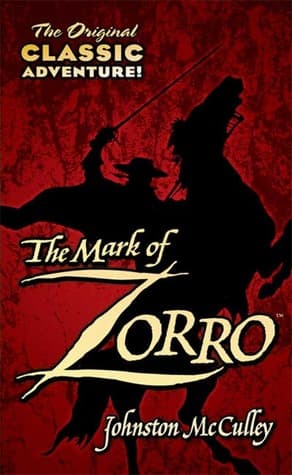
Johnston McCulley (2000)
Genre
Historical Fiction / Romance
Reading Time
265 min
Key Themes
See below
Sign in to track this book
In a California scarred by tyranny, a masked avenger with a flashing blade and a mocking laugh carves a legend of defiance against corrupt caballeros and their oppressive rule.
Don Diego Vega, a young hidalgo, returns to El Pueblo de Nuestra Señora la Reina de los Ángeles after several years of study in Spain. He finds his California under the rule of Governor Alvarado and his henchman, Captain Ramon. The native population and poor settlers are exploited, haciendas are seized, and justice is forgotten. His father, Don Alejandro Vega, a respected but aging caballero, expresses his frustration and helplessness, wishing for a champion to rise against the oppressors. Don Diego, however, acts uninterested, adopting the persona of a dandy, much to his father's disappointment and the disdain of the local gentry, including Lolita Pulido.
Soon after Don Diego's return, a masked rider, clad in black and known as Zorro (Spanish for 'fox'), begins to terrorize the corrupt officials and military. Zorro's first acts include rescuing a native man from Captain Ramon's cruelty, publicly humiliating Sergeant Gonzales, and leaving his 'Z' mark carved with his sword. These acts spread fear among the oppressors and hope among the oppressed. Governor Alvarado and Captain Ramon are angry, vowing to capture the outlaw, while the common people begin to whisper about a savior. Don Diego, as a dandy, expresses fear and admiration for Zorro, further cementing his cover.
The noble Pulido family, once wealthy, falls into financial ruin due to Governor Alvarado's policies and Captain Ramon's extortion. Don Carlos Pulido and his wife, Doña Catalina, face losing their hacienda and living in poverty. Their daughter, Lolita Pulido, is pressured by her family to marry either Don Diego Vega, whose family is wealthy, or Captain Ramon, who wants her. Lolita dislikes both options; she finds Don Diego insipid and Captain Ramon repulsive. Her heart secretly yearns for Zorro, whom she admires for his courage and sense of justice, though she has never met him.
Zorro's actions grow. He raids the Governor's treasury to return stolen money to the poor, humiliates Captain Ramon multiple times, and protects innocent individuals from the army's abuses. He uses his wit, agility, and swordsmanship to outsmart his pursuers, often leaving them tied up or publicly shamed. His actions inspire the local peons and natives to believe that justice is possible. Sergeant Gonzales, despite his humiliation, respects Zorro's skill. Meanwhile, Don Diego maintains his effeminate facade, even fainting when danger is near, further diverting suspicion.
Zorro fights Captain Ramon, defeating him but sparing his life, further angering the captain. The Pulido family, desperate, approaches Don Diego Vega, hoping he will marry Lolita and save them from destitution. Don Diego, playing his part, hesitantly agrees, much to Lolita's dismay. She finds him unappealing and openly expresses her disdain for his lack of courage. Don Diego, however, sees this as an opportunity to get closer to the family and protect them, while maintaining his secret identity.
Governor Alvarado and Captain Ramon plan to capture Zorro. They announce a ball at the Pulido hacienda, knowing that Zorro, the protector of the innocent, will likely appear. They station soldiers strategically and plan to ambush him. Don Diego, aware of the trap, attends the ball as a dandy, observing the arrangements. Lolita, still disgusted by Don Diego, feels drawn to the danger and excitement surrounding Zorro, further solidifying her admiration for the masked hero.
During the ball, Zorro makes a dramatic appearance, leaping into the hacienda amidst the festivities. He confronts Captain Ramon and Governor Alvarado, engages in sword fights with multiple soldiers, showing his skill. He speaks privately with Lolita, confessing his admiration for her and hinting at his true identity, further captivating her heart. After creating a diversion, he makes an escape, leaving the authorities frustrated and humiliated once more. Don Diego, of course, acts terrified throughout the ordeal, hiding and trembling, maintaining his cover.
Angry at Zorro's defiance, Governor Alvarado and Captain Ramon begin arresting prominent hidalgos, including Don Alejandro Vega and Don Carlos Pulido, accusing them of complicity with Zorro. They are imprisoned and threatened with execution. This act pushes the oppressed population to their breaking point. Zorro, seeing the danger to his father and the Pulidos, realizes it's time to move beyond individual acts of heroism and instigate a larger rebellion. He sends messages to the peons and natives, urging them to rise up against their oppressors and meet him at a designated location.
Zorro, having gathered a determined force of peons and natives, launches an assault on the barracks where the hidalgos are held. He leads the charge, fighting alongside his army. During the chaos, Zorro confronts Captain Ramon in a sword duel. Zorro's skill prevails, and he disarms and subdues Ramon, though he again chooses not to kill him. The prisoners are freed, and the rebellion gains momentum, overwhelming the remaining soldiers loyal to Alvarado.
With Captain Ramon defeated and Governor Alvarado's power crumbling, Zorro gathers the assembled crowd. He removes his mask, revealing himself to be Don Diego Vega. The revelation shocks everyone, especially Don Alejandro and Lolita, who now understand his earlier 'cowardice' was a ruse. Don Diego explains his reasons for fighting for justice. Soon after, a new, benevolent governor arrives from Spain, having been informed of Alvarado's corruption. Don Diego is praised as a hero, and the future of California looks brighter, with justice and peace restored.
With his identity revealed and the corrupt regime overthrown, Don Diego Vega is no longer the dandy but a revered hero. Lolita Pulido, who once scorned him, now sees him with new eyes, filled with admiration and love. She realizes that the brave, Zorro was always beneath the surface of the seemingly uninterested nobleman. Don Diego and Lolita declare their love for each other, and their impending marriage promises a union that symbolizes the new era of justice and prosperity for California. The story concludes with the promise of a peaceful future under a fair government, with Zorro's legacy as a champion of the oppressed established.
The Protagonist
Don Diego transforms from a seemingly indifferent fop into an unmasked hero, earning the respect and love of those he protects.
The Supporting
Lolita evolves from a disdainful young woman to one who understands and loves Don Diego, recognizing the hero within him.
The Antagonist
Ramon's arrogance and cruelty lead to his downfall and defeat by Zorro.
The Supporting
Don Alejandro moves from disappointment in his son to immense pride and understanding upon Zorro's unmasking.
The Supporting
Gonzales remains largely static but serves to highlight Zorro's ingenuity and the futility of the army's efforts.
The Antagonist
Alvarado's tyrannical rule is ultimately overthrown by Zorro's rebellion.
The Supporting
Bernardo remains a steadfast and loyal companion, never wavering in his support for Zorro.
The Supporting
Don Carlos experiences the depths of despair and oppression before being rescued by Zorro.
The Supporting
Doña Catalina endures hardship and worry, eventually finding relief and joy after Zorro's victory.
The novel's central theme is the struggle between the oppressive rule of Governor Alvarado and Captain Ramon, and the fight for justice championed by Zorro. The book shows the suffering of the native population and poor settlers under the regime, including abuses of power, arbitrary arrests, and economic exploitation. Zorro is a symbol of hope, enacting swift and often humiliating justice against the oppressors, inspiring the downtrodden and leading to a rebellion that restores fairness to California. His actions show that even against great odds, a stand for justice can win.
“"He was a phantom, an avenger, a champion of the oppressed, and the mark he left was the symbol of their hope."”
Don Diego Vega's dual identity as the dandy and the masked Zorro is a core part of the story, exploring identity and deception. Don Diego acts weak and uninterested to deflect suspicion, allowing Zorro to operate freely. This deception shows the power of appearances and how one's true character can be hidden. Lolita Pulido's initial disdain for Don Diego and her admiration for Zorro underscore this theme, as she falls in love with the hero while not knowing his true identity, only to reconcile these two aspects at the story's climax.
“"The mask was not merely a disguise; it was a release, a permit to be the man he truly was, a man of fire and steel."”
Zorro and his 'Z' mark, is a powerful symbol throughout the novel. Initially, Zorro is a lone individual, but his daring acts and the 'Z' he leaves behind quickly make him a legend and a rallying cry for the oppressed. The symbol instills fear in the corrupt officials and ignites hope in the common people. It represents resistance, courage, and the promise of retribution, showing how a single symbol can unite a populace and inspire a movement for change against an entrenched power structure.
“"The 'Z' carved by a rapier's point was more than a letter; it was a challenge, a promise, and a curse to the tyrants of California."”
The theme of love and chivalry is in Zorro's relationship with Lolita Pulido. While Lolita initially scorns Don Diego, she is captivated by Zorro's bravery, charm, and his acts of protection towards her family. Zorro is the classic chivalric hero, fighting for justice and defending the honor of the innocent, particularly Lolita. His romantic gestures, daring rescues, and whispered confessions of admiration win her heart, proving that true love responds to courage and integrity, rather than superficial charm or wealth. Their eventual union symbolizes the triumph of virtue and true heroism.
“"Her heart, though she knew it not, was already given to the masked rider, to the spirit of daring and justice he represented."”
Don Diego Vega's disguise as the foppish dandy to hide his true persona as Zorro.
The secret identity is the most crucial plot device. Don Diego Vega deliberately cultivates an effeminate, cowardly, and disinterested public persona to deflect any suspicion that he could be the daring Zorro. This allows him to move freely, gather information, and interact with both the oppressors and the oppressed without revealing his true intentions. It creates dramatic irony, as characters like Lolita and Don Alejandro are initially disappointed in Don Diego while simultaneously admiring Zorro. The unmasking is the story's climax, revealing the depth of his sacrifice and cleverness.
Zorro's signature 'Z' carved by his rapier.
The 'Mark of Zorro' is a powerful symbol and a recurring plot device. Zorro frequently leaves his distinctive 'Z' carved with his rapier on walls, uniforms, or even the faces of his defeated enemies. This mark serves multiple functions: it acts as a calling card, a taunt to the authorities, and a sign of hope and defiance for the oppressed. It transforms Zorro from a mere individual into a legend, a symbol that unites the common people and fuels their belief in a coming justice. It's a constant reminder of his presence and effectiveness.
The audience's awareness of Don Diego's dual identity, while characters remain ignorant.
Dramatic irony is heavily employed throughout the narrative. The reader is aware from early on that Don Diego Vega and Zorro are one and the same, while most of the characters in the story remain ignorant. This creates tension and humor, especially in scenes where Don Diego's 'cowardice' is openly mocked by characters who simultaneously praise Zorro. It allows the audience to appreciate Don Diego's cleverness and the effectiveness of his disguise, enhancing the narrative's engagement and building anticipation for the eventual unmasking.
The portrayal of the military and government as largely inept and easily outwitted.
The incompetence of the authorities, particularly Sergeant Gonzales and the general soldiers, serves as a recurring plot device to highlight Zorro's superior skill and intellect. Despite their numbers and official power, the military is consistently outsmarted, humiliated, and defeated by Zorro. This device not only provides comic relief but also makes Zorro's victories more believable and satisfying, emphasizing that courage and cleverness can overcome brute force and corruption, even when the odds are stacked against the hero.
“He was a man of mystery, a figment of the night, a shadow that struck and vanished.”
— Describing Zorro's elusive nature and impact on the populace.
“The poor have no law but their own despair.”
— Don Diego reflecting on the plight of the common people under oppressive rule.
“It is not the sword, but the spirit behind it that counts.”
— Zorro's philosophy on true strength, not just physical prowess.
“A mask can hide a face, but it cannot hide a heart.”
— Don Diego pondering the true nature of his dual identity.
“Fear is a poor master, but a good servant.”
— Zorro using the fear he inspires to his advantage against his enemies.
“To laugh at danger is to conquer it.”
— Zorro's audacious and playful approach to perilous situations.
“The greatest trick the devil ever pulled was convincing the world he didn't exist.”
— An observation, often attributed to the book's narrative style, about the stealth and impact of hidden forces.
“The weak must ever look to the strong for justice.”
— A statement highlighting the imbalance of power and the need for a champion.
“Chivalry is not dead, merely sleeping.”
— Don Diego's internal thought, suggesting his role is to awaken noble ideals.
“It is better to die on one's feet than to live on one's knees.”
— A rallying cry for freedom and resistance against tyranny.
“The world needs a hero, even if it doesn't know it yet.”
— Don Diego's realization of his destiny to become Zorro.
“A man's true worth is not in his titles, but in his deeds.”
— Don Diego's internal monologue about the superficiality of aristocracy versus genuine action.
“One must sometimes play the fool to outwit the wise.”
— Don Diego's strategy of feigning effeminacy to deflect suspicion.
“The mark of Zorro was not just a letter, but a symbol of hope.”
— The impact of Zorro's signature 'Z' on the downtrodden.
Ready to see how well you understood this book? Take our interactive quiz with 10 questions.

Biography coming soon.







