“Seven half-bloods shall answer the call, To storm or fire the world must fall. An oath to keep with a final breath, And foes bear arms to the Doors of Death.”
— The Great Prophecy that looms over the seven demigods, driving their quest.

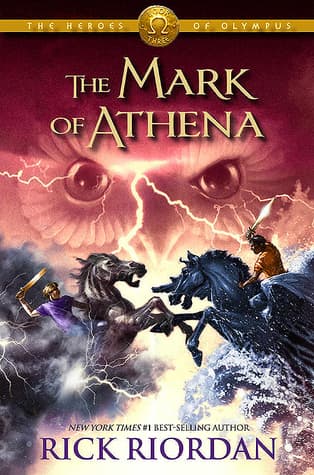
Rick Riordan (2012)
Genre
Fantasy / Children's / Young Adult / Romance
Reading Time
10-12 hours
Key Themes
See below
Sign in to track this book
As war brews between Greek and Roman demigods, Annabeth Chase reunites with Percy, deciphers her mother's command, and leads the quest to close the Doors of Death, all while fearing how six months apart changed the boy she loves.
The Greek demigods, Annabeth Chase, Jason Grace, Piper McLean, and Leo Valdez, arrive at Camp Jupiter aboard the flying warship, the Argo II. They intend to unite the two camps and prepare for the prophecy of the Seven. However, Leo, possessed by an eidolon, fires on Camp Jupiter, causing destruction and increasing tensions. This forces the Greeks to flee, leaving Percy Jackson, Frank Zhang, and Hazel Levesque to deal with the Roman fallout. The attack breaks the fragile alliance they hoped to create, setting the stage for conflict.
After the disastrous arrival, the Argo II, with its seven demigod crew (Percy, Annabeth, Jason, Piper, Leo, Frank, and Hazel), sets off for Rome to fulfill the Prophecy of the Seven and find the Doors of Death. Roman forces, led by Octavian, immediately pursue them, seeing them as enemies. Their journey is dangerous, including encounters with sea monsters and the vengeful goddess Phorcys and her sister Keto, who capture Percy and Frank. The crew must learn to work together despite their differences and past disagreements, knowing the world's fate rests on their success.
Percy and Frank are captured by the ancient sea gods Phorcys and Keto, who hold them in an aquarium-like prison. They are forced to perform for the monstrous deities, facing challenges. However, the rest of the Argo II crew, led by Annabeth, stages a rescue. During the escape, Frank discovers a new ability to transform into an empousa, a vampiric demon, which helps them fight Phorcys and Keto. This incident strengthens the bond between Percy and Frank and shows Frank's evolving powers.
The Argo II crew meets Bacchus, the Roman god of wine and revelry, in Topeka, Kansas. Bacchus, who is often annoyed, reveals that the giants are stirring and that the demigods are heading into dangerous territory. He warns them that the ancient lands are alive with monsters and Gaea's power is rising. Despite his uncooperative nature, Bacchus provides cryptic warnings and confirms the urgency of their quest, emphasizing that the dangers they face are greater than anything they have encountered before.
Leo Valdez continues to struggle with the eidolon that possessed him and caused the attack on Camp Jupiter. While the eidolon is expelled, the incident leaves a lingering distrust, especially from the Roman demigods. Leo feels guilt and alienation, fearing he might accidentally harm his friends again. This internal conflict is a challenge for him, as he tries to prove his loyalty and control his powers, all while dealing with the responsibility for the initial conflict between the two camps.
Annabeth Chase, guided by the Mark of Athena, begins a solo quest beneath Rome to find the Athena Parthenos. Her mother, Athena, has tasked her with avenging the goddess and retrieving the statue to unite the Greeks and Romans. This journey takes her through treacherous trials, including facing Arachne, the monstrous weaver cursed by Athena. Annabeth must rely on her wits and wisdom, confronting her fears and her mother's expectations, all while navigating a labyrinthine trap designed to break her.
Annabeth's solo quest ends in a confrontation with Arachne, the monstrous spider-woman, in her lair beneath Rome. Arachne, who blames Athena for her transformation, intends to trap and kill Annabeth. Annabeth, using her intelligence and strategy, challenges Arachne to a weaving contest, knowing that the spider's pride will be her downfall. Annabeth cleverly weaves a tapestry showing the gods' hubris, angering Arachne and allowing Annabeth to manipulate her into a trap, securing the Athena Parthenos and escaping the lair.
The demigods, after reuniting with Annabeth and securing the Athena Parthenos, discover that the Doors of Death have two sides: one in Tartarus and one in the mortal world. They realize that to close them, both sides must be addressed at the same time. This revelation adds pressure to their quest, as it means a more complex and dangerous undertaking than they first thought. The discovery confirms the seriousness of their mission and the sacrifices needed to defeat Gaea.
After Annabeth defeats Arachne and secures the Athena Parthenos, the floor of Arachne's lair collapses. Percy, unwilling to let Annabeth face the danger alone, grabs her hand. Together, they fall into the abyss, directly into Tartarus, the deepest pit of the Underworld. This dramatic cliffhanger leaves the rest of the demigods stunned, as their two most experienced leaders are lost to the most dangerous realm, setting the stage for the next book.
With Percy and Annabeth fallen into Tartarus, the remaining demigods—Jason, Piper, Leo, Frank, and Hazel—deal with the loss. They are on their own, with the Athena Parthenos secured but their leaders gone. They must now regroup, mourn their friends, and figure out how to continue their quest to close the Doors of Death and defeat Gaea, all while dealing with the emotional impact of their friends' sacrifice. Their resolve is tested, but they understand the responsibility that now rests on their shoulders.
The Protagonist
Annabeth overcomes her fear of Arachne and the weight of her mother's expectations, emerging as a more confident and capable leader.
The Protagonist
Percy reaffirms his loyalty to his Greek friends and Annabeth, demonstrating his selflessness by falling into Tartarus with her.
The Protagonist
Jason grapples with his dual identity, ultimately embracing his role as a leader who can unite both Greek and Roman traditions.
The Protagonist
Piper grows in confidence in her charm-speaking abilities and her role as a vital member of the quest, proving her strength beyond just her powers.
The Protagonist
Leo struggles with guilt and self-doubt after the eidolon possession, working to regain his friends' trust and his own self-confidence.
The Protagonist
Frank gains confidence in his shapeshifting abilities and leadership potential, proving his bravery in battle.
The Protagonist
Hazel confronts her past and grows more confident in her unique powers, using them to aid her friends.
The Antagonist
Octavian solidifies his role as an antagonist, becoming a significant obstacle to the unity of the two camps.
The Antagonist
Arachne's ancient grudge leads to her ultimate defeat at the hands of Annabeth, a daughter of Athena.
The theme of identity is central, especially for Jason, who deals with his Roman upbringing versus his Greek allies. Leo struggles with being an accidental antagonist due to eidolon possession, while Frank and Hazel, as Roman demigods, also find their place among the Greeks. Percy, too, must reconcile his lost memories with his current self. The characters continually question where they belong and who they are when faced with conflicting loyalties and unexpected alliances. This is clear when Jason says, 'I'm a Roman, but I'm also a Greek. I'm both. And that's okay.'
““I’m a Roman, but I’m also a Greek. I’m both. And that’s okay.””
Trust is fragile throughout the book. The initial attack on Camp Jupiter by Leo, under the influence of an eidolon, breaks the new trust between the Greeks and Romans. The demigods must learn to trust each other, overcoming past disagreements and cultural differences to work as a team. Annabeth's solo quest to find the Athena Parthenos requires immense self-trust and trust in her mother's cryptic guidance. The threat of betrayal, from external enemies like Octavian and internal struggles like Leo's possession, constantly looms over the group.
““Trust is a two-way street. If you want me to trust you, you have to trust me.””
The Prophecy of the Seven heavily influences all the characters, driving their actions and decisions. The demigods are constantly reminded of their predetermined roles and the responsibility placed upon them to save the world. Annabeth's personal quest, guided by the Mark of Athena, adds another layer of prophetic burden. The characters feel the pressure of their destiny, knowing that failure could mean the end of everything. This theme highlights the struggle between free will and fate, as they try to interpret and fulfill ancient predictions.
““Seven half-bloods shall answer the call, / To storm or fire the world must fall. / An oath to keep with a final breath, / And foes bear arms to the Doors of Death.””
Love, in its various forms—romantic, platonic, familial—motivates many of the characters' actions and leads to sacrifices. Percy and Annabeth's deep love for each other is a driving force, ending in Percy's selfless act of falling into Tartarus with Annabeth. Piper's love for Jason, Frank's devotion to Hazel, and the camaraderie among the demigods inspire them to protect each other. The sacrifices made, both small and grand, show the strong bonds formed under extreme pressure, demonstrating that love is a powerful force against Gaea.
““You’re not getting away from me. Never again.””
The flying warship built by Leo Valdez, serving as the primary mode of transport.
The Argo II is a magical, bronze-plated warship capable of flight and sailing, built by Leo Valdez. It serves as the mobile base for the Seven demigods on their quest, symbolizing the technological prowess of the Hephaestus cabin and the ambition of the Greek demigods. Its initial appearance at Camp Jupiter, with its dragon figurehead Festus, inadvertently triggers the conflict, making it both a tool for unity and a source of tension. Throughout the journey, it faces numerous attacks and requires constant repairs, becoming a character in itself.
A magical symbol guiding Annabeth on her solo quest.
The Mark of Athena is a mysterious symbol given to Annabeth by her mother, Athena. It literally guides Annabeth through a series of clues and trials beneath Rome to find the Athena Parthenos. This device serves as a direct link to Annabeth's heritage and her mother's divine will, highlighting her personal quest within the larger narrative. It represents the wisdom and strategic thinking of Athena, while also imposing a heavy burden on Annabeth, forcing her to confront her fears and prove her worth independently.
Malevolent spirits capable of possessing demigods.
Eidolons are disembodied spirits that can possess living beings, taking control of their actions and voices. They are introduced early in the book when one possesses Leo Valdez, causing him to attack Camp Jupiter and inadvertently ignite the conflict between the two camps. This plot device creates internal conflict and distrust among the demigods, as they struggle to identify and fight an enemy that can hide within their own ranks. It highlights the insidious nature of Gaea's forces, which can turn friends against each other.
An ancient, powerful statue of Athena, crucial for uniting the camps.
The Athena Parthenos is a colossal, ancient statue of Athena, lost for centuries and believed to be the key to uniting the Greek and Roman demigods. It is the ultimate goal of Annabeth's solo quest. Its recovery is not just about retrieving a powerful artifact, but about mending the ancient rift between the two pantheons. This device represents the potential for peace and alliance, making its retrieval a mission of paramount importance and a symbol of hope for the future.
“Seven half-bloods shall answer the call, To storm or fire the world must fall. An oath to keep with a final breath, And foes bear arms to the Doors of Death.”
— The Great Prophecy that looms over the seven demigods, driving their quest.
“She was pretty, no doubt. But she was also terrifying. She was the kind of girl who makes you want to get your life in order.”
— Percy Jackson's internal thoughts about Annabeth Chase.
“Sometimes, you have to be a little crazy to be a hero.”
— Leo Valdez's outlook on their dangerous adventures.
“Annabeth didn't need a weapon. She was a weapon.”
— Percy's realization about Annabeth's intelligence and resourcefulness.
“The world was a big place, and they were just seven kids. But they were seven kids with attitude, and they were going to save it.”
— A general sentiment about the demigods' determination.
“You could not be a hero without being a monster first.”
— A darker reflection on the nature of power and the choices heroes make.
“Friends, Romans, countrymen, lend me your ears! I come to bury Caesar, not to praise him.”
— Jason Grace's internal thought, referencing Shakespeare, showing his Roman side.
“It was impossible. But Annabeth had always liked impossible.”
— Annabeth facing a seemingly insurmountable challenge.
“He knew he was going to die. But he knew he wouldn't die alone.”
— A moment of courage and camaraderie amongst the demigods.
“The heart of a hero is not measured by the size of their strength, but by the strength of their heart.”
— A philosophical thought on true heroism.
“Even in the darkest places, there is always hope. You just have to be brave enough to find it.”
— A message of optimism amidst despair.
“She had faced monsters and gods, but nothing terrified her as much as the idea of losing him.”
— Annabeth's deep feelings for Percy Jackson.
“Being a demigod means you're always on the run, always fighting. But it also means you're never truly alone.”
— Frank Zhang reflecting on the life of a demigod.
“You can't spell 'Annabeth' without 'Athena.' And you can't spell 'smart' without 'Annabeth.'”
— Percy's playful yet admiring thought about Annabeth's intelligence.
Ready to see how well you understood this book? Take our interactive quiz with 10 questions.

Biography coming soon.







