“The thing about secrets is that they’re like living things. They grow, they change, they fester.”
— A character reflects on the nature of hidden truths and their impact.

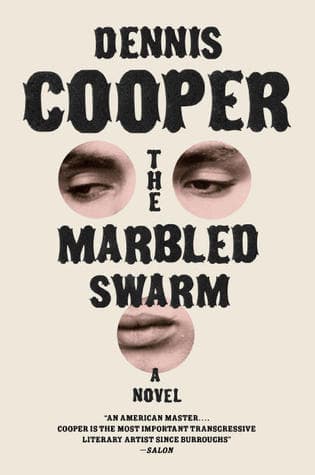
Dennis Cooper (2011)
Genre
Thriller / Mystery
Reading Time
240 min
Key Themes
See below
Sign in to track this book
In a world of inherited secrets and high artifice, a narrator searches for the truth behind 'the marbled swarm,' a language key to generations of coercion hidden beneath French aristocracy.
The story begins with the narrator's arrival at his ancestral chateau in the French countryside. His ailing father, a reclusive man, summoned him. The narrator feels uneasy, having been away for many years. He notices the peculiar atmosphere of the estate, the hidden passages, and the silence. His father, both revered and feared, hints at a family 'tradition' the narrator is expected to uphold. This tradition involves a cryptic language system and disturbing rituals, rooted in the family's history and the chateau's architecture. These initial observations set the novel's unsettling, mysterious tone.
The narrator's father introduces him to 'the marbled swarm,' a central, enigmatic part of their family's legacy. It is a complex, inherited system of language, gestures, and unspoken rules passed down through generations. This 'swarm' dictates how one perceives and interacts with the world, especially regarding the family's secret practices. The narrator struggles to understand it but knows it involves control, manipulation, and a unique way of 'scoring' human interactions. He senses a darkness and predatory nature to this system, though its exact purpose remains unclear.
The narrator discovers the chateau is home to young men, called 'the boys.' These young men are beautiful, passive, and their presence is a mystery. They are not servants, but their lives seem consumed by the chateau's routines and the father's demands. The narrator observes their interactions with his father, which show deference, fear, and a strange intimacy. He realizes these boys are central to the 'marbled swarm' and the family's secret practices, both participants and subjects in its web of control. Their silence and vacant expressions deepen the narrator's unease.
Driven by curiosity and a desire to understand his inheritance, the narrator explores the chateau. He finds hidden rooms, secret passages, and concealed compartments that reveal a history of surveillance. These explorations uncover disturbing artifacts: peculiar drawings, fragmented notes in a coded language, and objects suggesting strange rituals. Each discovery deepens his sense of foreboding and reinforces that the chateau is an extension of the 'marbled swarm.' The architecture seems designed for observation and control, blurring the lines between observer and observed.
As his father's health declines, the pressure on the narrator to continue the family's 'game' grows. His father, through cryptic words and manipulations, pushes him to understand and accept the 'marbled swarm.' The narrator feels a hypnotic pull to follow his father, despite his repulsion. He begins to internalize the 'game's' rules, observing the boys with a new perspective, and experimenting with the control system. This transition marks his descent into the family's legacy, blurring the lines between observer and participant.
Seeking a break from the chateau's oppressive atmosphere, the narrator travels to Paris. He hopes for normalcy or escape, but the city offers little comfort. Instead, he applies the 'marbled swarm's' principles to interactions with strangers, especially young men. The 'game' has begun to influence his perception of the outside world, turning ordinary encounters into potential 'scores.' He observes people through the lens of manipulation, realizing the 'swarm' is not confined to the chateau but is a state of mind he has internalized. This trip shows the pervasive nature of his inheritance.
Upon returning to the chateau, the narrator actively participates in the 'game.' He uses the 'marbled swarm's' principles to manipulate the boys, mirroring his father's methods. He experiments with subtle psychological tactics, observing reactions and finding satisfaction in his growing power. The boundaries between his identity and the 'swarm' dissolve as he adopts the predatory mindset of his family's legacy. These experiments are not physically violent but focus on psychological coercion and the erosion of individual will, pushing the boys into total surrender.
As the narrator delves deeper into the 'marbled swarm,' his identity becomes fluid. He questions his memories, motivations, and the reality of his past. The line between himself and his father, and between himself and the 'swarm's' rules, blurs. He embodies the system he initially found repellent, becoming a vessel for its continuation. This blurring is reflected in the narrative's fragmented style, mirroring the narrator's deteriorating mental state and his immersion into the family's traditions. He is no longer just playing the game; he is becoming the game.
In the final stages, the narrator fully surrenders to the 'marbled swarm.' This surrender is not defeat but complete embrace and integration into the system. He achieves a perverse understanding of the 'swarm's' control mechanisms and the beauty of total submission, for himself and his 'boys.' Morality and conventional understanding dissolve, replaced by the 'swarm's' logic. The ending is ambiguous, not in events, but in the psychological state it leaves the reader with: a chilling portrait of a mind consumed by a dark, inherited legacy, finding peace in its depravity.
The novel concludes with the implication that the 'marbled swarm' will continue, passed down to another generation. The narrator, having embraced his role, becomes the new custodian of this dark legacy. The cycle of coercion, surrender, and the 'game' continues, ensuring its survival within the chateau's isolated world. The ending offers no redemption or escape, presenting a chilling portrait of an inescapable system of control, forever linking the family to its traditions. The narrator has adopted the 'swarm' and become part of its ongoing existence.
The Protagonist
He transforms from a detached observer into a willing, even eager, participant and perpetuator of the 'marbled swarm,' shedding his former self.
The Antagonist/Catalyst
His physical decline mirrors the narrator's ascent, as he successfully transfers the burden and power of the 'marbled swarm' to his son.
The Supporting
They remain largely static, serving as the constant, passive instruments within the 'marbled swarm's' ongoing rituals.
The novel explores how destructive thought patterns and behaviors pass through generations, becoming an inescapable legacy. The 'marbled swarm' is a deeply ingrained way of perceiving and interacting with the world. The narrator's struggle and surrender show the powerful grip of inherited pathology, suggesting some destinies are set by ancestral actions. This is clear as the narrator, despite initial repulsion, continues his father's 'game,' becoming a mirror of what he feared.
““The game was never about winning or losing, but about becoming the game itself.””
A central theme is the dynamic between controlling others and complete surrender, both by the manipulated and the manipulator. The 'marbled swarm' is a system designed for total psychological control, leading its subjects to a state of willing submission. Paradoxically, the narrator's journey to becoming the controller involves his own profound surrender to the 'swarm's' logic. Scenes where the narrator manipulates the boys, and his own internal capitulation, show this interplay, blurring lines between power and submission.
““To truly control, one must first understand the beauty of being controlled.””
The narrator's sense of self constantly shifts as he becomes immersed in the 'marbled swarm.' His memories are unreliable, and his identity intertwines with the 'game' and his father's legacy. The novel suggests that identity is not fixed but can be reshaped by powerful external or inherited internal forces. This is clear in the narrator's blurring memories and his inability to distinguish his own desires from the 'swarm's' dictates, becoming a vessel for its continuation.
““My past was a series of echoes, distorted by the present, or perhaps by the swarm itself.””
The world of the chateau and the 'marbled swarm' is full of artifice, where interactions are performances and reality is constructed. The family's rituals are a form of perverse theater, with specific 'scores' and unspoken rules. High art, old money, and haute cuisine cover the dark core of coercion. This theme shows how appearances create a compelling, yet false, reality, where genuine emotion is replaced by calculated performance. The 'boys' are performers, playing roles in the 'game' for the narrator's and his father's amusement.
““Every gesture, every silence, was a note in the symphony of the game.””
The narrator's subjective and deteriorating perception blurs the line between reality and delusion.
The unnamed narrator's perspective is highly subjective and increasingly unreliable as he succumbs to the 'marbled swarm.' His memories are fragmented, his interpretations are colored by his growing immersion in the family's perverse logic, and his mental state deteriorates. This device creates a constant sense of unease and ambiguity for the reader, making it difficult to discern what is objectively real and what is a product of the narrator's warped perception or the 'swarm's' influence. It forces the reader to question the reality of events and the narrator's motivations, deepening the mystery and psychological horror.
The isolated, complex château mirrors the psychological maze of the 'marbled swarm.'
The ancestral château functions as more than just a setting; it is a character in itself, a physical manifestation of the family's dark legacy and the 'marbled swarm.' Its hidden passages, secret rooms, and oppressive atmosphere create a sense of entrapment and surveillance. The intricate architecture mirrors the complex, convoluted nature of the 'swarm's' rules and the narrator's psychological journey into its depths. Its isolation reinforces the idea of a self-contained, inescapable world where conventional morality does not apply, further immersing both the characters and the reader in its perverse reality.
The 'marbled swarm' itself is a complex, symbolic language system that dictates the family's rituals.
The 'marbled swarm' is a central plot device, functioning as a complex, inherited system of language, gestures, and unspoken rules. It is not literally a swarm but a metaphor for a pervasive, intricate network of control and meaning. This cryptic 'language' dictates how the family members, particularly the father and narrator, interact with and manipulate the 'boys.' Its abstract nature makes it deeply unsettling, as its exact mechanisms are never fully explicit, leaving much to the reader's imagination and contributing to the pervasive sense of mystery and dread surrounding the family's practices.
Life within the château is framed as an intricate, perverse game with specific rules and 'scores.'
The concept of a 'game' is used throughout the novel to describe the family's rituals and interactions. This metaphor dehumanizes the 'boys' into mere pawns or players and reframes morally reprehensible acts as strategic moves within a structured system. It allows the characters, particularly the narrator, to detach themselves from the ethical implications of their actions, viewing them as part of a complex, inherited challenge rather than acts of cruelty. The 'game' provides a framework for the 'marbled swarm,' giving its abstract principles a tangible, albeit perverse, application within the château.
“The thing about secrets is that they’re like living things. They grow, they change, they fester.”
— A character reflects on the nature of hidden truths and their impact.
“There are some wounds that never close, no matter how much time passes, no matter how many bandages you apply.”
— A character's internal monologue about lingering emotional pain.
“Every lie is a brick in a wall you build around yourself, until you can no longer see out, or let anyone in.”
— A philosophical observation on the isolating nature of deception.
“The city, at night, was a different creature entirely. All its sharp edges softened, its hidden desires brought to the surface by the neon glow.”
— A description of the urban landscape after dark.
“Sometimes, the most dangerous people are the ones who seem the most ordinary.”
— A detective's realization about the true nature of evil.
“Memory is a treacherous thing. It can betray you, or it can save you, depending on what you choose to remember.”
— A character struggles with unreliable recollections.
“The truth, like a shard of glass, can be incredibly painful when you finally grasp it.”
— A character confronts a harsh reality.
“Fear has a way of twisting everything, making shadows into monsters and whispers into screams.”
— A character experiencing intense paranoia.
“You can run from your past, but you can never truly escape it. It always catches up, eventually.”
— A character grappling with unresolved issues from their history.
“There's a certain kind of beauty in destruction, if you're willing to look for it.”
— A morally ambiguous character's perspective on chaos.
“The silence was heavier than any sound, a suffocating blanket that pressed down on everything.”
— A description of an oppressive atmosphere.
“Every choice you make, no matter how small, sends ripples through the fabric of your life.”
— A reflection on the butterfly effect of decisions.
“Trust is a fragile thing, easily broken, and almost impossible to fully mend.”
— A character's cynical view on human relationships.
“The darkness wasn't empty; it was filled with all the things you didn't want to see, didn't want to admit.”
— A character confronting their inner demons in a dark setting.
Ready to see how well you understood this book? Take our interactive quiz with 10 questions.

Dennis Cooper is an experimental novelist known for his transgressive and often controversial works that explore themes of youth culture, sexuality, and violence. His notable novel, "The Marbled Swarm," is characteristic of his challenging and boundary-pushing literary style. Cooper's writing is recognized for its unique voice and unflinching examination of dark subject matter.







