“The unexamined life is not worth living, but the examined life is no bowl of cherries either.”
— David Staunton reflects on his psychoanalysis and the challenges of self-awareness.


Robertson Davies (2006)
Genre
Literary Fiction / Historical Fiction
Reading Time
360 min
Key Themes
See below
Sign in to track this book
A successful but emotionally distant lawyer undergoes Jungian analysis and meets people who help him understand his enigmatic father's life and death.
David Staunton, a brilliant and successful criminal lawyer, feels a deep personal crisis after his father, Boy Staunton, dies ambiguously. Despite his professional success, David feels empty and disconnected from others. He struggles to grieve for his father and with their difficult relationship. Needing to understand himself and following a colleague's advice, David decides to try Jungian analysis. He travels to Zürich, Switzerland, to begin therapy with Dr. Johanna von Haller, a well-known Jungian analyst. This choice is a big change from his usual rational life, opening him to explore his unconscious mind and hidden parts of his personality.
In his sessions with Dr. von Haller, David begins the hard process of looking inward. He first resists the symbolic parts of Jungian thought but slowly starts to examine his past. A main focus is his relationship with his father, Boy Staunton, whom David admired but also resented for his strong presence and emotional distance. David remembers his childhood, which was privileged but emotionally cold, and his mother's quiet unhappiness. He deals with feelings of not being good enough, a fear of failure, and the constant pressure to meet his father's expectations. Dr. von Haller guides him through dream analysis and active imagination, helping him find archetypal patterns and hidden emotions linked to his family history and the Deptford community.
As his analysis continues, David confronts his 'shadow'—the hidden, unwanted parts of his personality. He realizes he can be cruel and tends to think about emotions rather than feel them, often hurting real human connection. Dr. von Haller also teaches him about the 'anima,' the unconscious feminine part in a man. David starts to see how his inability to connect with women, and his general emotional distance, comes from a neglected anima. He remembers his short, unsatisfying relationships and his deep fear of intimacy. This realization is both painful and freeing; it shows him a way to better emotional balance. He begins to understand how his father's own struggles with these archetypes affected his upbringing.
Dr. von Haller often connects David's personal history to the Deptford community, especially the people involved in his father's life and death. Dunstan Ramsay, David's godfather and his father's long-time acquaintance, often comes up. David remembers Ramsay's unusual nature, his studies, and his somewhat unsettling presence. He starts to understand that Ramsay, along with other Deptford figures like Mrs. Dempster and Paul Dempster (now the magician Magnus Eisengrim), hold important clues to his father's complex character and the events around his death. The analyst helps David see that his father was not just the successful public figure he seemed to be, but a man caught in a web of past relationships and secrets.
Near the end of his therapy in Zürich, David receives an interesting invitation. Dr. von Haller, seeing his intelligence and progress, suggests he attend an annual Jungian conference at the remote Swiss castle of Sorgenfrei, hosted by the wealthy collector, Liesl Naegeli. This invitation moves him from individual analysis to a more communal, but still psychological, experience. Liesl Naegeli is Magnus Eisengrim's sister and a long-time friend of Dunstan Ramsay. David is unsure at first, preferring his structured life, but Dr. von Haller encourages him to use this chance for more self-discovery and a different kind of psychological exploration. This sets the stage for David to meet the very people connected to his father's past.
David travels to Sorgenfrei, a remote and somewhat grand castle, where he finds himself among an unusual and intellectually lively group. He immediately notices Dunstan Ramsay, his godfather, whom he has not seen in years. Ramsay, now an elderly scholar, greets him with warmth and his usual reserve. David also meets Liesl Naegeli, the strong and sharp hostess, whose directness and insight both challenge and interest him. Other guests include academics, artists, and Jungian enthusiasts. The atmosphere is one of intense intellectual discussion, deep psychological inquiry, and a touch of drama. David, used to the strict world of law, finds himself in a place where the lines between reality and symbolism often blur.
At Sorgenfrei, David sees the unique relationship between Dunstan Ramsay, Liesl Naegeli, and Magnus Eisengrim (Paul Dempster), whom he now knows as the famous magician. He learns that these three form a 'Deptford Trinity,' deeply connected by their shared past and the snowball incident that hit Mrs. Dempster. He sees their intellectual debates, their deep understanding of each other, and the strong, almost mystical, bond between them. Liesl, in particular, is a powerful presence, challenging Ramsay's scholarly strictness and Eisengrim's theatrical persona. David begins to understand that these people hold the answers to a story far more complex and important than he ever thought, a story that greatly affected his father, Boy Staunton.
The central mystery of Boy Staunton's death becomes a main topic at Sorgenfrei. David learns that his father's death was not an accident, but a carefully planned suicide, arranged by Boy himself, with Magnus Eisengrim's unwitting help. The 'magic trick' of the car driving into the lake was a final act of control and a symbolic return to the water, a recurring idea in his life. Liesl Naegeli and Dunstan Ramsay offer important details, revealing Boy's deep unhappiness, his inability to face his past, and his spiritual emptiness despite his material success. David is shocked by this, forced to rethink everything he knew about his father and his family history.
During his time at Sorgenfrei, David learns about the Manticore, a mythical creature with a lion's body, a man's face, and a scorpion's tail. This creature becomes a strong symbol for David's own psychological state—a man of intellect and power (lion's body) but with a destructive, poisonous side (scorpion's tail) and a human face that often hides his true nature. Through talks with Ramsay and Liesl, and his own thoughts, David starts to bring these different parts of himself together. He accepts his own Manticore nature, recognizing both his strengths and his flaws. This realization is an important step in his self-discovery, moving him towards a more complete and real self. He also sees the Manticore in his father, Boy Staunton.
David's time at Sorgenfrei ends with him accepting his father's complex life and death, and a clearer understanding of his own identity. He comes to terms with the fact that Boy Staunton was not simply a hero or villain, but a flawed and sad figure. David also acknowledges his own emotional repression and the need to embrace his more intuitive side. He has moved from intellectual analysis to a more complete, psychological understanding of himself and the world. While the process continues, he leaves Sorgenfrei feeling free, ready to face his future with new authenticity and a greater ability to connect, having learned from his Jungian journey and the revelations from the Deptford Trinity.
The Protagonist
David evolves from a rigidly rational and emotionally repressed individual to someone who begins to integrate his unconscious self, accepting his flaws and embracing a more holistic understanding of his identity.
The Antagonist/Catalyst
His character arc is revealed retrospectively; he is shown to have lived a life of outward success but inward spiritual decay, culminating in a tragic, symbolic suicide.
The Supporting
She serves as a catalyst for David's initial transformation, helping him to break free from his emotional repression and begin his individuation process.
The Supporting
His arc extends from 'Fifth Business,' here he continues to embody the wise old man archetype, offering perspective and guidance to David, solidifying his role as a chronicler and interpreter of the Deptford saga.
The Supporting
She acts as a powerful catalyst for David's growth, challenging his assumptions and providing the intellectual and emotional space for profound revelations.
The Supporting
His arc from 'Fifth Business' continues; here he is a fully realized, powerful figure who, through his very existence, provides a tangible link to the Deptford past and the final act of Boy Staunton's life.
The Mentioned/Catalyst
Her story is primarily established in 'Fifth Business'; in 'The Manticore,' she serves as a symbolic anchor to the past events that shaped the characters' lives.
The Supporting
He remains relatively static, serving primarily as a contrast to David's initial state of emotional repression.
The novel's main theme is David Staunton's difficult journey of self-discovery through Jungian analysis. He deals with a divided identity, shaped by his father's influence and his own emotional repression. Therapy makes him confront his 'shadow' self, integrate his 'anima,' and understand the archetypal forces in his life. This search leads him to recognize his own 'Manticore' nature, helping him become a more complete and real person. His journey shows that true identity comes not from professional success or social roles, but from integrating conscious and unconscious parts of oneself.
“What had I ever done but live a life that was one long evasion of the truth about myself?”
The past, especially the Deptford events around the snowball incident and the lives of Boy Staunton, Dunstan Ramsay, and Magnus Eisengrim, greatly affects the present. David's inability to grieve for his father or form real relationships is directly linked to unresolved emotional and psychological burdens passed down. The discoveries at Sorgenfrei, detailing Boy Staunton's complex life and his planned suicide, show how unaddressed past problems and hidden emotions can lead to destructive results. The novel suggests that understanding and accepting the past is necessary for psychological wholeness.
“It was not enough to know the facts; I had to know the feeling behind the facts.”
Jungian psychology is not just a plot element but a main theme in the novel. Ideas like the 'shadow,' 'anima,' 'individuation,' and various archetypes (e.g., the Manticore, the wise old man, the trickster) are directly discussed and applied to David's journey. His therapy with Dr. von Haller and the talks at Sorgenfrei show how these psychological ideas can explain personal history, relationships, and the deeper meanings behind seemingly random events. The novel explores how understanding these universal patterns can lead to deep self-knowledge and spiritual growth.
“The Manticore is a creature of intellect and power, but also of poison and self-destruction. It is a symbol of the human condition, Mr. Staunton.”
The story often blurs the lines between objective truth and subjective experience, reality and illusion. Boy Staunton's life was a carefully built facade, and his death, arranged as a 'magic trick,' further highlights this theme. Magnus Eisengrim, the magician, represents the power of illusion, making characters and readers question what is real. David, as a lawyer, initially relies only on facts, but his Jungian journey teaches him that psychological and symbolic truths are just as, if not more, important. The novel suggests that a deeper understanding of life requires accepting paradox and the interplay of visible and invisible forces.
“Truth, Mr. Staunton, is not always what can be proved in a court of law.”
Beneath David's initial intellectualism is a strong desire for meaning that his successful but empty life cannot provide. His father's spiritual emptiness, despite his wealth, serves as a warning. The novel explores different ways to find meaning: through Jungian self-reflection, the study of hagiography (Dunstan Ramsay), and the esoteric world of magic (Magnus Eisengrim and Liesl Naegeli). The Deptford Trilogy looks at the spiritual, and 'The Manticore' continues this by showing David's move from a purely rational view to one that acknowledges the spiritual and symbolic aspects of existence.
“The greatest tragedy of all is not to die, but to live without ever having truly lived.”
The primary narrative framework and catalyst for David's psychological journey.
Jungian analysis serves as the central plot device, structuring David Staunton's journey of self-discovery. The novel details his therapy sessions with Dr. von Haller, including dream interpretation, active imagination, and discussions of archetypes like the Shadow, Anima, and the process of individuation. This framework allows the author to explore complex psychological themes directly, providing a lens through which David, and the reader, can understand his past, his relationship with his father, and his own emotional landscape. It moves the plot forward by revealing layers of David's unconscious and connecting him to the broader Deptford mythology.
A symbolic creature representing David's complex and contradictory nature.
The Manticore, a mythical beast with a man's face, lion's body, and scorpion's tail, functions as a powerful symbolic plot device. It is introduced and discussed at Sorgenfrei, becoming a central metaphor for David's own psychological makeup: his intellectual prowess (man's face), his hidden power and aggression (lion's body), and his capacity for self-destruction or inflicting emotional pain (scorpion's tail). Recognizing and integrating this archetype is crucial to David's individuation process, helping him accept the contradictory aspects of his personality and understand his father's similar struggles. It provides a concrete image for abstract psychological concepts.
A group of interconnected characters whose shared past reveals the truth of Boy Staunton's life and death.
The 'Deptford Trinity' – Dunstan Ramsay, Liesl Naegeli, and Magnus Eisengrim – acts as a collective plot device. Their reunion at Sorgenfrei and their shared history with Boy Staunton provide the crucial missing pieces to the puzzle of his life and death. Each member offers a unique perspective on the past, allowing David to piece together a more complete and nuanced understanding of his father. Their collective wisdom, eccentricities, and deep psychological insights serve to expand David's worldview beyond his initial rigid rationality, driving the plot towards the ultimate revelation of Boy's suicide and its symbolic meaning.
The plot unfolds through David's memories and the gradual unveiling of past events.
The novel employs a retrospective narrative, where the present-day events of David's therapy and his time at Sorgenfrei are interspersed with flashbacks and recounted memories. This device allows David to revisit and re-evaluate his childhood, his relationship with his father, and the key events of the Deptford saga from a new, psychologically informed perspective. The plot progresses through a series of revelations, as David gradually uncovers truths about his past that were previously repressed or misunderstood, culminating in the shocking truth about his father's death. This structure emphasizes the theme of the past's enduring influence.
“The unexamined life is not worth living, but the examined life is no bowl of cherries either.”
— David Staunton reflects on his psychoanalysis and the challenges of self-awareness.
“We are all the heroes of our own stories, and the villains of other people's.”
— David discusses perception and identity during therapy sessions.
“The past is not dead; it is not even past.”
— A reflection on how childhood and family history shape adult life.
“To know oneself is to know one's limitations, and that is the beginning of wisdom.”
— Dr. von Haller guides David toward self-acceptance in analysis.
“We inherit not only our parents' genes but their unresolved conflicts.”
— David grapples with his father's influence and legacy.
“The mind is a labyrinth, and psychoanalysis is the thread that leads us out.”
— Metaphor used to describe the therapeutic process in the novel.
“Truth is not a diamond to be held up to the light, but a prism that refracts differently for each observer.”
— Discussion on subjective reality and personal truth.
“We are all actors on the stage of life, but some of us have forgotten our lines.”
— Reflection on social roles and personal authenticity.
“The shadow of the father falls long upon the son.”
— David contemplates his father's dominance and his own identity.
“To love is to risk, and to risk is to be vulnerable—that is the human condition.”
— Exploration of emotional vulnerability in relationships.
“The law is a mirror of society, but like all mirrors, it can distort as much as it reflects.”
— David, a lawyer, critiques the legal system and its imperfections.
“We build our prisons with the bricks of our own fears.”
— Insight into how personal anxieties constrain one's life.
“The analyst's couch is not a place of comfort, but a battlefield of the soul.”
— Description of the intense, often painful process of psychoanalysis.
“In the end, we are all alone with our choices, and that is both our burden and our freedom.”
— David comes to terms with personal responsibility and autonomy.
Ready to see how well you understood this book? Take our interactive quiz with 10 questions.
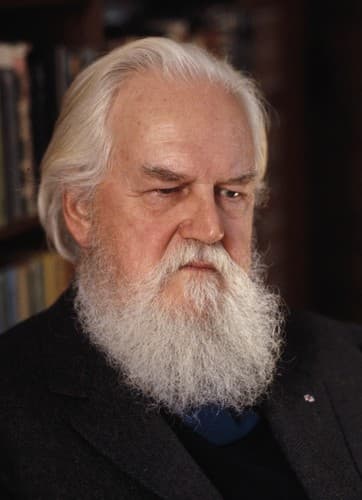
William Robertson Davies was a Canadian novelist, playwright, critic, journalist, and professor. He was one of Canada's best known and most popular authors and one of its most distinguished "men of letters", a term Davies gladly accepted for himself. Davies was the founding Master of Massey College, a graduate residential college associated with the University of Toronto.







