“The fog was a living thing, a malevolent presence that had swallowed the village whole.”
— Describing the oppressive atmosphere of the village of Long Piddleton.

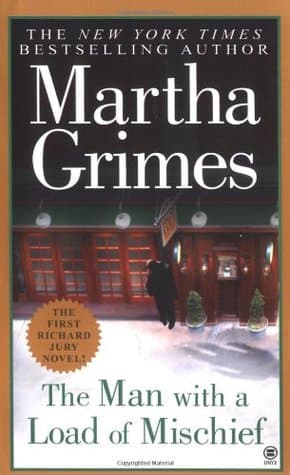
Martha Grimes (1901)
Genre
Thriller / Mystery
Reading Time
544 min
Key Themes
See below
Sign in to track this book
When two charming village pubs become sites for murder, Detective Chief Inspector Richard Jury and Melrose Plant must uncover local secrets and hidden animosities to find a killer.
The English village of Long Piddleton is shaken when a discovery is made at The Man With a Load of Mischief pub. The body of Simon Lean, a local solicitor, is found in a beer keg in the cellar. The pub's owner, Mrs. Ringer, makes the find. The local police, led by Inspector Macalvie, are puzzled by the death and the lack of obvious motive or suspects. The incident immediately casts a shadow over the peaceful community, drawing attention from outsiders and causing a stir among residents.
Because of the unusual circumstances of Simon Lean's murder and the local police's lack of progress, Scotland Yard is called in. Detective Chief Inspector Richard Jury arrives in Long Piddleton. He is struck by the village's almost too-perfect appearance and its peculiar residents. Jury begins his investigation by interviewing Mrs. Ringer and other villagers, trying to understand Lean's last movements and any potential enemies. He finds himself navigating village gossip, hidden resentments, and a general reluctance from locals to offer helpful information.
Soon after arriving, Jury meets Melrose Plant, an unemployed, aristocratic gentleman who lives in a large but crumbling manor house nearby. Plant, whose real name is the Earl of Caverness, has given up his title and lives a life of quiet observation, often visiting local pubs. Jury finds Plant to be a valuable, if unusual, ally. Plant understands human nature and the social dynamics of Long Piddleton, often pointing Jury toward subtle clues and hidden motives that villagers might overlook or hide. Their partnership quickly becomes important to the investigation.
Just as Jury starts to understand the first murder, a second, equally strange killing occurs. The body of George Cross, a clockmaker, is found hanging from the sign of The Jack and Hammer pub, replacing the mechanical figure that usually hangs there. This second murder, happening in such a similar, dramatic way, causes panic in Long Piddleton. It confirms that a killer is in the village and increases the pressure on Jury to solve the case. The connection between the two victims and the two pubs becomes a main focus of the investigation.
Jury and Plant work to understand the meaning of the two pubs, The Man With a Load of Mischief and The Jack and Hammer. They interview the owners, bartenders, and regular customers, looking for common threads or rivalries. They learn about the pubs' long histories, their distinct atmospheres, and the types of people who frequent them. Plant, with his knowledge of local stories and gossip, helps Jury navigate the complex social circles in the village, revealing old feuds, secret love affairs, and hidden financial dealings that might provide a motive for the murders. The pubs become central characters in the mystery.
As Jury and Plant dig deeper, they discover that Long Piddleton, beneath its charming exterior, hides many secrets. Financial problems, illicit relationships, and old grudges begin to appear. Simon Lean, the first victim, was a solicitor involved in various village dealings, suggesting motives tied to money or property. George Cross, the second victim, was a clockmaker, and his connection to Lean or any other villager is initially unclear. The investigators realize that the killer is likely someone within the community, someone familiar with the victims and the village's hidden currents, rather than an outsider.
Jury, with his eye for detail, considers the unusual names of the two pubs: 'The Man With a Load of Mischief' and 'The Jack and Hammer.' He wonders if these names, and their associated imagery, hold a symbolic key to the killer's motive or method. Plant, ever the literary mind, speculates on potential allegorical connections, suggesting that the killer might be acting with a twisted sense of justice or a desire to communicate a message through the macabre settings of the murders. This line of inquiry adds another layer to the investigation, moving beyond simple motives to a more psychological understanding of the perpetrator.
Through diligent interviewing and careful piecing together of alibis and motives, Jury and Plant begin to focus on a specific person in the village. This person, initially seeming harmless, gradually shows inconsistencies in their story and has a hidden connection to both victims. The motive appears to come from a long-standing grievance or a desire for revenge, perhaps related to past events that have been carefully hidden. The idyllic appearance of Long Piddleton truly cracks as the reality of a killer living among them becomes clear, forcing the villagers to confront their own part in keeping the village's secrets.
The investigation ends in a tense confrontation where Jury and Plant, with their evidence and insights, corner the killer. The perpetrator, driven by a deep sense of injustice and a carefully planned revenge, reveals their scheme. The seemingly random nature of the murders is explained, showing a precise, symbolic connection between the victims, the pubs, and the killer's personal history. The confrontation exposes the dark side of Long Piddleton, showing how old resentments can grow and erupt into violence, shattering the peace of the village and leaving its residents changed.
With the killer caught, Long Piddleton begins to heal and come to terms with the events. The idyllic image of the village is broken, replaced by the reality of human malice. Jury reflects on the case, the peculiar crimes, and the unexpected bond he formed with Melrose Plant. The experience shows him that even in the most beautiful places, darkness can hide. As Jury prepares to leave, a sense of melancholy hangs over the village, along with a renewed appreciation for the truth, however unsettling.
The Protagonist
Jury arrives in Long Piddleton as an outsider, gradually peeling back its layers to expose the hidden darkness, reinforcing his belief that evil can reside anywhere.
The Supporting
Plant moves from a detached observer to an active participant in solving the murders, finding a new purpose in assisting Jury.
The Supporting
Macalvie learns to trust and respect Jury's methods, growing in his own understanding of complex criminal investigations.
The Mentioned
As a victim, his 'arc' is revealed posthumously as details of his life and connections are uncovered.
The Mentioned
His 'arc' is also revealed posthumously, as his life and connections are explored to find a link to the first murder.
The Supporting
She endures the trauma of discovery and the disruption of the investigation, her resilience highlighting the village's strength.
The Supporting
The villagers collectively move from a state of denial and secrecy to confronting the dark truths within their community.
The novel explores the contrast between Long Piddleton's charming appearance and the dark realities beneath its surface. The village initially seems like a peaceful English haven. However, the murders quickly break this illusion, revealing a community full of hidden secrets, old resentments, illicit affairs, and financial problems. The killer is likely someone who seemed harmless, showing how easily evil can hide in plain sight. This theme is central to the mystery, as Jury and Plant must uncover layers of deception to find the truth, proving that beauty can often mask depravity.
“'The village was a lie, a painted backdrop hiding a stage where dark deeds were played out.'”
The book looks into the nature of evil, suggesting it is not always external or monstrous, but can grow within seemingly ordinary people and communities. The murders are not random acts but come from deep motives—revenge, jealousy, or a twisted sense of justice—developed over time. The killer is not a stranger but someone from the close-knit village, highlighting how everyday resentments can become horrific acts. This theme forces characters and readers to consider that anyone is capable of darkness, and that evil can be a planned act rather than an impulsive one, reflecting the complexities of human morality.
“'It wasn't the stranger you had to fear, Jury thought, but the face you saw every day.'”
While Long Piddleton is a close-knit community, the novel also explores themes of isolation within it. Despite living close by, many villagers hide deep secrets and resentments, leading to emotional isolation. The murders make this worse, as suspicion falls on everyone, causing people to withdraw and distrust their neighbors. The killer acts from a place of deep isolation, driven by grievances that made them feel alienated from the community. Jury, as an outsider, initially feels isolated but slowly connects by forming a bond with Melrose Plant, showing how connection can be found even amidst widespread distrust.
“'Even in a village, one could be utterly alone, especially with a secret to keep.'”
A significant theme is the symbolic nature of the murders. The killer not only commits murder but stages the bodies in specific, grotesque ways—stuffed in a beer keg, replacing a mechanical figure on a pub sign. The names of the pubs, 'The Man With a Load of Mischief' and 'The Jack and Hammer,' are not coincidental but hold symbolic meaning for the perpetrator. This suggests a killer driven by motive and a desire to send a message, enact a twisted form of justice, or re-enact a past event. The dramatic staging makes the crimes more chilling and provides important clues for Jury and Plant to decipher.
“'This wasn't just murder; it was a statement, a macabre performance.'”
The murders occur within a confined community, limiting the suspect pool.
The novel utilizes the classic 'closed circle' or 'locked room' mystery trope, where the murders occur within the isolated, self-contained village of Long Piddleton. This device immediately narrows the suspect pool to the residents of the village, increasing tension and suspicion among the characters. It allows for a deep exploration of the interpersonal relationships, secrets, and histories of the villagers, as the killer must be someone known to the community. This setup enhances the theme of appearance versus reality, as the killer is forced to hide in plain sight among their neighbors, making the familiar suddenly terrifying.
Melrose Plant, a keen but unofficial investigator, offers crucial insights.
Melrose Plant serves as the eccentric observer and sidekick, a common device in mystery fiction. Despite having no official police capacity, his aristocratic background, local knowledge, and sharp observational skills make him an invaluable asset to Detective Chief Inspector Jury. Plant's ability to blend into the village, gather gossip, and interpret subtle social cues allows him to uncover information that Jury, as an outsider, might miss. He provides a foil to Jury's more formal approach, often offering humorous commentary while also driving the plot forward with his unique insights into human nature and local lore. This dynamic adds both intellectual depth and charm to the investigation.
The locations and methods of murder hold symbolic meaning for the killer.
The novel prominently features symbolic crime scenes, where the killer meticulously stages the bodies in ways that hold specific meaning. The first victim is found in a beer keg at 'The Man With a Load of Mischief,' and the second replaces a mechanical figure on the sign of 'The Jack and Hammer.' These aren't just random locations; the names of the pubs and the methods of disposal are deliberate, acting as a form of communication or a twisted re-enactment by the perpetrator. This device elevates the murders beyond simple acts of violence, providing critical clues about the killer's motive, psychological state, and connection to the victims, forcing Jury to interpret the 'message' behind the macabre displays.
Misleading clues and false suspects divert the investigation.
As is typical in a mystery, the narrative employs several red herrings to misdirect both the investigators and the reader. These can take the form of suspicious characters with plausible motives, misleading pieces of evidence, or false leads that appear to point towards an obvious culprit. These diversions serve to increase suspense, complicate the investigation, and challenge Jury's deductive reasoning. By introducing multiple potential suspects and motives, the novel keeps the audience guessing, making the eventual revelation of the true killer more surprising and satisfying. The red herrings often play on the villagers' own hidden secrets and prejudices, making them seem more credible.
“The fog was a living thing, a malevolent presence that had swallowed the village whole.”
— Describing the oppressive atmosphere of the village of Long Piddleton.
“Richard Jury, for all his polished exterior, was a man who understood the dark corners of the human heart.”
— Introducing the detective Richard Jury's character.
“There's always a reason, even if it's a reason only a madman could understand.”
— Jury contemplating the motive behind a seemingly senseless crime.
“Long Piddleton had a way of keeping its secrets, burying them deep beneath layers of ivy and complacency.”
— Reflecting on the village's hidden past and resistance to outsiders.
“He found that the truth, much like a good ale, often had a bitter aftertaste.”
— Jury's realization about the unpleasant nature of certain discoveries.
“The pub, 'The Man With a Load of Mischief,' seemed to hum with unspoken stories, a repository of village lore.”
— Describing the central pub and its significance.
“It wasn't the grand gestures that revealed a person, but the small, unconscious tells.”
— Jury's observation on human behavior and uncovering deception.
“Even the most ordinary lives could harbor extraordinary darkness.”
— A thought about the hidden complexities within seemingly normal people.
“The past, like a persistent ghost, always found a way to haunt the present.”
— Considering how past events influence current mysteries.
“Curiosity, he mused, was both a blessing and a curse for a detective.”
— Jury reflecting on his own driving force.
“The quietest places often held the loudest secrets.”
— A thought about the deceptive tranquility of rural settings.
“Justice wasn't always swift, and rarely clean.”
— Jury's cynical view on the nature of justice.
“He had learned that madness often wore the most convincing mask of sanity.”
— Observing the psychological aspects of the characters.
“The scent of damp earth and old beer hung in the air, a peculiar perfume of English village life.”
— Sensory description of the local environment.
Ready to see how well you understood this book? Take our interactive quiz with 10 questions.

Biography coming soon.







