“The greatest crimes are not those that shed blood, but those that crush the spirit.”
— A general reflection on the nature of suffering inflicted by society.

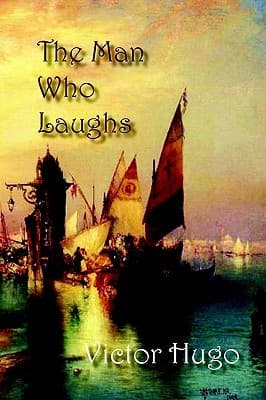
Victor Hugo (2011)
Genre
Historical Fiction / Romance
Reading Time
1500 min
Key Themes
See below
Sign in to track this book
In 17th-century England, a man with a carved smile faces a cruel society, torn between a blind woman's love and a noblewoman's obsession, while a past secret threatens his life.
On a cold night in January 1690, a ten-year-old boy named Gwynplaine is left on the coast near Portland by Comprachicos, who carved his face into a permanent grin. The men sail away, leaving him to die. Gwynplaine, barefoot and scared, walks through a snowstorm. He finds a gallows with a hanged man's body. Underneath it, he finds a frozen woman. He hears a sound and discovers a living infant girl, still nursing at the dead woman's breast. He takes the baby, names her Dea, and continues looking for shelter.
Gwynplaine, carrying Dea, reaches a caravan belonging to Ursus, an eccentric philosopher and showman, accompanied by his tamed wolf, Homo. Ursus, despite claiming to dislike people, is moved by the two abandoned children, one with a horrifying grin and the other blind. He takes them in, giving them food, warmth, and a family. Ursus becomes a father figure, teaching Gwynplaine and raising Dea with love and care, creating a small, unconventional home built on affection and need.
Years pass. Gwynplaine grows into a young man, his disfigured face, locked in an eternal grin, the main attraction of Ursus's traveling show. Ursus stages plays where Gwynplaine's 'laugh' is the tragic highlight, while Dea, now a beautiful young woman, plays his innocent, blind companion. Their act, 'Chaos Vanquished,' becomes very popular in England. Dea, unable to see Gwynplaine's disfigurement, loves him purely, seeing only his inner goodness. Gwynplaine loves her just as much, making them inseparable.
During a performance in London, the Duchess Josiana, Queen Anne's half-sister, is captivated by Gwynplaine's unique disfigurement. Bored by traditional beauty, she finds his grotesque grin both horrifying and alluring, a contrast to her refined society. She sends him a message, wanting to meet privately. This bewilders and disturbs Gwynplaine, who is devoted to Dea.
Following Josiana's summons, Crown agents, led by Barkilphedro, abduct Gwynplaine. He is taken to a prison and questioned. He learns a shocking truth: he is not the abandoned street child he thought, but the rightful heir to the barony of Clancharlie, Lord Fermain Clancharlie. His disfigurement was done by the Comprachicos on King James II's orders, to prevent him from claiming his inheritance and to punish his rebellious father, Lord Linnaeus Clancharlie.
With his true identity revealed, Gwynplaine is recognized as Lord Fermain Clancharlie. He is dressed in fine clothes, given an estate, and prepared to take his place in the House of Lords. Meanwhile, Ursus and Dea are distraught, believing Gwynplaine has been murdered. Dea, who relies on Gwynplaine's love, falls into deep despair. Her health quickly worsens with the perceived loss of her beloved, causing profound grief for their small family.
As Lord Clancharlie, Gwynplaine must interact with the aristocracy. Josiana, now aware of his true identity and new status, continues to pursue him, finding his grotesque grin even more fascinating now that it is combined with his noble position. She proposes marriage, seeing him as a curiosity and a way to satisfy her own desires. Gwynplaine, however, is repulsed by her superficiality and her disregard for his feelings and his love for Dea. He rejects her advances despite social pressure.
In his new role as a peer, Gwynplaine is expected to take his seat in the House of Lords. He uses this platform not to embrace his new status but to give a passionate speech. He criticizes the injustice, poverty, and suffering of common people, contrasting it with the aristocracy's wealth and indifference. However, his disfigured face and emotional pleas are met with laughter and mockery from the lords, who see him only as a grotesque jester, not a legitimate voice. His attempt to connect his past and present fails.
Humiliated and disgusted by the aristocracy's reaction and his inability to be taken seriously, Gwynplaine leaves his noble life. He rejects the wealth and title, realizing his true happiness is with Ursus and Dea. He frantically searches for them, eventually finding their caravan about to sail from England. He rushes aboard, reuniting with a weakened and despairing Dea, who is overjoyed but fragile from her grief and the shock of his return.
The reunion is short-lived. Dea, though happy to have Gwynplaine back, has been too affected by the trauma of his perceived loss. Her delicate health, already fragile due to her blindness, cannot withstand the emotional turmoil. She dies peacefully in Gwynplaine's arms, her last words expressing her pure, unwavering love for him and her unique view of his 'beautiful' face. Gwynplaine, devastated by the loss of his only true love, is left broken, his life's purpose gone with her last breath.
With Dea's death, Gwynplaine loses his will to live. He has rejected nobility and lost the only person who truly loved him for who he was, beyond his disfigurement. He sees no future or purpose. In a final act of despair, he throws himself into the sea, choosing death over a life without Dea. Ursus and Homo are left to mourn their family, the tragic end showing society's indifference to those who are different or marginalized.
The Protagonist
From an abandoned, disfigured boy, he becomes a celebrated showman, then a reluctant lord, ultimately rejecting nobility for love, only to lose everything and die by suicide.
The Supporting
She grows from a helpless infant into a loving woman, her life inextricably linked to Gwynplaine, ultimately dying from the trauma of his perceived loss.
The Supporting
From a solitary misanthrope, he reluctantly becomes a devoted patriarch, only to suffer the tragic loss of his adopted children.
The Antagonist/Supporting
Her initial fascination with Gwynplaine as a showman intensifies upon learning his true identity, but she is ultimately rejected by him.
The Supporting
He is displaced from his title by Gwynplaine's return and eventually marries Josiana after Gwynplaine's rejection.
The Antagonist
He orchestrates Gwynplaine's return to nobility, hoping to profit from it, and ultimately plays a role in his tragic downfall.
The Supporting
Remains a constant, loyal companion to Ursus throughout the entire narrative.
The Mentioned
His past actions and political stance set in motion the tragic events of Gwynplaine's life.
This theme is central to the novel, explored through Gwynplaine's disfigurement. His permanent grin, a symbol of joy, hides deep suffering, creating a contrast between his appearance and his inner self. Dea's blindness lets her look past this superficiality, loving Gwynplaine for who he truly is, showing the value of inner beauty over physical form. Duchess Josiana represents society's interest in the grotesque, valuing Gwynplaine's disfigurement as a novelty rather than seeing the man beneath. The aristocracy's laughter at Gwynplaine's speech shows their inability to see past his 'mask' to the truth of his words.
“''Oh! I see him!'' she cried. ''He is beautiful!''”
Hugo describes the large gap between the poor and the rich aristocracy in 17th-century England. Gwynplaine's journey from an abandoned child to a showman, then to a lord, shows how arbitrary social status is and how much the lower classes suffer. His speech in the House of Lords, where he tries to speak for the poor, is met with ridicule, showing the ruling elite's indifference and cruelty. The Comprachicos' actions, ordered by a king, also show the abuse of power against the vulnerable. The novel criticizes a society where birthright determines worth and real suffering is ignored.
“''I am a symbol. I am the Man Who Laughs. I am the people.''”
Despite the cruelty and indifference in the novel, the theme of pure, unconditional love appears in the relationship between Gwynplaine and Dea. Their love, not affected by physical appearance or social judgment, represents hope and humanity. Ursus, who claims to dislike people, also shows compassion by taking in the two abandoned children, forming an unconventional but loving family. This theme suggests that true connection and empathy can overcome difficult circumstances, providing comfort and meaning in a world often without it. This love is what Gwynplaine ultimately chooses over wealth and title.
“''You are my brother, my husband, my all!''”
Hugo often puts the grotesque next to the sublime, especially through Gwynplaine. His disfigured face, a symbol of the grotesque, contrasts with the sublime beauty of Dea's innocence and her spiritual view of him. The novel explores how the grotesque can cause both horror and a strange aesthetic interest, as seen in Josiana's attraction. This theme also shows up in Ursus's caravan, a humble place that holds deep love and philosophical thought, contrasting with the wealthy but morally empty world of the aristocracy.
“''He was the mask of tragedy with the grin of comedy.''”
Gwynplaine's life is largely shaped by fate: his abandonment, his disfigurement, and the discovery of his noble birth are all outside his control. However, the novel also looks at his attempts to use his free will, particularly in rejecting nobility and choosing to return to Dea. His tragic end suggests the strong power of fate and an individual's inability to escape the consequences of their past or society's oppressive forces, even when trying to choose a different path. His destiny seems set by the initial act of mutilation.
“''Man is a plaything of circumstance.''”
A physical mark symbolizing social commentary and internal suffering.
Gwynplaine's surgically carved, perpetual grin is the central symbolic and plot device. It is a physical manifestation of his tragic past and a constant reminder of the Comprachicos' cruelty. Functioning as an ironic mask, it forces him into the role of a jester while concealing his inner sorrow. This grin acts as a magnet for both the innocent love of Dea and the morbid fascination of Josiana, driving key plot points and highlighting the theme of appearance versus reality. It also serves as a powerful visual metaphor for the suffering of the common people, whose pain is often dismissed with a laugh by the powerful.
A shadowy organization representing hidden cruelty and political machination.
The Comprachicos (or 'child-buyers') are a sinister, shadowy group responsible for kidnapping and disfiguring children for profit, often selling them to circuses or nobility for entertainment. They are the initial cause of Gwynplaine's suffering and the catalyst for the entire plot. As a plot device, they introduce the element of historical horror and political intrigue, revealing that Gwynplaine's disfigurement was not random but a targeted act of political revenge ordered by King James II. They represent the dark underbelly of society and the abuse of power against the most vulnerable, setting the tragic tone of the narrative.
A deus ex machina that elevates Gwynplaine to nobility, creating dramatic irony.
The discovery of Gwynplaine's true identity as Lord Fermain Clancharlie and the rightful heir to a barony serves as a major plot device, shifting the narrative from a tale of a showman to one of aristocratic drama. This inheritance is effectively a deus ex machina, providing a sudden, unexpected change in Gwynplaine's circumstances. It creates dramatic irony by placing a man disfigured to be a jester into the highest echelons of society, allowing Hugo to critique the hypocrisy and superficiality of the aristocracy. This device directly leads to Gwynplaine's tragic attempt to bridge the class divide and his ultimate disillusionment.
A narrative device enabling unconditional love and challenging societal perception.
Dea's blindness is a crucial narrative device that allows for the purest form of love to exist in the novel. Because she cannot see Gwynplaine's grotesque face, she loves him solely for his character, his voice, and his touch, seeing him as beautiful. This blindness directly challenges society's superficial judgments based on physical appearance and highlights the theme of inner beauty. It also makes her incredibly vulnerable and dependent on Gwynplaine, intensifying the tragedy when he is taken from her and ultimately contributing to her death, underscoring the fragility of their unique world.
A symbolic setting representing a sanctuary outside societal norms.
Ursus's caravan, often referred to as the 'Green Box,' serves as more than just a setting; it is a symbolic plot device. It represents a mobile sanctuary, a haven for the marginalized and outcast, where an unconventional family forms bonds of love and loyalty outside the rigid structures of society. It is a place of relative freedom, philosophical discourse, and genuine human connection, standing in stark contrast to the oppressive and hypocritical world of the English aristocracy. Its mobility also allows for the characters' travels across England, providing a backdrop for their performances and encounters.
“The greatest crimes are not those that shed blood, but those that crush the spirit.”
— A general reflection on the nature of suffering inflicted by society.
“He who is not capable of love is not capable of hate.”
— A philosophical observation about the depth of human emotion.
“To be born a monster is not a crime, but to die a monster is.”
— A contemplation on the responsibility of an individual for their own moral development, despite their birth circumstances.
“The people, in their ignorance, are sometimes more easily swayed by a grotesque mask than by a noble face.”
— Referring to the public's reaction to Gwynplaine's disfigurement and his role as a performer.
“Melancholy is the pleasure of being sad.”
— A poetic description of the nature of melancholy.
“Justice is the right of the people, and injustice is the wrong of the people.”
— A fundamental statement about the nature of justice and its societal implications.
“The eye sees only what the mind is prepared to comprehend.”
— An observation on perception and understanding, particularly in relation to the characters' reactions to Gwynplaine.
“The human heart has a limit to its joy, but none to its suffering.”
— A somber reflection on the capacity for human emotion.
“To be deformed is to be alone.”
— Gwynplaine's personal experience and feeling of isolation due to his disfigurement.
“The true nobility is not in birth, but in character.”
— A recurring theme challenging the concept of inherited aristocracy.
“The greatest victory is that which is won over oneself.”
— A reflection on inner struggle and self-mastery.
“Silence is a sort of protest. Sometimes it is a confession.”
— Reflecting on the power and meaning of silence in human interaction.
“What is terrible is not to die, but to die uselessly.”
— A thought on the meaning and purpose of life and death.
“The smile is the most terrible of masks.”
— Directly related to Gwynplaine's permanent smile, which hides his inner torment.
Ready to see how well you understood this book? Take our interactive quiz with 10 questions.
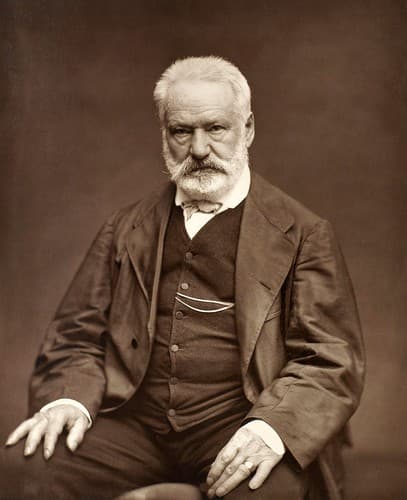
Victor-Marie Hugo was a French Romantic writer and politician. During a literary career that spanned more than sixty years, he wrote in a variety of genres and forms. He is considered to be one of the greatest French writers of all time.







