“He was an alien, a visitor from another planet, but he was also a man, and he knew what it was like to be a man.”
— Describing Newton's dual nature and his understanding of humanity.

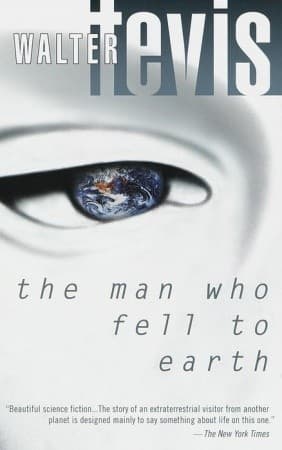
Walter Tevis (1963)
Genre
Fantasy / Science Fiction
Reading Time
210 min
Key Themes
See below
Sign in to track this book
An alien arrives on Earth to save his dying world, but human vices and loneliness trap him, turning his hope into despair.
Thomas Jerome Newton, an alien from Anthea, crash-lands in Kentucky, USA. He looks human, but his eyes are a bit different, and he has no navel. He quickly patents advanced Anthean technology, like self-developing film and a high-efficiency rotary engine, under the name 'World Enterprises.' He wants to get rich to build a spaceship. This ship will take the last survivors of his dying planet to Earth. Newton is very smart but struggles to understand human social customs and emotions. He stays detached, almost childlike, as he navigates his new environment, focused only on saving his people.
Within a few years, Newton's patents make him very wealthy, and World Enterprises becomes a global company. He lives alone in a fancy apartment, with only a few trusted human employees who do not know he is an alien. One day, he meets Mary-Lou, a simple hotel clerk, when he gets sick with a human cold. His alien body is not ready for it. Mary-Lou takes him in and cares for him. While recovering, Newton tells her he is an alien, shows her his unique body, and explains his mission. Mary-Lou is shocked at first but slowly accepts his story, though she finds it hard to understand fully.
With his money secure, Newton starts building his spaceship in a remote desert. He hires Dr. Bryce, a smart but disgraced chemistry professor, to oversee the technical work. He does not tell Bryce the ship's true purpose. Newton's relationship with Mary-Lou gets deeper, but they often misunderstand each other. He finds her human emotions and needs confusing and overwhelming. She struggles with his emotional distance and his constant focus on his mission. He drinks a lot, trying to quiet his inner conflict and his growing feeling of being an outsider, both from his home planet and his adopted world.
Dr. Bryce, initially focused on the spaceship's technical challenges, becomes more curious about Newton's identity and the source of his knowledge. He does his own research, finding problems in Newton's past and noticing his unusual physical traits. Bryce eventually confronts Newton, who, tired of lying and trusting Bryce's scientific honesty, reveals his alien identity and the ship's purpose. Bryce, a scientist, is skeptical at first but Newton's detailed explanations and demonstrations convince him. He becomes a reluctant friend and a more dedicated assistant.
As the spaceship nears completion, Newton's health gets worse. He becomes addicted to alcohol and television, finding comfort in the mindless entertainment and the numbing effects of liquor. His relationship with Mary-Lou becomes more strained, marked by her jealousy and his increasing withdrawal. He shows her pictures of Anthea—a desolate, dying world with three suns and a few gentle inhabitants—hoping she will understand his urgency, but she remains focused on their human life. He records messages for his family on Anthea, expressing his despair and the growing difficulty of his mission, feeling the heavy weight of his responsibility and his deep loneliness.
On the night before the spaceship's launch, government agents, who have been watching Newton's unusual activities and his vast wealth, raid the launch site. They arrest Newton, thinking he is a foreign spy or a dangerous strange person. The spaceship is taken and taken apart. Newton, confused and weakened by his addictions, does not fight back. He undergoes many physical and psychological examinations. During these, his alien body is discovered, though his captors largely misunderstand his true origins and mission. He is held in a secure, isolated facility.
Newton is imprisoned in a sterile, white room, always watched. He undergoes many medical tests, including an eye exam that permanently damages his Anthean eyes, making them sensitive to light and leaving him practically blind without special glasses. The doctors, fascinated by his unique body, continue to examine him, treating him more like a specimen than a thinking being. His contact with the outside world is cut off, and he cannot explain his mission or his trouble. This captivity further breaks his spirit, as his only hope of saving his people is now lost.
After years in prison, Newton is eventually released. He is no longer seen as a threat, perhaps forgotten by those who imprisoned him. He is a shell of his former self, his alien eyes damaged, his spirit crushed, and his addictions worse. He finds Mary-Lou, but their reunion is sad. She has aged and become tough, and their past together is spoiled by his long absence and his failure. He tries to reconnect with her, but the magic and hope of their earlier relationship are gone. He is a man without a purpose, completely lost on a planet that is not his own.
Newton withdraws into a life of isolation and alcoholism. He uses his remaining wealth to live alone, surrounded by only liquor and the constant sound of television. He sometimes tries to write a message to Anthea, his home planet, but his damaged eyes and alcohol-affected mind stop him. He is a ghost, a lost soul, trapped on Earth forever, unable to go home and unable to complete his mission. He becomes a legendary, tragic figure, the 'man who fell to Earth,' a silent reminder of the failure of understanding between species and the destructive power of human society.
The Protagonist
Newton transforms from a hopeful, determined alien into a broken, alcoholic recluse, losing his mission and his identity in the process.
The Supporting
Mary-Lou's initial openness and care for Newton are gradually replaced by confusion, frustration, and ultimately, a resigned acceptance of his broken state.
The Supporting
Bryce evolves from a cynical, disgraced scientist to a man whose worldview is fundamentally altered by his encounter with Newton, becoming a silent observer of his tragic fate.
The Mentioned
Their fate remains unknown, symbolizing the ultimate failure of Newton's mission.
The Antagonist
They successfully neutralize Newton as a perceived threat but inadvertently destroy his ability to save his planet, demonstrating their short-sightedness.
The Mentioned
Their fate remains uncertain, reflecting the tragic failure of Newton's mission.
The main idea of the novel is Newton's deep alienation. Even though he looks human, he is fundamentally different. He cannot connect emotionally with humans like Mary-Lou or fully understand their irrational behaviors. His mission isolates him, and even with people around, he remains an outsider, longing for his home planet. His inability to explain how urgent his situation is makes this worse, leading to a deep, constant loneliness that pushes him to alcohol and despair, as seen in his isolated life after his release.
“He took another drink. What he needed was to be drunk, so that he could escape from the terrible, gnawing loneliness.”
Newton arrives on Earth with a good, selfless mission, but human vices and systems slowly corrupt him. He starts drinking as a way to cope, becoming an alcoholic. His advanced technology is first used for good (funding his mission), but his wealth also attracts unwanted attention. The government's suspicion, imprisonment, and invasive experiments eventually break him, turning a kind alien into a broken, isolated human-like figure. The novel suggests that humanity's fear, greed, and lack of understanding destroy innocence and potential.
“He was the man who fell to Earth. But he was more than that. He was the man who fell to Earth and then became a man.”
Newton's time on Earth is defined by his hope to save his people. He puts all his intelligence and resources into building the spaceship. However, this hope is shown to be very fragile, always threatened by human misunderstanding, his own emotional struggles, and government intervention. His mission's failure, despite his huge efforts, shows that even the best and most urgent projects can be stopped by outside forces and inner weaknesses, leading to a sad feeling of pointlessness.
“The ship was built. The dream was real. And then the dream was gone.”
Newton's journey is one of major identity change. He starts as a pure Anthean, driven only by his species' survival. As he spends more time on Earth, he gradually takes on human traits, both physical (like getting sick) and behavioral (like drinking and watching television). His physical appearance, though initially alien, becomes more 'human' to others. By the end, after his eyes are damaged and his mission is lost, he has become a broken, human-like alcoholic. His alien identity is shattered, and his Anthean purpose is gone. He is no longer truly Anthean, but also not fully human, existing in a sad, in-between state.
“He was losing himself. The Anthean was dying, and in its place, something new, something human, was growing.”
Primarily follows Newton's perspective, but occasionally shifts to others.
The narrative largely maintains a close, first-person limited perspective on Thomas Jerome Newton, allowing readers to experience his internal struggles, his alien logic, and his growing despair. However, Tevis occasionally shifts to the perspective of characters like Mary-Lou or Dr. Bryce, providing external observations of Newton and highlighting the human inability to fully grasp his true nature. This shifting perspective emphasizes Newton's isolation and the communication barrier between him and humanity, while also building suspense around his true identity for the reader.
Represent Newton's escape from reality and his immersion in human culture.
Alcohol and television serve as powerful symbols of Newton's decline and his immersion into human culture. Initially, he views them with alien detachment, but they quickly become his primary coping mechanisms. Alcohol numbs his profound loneliness and the despair of his failing mission, while television provides a constant, mindless distraction from his internal torment. These addictions represent his corruption by human vices and his surrender to a passive, escapist existence, contrasting sharply with his initial driven, purposeful alien nature.
A literal and symbolic vessel of hope and ultimate failure.
The spaceship is the central physical object of Newton's mission, representing his hope for salvation for his people. Its construction is a testament to his genius and determination. Symbolically, it embodies the bridge between two worlds and the potential for interspecies connection and survival. Its eventual confiscation and dismantling by human authorities signify the crushing of that hope, the failure of his mission, and humanity's destructive response to the unknown, leaving Newton and his people without a means of escape.
A physical manifestation of his alien nature and his ultimate vulnerability.
Newton's eyes are a subtle but crucial detail. Initially described as slightly different, they are a physical marker of his alien identity. The damage inflicted upon them during his imprisonment, rendering him effectively blind without special glasses, is deeply symbolic. It represents not only his physical incapacitation but also his loss of vision, both literally and metaphorically. His ability to 'see' his mission through to completion is destroyed, and he is left permanently altered, a visible testament to the trauma he endured on Earth.
“He was an alien, a visitor from another planet, but he was also a man, and he knew what it was like to be a man.”
— Describing Newton's dual nature and his understanding of humanity.
“The greatest tragedy of mankind is that it has not yet learned to live.”
— A philosophical observation from Newton about humanity's condition.
“Loneliness was a cold, hard fact, a thing that could not be denied or escaped.”
— Newton's internal struggle with isolation on Earth.
“He knew that he would never truly be one of them, that he would always be an outsider, a stranger.”
— Newton's realization about his permanent status on Earth.
“Water, he thought, water was the key to everything. Water was life.”
— Newton's initial focus on Earth's resources, particularly water, for his home planet.
“The human race was a strange, complicated thing, full of contradictions and paradoxes.”
— Newton's observations on the complexities of human nature.
“He had come to Earth to save his people, but he had found himself instead.”
— Newton's personal journey and unexpected self-discovery.
“There was a sadness in him, a deep, pervasive melancholy that he could not shake.”
— Reflecting Newton's internal emotional state throughout his time on Earth.
“The television was a window, a strange, flickering window into the human soul.”
— Newton's fascination with and interpretation of television as a medium.
“He had money now, more money than he could ever spend, but it didn't make him happy.”
— Newton's experience with wealth and its inability to bring contentment.
“The air was thick with the smell of gasoline and exhaust fumes, the smell of human civilization.”
— Newton's sensory experience of Earth's urban environment.
“He was a man caught between two worlds, a man who belonged to neither.”
— Summarizing Newton's ultimate predicament and sense of displacement.
“The stars, he thought, the beautiful, distant stars. They were his home.”
— Newton's longing for his true origin and planet.
“Sometimes, he wished he had never come. Sometimes, he wished he could just disappear.”
— Newton's moments of despair and desire to escape his situation.
Ready to see how well you understood this book? Take our interactive quiz with 10 questions.
Biography coming soon.







