“It was impossible, he decided, to be bored while watching a queue.”
— Grant observes the queue at the theatre, setting the scene for the murder.

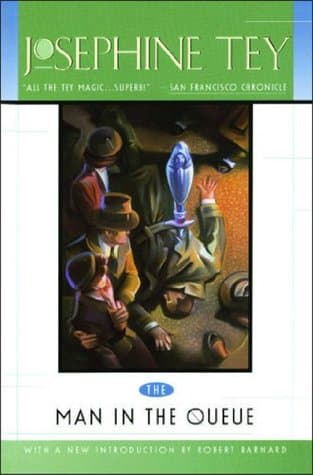
Josephine Tey (1927)
Genre
Historical Fiction / Mystery
Reading Time
255 min
Key Themes
See below
Sign in to track this book
In the bustling queue for London's hottest show, a man drops dead with a silver dagger in his back, leaving Inspector Alan Grant to untangle a seemingly impossible murder witnessed by many but seen by none.
In London, a long queue waits outside the Woffington Theatre for a popular musical comedy. As the doors open and the crowd moves forward, a man named Robert Blair collapses, seemingly having fainted. A fellow queue-member, Mr. William Jenkins, tries to help him, only to find a small silver dagger in Blair's back. The immediate chaos is made worse because, despite the dense crowd, no one saw the stabbing or anyone suspicious flee. Inspector Alan Grant of Scotland Yard is called to the scene, facing a seemingly impossible crime with many potential witnesses who saw nothing.
Inspector Grant begins his investigation, focusing on the murder weapon: a unique silver dagger with a fine design, suggesting it might be an antique or a souvenir. Robert Blair's identity is quickly confirmed by documents on him. Grant learns that Blair was an ordinary civil servant with no clear enemies or criminal ties. His landlady and colleagues offer little information about anyone who might want to harm him. The impossibility of the crime—a murder committed in daylight among a crowd without a single witness—becomes the main challenge for Grant and his team.
Because the dagger is unique, Grant's main inquiry focuses on its origin. He sends his officers to search antique shops, pawn brokers, and prop makers across London. This search eventually leads them to a theatrical prop maker who identifies the dagger as one of a set made for a historical play, 'The Rose and the Ring,' which had recently ended its run. This discovery provides a key link, suggesting the killer might have theatre connections or access to such props, narrowing the large group of potential suspects.
Further investigation into the prop daggers shows that one was owned by an actor named Mr. Gilbert, who had a major role in 'The Rose and the Ring.' Inspector Grant interviews Gilbert, who confirms he had such a dagger for his stage performance. However, Gilbert has a solid alibi for the time of the murder, having been at a rehearsal across town. He also explains that his dagger was stolen from his dressing room several weeks prior, a theft he had not reported, thinking it a minor loss. This revelation complicates the case, indicating the killer likely got the weapon by theft.
While pursuing the dagger's origin, Grant's team continues to investigate Robert Blair's personal life. They find that despite his ordinary life, Blair had been secretly seeing a woman named Christine Clay, a chorus girl from the Woffington Theatre. This secret relationship introduces a potential motive that was previously missing. Grant learns that Blair and Christine had recently argued, hinting at trouble in their affair. This development shifts the investigation's focus toward the theatre's staff and Christine's acquaintances, opening a new line for suspects.
As Inspector Grant prepares to question Christine Clay more thoroughly about her relationship with Robert Blair and their recent argument, she mysteriously disappears. Her sudden disappearance immediately makes her a suspect, suggesting she might be the killer or deeply involved. Grant uses his resources to find her, believing she has important information. Her absence creates speculation among the theatre community and the press, adding pressure to Grant's investigation and creating a public perception that the 'chorus girl' is the main suspect, despite the lack of direct evidence.
Grant's persistent inquiries eventually reveal that Christine Clay bought a train ticket and left London shortly after Blair's murder. He carefully traces her movements, following a trail that suggests she was trying to avoid detection. This discovery confirms his suspicion that she is either the killer or is hiding something important. The pursuit now extends beyond London, requiring Grant to work with police forces in other areas, intensifying the search for the missing chorus girl and the truth behind Blair's death.
With Christine Clay now a fugitive, Grant considers the possibility that someone else, perhaps a jealous lover or a disgruntled ex-partner, might have killed Robert Blair out of jealousy over his relationship with Christine. He interviews other members of the Woffington Theatre company, especially those known to have romantic interests in Christine. This inquiry introduces several new potential suspects, none of whom have strong alibis or clear motives, complicating the already intricate case and making Grant consider the complex relationships within the theatre world.
After a relentless search, Christine Clay is finally found and brought in for questioning. During a tense interrogation with Inspector Grant, she strongly denies killing Robert Blair. She admits to their secret affair and their recent argument, but insists she had no part in his death. Under Grant's careful questioning, Christine eventually reveals a key detail: she saw a distinctive red scarf worn by a man near Blair in the queue just before the collapse. This detail, previously overlooked, gives Grant a new, tangible lead and shifts the focus away from Christine as the main suspect.
With Christine's description of the red scarf, Inspector Grant re-examines witness statements and the theatre queue. He focuses on individuals standing near Blair, especially those who might have worn such an item. His investigation leads him to an ordinary man, Mr. William Jenkins, the same man who first tried to help Blair. Through careful reconstruction and psychological insight, Grant deduces that Jenkins, driven by a personal grievance against Blair, used the crowd's surge as cover. He timed the stabbing precisely, using the chaotic movement to prevent anyone from seeing his hand, then quickly disposed of the dagger, blending back into the crowd, appearing to be merely another concerned bystander. Jenkins held a long-standing grudge against Blair for a perceived wrong or betrayal, which he finally acted upon.
The Protagonist
Grant's journey is less about personal transformation and more about demonstrating his exceptional deductive reasoning as he unravels an increasingly complex and improbable murder.
The Victim
Blair's character is revealed posthumously, transforming from an unknown victim to a man with a secret life, whose actions ultimately led to his demise.
The Supporting
Christine moves from being a primary suspect to a vital witness, revealing her innocence and providing the key clue to the true killer.
The Antagonist
Jenkins's arc is one of dramatic revelation, transforming from an innocent bystander to the calculated murderer, exposing the hidden depths of human resentment.
The Supporting
Gilbert's role is primarily to provide exposition regarding the murder weapon's history, without undergoing significant personal development.
The Supporting
Kent's character remains largely static, serving as a pillar of authority and a sounding board for Grant's theories.
The Supporting
Williams's character primarily serves to aid Grant's investigation and provide a sense of the police procedural elements.
This theme is central to the mystery, as a murder happens in daylight with many witnesses, yet no one sees anything. The novel explores how easily human perception can be misled, especially when people focus on their own goals (like getting into a theatre) or do not expect anything unusual. The 'man in the queue' scenario highlights the unreliability of eyewitness testimony and the difficulty of finding truth from many flawed perspectives. Grant must assemble fragments of observation and deduction to recreate an event that, by all accounts, should have been impossible to miss. Christine Clay's seemingly minor observation of a red scarf becomes the crucial detail that solves the 'unseen' murder.
“''How can a man be killed in a crowd like that and no one see it? It's impossible!''”
The novel explores the idea that individuals often lead lives more complex and secretive than they show. Robert Blair, the victim, initially appears to be a mundane civil servant, but Grant uncovers his secret affair with Christine Clay, revealing a hidden romantic life. Similarly, the killer, Mr. Jenkins, is an unassuming man whose polite exterior hides a deep-seated grievance and a capacity for murder. The Woffington Theatre itself, with its glamorous facade, conceals personal dramas, jealousies, and secret relationships among its performers. This theme shows that appearances can be deceptive, and true motives and identities often lie beneath conventional layers.
“''Every man has a secret life, Inspector. Some just keep it better hidden than others.''”
The motive behind Robert Blair's murder is a long-held personal grievance, highlighting retribution and the individual's pursuit of their own justice. Mr. Jenkins's act is not driven by immediate passion but by a calculated desire to avenge a past wrong. The novel questions the effectiveness of societal justice when personal resentments simmer and lead to violence. Grant's role is to apply the formal justice system, but the crime's underlying motivation speaks to a more primal sense of righting a wrong, albeit through a terrible act. This theme explores the dark side of human nature when perceived injustices are allowed to fester.
“''He'd done me wrong, Inspector. A wrong that needed righting. And no one else would do it.''”
Inspector Grant's character embodies the theme of meticulous deduction and keen observation over brute force or obvious clues. Faced with a crime where conventional evidence is almost nonexistent, Grant relies on his ability to observe human behavior, piece together fragmented accounts, and infer motives from subtle details. His success depends on his ability to think creatively, consider the crime's psychological aspects, and reconstruct the 'how' without an initial clear 'who' or 'why.' The novel celebrates the intellectual rigor needed to solve seemingly impossible puzzles, proving that careful thought can overcome even the most cunningly hidden crimes.
“''The facts are always there, Sergeant. It's merely a matter of seeing them in the right order.''”
A murder committed in plain sight with no witnesses.
This is the central conceit of the novel. The murder of Robert Blair occurs in a dense queue of people outside a theatre, yet not a single person claims to have seen the stabbing or the killer. This device creates immediate intrigue and challenges the detective's abilities, making the solution seem almost supernatural until Grant meticulously reconstructs the killer's method. It relies on the psychological effect of crowds and the limitations of human observation, setting up a seemingly unsolvable puzzle that drives the entire narrative.
Christine Clay's disappearance misdirects the investigation.
The sudden vanishing of Christine Clay, Robert Blair's secret lover, serves as a significant red herring. Her flight from London immediately makes her the prime suspect, diverting Inspector Grant's attention and resources for a considerable portion of the investigation. This device plays on common crime novel tropes (the 'jealous lover' or 'guilty flight') to mislead both the characters and the reader, building suspense and delaying the discovery of the true killer until Christine is cleared and provides the crucial, overlooked detail.
A distinctive silver dagger with theatrical origins.
The murder weapon, a unique silver dagger, is not just a tool but a key plot device. Its distinctive appearance allows Inspector Grant to trace its origin to a theatrical prop maker and then to a specific play and actor. This provides a crucial initial lead when other clues are scarce. The fact that it was stolen further complicates the trail but ultimately narrows the pool of suspects, connecting the crime to a specific subculture (theatre) and providing a tangible link in an otherwise 'unseen' murder.
Multiple witnesses offer contradictory or incomplete accounts.
Despite the abundance of people present at the murder, their collective testimony is largely unreliable. Many witnesses provide vague descriptions, focus on irrelevant details, or simply saw nothing due to the crowd and the speed of the crime. This device emphasizes the subjective nature of perception and the difficulty of gathering accurate information from a chaotic event. Grant must sift through these unreliable accounts, finding the tiny kernels of truth (like Christine's observation of the red scarf) that ultimately lead to the killer, demonstrating the challenge of human memory and observation under stress.
“It was impossible, he decided, to be bored while watching a queue.”
— Grant observes the queue at the theatre, setting the scene for the murder.
“The great thing about murder was its suddenness. It left no time for argument or appeal.”
— Grant's internal reflection on the nature of murder, early in the investigation.
“The English, he thought, were a race of people who loved to queue. It was in their blood.”
— Grant's musings on British national character while investigating.
“One could not, after all, argue with a dead man.”
— Grant considering the limitations of evidence and witness testimony.
“Facts, like water, always found their own level in the end.”
— Grant's belief in the eventual surfacing of truth during the investigation.
“There was a curious intimacy in a queue, a shared anonymity.”
— Grant reflecting on the social dynamics of the queue where the murder occurred.
“The human mind was an intricate and often illogical machine.”
— Grant pondering the motivations and testimonies of various witnesses.
“It was not the spectacular lies that trapped you, but the small, quiet, persistent ones.”
— Grant's thoughts on the deceptive nature of seemingly minor details.
“London had a way of absorbing its secrets, of holding them close.”
— Grant's sense of the city's vastness and its capacity to hide truths.
“He often wondered if people truly saw what was in front of them, or merely what they expected to see.”
— Grant's contemplation on perception and eyewitness reliability.
“Justice, he thought, was a slow and often circuitous route, but it usually arrived eventually.”
— Grant's enduring faith in the legal process, despite its complexities.
“The past, like a shadow, followed one, no matter how fast one ran.”
— Grant's realization of the inescapable influence of past events on the present.
“There was a vast difference between knowing something and proving it.”
— Grant grappling with the challenges of gathering concrete evidence for a conviction.
“The theatre, even when empty, held the echoes of a thousand emotions.”
— Grant's atmospheric observation of the theatre, a key location in the plot.
Ready to see how well you understood this book? Take our interactive quiz with 10 questions.

Biography coming soon.