“We are all prisoners of our own making, but some of us have the keys and just don't know it.”
— Charles reflects on his life and the choices that led him to his current situation.

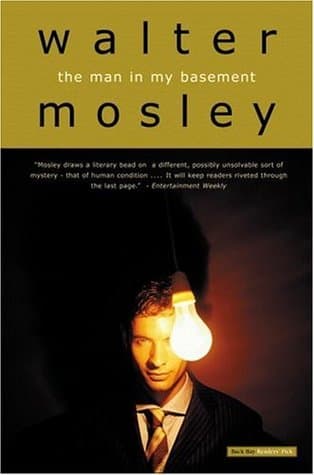
Walter Mosley (2004)
Genre
Literary Fiction / Thriller / Mystery
Reading Time
270 min
Key Themes
See below
Sign in to track this book
A desperate young Black man, trying to save his family home, agrees to imprison a mysterious white man in his basement, leading to a dangerous journey of hidden identities, racial tensions, and moral choices that threaten his family's legacy and his own sense of self.
Charles Blakey, a young Black man in Lyme, New York, is close to losing his family home because of debts and overdue property taxes. His grandmother and sister, his only remaining family, have moved, leaving him alone in the house that has been in his family for generations. One day, a wealthy, mysterious white man named Anniston Spades comes to Charles's door. He offers an unusual deal: he will pay Charles $50,000 to rent his basement for one year, with a chance to renew, and an extra $1,000 each month for 'access.' Charles, desperate and seeing no other way to save his home, agrees, even though the request is unsettling. Spades insists on strict rules, including that no one else know he is there and that Charles be the only one to talk to him.
After taking the first payment, Charles starts to prepare his basement. Spades gives specific instructions for changes, including strengthening the door, installing a heavy lock, and setting up a cot and basic items. During this, Spades reveals his real plan: he wants Charles to imprison him in the basement. He explains he wants to be confined, a self-punishment for past wrongs, though he does not give details. Charles is shocked and unsure at first, but the large sum of money and his bad financial situation convince him. He locks Spades in, becoming his unwilling jailer, and starts to deal with the moral parts of his agreement.
A routine quickly starts. Charles brings Spades food and water daily, and during these times, they begin to talk. Spades, though confined, is clear, smart, and often philosophical. He talks about history, morality, justice, and human nature, often questioning Charles's ideas. He tells Charles exactly what to say if anyone asks about him, making up a story about a distant relative. Charles, still uneasy, finds himself drawn into these talks. They offer a strange intellectual stimulation and a way to forget his own problems. The money from Spades allows Charles to pay his debts and start repairs on his old house, giving a clear benefit to his morally unclear arrangement.
Anniston Spades, a wealthy and important man, does not disappear unnoticed. Detective Kincaid, a local police officer, starts looking for him. Kincaid, at first suspicious of Charles because he is Black and suddenly has more money, starts to visit Charles's neighborhood, asking quiet questions and watching him. Charles becomes more and more paranoid, always worried Kincaid will find Spades in his basement. He carefully follows Spades's rules for secrecy, making up alibis and avoiding anything that might attract more attention. The pressure from Kincaid makes Charles's inner conflict and the moral weight of his secret worse.
Through their talks, Spades slowly reveals parts of his past. He talks about a long life with power, wealth, and many moral failures. He hints at having used others, especially Black people, to get his money. He also suggests a deep personal tragedy involving a woman he loved and lost because of his own actions. He says he has 'done terrible things' and believes his self-imprisonment is a needed act of punishment, a way to face his conscience. Charles starts to see a man weighed down by great guilt, whose wish for confinement comes from a deep need for atonement, not a fear of outside punishment.
Mrs. Spades, Anniston's elegant and determined wife, eventually comes to Charles's house. Kincaid told her Charles was the last person to see her husband. She asks Charles about Anniston's disappearance, her worry mixed with a clear sense of tiredness and perhaps a deeper understanding of her husband's strange ways. Charles, using Spades's made-up story, says he knows nothing and that Spades just left after a short visit. Mrs. Spades is not fully convinced, but she leaves. Her visit leaves Charles shaken and makes his already difficult situation even more complicated, showing the real effects of his secret.
As months pass, Charles gets more involved in Spades's psychological world. He starts to question Spades's true reasons for atonement. Is it real penance, or is it a trick? Is Charles involved in a type of torture, or is he just helping a man's unique way of self-reckoning? The money has clearly made his life better, but the moral cost bothers him. He debates with Spades about justice, freedom, and responsibility, finding his own views challenged and expanded. Charles realizes he is not just a jailer, but an active part of Spades's deep, and perhaps strange, experiment in self-punishment.
After almost a year of confinement and deep discussions, Anniston Spades makes a shocking request: he asks Charles to kill him. Spades explains that his punishment is done, and that death, by Charles's hand, would be the final act of justice and release. He sees it as the last, needed step in making up for his lifetime of wrongs. This request sends Charles into an even deeper moral problem. He is horrified by the idea, yet Spades presents his argument with chilling logic, saying that Charles, as the keeper of his conscience, is the most fitting person to give this final judgment. The request challenges Charles's understanding of right and wrong, and his part in Spades's self-destruction.
Charles cannot kill Spades. Despite Spades's constant arguments and his own complex feelings, Charles cannot commit murder, even when asked by the victim. He sets his own moral limits, refusing to be a tool for Spades's final atonement. This refusal is a turning point for Charles; he takes back control and shows his own moral code. Spades, disappointed but seeming to understand, accepts Charles's decision. Rejecting Spades's final request makes Charles face his own involvement and the limits of his moral duties, strengthening his identity apart from Spades's influence.
As the agreed year of confinement ends, Anniston Spades gets ready to leave. He thanks Charles, recognizing the great effect their unique arrangement had on him. Spades leaves Charles with a final, large sum of money, making sure Charles is financially secure and his family home is saved. With Spades gone, Charles is left alone in his house, which is now fully repaired and safe. He saved his home, but the experience changed him forever. The talks, the moral problems, and the burden of his secret have changed him, giving him a deeper understanding of himself, justice, and the complexities of human nature.
The Protagonist
From a desperate, passive individual, Charles transforms into a morally discerning and self-assured man who reclaims his agency.
The Antagonist/Catalyst
Spades seeks a unique form of atonement through self-imprisonment, culminating in a request for death as the final act of penance.
The Supporting
Kincaid's investigation provides external pressure on Charles, driving the plot's tension.
The Supporting
She actively seeks her husband, representing the external world's search for Anniston Spades.
The Mentioned
Not present in the narrative, but her absence emphasizes Charles's isolation.
The Mentioned
Not present in the narrative, but her influence shapes Charles's values and connection to his home.
The novel looks at the nature of justice, both for society and for individuals, and the idea of atonement. Anniston Spades believes his self-imprisonment is a necessary punishment for a lifetime of moral wrongs, especially his use of Black people. He seeks a self-imposed justice, outside the legal system. Charles, as his jailer, must deal with what true justice means and if Spades's suffering truly makes up for his past. The end, with Spades's request for death, pushes this theme, asking if death can be a final act of penance or just an escape.
““I have done terrible things, Charles. Things that demand a reckoning.””
Charles Blakey's agreement to imprison Spades puts him in a difficult moral situation. He takes money to help a man punish himself, becoming involved in an act that blurs the lines between imprisonment, therapy, and a shared delusion. The novel makes the reader, along with Charles, question the morality of his actions: is he just a businessman, a jailer, or part of something much more ethically complex? The talks between Charles and Spades constantly challenge Charles's own moral views, making him define his limits and finally show his own ethical independence by refusing Spades's final request.
““You’re a good man, Charles. But even good men can be corrupted by circumstance, can’t they?””
Charles Blakey's journey is one of self-discovery. At first, he is lost, defined by his money problems and the burden of his family home. His unique relationship with Anniston Spades forces him into a role he never imagined, making him face his values, intelligence, and strength. Through the debates and ethical challenges, Charles changes from a desperate young man into a more self-aware, morally firm person. He learns to assert his own identity and moral control, separate from Spades's strong influence, finally saving his home and, more importantly, himself.
““I was no longer just Charles Blakey, a man about to lose his home. I was Charles Blakey, the keeper of a man’s conscience.””
The racial dynamic between Charles, a financially struggling Black man, and Anniston Spades, a wealthy white man with a history of exploitation, is key to the novel. Spades's past wrongs involved using Black people, and his choice of Charles as his jailer adds a complex layer to their power dynamic. While Spades is physically confined, he has intellectual and financial power over Charles. The novel subtly explores historical injustices and how they appear in modern relationships, even in unusual situations. Charles's final refusal of Spades's last demand can be seen as an assertion of control against a historically oppressive power structure.
““My wealth, Charles, was built on the backs of men like you, though not always in such direct ways.””
A physical and symbolic space for confinement and introspection.
The basement serves as the central physical setting for Anniston Spades's self-imprisonment. More than just a room, it becomes a symbolic space representing confinement, penance, and the hidden depths of the human psyche. For Spades, it is his purgatory; for Charles, it is a source of both financial salvation and profound moral burden. The enclosed, isolated nature of the basement facilitates the intense, philosophical dialogues between the two men, allowing for deep introspection and the exploration of complex ethical questions without external distractions. It isolates them from the outside world, creating a unique, self-contained moral laboratory.
The primary means of character development and thematic exploration.
The conversations between Charles and Anniston Spades are not just casual chats; they are extended philosophical debates that drive the narrative and explore the novel's core themes. Spades, with his vast knowledge and guilt-ridden intellect, challenges Charles's worldview on justice, morality, freedom, and human nature. These dialogues are the primary mechanism through which Spades's past is revealed and Charles's character develops, as he is forced to engage intellectually and ethically. They transform the simple premise of 'man in the basement' into a profound exploration of complex ideas, making the reader a silent participant in their intellectual sparring.
The inciting incident and driving force of the plot, creating a moral dilemma.
The initial agreement between Charles and Anniston Spades – $50,000 for basement rental and $1,000 monthly for 'access' – is the central plot device that sets the entire story in motion. It's a Faustian bargain, offering Charles financial salvation at a significant moral cost. This unconventional contract is not merely transactional; it creates a unique power dynamic and a profound ethical dilemma that Charles must navigate. The terms of the bargain dictate the relationship between the two men and force Charles into a position where he must constantly weigh financial gain against his conscience, driving much of the internal conflict and plot progression.
A symbol of Charles's heritage, responsibility, and the stakes of his actions.
Charles's family home is more than just a house; it is a powerful symbol of his heritage, his connection to his ancestors, and the responsibility he feels to preserve his family's legacy. Its impending foreclosure is the catalyst that forces Charles to accept Spades's unusual offer. The house represents his roots, his identity, and the tangible stakes of his moral compromises. Saving the home becomes intertwined with Charles's journey of self-discovery and his assertion of moral agency, transforming it from a mere dwelling into a representation of his enduring spirit and the value of his history.
“We are all prisoners of our own making, but some of us have the keys and just don't know it.”
— Charles reflects on his life and the choices that led him to his current situation.
“The past is a ghost that haunts the present, and the future is a shadow we can never quite catch.”
— Charles contemplates the nature of time and memory.
“Sometimes the most dangerous thing in the world is a man with nothing left to lose.”
— Charles considers his own desperation and that of Anniston Bennet.
“We build our own cages, then wonder why we can't fly.”
— Charles muses on self-imposed limitations.
“The truth is a mirror, and sometimes we don't like what we see.”
— Charles confronts uncomfortable truths about himself.
“Fear is a prison without walls, and we are all its inmates.”
— Charles reflects on the pervasive nature of fear in his life.
“We are all stories in the end, and some stories are written in blood.”
— Charles considers the legacy of violence and history.
“The line between good and evil is drawn in sand, and the tide is always coming in.”
— Charles grapples with moral ambiguity.
“Memory is a thief that steals the present to pay for the past.”
— Charles reflects on how his memories affect his current life.
“We are all actors on a stage, but some of us have forgotten our lines.”
— Charles feels lost and uncertain about his role in life.
“The heart is a dark forest, and we are all lost in its shadows.”
— Charles explores his own emotions and inner turmoil.
“Sometimes the only way to find yourself is to lose everything else.”
— Charles considers the transformative power of loss.
“We are all broken in some way, but it's the cracks that let the light in.”
— Charles finds a moment of hope amidst his struggles.
“The world is a mirror, and it shows us what we choose to see.”
— Charles reflects on perception and reality.
Ready to see how well you understood this book? Take our interactive quiz with 10 questions.

Biography coming soon.







