“Everyone has a first song. A song that makes them remember a moment, a person, a place, a feeling. A song that will always be theirs.”
— Frankie's music teacher, the Maestro, explains the significance of music.

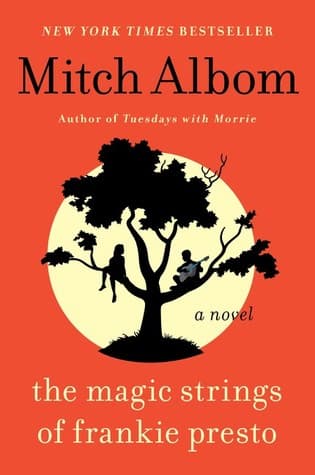
Mitch Albom (2015)
Genre
Fantasy / Historical Fiction
Reading Time
10-12 hours
Key Themes
See below
Sign in to track this book
Frankie Presto's six magical guitar strings, from a burning Spanish church to American music, don't just play melodies; they weave through decades, altering the destinies of legends and ordinary people.
The story begins with the Spirit of Music telling about Frankie Presto's life and death. Frankie is born in 1936 during the Spanish Civil War, in a burning church in Villareal. His mother, Aurora, dies giving birth. A blind guitar teacher, El Maestro, finds the baby unharmed among the ruins. El Maestro raises Frankie, teaching him music. Frankie quickly shows an extraordinary talent for guitar, with a natural connection to its strings and melodies. El Maestro teaches him not just technique, but that music is a gift, a language, and a responsibility. Frankie's early life is filled with El Maestro's warmth and constant music, which becomes his whole world.
As the Spanish Civil War worsens, Villareal becomes dangerous. El Maestro decides he cannot protect Frankie and makes the hard choice to send him to America. He gives Frankie his most prized possession: an old guitar with six unique, blue strings, explaining they can change lives, for good or bad. Nine-year-old Frankie, holding his guitar, is smuggled onto a ship to the United States, hidden in the cargo hold. The journey is dangerous and lonely, a sharp change from his sheltered childhood. He arrives in New York City as an orphan and refugee, with only his musical gift and the mysterious strings, facing an unknown future in a new land.
Arriving in New York City, Frankie is alone and has no resources. He learns to survive on the streets, playing his guitar for money in subway stations and parks. His talent, even when he is young, draws attention. He meets various people, some kind, some not. A jazz musician recognizes Frankie's raw talent and gives him a look into the lively American music scene. Frankie's music becomes his only way to communicate and a shield against his new life's harshness. He starts to see the deep effect his playing has on people, watching how the blue strings can bring out strong emotions and even change situations.
While playing guitar in a New York City club, young Frankie Presto is discovered by Duke Ellington. Ellington is captivated by Frankie's unique style and the almost otherworldly quality of his music. He takes Frankie under his wing, giving him chances to perform and learn from great musicians of the time. This period changes Frankie, exposing him to different genres and improving his skill. He starts to meet other famous musicians, subtly influencing their work and lives with his magical strings. Ellington becomes a mentor, guiding Frankie through the music world and helping him understand the responsibility that comes with his gift.
Frankie Presto's fame grows quickly. He becomes a celebrated solo artist, captivating audiences with his soulful voice and guitar playing. His records top the charts, and he becomes a pop star. During this time, he meets and influences many iconic musicians, including Hank Williams and Elvis Presley, with his magical blue strings subtly changing their performances or life paths. But with more fame comes a deeper understanding of the strings' power. Frankie realizes each of the six strings represents a life he will change, and this power is a double-edged sword, capable of both good and unintended harm. He struggles with this responsibility, feeling the weight of the choices his music allows.
Amid his rising fame, Frankie falls deeply in love with a singer named Aurora, who has the same name as his deceased mother. Their romance is passionate, giving Frankie a sense of belonging and happiness he had wanted. Aurora becomes his inspiration and his support. However, Frankie's past and the mysterious power of his strings continue to trouble him. He struggles to balance his personal life with his gift's demands, often feeling like a channel for something bigger than himself. The strings, in their magical way, sometimes interfere with his relationships, causing misunderstandings or forcing hard decisions. His love for Aurora is deep, but the shadow of his unique abilities and the lives he is meant to change hangs over their future.
At the peak of his popularity, Frankie Presto makes a tragic mistake involving one of his magical strings and its effect on Aurora. The details are initially unclear, hinted at by the Spirit of Music. This mistake, along with the pressure of fame and his gift's burden, overwhelms him. Tortured by guilt and a sense of responsibility for the lives he has changed, Frankie suddenly disappears. He leaves behind his fame, fortune, and the woman he loves. His disappearance becomes a great mystery in music history, fueling legends about the guitar hero who simply walked away. His legend, however, only grows in his absence.
For decades after he disappears, Frankie Presto lives a quiet life, trying to escape the spotlight and his magical strings. He travels the world, often using different names, trying to find peace and make up for his past actions. During this time, he continues to play music, but mostly for himself or small, unknown audiences, never seeking fame. He thinks deeply about what El Maestro taught him about the responsibility of talent and music's true purpose. This is a time of deep reflection and healing, as he slowly accepts the power he has and the weight of the six lives he was meant to change. He learns to forgive himself, understanding that even with good intentions, consequences are unavoidable.
Decades after vanishing, an aging Frankie Presto mysteriously reappears, drawn by an unseen force to fulfill his final destiny. The Spirit of Music reveals his reappearance is linked to the last of his six magical strings, meaning one final life he is meant to change. He performs a spectacular, unannounced concert, a culmination of his life's journey and musical wisdom. This performance is not about fame or money, but about completing his purpose. The audience, though at first confused, is mesmerized by the raw emotion and skill of the legendary guitarist. This final concert is a powerful, cathartic experience, for Frankie and for all who see it, as he puts his whole being into the music.
During his final concert, Frankie Presto directs his music toward a specific person in the audience, subtly but deeply changing their life, fulfilling the prophecy of the sixth magical string. This person's story is connected to Frankie's, showing how their paths were always meant to cross. Immediately after this key moment, Frankie Presto dies on stage, surrounded by the music he loved and the audience he had captivated one last time. His death is shown not as an end, but as a transition, a return to the universal harmony from which music comes. The Spirit of Music ends the story, highlighting Frankie's legacy as the greatest guitar player ever, whose music went beyond sound to touch the soul of humanity, leaving a lasting mark on the world.
The Protagonist
Frankie evolves from a gifted but naive child into a world-renowned musician burdened by his power, eventually finding peace and purpose by accepting his unique destiny.
The Narrator/Guiding Presence
The Spirit of Music remains constant, but its narrative deepens its understanding of humanity through Frankie's journey.
The Supporting
El Maestro's arc is largely complete before the main narrative, serving as a foundational influence and moral compass for Frankie.
The Supporting
Aurora experiences the joy and pain of loving a man with an extraordinary gift, ultimately becoming a catalyst for Frankie's self-imposed exile and eventual return.
The Supporting/Mentioned
Ellington's role is primarily as a mentor, his arc being an established legend who recognizes and fosters new talent.
The Mentioned
Williams's arc is external to Frankie's, serving as an example of the widespread, often unseen, effects of Frankie's gift.
The Mentioned
Presley's arc is external, serving as another illustration of Frankie's pervasive musical impact.
This is the main theme, explored through Frankie's magical strings. His musical ability is a gift but also a burden, as each of the six blue strings represents a life he will change. The novel asks if talent is a blessing or a curse, and what it means to have such power. El Maestro teaches Frankie that 'talent is a loan,' stressing the need to use it wisely. Frankie's journey is a struggle to understand and manage this power, leading to triumphs and mistakes, ending in his self-imposed exile and eventual redemption.
“'Talent is a loan. And you must pay it back by making your life about more than just your talent.'”
Music is shown as a living thing that can deeply transform. The Spirit of Music narrates the story, showing how melodies can heal, inspire, destroy, and connect. Frankie's guitar strings literally change lives, showing music's ability to alter destinies, bring out strong emotions, and cross barriers. The novel portrays music as a universal language that speaks to the soul, connecting cultures, generations, and even life and death. It emphasizes that music is not just entertainment but a basic force in human experience.
“'Music, in its purest form, is the sound of the universe. It is the language of God.'”
Frankie's life is full of deep love and loss. Losing his mother and then El Maestro shapes his early life. His passionate love for Aurora brings him great joy but also leads to his biggest mistake and heartbreak. The novel explores how loss can cause growth and reflection. Frankie's decades of solitude are an act of penance and self-healing, leading to his redemption as he accepts his destiny and uses his gift in his final act. His journey suggests that true peace comes from facing one's past and accepting all of human experience.
“'Every loss, every regret, every mistake… they are all notes in the song of your life.'”
A main theme is that all lives are connected, often in unseen ways. Frankie's six magical strings explicitly link him to six people whose lives he will change, but the story also shows how his influence reaches many others, including famous musicians like Duke Ellington and Elvis Presley. The Spirit of Music often highlights the ripple effect of actions and the complex web of relationships that shape human destiny. This theme suggests that no one lives alone and that even small acts or meetings can have far-reaching effects, emphasizing the shared human experience.
“'We are all connected, like notes in a symphony. One wrong note can alter the entire melody.'”
Frankie's guitar strings, each representing a life he will irrevocably change.
These six blue strings are the central magical realism element. They are not merely guitar strings but a tangible manifestation of Frankie's extraordinary gift and destiny. Each string is imbued with the power to profoundly alter the life of an individual, for better or worse. They serve as a constant reminder of the burden and responsibility of Frankie's talent. As the story progresses, the snapping or breakage of a string often signals a pivotal moment or a life-altering event, driving the narrative forward and highlighting the interconnectedness of Frankie's fate with others.
An omniscient, personified narrator that embodies the essence of music.
The Spirit of Music is an effective and unique narrative device. By having Music itself tell Frankie's story, the author imbues the narrative with a poetic, philosophical, and universal quality. This narrator possesses omniscience, able to recount past, present, and future events, and offer profound insights into the nature of art, talent, and humanity. It provides a detached yet deeply empathetic perspective, allowing for a broader commentary on Frankie's life and the world of music, while also maintaining a sense of magical realism throughout the story.
The appearance of real-life historical figures whose lives are touched by Frankie.
The novel cleverly integrates numerous real-life musical legends (e.g., Duke Ellington, Hank Williams, Elvis Presley) into Frankie's fictional journey. These cameos serve to ground the fantastical elements in a recognizable historical context, making Frankie's story feel more authentic and impactful. More importantly, they demonstrate the pervasive influence of Frankie's magical talent, showing how his music subtly but profoundly affected the course of musical history and the lives of iconic artists, even without direct acknowledgment from those figures themselves. This device blurs the line between fiction and reality, enhancing the sense of wonder.
The story is told through a non-chronological sequence, jumping between different periods of Frankie's life.
The Spirit of Music often presents Frankie's life in a non-linear fashion, jumping between his childhood, his rise to fame, his disappearance, and his final days. This narrative structure creates a sense of mystery and suspense, gradually revealing key events and their consequences. It allows the narrator to highlight thematic connections across different time periods and build anticipation for crucial plot points, such as the identities of the six lives changed by the strings. This device mirrors the complex, interwoven nature of music itself, where different melodies and harmonies from various points in time can combine to create a complete composition.
“Everyone has a first song. A song that makes them remember a moment, a person, a place, a feeling. A song that will always be theirs.”
— Frankie's music teacher, the Maestro, explains the significance of music.
“How do you know when love is real? You don't. You just hope. And you jump.”
— Frankie reflects on his relationship with Aurora.
“The problem with being a genius is that you don't always know it. You just do things. And then people watch you do things, and they call you a genius.”
— Frankie's perspective on his own extraordinary talent.
“A life is not a series of events, but a series of choices.”
— Death, the narrator, offers a philosophical observation.
“Every song is a journey. A melody that takes you somewhere, even if you’ve never been there before.”
— Frankie describes the power and escapism of music.
“What is a soul if not a string of notes, a melody that plays inside you?”
— Death ponders the essence of a human being in musical terms.
“When you are young, you think your life will go on forever. Then you get older, and you realize it's just a blink.”
— Frankie reflects on the passage of time.
“Music is what saves us from ourselves.”
— Frankie's deep belief in the redemptive power of music.
“Sometimes, the greatest gift you can give someone is to let them go.”
— A hard lesson learned about love and sacrifice.
“He played for the world, but he only ever wanted to play for one.”
— A poignant summary of Frankie's musical motivation.
“The greatest songs are not about what you remember, but what you feel.”
— Frankie's philosophy on the emotional core of music.
“We are all born with a little bit of magic inside us. It’s what we do with it that counts.”
— A general observation about human potential and purpose.
“He didn't just play the guitar; he spoke through it.”
— A description of Frankie's unique and expressive playing style.
“Every time you play, you leave a piece of yourself behind.”
— The Maestro's teaching about the artist's connection to their work.
Ready to see how well you understood this book? Take our interactive quiz with 10 questions.

Biography coming soon.







