“And he took the head, and carried it with him, and his companions with him, and went thence toward Harlech, and a goodly company they were.”
— Bran's head is carried by the survivors after a great battle.

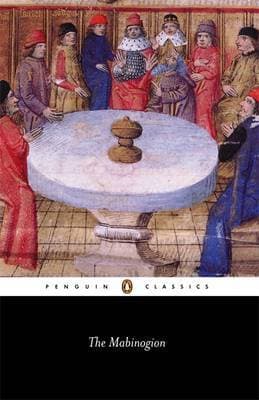
Anonymous (2018)
Genre
Fantasy / Historical Fiction
Reading Time
360 min
Key Themes
See below
Sign in to track this book
Explore ancient Wales, where mythical heroes, enchanted creatures, and otherworldly encounters tell a story of pre-Christian Celtic lore and medieval chivalry, echoing from forgotten ages into today.
Pwyll, Prince of Dyfed, while hunting, lets his hounds attack a stag already brought down by the hounds of Arawn, King of Annwn (the Otherworld). To make up for this, Arawn suggests Pwyll take his place for a year and a day. Pwyll, disguised as Arawn, rules Annwn and defeats Arawn's enemy, Hafgan, by striking him only once as told. During this time, Pwyll sleeps next to Arawn's beautiful wife without touching her, showing great self-control. After the year, Pwyll and Arawn return to their own forms and kingdoms, having become strong friends. Pwyll earns the name 'Pwyll Head of Annwn' for his honorable actions.
After his return, Pwyll meets Rhiannon, a beautiful and mysterious woman riding a horse no one can catch. He learns she is escaping a forced marriage to Gwawl ap Clud. Pwyll and Rhiannon plan: Pwyll, disguised as a beggar, asks Gwawl for a favor at their wedding feast, which is to fill a magical bag with food. Gwawl agrees, but the bag can never be filled. Pwyll then tricks Gwawl into the bag, and his men beat Gwawl, forcing him to give up Rhiannon and his treasures. Pwyll and Rhiannon marry and rule Dyfed, but their happiness does not last.
Rhiannon gives birth to a son, Pryderi, but the baby vanishes on his birth night. Rhiannon's ladies-in-waiting, fearing punishment, smear dog's blood on her and accuse her of killing and eating her child. As punishment, Rhiannon must sit by the horse-block at the court gate for seven years, offering to carry guests on her back. Meanwhile, Teyrnon Twrf Liant, a lord, finds a foaled colt and a baby boy near his stables, both appearing on May Eve for seven years. He raises the boy, who grows very fast. The boy eventually recognizes Pwyll's horses and reveals his true identity, reuniting with his parents and clearing Rhiannon's name.
Matholwch, King of Ireland, comes to ask for the hand of Branwen, sister of Bendigeidfran, King of Britain. The marriage is agreed, but Branwen's half-brother, Efnisien, is angry his consent was not sought. In a fit of rage, he harms Matholwch's horses. To calm Matholwch, Bendigeidfran gives him new horses and a magical cauldron of rebirth. Despite this, Matholwch treats Branwen badly in Ireland, making her work in the kitchen. She sends a starling with a message to Bendigeidfran, who then gathers a huge army to rescue her, starting a terrible war.
Bendigeidfran, so large he forms a bridge across the sea, invades Ireland. Matholwch tries to make peace, offering to build a house big enough for Bendigeidfran, but Efnisien, still evil, throws Irish warriors into the magical cauldron of rebirth, which brings them back to life, though without speech. Efnisien, seeing the endless cycle of death, sacrifices himself by hiding among the Irish bodies and breaking the cauldron from inside, dying in the process. The war continues, destroying both armies, with only seven British survivors, including Pryderi and Manawydan, and Branwen herself, who dies of a broken heart after seeing the destruction.
After the tragic war, the seven survivors, carrying Bendigeidfran's head, return to Britain. After a long journey and a period of feasting, they bury the head in London. Manawydan, brother of Bendigeidfran, and Pryderi, son of Pwyll and Rhiannon, decide to return to Dyfed with Rhiannon and Pryderi's wife, Cigfa. Upon their arrival, they find Dyfed completely empty, without people, animals, or even their homes. A thick mist falls, and when it lifts, the land is strangely silent and empty, under a powerful spell, leaving the four of them alone in the desolate kingdom.
Manawydan, Pryderi, Rhiannon, and Cigfa try to make a living by various trades, but each time their efforts are mysteriously ruined. Eventually, Pryderi is trapped by a golden bowl in an enchanted castle, and Rhiannon tries to rescue him, only to become trapped herself. Manawydan and Cigfa are left alone. Manawydan starts farming, and when his wheat fields are repeatedly plundered by mice, he catches three, planning to hang them. A scholar, a priest, and finally a bishop intervene, begging for the mice's release. The bishop reveals himself as Llwyd ap Cil Coed, who enchanted Dyfed in revenge for Gwawl ap Clud's humiliation by Pwyll. Manawydan agrees to release the mice in exchange for Pryderi and Rhiannon's return and the lifting of the enchantment from Dyfed.
Math, son of Mathonwy, King of Gwynedd, must always have his feet held by a virgin, unless he is at war. Gilfaethwy, Math's nephew, loves Goewin, Math's current foot-holder. Gwydion, Gilfaethwy's brother, starts a war with Pryderi of Dyfed to free Math from his requirement, allowing Gilfaethwy to rape Goewin. After the war, Math finds out about the trick and punishes Gwydion and Gilfaethwy by changing them into various pairs of animals for three years, forcing them to have offspring in each form. Goewin then marries Math, but Math still needs a new virgin foot-holder.
Math needs a new virgin foot-holder, but the only suitable woman left is Arianrhod, Gwydion's sister. When she steps over Math's magic wand to prove her virginity, she instantly gives birth to a fully formed boy and a small, unformed being. The boy, later named Lleu Llaw Gyffes by Gwydion, is raised by his uncle. Arianrhod, shamed, places three geasa (taboos) on Lleu: he will never have a name unless she gives it, never carry weapons unless she equips him, and never have a human wife. Gwydion, through cleverness and magic, overcomes the first two geasa. To overcome the third, Math and Gwydion conjure a wife for Lleu from oak blossom, broom, and meadowsweet, naming her Blodeuwedd.
Lleu Llaw Gyffes and Blodeuwedd live happily for a time, but Blodeuwedd falls in love with Gronw Pebr, Lord of Penllyn. She plans with Gronw to find out the impossibly specific ways Lleu can be killed: he must stand with one foot on a bath and one on a goat, under a thatched roof, and be struck by a spear made only during church service over a year. Blodeuwedd tricks Lleu into showing this position, and Gronw strikes him. Lleu turns into an eagle and flies away, badly wounded. Gwydion, upset, searches for him.
Gwydion follows the eagle, eventually finding Lleu in a decaying state. Through magic and a healing chant, Gwydion changes Lleu back into human form and slowly restores his health. Gwydion then seeks revenge. He finds Blodeuwedd and her maidens fleeing. As punishment for her betrayal, Gwydion turns Blodeuwedd into an owl, forever to be hated by other birds and only to fly at night. Gwydion then faces Gronw Pebr, demanding a return blow for Lleu's injury. Gronw is allowed to place a stone between himself and the spear, but Gwydion's magically strengthened spear pierces the stone and Gronw, completing the revenge and restoring balance.
The Protagonist
Pwyll transforms from an impetuous hunter to a wise and respected ruler, known for his integrity and resilience in the face of adversity.
The Protagonist/Supporting
Rhiannon endures unjust suffering and public humiliation, ultimately being vindicated and restored to her rightful place, demonstrating unwavering strength.
The Supporting/Protagonist
Pryderi grows from a lost child to a valiant warrior and king, repeatedly facing and overcoming magical adversity.
The Protagonist
Bendigeidfran sacrifices himself to avenge his sister, becoming a symbolic protector even after death.
The Protagonist
Manawydan transitions from a supportive royal sibling to a sagacious figure who restores order through cunning and patience.
The Antagonist/Supporting
Efnisien's destructive path culminates in a final, self-sacrificial act that, while still violent, serves to end a greater war.
The Supporting
Math's role is largely static as a powerful, wise, and just, albeit magically constrained, ruler.
The Protagonist/Antagonist
Gwydion evolves from a manipulative schemer to a devoted guardian and avenger, demonstrating both selfish ambition and profound loyalty.
The Protagonist
Lleu is born under unusual circumstances, overcomes magical curses to gain status, is betrayed, and is ultimately restored to power.
The Antagonist
Blodeuwedd transforms from an innocent, magically created wife into a treacherous betrayer, and finally into an owl as punishment.
The Mabinogion consistently blurs the lines between the mortal world and Annwn (the Otherworld). Characters like Pwyll directly interact with Otherworld kings and their realms, experiencing magical consequences and forming lasting bonds. The enchantment of Dyfed by Llwyd ap Cil Coed, an Otherworld figure, shows how human fates are tied to the actions of supernatural beings. Even the landscape has magic, reflecting the Celtic belief in a spiritual dimension mixed with the physical. This theme is key to understanding the characters' motivations and challenges.
“And he saw a rider coming after him, upon a big pale horse, and a hunting-dress upon him of a greyish-brown colour, and a horn about his neck, and a leash of hounds after him.”
Justice and retribution run strongly through the tales. Pwyll's initial offense against Arawn leads to a year of punishment, while Rhiannon suffers years of false accusation before she is cleared. The brutal war with Ireland is a direct result of Efnisien's destruction of Matholwch's horses and Branwen's mistreatment. Similarly, Llwyd ap Cil Coed's enchantment of Dyfed is a direct act of revenge for Gwawl's humiliation. The punishments, like Gwydion and Gilfaethwy becoming animals or Blodeuwedd becoming an owl, are often fitting, showing a cosmic balance.
“And because of the disgrace that had been done to her, she uttered a shriek, and a mighty grievous shriek it was. And after that shriek she fell down dead.”
Magic in the Mabinogion is a pervasive, powerful, and often morally unclear force. It is used for both creation (e.g., the Cauldron of Rebirth, Blodeuwedd's creation) and destruction (e.g., Efnisien breaking the cauldron, the enchantment of Dyfed). Characters like Gwydion are master users of magic, using it to reach their goals, sometimes for good, sometimes for ill. The magical geasa placed on Lleu Llaw Gyffes show its binding nature, while the ability to change humans into animals or conjure a wife from flowers shows its endless possibilities. Magic is rarely a simple solution, often bringing unexpected problems.
“And they took the blossoms of the oak, and the blossoms of the broom, and the blossoms of the meadowsweet, and from these they conjured the fairest and most beautiful maiden anyone had ever seen.”
Family ties and loyalty are central, yet often lead to conflict. Bendigeidfran's devotion to Branwen causes a devastating war, while Gwydion's schemes are often driven by loyalty to his brother Gilfaethwy or his son/nephew Lleu. However, these bonds are often tested by betrayal. Efnisien's malice toward his half-siblings, Blodeuwedd's betrayal of Lleu, and the false accusations against Rhiannon all show how fragile trust is, even in close relationships. The tales explore the deep impact of these loyalties and betrayals on individuals and kingdoms.
“Evil did you do to me, and not well have I deserved it from you.”
The idea of rightful rule and the challenges of succession appear throughout the stories. Pwyll's journey to earn the name 'Head of Annwn' and his eventual succession by Pryderi are key examples. The tales explore what makes a just ruler, often linking it to honor, wisdom, and the ability to protect one's people. The magical conditions around Math's rule, and the political plots to secure or challenge power (e.g., Gwydion's plotting against Pryderi's kingdom to free Math), highlight how uncertain rule is in a world influenced by both mortal and magical forces.
“For it is not fitting that a man should be king who has not a wife.”
A magical prohibition or obligation that significantly restricts a character's actions or fate.
The geis is a recurring magical constraint. Examples include Math's geis requiring a virgin foot-holder, which drives the plot of 'Math Son of Mathonwy', and the three geasa placed upon Lleu Llaw Gyffes by Arianrhod, which Gwydion must repeatedly overcome. These geasa create narrative tension, force characters into difficult situations, and often serve as catalysts for major plot developments, demonstrating the power of words and magical pronouncements in shaping destiny.
Characters or objects changing form through supernatural means.
Transformations are central to the Mabinogion. Pwyll and Arawn exchange forms, Gwydion and Gilfaethwy are transformed into animals as punishment, Lleu Llaw Gyffes turns into an eagle after his betrayal, and Blodeuwedd is turned into an owl. These transformations serve various purposes: as punishment, disguise, a means of survival, or to reflect a character's inner nature. They emphasize the fluid boundaries between human, animal, and magical realms, and often signify a profound shift in a character's status or fate.
Direct interaction between mortal characters and beings or places from the supernatural realm.
From Pwyll's initial encounter with Arawn in Annwn to the enchantment of Dyfed by Llwyd ap Cil Coed, the Otherworld is not a distant concept but an active participant in the mortal world. These encounters often initiate major plotlines, introduce magical elements, and challenge the protagonists' understanding of reality. They highlight the Celtic worldview where the mundane and supernatural are deeply intertwined, and where mortals can gain power or suffer misfortune through their interactions with beings from beyond.
A powerful artifact with the ability to restore life or other magical properties.
The Cauldron of Rebirth given by Bendigeidfran to Matholwch is a potent symbol of life and death. It can revive fallen warriors, though they return mute. This device prolongs the devastating war with Ireland, demonstrating the double-edged nature of such power. Its eventual destruction by Efnisien's suicidal act signifies a desperate attempt to end an endless cycle of violence, making it a pivotal object in the narrative and a powerful symbol of magical warfare and its ultimate costs.
“And he took the head, and carried it with him, and his companions with him, and went thence toward Harlech, and a goodly company they were.”
— Bran's head is carried by the survivors after a great battle.
“Though small be thy beginning, greater shall be thy latter end.”
— Manawydan comforts Pryderi, offering hope for the future.
“And he was the best horseman of the three knights, and the most courteous, and the most generous, and the most handsome.”
— Describing the ideal qualities of a knight, likely in reference to Pwyll.
“And the man who had done this was a man of the court, and he was a great huntsman, and his name was Gwydion son of Don.”
— Introducing Gwydion's cunning and magical abilities.
“A counsel which is not good, is not a counsel.”
— A character reflecting on the quality and wisdom of advice given.
“And it was no small wonder, for there was no sound of the sea, nor of the birds, nor of the wind, nor of any living creature.”
— Describing a moment of profound, unnatural silence and stillness.
“And that night they heard a voice singing wonderfully, and never had they heard a voice so sweet.”
— The enchantment of the birds of Rhiannon.
“And there was a youth came to the court, and he was the fairest youth that ever Pwyll saw.”
— The arrival of a significant character, often a hero or a figure of destiny.
“And it was decreed that no one should open the door facing Cornwall and Ireland, until they were tired of the feasting.”
— The command concerning the magical feasting hall and its forbidden door.
“For there is no good in the world but to do what is right.”
— A moral reflection on the importance of righteousness.
“And when he came there, he found nothing but a vast wilderness, and a great forest.”
— Describing a desolate landscape, often after a magical or destructive event.
“And a dream came to him, and he thought that he saw a great light, and heard a great sound.”
— A character experiencing a significant, prophetic dream.
“And for all the good that he had done, he was now in great trouble.”
— Highlighting the irony or injustice of a character's misfortune despite their good deeds.
“And it was not long after that, that the land became waste, and the people perished.”
— The dire consequences of a curse or a great tragedy upon a land.
Ready to see how well you understood this book? Take our interactive quiz with 10 questions.

Anonymous may refer to:Anonymity, the state of an individual's identity, or personally identifiable information, being publicly unknown Anonymous work, a work of art or literature that has an unnamed or unknown creator or author Anonymity, a property of a voting rule, saying that it does not discriminate apriori between voters







