“The world in which we live is fluid, and the course of a human life, no less so.”
— A general observation on life's unpredictable nature.

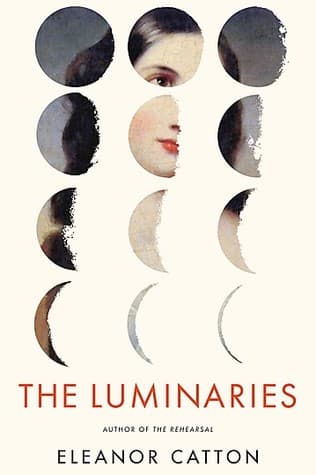
Eleanor Catton (2013)
Genre
Literary Fiction / Historical Fiction / Mystery
Reading Time
1000 min
Key Themes
See below
Sign in to track this book
In 1866 New Zealand, a young prospector uncovers a mystery involving twelve men, a missing fortune, and strange events, all tied to fate and the stars.
On a stormy night in January 1866, Walter Moody, a young man from Britain, arrives in Hokitika, New Zealand, hoping to find gold. He checks into the Crown Hotel and, in the smoking room, finds himself among a secret meeting of twelve notable local men. These men, including banker Alistair Lauderback, Maori carver Te Rau Tauwhare, and opium dealer Quee Long, are discussing strange events that have recently shaken the town. These events include the disappearance of wealthy prospector Emery Staines, the suicide attempt of prostitute Anna Wetherell, and the discovery of a large gold fortune in the hut of opium addict Crosbie Wells. Moody, a lawyer, gets pulled into their theories and suspicions.
The story describes the events before Moody arrived. Crosbie Wells, a struggling prospector, is found dead in his isolated hut, with a lot of gold hidden under his floorboards. His death looks suspicious, with signs of foul play. Finding gold with Wells is especially confusing, as he was known to be poor. This discovery fuels the speculation among the twelve men at the Crown Hotel, who are trying to figure out how Wells got such wealth and if his death connects to Emery Staines's disappearance and Anna Wetherell's suicide attempt. The gold becomes a key clue.
The story moves to Anna Wetherell, a young woman who arrived in Hokitika on the same ship as Emery Staines. She is found unconscious in the street after taking laudanum. Her recovery is slow, and she has no memory of the events leading up to her overdose. Dr. Gideon Prosper, the town physician, cares for her, while Reverend Cowell and brothel madam Lydia Wells (Crosbie's estranged wife) also help in her recovery and later accusations. Anna's past slowly comes out, suggesting a link to Emery Staines and the gold, making her a main character in the mystery, though her memory loss complicates the investigation.
Anna Wetherell is arrested and charged with Crosbie Wells's murder and gold theft. The trial becomes a focus of the town, with various characters giving testimony. The prosecution, led by Te Rau Tauwhare, tries to link Anna to the crime with circumstantial evidence and her connection to Crosbie and Emery Staines. Lydia Wells, Crosbie's widow, gives damaging testimony against Anna, wanting the gold for herself. Walter Moody, though not officially involved, watches the proceedings closely, seeing the complex web of relationships and motives, and starts to form his own ideas about the truth.
The real story of Emery Staines's disappearance gradually comes out. He and Anna Wetherell had a secret relationship, and Staines had indeed found gold. However, a series of bad events, including a robbery by Francis Carver and George Shepard, led to the gold being taken from him. Staines, affected by opium and a strong astrological alignment, becomes confused and disappears from public view, thought to be dead. His fate is connected to the gold found in Crosbie Wells's hut, further complicating the murder investigation and creating a sense of karmic justice among the characters.
Lydia Wells, Crosbie's estranged wife and a clever fortune-teller, is shown to be a main manipulator. She had an affair with Francis Carver and conspired with him to steal gold from Emery Staines. After Crosbie Wells accidentally got the stolen gold, Lydia helped murder him, poisoning him and framing Anna Wetherell. Her testimony against Anna at the trial is a planned act to divert suspicion and get the fortune for herself and Carver. Her ambition and greed drive many of the tragic events.
Francis Carver is revealed as the real villain. He is a brutal criminal, responsible for the initial robbery of Emery Staines's gold and, later, Crosbie Wells's murder with Lydia. Carver's violent nature and his pursuit of wealth drive much of the plot's dark side. He tries to silence witnesses and control events to his advantage, using threats and force. His actions directly lead to Anna Wetherell's suffering and Crosbie Wells's death, making him the most responsible figure in the tragic events that plague Hokitika.
The story explains the strong astrological connection between Anna Wetherell and Emery Staines. They are 'soul mates' whose lives are connected, meaning that when one suffers, the other feels a similar pain. This cosmic link explains why Anna attempted suicide when Emery was attacked and left for dead, and why Emery experienced a period of extreme confusion and memory loss when Anna was in a similar state. Their shared fate is a central part of the story's astrological structure, showing the powerful, unseen forces that control their lives and those around them.
After much intrigue and legal maneuvering, the fate of Crosbie Wells's gold is settled. It is decided that the gold rightfully belongs to Emery Staines, having been stolen from him by Francis Carver and Lydia Wells. The legal process is difficult, but eventually, justice is done, and the gold is returned to its rightful owner. This resolution brings a sense of closure to one of the central mysteries, though the emotional and physical scars left by the events remain. The gold, a cause of so much greed and violence, ultimately returns to its original prospector.
Francis Carver eventually dies violently, a victim of his own ruthlessness. Lydia Wells, though not facing the harshest legal punishment, loses her social standing and her claim to the gold, ending her manipulative power. Anna Wetherell is found not guilty of murder and begins to recover from her ordeal, her memory slowly returning. Emery Staines, having survived his difficult experience, reunites with Anna. While not every wrong is perfectly fixed, the main perpetrators face consequences, and the community of Hokitika can begin to heal from the turmoil and violence that gripped it, although the scars of greed and betrayal remain.
The Protagonist
Initially a detached observer, Moody becomes increasingly involved in the mystery, eventually playing a crucial role in uncovering the truth and understanding the astrological forces at play.
The Central Figure/Victim
From a victim of circumstance and memory loss, Anna slowly recovers her memories and her agency, ultimately finding justice and reunion with Emery.
The Central Figure/Missing Person
From a missing, presumed-dead prospector, Staines eventually resurfaces, recovers his memory and fortune, and reunites with Anna.
The Antagonist
Lydia's schemes are gradually exposed, leading to her downfall and the loss of her social standing and financial aspirations.
The Antagonist
Carver's violent actions lead to his eventual demise, a victim of his own ruthlessness.
The Victim
Wells's death is the inciting incident, and his character is explored posthumously as the mystery of his gold and murder unfolds.
The Supporting
Lauderback remains a stable, influential figure, observing the events and eventually playing a role in the legal resolution.
The Supporting
Tauwhare observes and participates in the unraveling of the mystery, providing a moral compass and a voice of reason.
The Supporting
Quee Long remains a somewhat mysterious figure, providing subtle clues and observations that aid the investigation.
The novel explores the tension between predetermined destiny, especially through its astrological framework, and the choices characters make. Characters' actions are often influenced by their 'stars,' suggesting a cosmic plan for their lives. For example, Anna Wetherell and Emery Staines are linked by astrology, feeling each other's pain and fortune. However, within this framework, characters like Lydia Wells and Francis Carver choose greed and lies, showing that human choice, for good or bad, still shapes events. The story questions whether characters are just puppets of their stars or if they have the free will to defy their celestial maps.
“What if the world was a great machine, and we were all just cogs within it, our lives turning on the same old spindle, over and over, until the whole thing wore out?”
The pursuit of justice, both legal and karmic, is a main theme. The legal system, shown by Anna Wetherell's trial, is imperfect and easily manipulated by false testimony and bias. However, the novel also suggests a deeper, almost cosmic sense of retribution, where wrongdoers like Francis Carver and Lydia Wells eventually face consequences for their actions, even if not always through traditional legal means. The gold, a symbol of greed, ultimately returns to its rightful owner, Emery Staines, suggesting a natural order that seeks balance. The twelve men at the Crown Hotel show the community's desire to understand and bring justice to the chaotic events.
“Every secret will be told, every truth revealed, every debt repaid.”
The appeal of gold and the corrupting effect of wealth are common themes. The gold rush setting naturally highlights human greed, as characters like Francis Carver and Lydia Wells resort to robbery, murder, and complex schemes to get the fortune. Crosbie Wells's accidental possession of the gold leads directly to his death, showing its dangerous power. The pursuit of wealth distorts moral compasses, leading to betrayal and violence. Even seemingly respectable members of society are involved in the tangled web of greed, showing how easily the promise of riches can corrupt individuals and a community.
“Gold was a living thing, a hungry thing, a thing that could make men mad.”
Many characters in 'The Luminaries' use false appearances or struggle with broken identities. Anna Wetherell's memory loss and the changing views of her character show how fragile identity is and how it can be shaped by outside accusations. Lydia Wells, a fortune-teller, carefully creates a deceptive persona to hide her criminal activities. Emery Staines's disappearance and subsequent confusion also involve a loss of self. The story's structure, revealing information bit by bit, forces the reader to constantly re-evaluate characters' true natures, emphasizing how easily appearances can mislead and how hard it is to truly know another person in a world full of secrets.
“A man's true nature, like a woman's, was a thing that could be hidden, altered, and even entirely forgotten.”
The novel's entire narrative and character relationships are meticulously structured around the zodiac and planetary alignments.
Each of the twelve men at the Crown Hotel represents a zodiac sign, and their personalities and roles align with astrological archetypes. Anna Wetherell and Emery Staines are 'luminaries' (the Moon and Sun, respectively), whose fates are intricately linked. The decreasing chapter lengths mirror the waning moon, and the plot unfolds according to specific astrological conjunctions and oppositions. This device not only adds a layer of intricate complexity to the narrative but also reinforces the theme of fate versus free will, suggesting a cosmic order that underpins all human actions and connections.
The story is told through the fragmented, often biased, accounts of various characters, particularly the twelve men.
The initial chapters are framed as Walter Moody receiving information from the twelve men, each offering their own perspective, theories, and prejudices about the events. This creates an unreliable and incomplete picture, forcing the reader to piece together the truth from conflicting testimonies. Anna Wetherell's amnesia further contributes to this, as her own memory is a fractured source of information. This device heightens the mystery and suspense, challenging the reader to discern truth from falsehood and highlighting the subjective nature of perception.
Clues and characters are deliberately presented to mislead the reader and investigators.
The novel employs numerous red herrings to deepen the mystery. For instance, Anna Wetherell is initially presented as the prime suspect for Crosbie Wells's murder, with seemingly damning circumstantial evidence and testimony against her. Similarly, the gold's origin and ownership are obscured, leading to various false theories among the characters. These misdirections force the reader to constantly re-evaluate their assumptions and contribute to the intricate, puzzle-like nature of the plot, making the eventual revelations more impactful.
Characters whose contrasting traits highlight the qualities of another character.
The novel uses foil characters to emphasize particular traits or themes. For example, the innocence and vulnerability of Anna Wetherell are thrown into sharp relief by the cunning and ruthless ambition of Lydia Wells. Similarly, the straightforward, albeit flawed, morality of characters like Te Rau Tauwhare contrasts with the utter depravity of Francis Carver. These pairings serve to illuminate the moral spectrum of Hokitika and underscore the choices characters make between good and evil, fate and free will.
“The world in which we live is fluid, and the course of a human life, no less so.”
— A general observation on life's unpredictable nature.
“Every man has his own destiny: the lucky, the unlucky, the rich, the poor, the good, the bad. All are written in the stars.”
— A reflection on astrological influence and predestination.
“It is not the facts themselves that interest me, but the connections between them.”
— Anna Wetherell discussing her unique perception and understanding.
“Gold is a key to unlock the earth, but it is also a key to lock the heart.”
— A comment on the corrupting influence of wealth and greed.
“There is no such thing as chance. There is only what is intended.”
— A deterministic view on events, suggesting a higher order.
“The past is never dead. It's not even past.”
— A character reflecting on how past events continue to influence the present.
“We are all bound, one to another, in a tapestry of invisible threads.”
— A metaphorical description of human interconnectedness.
“Truth is a thing of many facets, and each man sees but one.”
— A philosophical statement on the subjective nature of truth.
“The stars do not compel, they only incline.”
— A nuanced view of astrological influence, suggesting free will within a framework.
“A secret is a kind of currency, and like all currencies, it loses value the more it is exchanged.”
— A comment on the nature and diminishing power of secrets.
“Desire is a kind of illness, and love is its cure, or its complication.”
— A poignant observation on the complexities of love and desire.
“Justice is a debt that must be paid, whether in coin or in blood.”
— A stark view on the inevitability of retribution.
“Every moment of a human life is a coin, and it can be spent on anything at all.”
— A reflection on the value of time and choices made.
“The human heart is a dark forest, full of winding paths and hidden dangers.”
— A metaphorical description of the complexity and mystery of human emotions.
Ready to see how well you understood this book? Take our interactive quiz with 10 questions.

Biography coming soon.