“The best kind of pride is that which compels a man to do his best, even when no one is looking.”
— Sir Benjamin explains the values of the Merryweather family to Maria.

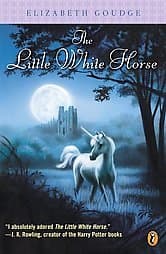
Elizabeth Goudge (1920)
Genre
Fantasy / Children's / Historical Fiction / Young Adult
Reading Time
240 min
Key Themes
See below
Sign in to track this book
Maria, an orphan, finds her purpose in ending an old family feud and bringing peace to Moonacre Valley, helped by a white horse and a forgotten princess's story.
Thirteen-year-old orphan Maria Merryweather, with her governess Miss Heliotrope and dog Wiggins, arrives at Moonacre Manor in Moonacre Valley after her parents die. She finds the place beautiful and strange. Her guardian, Sir Benjamin Merryweather, is kind and lives with his cook Marmaduke Scarlet and pet lion, Wrolf. Maria soon feels at home, despite a sad mood. She learns about the Merryweather family and their connection to the valley, especially the legend of the Moon Princess and the white horse, which seems to cause the valley's sadness.
Maria explores Moonacre Manor and the village, making friends with Robin, a local boy who works for Sir Benjamin. She learns that a bitter feud has existed for centuries between her family, the Merryweathers, and the de Noir family. This feud started over a stolen pearl necklace that belonged to the first Moon Princess. The feud has cursed the valley, causing unhappiness. Maria is told that a 'Moon Princess' will eventually end the curse and bring peace. She also meets the Old Parson, who knows much about the valley's history and gives hints.
During her explorations, Maria finds the de Noir family's home, Castle de Noir, and meets the Old Man de Noir and his grandson, Robin de Noir. The meeting is tense, showing the deep hatred between the families. Maria learns that the de Noirs are wild and often break laws. She also hears about the 'Black Men,' dangerous bandits who bother the valley and are often linked to the de Noirs, adding danger to the situation. Maria feels she must understand and solve the valley's problems.
As Maria learns more about the valley's history, with Miss Heliotrope's knowledge of old tales and Sir Benjamin's observations, she starts to understand the prophecy. It says a 'Moon Princess' will come to Moonacre, find the stolen pearls, and, with a white horse, unite the two fighting families, ending the curse. Maria begins to believe she is this prophesied Moon Princess. This realization gives her purpose and a big responsibility, knowing Moonacre's fate depends on her.
Maria, sure of her role, works to find the Moonacre pearls, stolen long ago and central to the curse. She reads old books, studies family portraits, and explores hidden parts of Moonacre Manor. Robin, the local boy, helps her search the grounds and surrounding areas. They follow clues and riddles, often guided by the Old Parson and Sir Benjamin. The search is hard, leading them to secret passages and forgotten places on the estate.
During her search, Maria has several magical meetings with the white horse. This creature appears and disappears, often at important times, giving silent guidance or comfort. The horse is not just a symbol but an active, magical part of her journey, representing hope and the valley's old magic. Its appearances confirm Maria's belief in the prophecy and her own purpose, showing that the valley's magic is helping her.
As Maria gets closer to finding the pearls, the de Noirs oppose her more. Robin de Noir, driven by his family's pride and wanting the pearls for himself, watches Maria closely. The 'Black Men,' led by the de Noirs, threaten Maria and her friends. They raid the valley, causing trouble and trying to stop Maria's search. Maria must face these dangers, using her courage and the loyalty of her friends, including Sir Benjamin and Wiggins, to protect herself and continue.
Following a final clue, Maria finds the Moonacre pearls hidden in a secret room in Moonacre Manor. The pearls are beautiful, glowing with a magical light that confirms their nature. This is a big win for Maria, but also a realization of the responsibility she now has. She understands that finding the pearls is just the first step; the real challenge is uniting the families and breaking the curse, which needs peace and reconciliation.
Maria, with Sir Benjamin and Marmaduke Scarlet, plans a feast, inviting both the Merryweathers and the de Noirs. This feast is meant for reconciliation. Despite initial tension, Maria, showing courage and wisdom, presents the Moonacre pearls. She talks about the old curse and the need for peace, asking both families to put aside their differences. Her sincerity and the pearls' magic start to soften the de Noirs' hearts, especially Robin de Noir's.
At the feast, Maria and Robin de Noir, seeing their shared purpose and connection, agree to marry. This marriage, joining the two old families, is the final act of reconciliation. As they promise their vows, the curse on Moonacre Valley lifts. The sadness disappears, replaced by joy and harmony. The valley is filled with new light, and the white horse gallops freely, a symbol of restored peace. Maria, the Moon Princess, has fulfilled her purpose, bringing lasting happiness to Moonacre.
The Protagonist
Maria transforms from a displaced orphan into a purposeful young woman who embraces her destiny and brings peace to an entire valley.
The Supporting
Sir Benjamin, initially resigned to the curse, finds renewed hope and joy through Maria's actions, finally seeing his family's legacy redeemed.
The Supporting
Miss Heliotrope remains a steadfast and supportive figure, helping Maria navigate her destiny while maintaining her own calm and insightful nature.
The Supporting/Love Interest
Robin de Noir transitions from a proud and somewhat antagonistic figure to a man who embraces peace and love, fulfilling his role in ending his family's long-standing feud.
The Antagonist
The Old Man de Noir, initially a staunch antagonist, is eventually softened by Maria's courage and the love between her and Robin, allowing the feud to end.
The Supporting
Wiggins remains a consistent source of companionship and protection for Maria, his loyalty unwavering throughout her quest.
The Supporting
Marmaduke Scarlet contributes to the domestic harmony of Moonacre Manor and supports Sir Benjamin and Maria in their efforts to restore peace.
The Supporting
The Old Parson acts as a timeless guide, subtly influencing events and providing wisdom that helps Maria fulfill her destiny.
The Supporting
Wrolf remains a constant, comforting, and protective presence, a symbol of Moonacre's unique magic.
The Symbolic/Supporting
The little white horse acts as a mystical guide and a symbol of Moonacre's enduring magic, its presence growing stronger as the curse is lifted.
The main theme is Maria's purpose as the 'Moon Princess' to end an old curse. From her arrival, clues and legends point to a chosen person, and Maria accepts this role. The prophecy is not just a fixed fate but a calling that needs her active involvement, courage, and moral choices. Her journey is about fulfilling this purpose, not just passively receiving it, shown by her search for the pearls and her decision to unite the families.
“''There's a prophecy about a Moon Princess who will come and find the pearls and bring peace to Moonacre.'”
The novel shows how destructive old feuds are and how strong forgiveness can be. The centuries-old hatred between the Merryweathers and the de Noirs has made Moonacre sad. Maria's goal is to find pearls and to bridge this gap with love and understanding. The reconciliation feast and Maria and Robin de Noir's marriage show the end of this cycle of hate, proving that real peace comes from letting go of past wrongs.
“''Only by love and a marriage between the two families can the curse be broken.'”
Maria's character shows how love and compassion can change things. Her kindness extends to everyone, from her uncle to the de Noirs, and even animals. Her genuine wish for others' happiness, her empathy, and her ability to love help her overcome the deep hatred and suspicion in the valley. Her love for Robin de Noir ends the family feud, dissolving the curse and bringing back harmony.
“''Love can break any spell, even one that's lasted for centuries.'”
Moonacre Valley itself is a character, with deep, old magic that affects its people and events. The beautiful scenery, the mysterious white horse, and the enchanted atmosphere all create wonder. This magic is linked to the valley's well-being, fading under the curse and growing strong when peace returns. Nature reflects the valley's emotional state, showing how humans and nature are connected.
“''Moonacre was a valley of magic, where everything was enchanted, even the sadness.'”
The story shows a clear conflict between the 'good' Merryweathers and the 'dark' de Noirs, but it also explores the complexities within these labels. While the de Noirs are associated with wildness and the 'Black Men,' Maria's interactions with Robin de Noir show that people are not just defined by their family's past. The story suggests that 'evil' often comes from pride, resentment, and misunderstanding, and that true good involves understanding and compassion, not just opposition.
“''It's not about good and bad families, Maria, but about good and bad hearts.'”
The central MacGuffin and symbol of the curse and its resolution.
The Moonacre pearls serve as the primary MacGuffin in the story. Their theft centuries ago initiated the curse and the feud between the Merryweathers and the de Noirs. Maria's quest to find them drives much of the plot. Beyond being a mere object, they are symbolic of the valley's lost harmony and the purity of the original Moon Princess. Their recovery is essential for the prophecy to be fulfilled, making them a tangible representation of the underlying magical conflict and its eventual resolution through reconciliation.
A narrative device establishing Maria's destiny and guiding the plot.
The prophecy is a key narrative device that establishes Maria's ultimate purpose in Moonacre. It provides a framework for the story, outlining the conditions for breaking the curse and hinting at Maria's role. It creates anticipation and gives Maria a clear objective. The prophecy is slowly revealed through various characters and legends, allowing Maria to discover her destiny organically rather than being told directly, which empowers her character arc and drives her investigations.
The core conflict driving the plot and shaping the characters' lives.
The centuries-old feud between the Merryweather and de Noir families is the central conflict of the novel. It provides the historical context for the curse, creates tension, and defines the relationships between many characters. This feud is not just a backdrop but an active force, influencing daily life in Moonacre and presenting the main obstacle Maria must overcome. Its resolution, through Maria's actions and the marriage to Robin de Noir, is the climax of the story.
A magical symbol and mystical guide for Maria.
The little white horse functions as a powerful symbol of Moonacre's inherent magic, purity, and hope. It is also a mystical guide, appearing at crucial moments to subtly nudge Maria towards her destiny or to offer reassurance. Its elusive nature and magical appearances reinforce the fantastical elements of the story. The horse's freedom at the end symbolizes the lifting of the curse and the restoration of harmony, making it a living embodiment of the valley's well-being.
The setting itself acts as a living entity, reflecting the story's emotional state.
Moonacre Valley is more than just a setting; it functions as a character in its own right. Its beauty, its underlying sadness, its ancient magic, and its unique inhabitants all contribute to its distinct personality. The valley's emotional state directly mirrors the presence or absence of the curse, becoming vibrant and joyful once peace is restored. This personification of the setting deepens the story's atmosphere and emphasizes the profound impact of the human conflict on the natural world.
“The best kind of pride is that which compels a man to do his best, even when no one is looking.”
— Sir Benjamin explains the values of the Merryweather family to Maria.
“It is a very odd thing—As odd as can be—That whatever Miss T eats Turns into Miss T.”
— A whimsical poem about Miss Heliotrope's peculiar digestion.
“The moon is a white horse, galloping across the sky.”
— Maria's imaginative observation of the night sky.
“There is no room in this world for second best. Either a thing is right, or it is wrong.”
— Sir Benjamin discusses the importance of moral clarity.
“Love is the only thing that can make the impossible possible.”
— Reflection on the power of love in resolving conflicts.
“A house is not a home until it has a cat.”
— Maria's thought upon arriving at Moonacre Manor.
“The past is always with us, but it need not rule us.”
— Advice given to Maria about family history and legacy.
“Courage is not the absence of fear, but the triumph over it.”
— Maria's realization during a moment of danger.
“Every ending is a new beginning in disguise.”
— Narrative reflection on the cyclical nature of life.
“The truest magic is found in kindness.”
— Lesson learned from the interactions with the valley's inhabitants.
“A garden is a friend you can visit any time.”
— Maria's appreciation of the gardens at Moonacre.
“We are all stories in the end. Make yours a good one.”
— Sir Benjamin's advice to Maria about her legacy.
“The heart knows what the mind cannot understand.”
— Maria's intuitive understanding of the valley's mysteries.
“To be truly rich is to have enough to share.”
— Reflection on the generosity of the Merryweather family.
Ready to see how well you understood this book? Take our interactive quiz with 10 questions.
Biography coming soon.







