“I think I can, I think I can.”
— The little blue engine repeats this phrase as she tries to pull the train over the mountain.

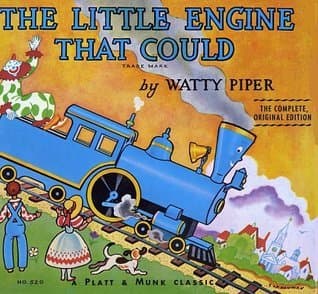
Watty Piper (1978)
Genre
Fantasy / Children's
Reading Time
15 min
Key Themes
See below
Sign in to track this book
A determined small blue engine pulls a trainload of Christmas toys over a tall hill to children, showing that courage comes in all sizes.
The story starts with a happy train, full of things for children. Its cars have toys, dolls, games, books, and food like oranges, apples, and milk. The train is happy and looks forward to taking its cargo to the good children on the other side of the mountain. It moves along, whistling, excited about the joy it will bring, not knowing about the difficulties ahead.
As the happy train travels, it hits an unexpected problem. It suddenly stops. The engine sputters, coughs, and then becomes silent. It cannot move forward. The train is stuck far from its goal, unable to carry the toys and food over the steep mountain to the waiting children. This breakdown leaves the dolls, toy animals, and other cargo in a difficult spot, as time runs out to reach the children.
A shiny new passenger engine, pulling a train with important people, comes by. The stranded train's conductor, a friendly Toy Clown, flags it down. He explains their problem and asks for help to pull the broken train over the mountain. But the Shiny New Engine, proud of its speed and passengers, laughs at the idea of pulling a 'dirty' train of 'toys and food.' It says it is too important for such a job and speeds away, leaving the Toy Clown and the stranded train sad.
Soon after, a big, strong freight engine, pulling many freight cars, approaches. The Toy Clown again steps forward, hopeful, and explains the situation, asking for help to get the toys and food to the children. But the Big Strong Engine, proud of its strength and heavy loads, looks down on the broken train. It says the toys and food are not important cargo and that it only pulls freight cars. With a huff, it moves past, leaving the stranded train and its passengers even more discouraged.
Next, an old, rusty engine, looking tired, slowly moves along the tracks. The Toy Clown, with little hope left, tries one last time to ask for help. He explains that the children are waiting for their toys and food and need help to cross the mountain. The Old Engine replies that it is too old and tired. It says it has worked hard for many years and is no longer strong enough for a difficult task like pulling a broken train over a steep hill. It slowly continues on its way, leaving the stranded train without help.
Just when all hope seems gone, a tiny blue engine appears, moving along the tracks. It is much smaller than the other engines, but it looks cheerful. The Toy Clown, unsure after so many rejections, decides to try one last time. He calls out to the Little Blue Engine, explaining their trouble and how the children need their toys and food. He asks if she, despite her size, would help pull their broken train over the mountain.
The Little Blue Engine pauses, saying she is very small and has never pulled a train of toys and food, especially not over such a high mountain. She shows her uncertainty about the hard task. However, when she sees the sad faces of the dolls and toy animals, and hears the urgency in the Toy Clown's voice about the waiting children, she decides she must try. She thinks helping others is important, even if the task seems too big.
With new resolve, the Little Blue Engine connects herself to the broken train. Taking a breath, she starts to pull, repeating "I think I can, I think I can." The weight is huge, and the climb is steep, but she keeps moving, slowly gaining speed. Each "I think I can" shows her growing belief in herself and her ability to meet the challenge. The toys and food in the cars watch worried as she puts in all her effort.
With great effort and steady resolve, the Little Blue Engine keeps climbing. Her words change as she reaches the top, to "I thought I could, I thought I could." The hardest part is over. Now, as she goes down the other side of the mountain, her chant changes again, to "I know I can, I know I can." The speed helps her, and she moves more easily, bringing the train closer to its destination with each moment.
Finally, the Little Blue Engine pulls the train into the station where the children are waiting. Their faces light up with joy as they see the train full of toys and treats. The children cheer for the Little Blue Engine, thankful for her courage and hard work. The Little Blue Engine, though tired, is happy, knowing she did what no other engine would. She showed that even the smallest can achieve great things with determination.
The Protagonist
She begins with self-doubt but, through sheer will and effort, overcomes a great challenge, transforming into a symbol of success and determination.
The Supporting
He begins with hope, faces disappointment, and eventually finds relief and gratitude.
The Antagonist (minor)
Remains static, embodying pride and indifference.
The Antagonist (minor)
Remains static, embodying strength without compassion.
The Supporting
Remains static, symbolizing the limitations of age.
The Supporting
Goes from joyous to stranded, then is rescued and delivered.
The Mentioned
Begin waiting, then receive their gifts.
This is the main theme, shown by the Little Blue Engine. Despite her small size and early doubts, she tells herself "I think I can," and through will and effort, she pulls the heavy train over the mountain. This theme teaches that working hard when things are difficult, even when others will not help, can lead to success. It is clear when she keeps going uphill, even when the task seems impossible.
“I think I can. I think I can. I think I can.”
The story shows how important it is to believe in yourself, even when others doubt you or when you face a big challenge. The Little Blue Engine's thought, "I think I can," is a strong statement of self-belief. Her change from unsure to confident, ending with "I know I can," shows how believing in your own power helps achieve goals, no matter what others think or what your initial limits are. The larger engines' lack of belief for "unimportant" tasks also contrasts with her inner strength.
“I'm not very big. I've never pulled a train over a mountain.”
The Little Blue Engine's positive attitude and hopeful view are key to her success. While other engines are proud, dismissive, or tired, she approaches the problem with a "can-do" spirit. Her optimism is not naive; it drives her to try and succeed where others failed. This theme suggests that a positive mindset can reveal potential and help overcome problems that seem too big for those with a negative or uncaring view.
“But I think I can. I think I can. I think I can.”
The Little Blue Engine helps because she feels for the stranded toys and waiting children. Unlike the other engines, who put their own importance or limits first, she thinks about what others need. This theme shows the value of helping others and being kind, even when it takes personal effort or goes beyond your usual duties. Her act of service brings joy to the children and to herself.
“The good little boys and girls on the other side of the mountain will have no toys or good food unless I help them.”
Giving human characteristics to inanimate trains.
The story extensively uses personification, attributing human qualities, emotions, and speech to the trains. The engines 'think,' 'feel proud,' 'scoff,' 'huff,' 'look tired,' and 'speak.' This device makes the characters relatable and allows for the exploration of human traits like pride, weariness, and determination through the actions of the trains. It helps convey the moral lessons in an accessible way for young readers.
The repeated phrase 'I think I can' as a symbol of perseverance.
The phrase 'I think I can' is a central and highly effective use of repetition. It serves as the Little Blue Engine's mantra, representing her growing self-belief and determination. The repetition builds suspense during the climb and reinforces the theme of perseverance. Its evolution to 'I thought I could' and 'I know I can' marks the progression of her journey and confidence, making the message memorable and impactful.
Contrasting engines highlighting the protagonist's virtues.
The Shiny New Engine, the Big Strong Engine, and the Old Engine serve as foil characters to the Little Blue Engine. Their contrasting traits—arrogance, indifference, and weariness—highlight the Little Blue Engine's humility, compassion, and determination. By showing what she is NOT, these foils emphasize her unique virtues and make her eventual success more significant and triumphant, reinforcing the story's core messages about inner strength over outward appearances.
“I think I can, I think I can.”
— The little blue engine repeats this phrase as she tries to pull the train over the mountain.
“I thought I could, I thought I could.”
— The little blue engine says this after successfully pulling the train over the mountain.
“I am a very important engine indeed.”
— The little blue engine reflects on her achievement after helping the toys and food.
“I can not, I can not.”
— The shiny passenger engine refuses to help the broken-down train.
“I am a freight engine. I only pull freight cars.”
— The big freight engine declines to help because he sees the task as outside his role.
“I am a rusty old engine. I can not, I can not.”
— The old engine refuses due to his age and perceived inability.
“The little blue engine had never been over the mountain, but she wanted to help.”
— Narration describing the engine's willingness despite inexperience.
“She was a happy little train, for she had such a jolly load.”
— Opening description of the train carrying toys and food for children.
“The toys and good food were for the good little boys and girls on the other side of the mountain.”
— Explanation of the train's mission to deliver essentials to children.
“Chug, chug, chug. Puff, puff, puff.”
— Onomatopoeic sounds representing the engine's effort and movement.
“The little blue engine smiled and seemed to say as she puffed steadily along, 'I think I can—I think I can—I think I can.'”
— Narration during the engine's climb, emphasizing her positive attitude.
“Over the mountain and down the other side, the little blue engine went.”
— Description of the engine's successful journey after her effort.
“The little boys and girls will be happy because you helped us, little engine.”
— The toys express gratitude to the engine after the delivery.
Ready to see how well you understood this book? Take our interactive quiz with 10 questions.

Biography coming soon.







