“If my life is going to mean anything, I have to live it myself.”
— Percy Jackson reflecting on his destiny and independence.

Rick Riordan (2005)
Genre
Fantasy / Children's / Young Adult
Reading Time
250 min
Key Themes
See below
Sign in to track this book
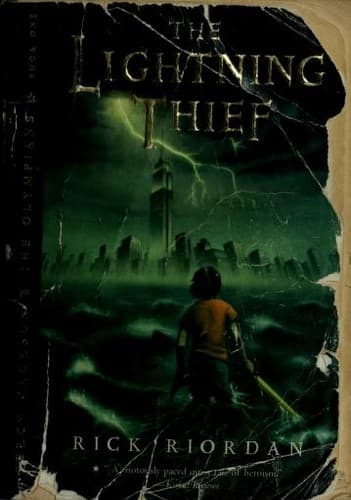
Thrust into a world of mythological monsters and divine treachery, an ordinary boy discovers he's the son of Poseidon and must embark on a perilous quest across modern America to prevent an Olympian war.
Percy Jackson, a troubled twelve-year-old with ADHD and dyslexia, attends Yancy Academy, a boarding school for 'troubled kids.' During a field trip to the Metropolitan Museum of Art, his pre-algebra teacher, Mrs. Dodds, turns into a Fury and attacks him, accusing him of stealing something. Percy instinctively uses a pen, Riptide, given to him by his Latin teacher, Mr. Brunner, which becomes a sword and vaporizes Mrs. Dodds. When he tries to tell his friend Grover Underwood and Mr. Brunner what happened, they deny she existed, making Percy doubt his sanity. This incident leads to his expulsion from Yancy Academy.
After his expulsion, Percy returns home to his mother, Sally Jackson, and abusive stepfather, Gabe Ugliano. Sally takes Percy and Grover on an unplanned trip to Montauk. During the drive, a big storm hits, and Grover reveals he is a satyr, warning them of danger. They are attacked by the Minotaur. Sally sacrifices herself to save Percy, seeming to dissolve into golden light when the monster grabs her. Angry, Percy defeats the Minotaur with one of its own horns, then collapses from exhaustion. He wakes up days later in a strange bed, at Camp Half-Blood, a secret training ground for demigods.
At Camp Half-Blood, Percy learns that Greek gods and goddesses are real and have children with mortals, called demigods. He meets Annabeth Chase, a daughter of Athena, and Luke Castellan, a son of Hermes. Chiron, his former Latin teacher Mr. Brunner, is a centaur and the activities director. Percy struggles to fit in and is placed in the Hermes cabin, for unclaimed demigods. During a game of capture the flag, Percy is healed by water, and a glowing trident appears above his head, showing he is a son of Poseidon, one of the 'Big Three' gods, whose children are forbidden due to an ancient oath.
Soon after Percy is claimed, Zeus accuses him of stealing his Master Bolt, the most powerful weapon in the universe. Poseidon is also accused of conspiring with Percy. With only ten days until the summer solstice deadline, a war between the gods approaches. Chiron advises Percy to go to the Underworld to confront Hades, who is suspected of stealing the bolt to cause a war. Percy receives a quest from the Oracle to go west, find what was stolen, and return it. He sets off with Annabeth and Grover, who are assigned to protect him.
Their journey west takes them through various states, where they meet many mythological creatures. They battle the Furies on a bus, encounter Medusa at 'Aunty Em's Garden Gnome Emporium' in New Jersey, and barely escape a trap set by Echidna and the Chimera at the Gateway Arch in St. Louis. Percy discovers he can control water and talk to sea creatures. They also get help from unexpected allies, such as a pink poodle named Gladiola, whose reward money helps them buy train tickets, and a helpful Nereid who gives Percy three magical pearls from his father.
The trio arrives in Las Vegas and finds the Lotus Hotel and Casino. Not knowing its magical properties, they enjoy the hotel's amenities, playing games and eating lotus flowers. The enchanted food makes them lose all sense of time and purpose, trapping them in a happy, forgetful state. Annabeth eventually realizes what is happening and snaps Percy and Grover out of their trance. They realize they have lost several days, leaving them only one day to finish their quest, and quickly leave the hotel.
Reaching Los Angeles, the trio finds the entrance to the Underworld at DOA Recording Studios. They bribe Charon and move through the fields of Asphodel. In Hades' palace, Percy confronts the god, explaining he did not steal the Master Bolt. Hades reveals that his Helm of Darkness was also stolen and accuses Percy of having both. Percy discovers the Master Bolt has mysteriously appeared in his backpack, placed there by an unknown person. He realizes Hades is not the thief. Using the pearls given by the Nereid, Percy, Annabeth, and Grover escape the Underworld, leaving Hades' Helm behind.
Teleported to Santa Monica beach by the pearls, Percy faces Ares, the god of war, who reveals he arranged the theft of both the Master Bolt and Hades' Helm. Ares had been manipulating Percy's quest, hoping to start a war. Percy challenges Ares to a duel and, using his water powers and demigod skills, wounds the god. Ares, humiliated, retreats, dropping Hades' Helm. Percy returns the Helm to a Fury, who promises to deliver it to Hades. Percy then flies to New York, confronting Zeus on Mount Olympus and returning the Master Bolt, preventing the war.
Back at Camp Half-Blood, Percy is a hero. During a walk in the woods with Luke, Luke reveals he is the true thief. He stole the Master Bolt and the Helm of Darkness from the gods for Kronos, the Titan Lord, who is manipulating events from Tartarus. Luke explains his disappointment with the gods and their perceived neglect of their demigod children. He summons a deadly scorpion to attack Percy, intending to kill him. Percy defeats the scorpion but is severely poisoned, barely surviving.
Percy recovers from the scorpion's poison with Chiron's help. He thinks about his adventures and Luke's betrayal. He can choose to stay at Camp Half-Blood year-round or return to his mother for the school year. Percy decides to return home, but not before confronting Gabe Ugliano. He gives Gabe Medusa's head, which his mother uses to turn Gabe into a statue, finally freeing herself. Percy looks forward to the next summer at Camp Half-Blood, knowing that the threat of Kronos and a larger war is still real, and his journey as a demigod has just begun.
The Protagonist
From a confused and troubled mortal boy, Percy transforms into a confident demigod hero, accepting his destiny and powers.
The Supporting
Annabeth learns to trust and rely on others, particularly Percy, overcoming her initial skepticism and pride.
The Supporting
Grover grows in confidence and courage, proving his worth as a protector and friend despite his anxieties.
The Supporting
Chiron's role remains largely consistent as a steadfast mentor, but his belief in Percy is reinforced.
The Antagonist
Luke's friendly facade crumbles to reveal his true bitterness and role as a disillusioned antagonist, setting up future conflicts.
The Supporting
Sally transitions from a seemingly helpless victim to a woman empowered to take control of her life after Percy's quest.
The Antagonist
Ares serves as an initial antagonist, leading Percy to believe he is the main villain, only to be revealed as a pawn.
The Supporting
Hades' role shifts from perceived antagonist to a neutral party seeking justice for his own stolen property.
The Mentioned
Zeus remains a powerful, unchanging force, his actions driving the plot's initial conflict and resolution.
The Mentioned
Poseidon's presence is felt throughout the story, culminating in his silent acknowledgement of Percy's success.
Percy's journey is one of self-discovery. He starts as a troubled boy who feels like an outcast, struggling with his ADHD and dyslexia. At Camp Half-Blood, he learns of his demigod heritage. He begins to understand why he is different and embraces his unique abilities. His quest to retrieve the Master Bolt is also a quest to understand who he is, where he comes from, and his place in both the mortal and divine worlds. He learns to trust his instincts and his powers.
“You are a demigod. You are a child of one of the Olympian gods.”
Family, both mortal and divine, is central to the story. Percy's strong loyalty to his mother, Sally Jackson, drives much of his initial motivation. At Camp Half-Blood, he finds a new 'family' in his friends, Annabeth and Grover, and the other demigods. The struggles among the Olympian gods themselves show dysfunctional family dynamics, mirroring mortal issues. Luke's betrayal comes from feeling abandoned by his divine father, Hermes, showing the results of neglected family ties.
“Even strength has to bow to a higher strength. Your mother was a queen.”
The book explores how prejudice and misunderstanding cause conflict. Percy is first judged and misunderstood by mortals and gods, mainly because of his undiagnosed learning differences and his mysterious heritage. Hades is unfairly blamed for the Master Bolt's theft simply because of his domain. The gods themselves quickly accuse each other based on old grudges and mistrust, almost causing a devastating war. The story encourages looking beyond appearances and first assumptions.
“The gods are not always fair, Percy. They can be vain and jealous.”
Grover's character shows the theme of environmentalism and respecting nature. As a satyr, he is deeply connected to the natural world and upset by pollution and deforestation. His ultimate goal is to find Pan, the lost god of the wild, a quest driven by the desire to protect the environment. This theme quietly shows the consequences of humanity's disregard for nature and the potential loss of its beauty and magic.
“The wild god, Pan, has been missing for two thousand years. Satyrs have been searching for him ever since.”
A magical veil that conceals the mythological world from mortals.
The Mist is a powerful magical force that veils the true nature of mythological creatures, gods, and events from mortals. It makes monsters appear as ordinary objects or people, and explains away supernatural occurrences with mundane explanations. For example, Mrs. Dodds's attack is dismissed as a hallucination. The Mist allows the demigod world to coexist with the mortal world without causing widespread panic or exposure, maintaining the secrecy of Olympus. Only certain individuals, like demigods and some rare mortals like Sally Jackson, can see through it.
A cryptic prediction that guides Percy's quest and foreshadows future events.
The Oracle of Delphi delivers a cryptic prophecy to Percy, outlining the parameters and potential outcomes of his quest. The prophecy states: 'You shall go west, and face the god who has turned. You shall find what was stolen, and see it safely returned. You shall be betrayed by one who calls you friend. And fail to save what matters most, in the end.' This device drives the plot forward, creating suspense and allowing for interpretation as events unfold. It also foreshadows Luke's betrayal and the 'failure' to save his mother from the Underworld in the conventional sense, though she is later freed.
Enchanted objects that aid or hinder the characters on their journey.
Various magical items play crucial roles in the story. Riptide, Percy's pen-sword, is a powerful weapon that always returns to his pocket, symbolizing his inherent demigod abilities. Annabeth's Yankees cap, a gift from her mother Athena, grants invisibility. The three pearls given by the Nereid allow Percy, Annabeth, and Grover to escape the Underworld, each teleporting one person. Luke's winged shoes, a gift from Hermes, are initially helpful but are later revealed to be cursed, pulling Grover into Tartarus, highlighting the dangers and double-edged nature of divine gifts.
A classic literary structure where heroes undertake a journey to achieve a specific goal.
The entire plot of 'The Lightning Thief' is structured as a classic quest narrative. Percy, the reluctant hero, is given a clear mission (find the Master Bolt, prevent war), is accompanied by loyal companions (Annabeth and Grover), faces numerous trials and monsters, receives aid from various sources, and ultimately confronts the antagonist. This structure allows for episodic adventures, character development, and the exploration of mythological settings across the United States, culminating in the hero's return home, changed by his experiences.
“If my life is going to mean anything, I have to live it myself.”
— Percy Jackson reflecting on his destiny and independence.
“Even strength must bow to wisdom sometimes.”
— Annabeth Chase explaining the value of intelligence over brute force.
“The real world is where the monsters are.”
— Percy realizing that dangers exist beyond the mythological realm.
“Families are messy. Immortal families are eternally messy.”
— Percy commenting on the complicated relationships among gods and demigods.
“I am impertinent.”
— Percy defiantly responding to a god's criticism.
“Knowing too much of your future is never a good thing.”
— Chiron warning Percy about the dangers of prophecies.
“You deal with mythological stuff for a few years, you learn that paradises are usually places where you get killed.”
— Percy expressing cynicism about seemingly perfect situations.
“A kind act can sometimes be as powerful as a sword.”
— Percy learning about the impact of compassion in a dangerous world.
“Even monsters have a story.”
— Percy showing empathy towards mythical creatures.
“The best people, the ones who really matter, are the ones who see you for who you are and help you become who you should be.”
— Percy appreciating the support of his friends.
“Being a half-blood is dangerous. It's scary. Most of the time, it gets you killed in painful, nasty ways.”
— Percy describing the harsh reality of being a demigod.
“Sometimes mortals can be more horrible than monsters.”
— Percy observing human cruelty during his journey.
“I'd rather be a half-blood than a regular kid any day.”
— Percy embracing his unique identity despite the risks.
“The world was collapsing, and the only thing that really mattered to me was that she was alive.”
— Percy's relief about his mother's safety amidst chaos.
Ready to see how well you understood this book? Take our interactive quiz with 10 questions.

Biography coming soon.







