“The Librarian, a creature whose very existence was a standing insult to the laws of evolution, had a simple philosophy: 'Oook.'”
— Describing the Librarian's unique form of communication.

Terry Pratchett (1986)
Genre
Fantasy / Science Fiction
Reading Time
277 min
Key Themes
See below
Sign in to track this book
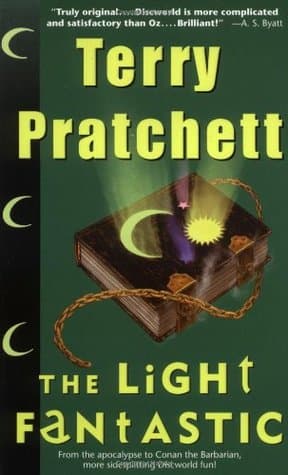
As a large red star moves towards Discworld, the only hope rests with the inept wizard Rincewind, who must save a world he once fell off.
After falling off Discworld at the end of *The Colour of Magic*, the wizard Rincewind finds himself in a void, protected by the sentient magic of the Octavo, the world's most powerful spellbook. The Octavo's eight Great Spells, which are in Rincewind's mind, transport him back to Discworld. He lands in the Forest of Skund, where a druidic stone circle discovers him and sees his return as a sign of disaster. At the same time, a large, red star appears in the sky, growing larger and threatening to hit Discworld. This event causes strange magical occurrences and widespread panic.
Rincewind soon meets his former companion, Twoflower, the naive tourist from the Counterweight Continent, and Twoflower's loyal, multi-legged Luggage. They had also been at the world's edge but were saved separately. Back in Ankh-Morpork, at the Unseen University, the Archchancellor, Cutwell, and other wizards consult old texts. They find a prophecy stating that Discworld can only be saved from the approaching star if the Octavo's eight Great Spells are read aloud by the person who holds them. This, of course, means Rincewind, making him the reluctant and least qualified hero.
Realizing Rincewind holds the key to the world's salvation, the wizards of Unseen University send a search party to find him. However, the ambitious wizard Trymon, who wants the Archchancellor's position and the Octavo's power, sees an opportunity. He believes he can take the spells from Rincewind's mind and use them himself, saving the world and securing his own power. Trymon's pursuit of Rincewind adds another layer of danger to Rincewind's already perilous journey, as he must avoid both collapsing reality and the malevolent intentions of his fellow wizards.
During their escape from the wizards and the increasingly chaotic Discworld, Rincewind, Twoflower, and the Luggage accidentally enter the domain of the Old Gods. These powerful, ancient deities, including Offler the Crocodile God and the Lady, are shown playing a cosmic board game with Discworld's fate as their stakes. The gods, amused by the mortals' situation, offer little direct help but provide cryptic clues. This encounter shows the indifference of higher powers to mortal suffering and the arbitrary nature of fate, further highlighting Rincewind's difficult position.
Meanwhile, back at Unseen University, Trymon, having incapacitated the Archchancellor, gathers the other wizards. He convinces them that Rincewind is too unreliable and that they can collectively summon the Octavo's power by performing a complex ritual, even without the actual book or Rincewind. Their ritual, however, goes badly wrong. Instead of harnessing the Octavo's power, they accidentally open a portal to the Dungeon Dimensions, unleashing terrifying, extra-dimensional creatures into the University. This act further destabilizes Discworld and shows Trymon's dangerous ambition and lack of true understanding of magic.
As the red star gets closer, Discworld's reality begins to visibly fall apart. Rivers dry up, forests turn to ash, and the ground crumbles. Rincewind, Twoflower, and the Luggage see these apocalyptic changes during their journey. The sky becomes a terrifying display of celestial events, and the air crackles with uncontrolled magic. This widespread decay and impending doom increase Rincewind's fear, as he deals with the immense responsibility placed on him and the seemingly hopeless situation.
Rincewind and his companions eventually return to Ankh-Morpork and the Unseen University, now a chaotic mess filled with creatures from the Dungeon Dimensions. Here, Rincewind confronts Trymon, who has been corrupted by the forbidden knowledge he sought, turning into a monstrous, power-hungry being. Trymon tries to forcibly take the spells from Rincewind, believing he is the only one worthy to use them. This confrontation is a battle not just of magic, but of different ideas about power and responsibility.
In the collapsing University and the battle with Trymon, the Octavo itself intervenes, guiding Rincewind. The book, having been held captive by Trymon, escapes and opens to the first page. With the red star now terrifyingly close, Rincewind, with no other choice, begins to read the eight Great Spells aloud. The spells, long dormant in his mind, flow forth, not as destructive forces, but as a mechanism of creation and rebirth, fulfilling the ancient prophecy.
As Rincewind reads the final spell, the true nature of the prophecy and the red star is revealed. The star is not a destructive force but a cosmic egg containing eight baby stars. The Octavo's spells provide the energy and magic needed to hatch these stars. Discworld is saved not by avoiding a collision, but by enabling a cosmic birth. The eight new stars, guided by Great A'Tuin, the giant turtle carrying Discworld, take their place in the heavens, forming the constellation that spells out 'Octavo'.
With the world saved and the stars reset, reality stabilizes. Trymon is defeated, eaten by the creatures he unleashed. Rincewind, exhausted but alive, finds himself a reluctant hero once more. Twoflower, having seen more adventure than he could have imagined, decides it's time to return to the Counterweight Continent, leaving his beloved Luggage with Rincewind. The Archchancellor is restored, and Unseen University begins rebuilding. Rincewind, no longer burdened by the spells, remains a wizard, though still inept, but now with a new, if reluctant, appreciation for his survival.
The Protagonist
Rincewind begrudgingly accepts his role in saving the world, moving from pure flight to a moment of reluctant heroism, though his fundamental cowardice remains.
The Supporting
Twoflower's adventure culminates in him returning home, having seen and experienced enough to tell his tales, but retaining his fundamental wonder.
The Supporting
The Luggage remains consistent in its loyalty and protective nature, ultimately transferring its allegiance to Rincewind.
The Antagonist
Trymon's ambition leads to his complete corruption and eventual demise, becoming a cautionary tale of magical hubris.
The Supporting
The Octavo acts as a guiding force, ensuring its purpose is fulfilled by Rincewind, and ultimately orchestrating the birth of new stars.
The Supporting
Death remains a constant, unchanging force, observing the chaos with detached amusement and a touch of professional curiosity.
The Supporting
The Archchancellor is temporarily sidelined but ultimately restored, reaffirming the traditional order of Unseen University.
The Mentioned
A'Tuin's cosmic journey continues, now with a new constellation of stars in tow.
The novel turns traditional fantasy ideas on their head by making the most cowardly wizard, Rincewind, the reluctant hero. His 'heroism' is almost entirely accidental, driven by his strong desire for self-preservation, which often leads him to inadvertently save the day. This theme is clear when Rincewind, despite his fear, is the only one who can read the spells, not through bravery, but by circumstance. His constant attempts to run away, only to find himself in deeper trouble, highlight the absurdity of expecting a grand, valiant hero.
“Rincewind was a wizard in the same way that a bottle of ketchup is a tomato. He had the right shape, but the contents were a little thin and watery.”
The book looks at different kinds of magic: the raw, ancient power of the Octavo, the formal, often ineffective magic of Unseen University, and the dangerous, corrupting influence of forbidden magic sought by Trymon. The Octavo's spells are for creation, not destruction, showing a deeper, more basic purpose to magic than just casting spells. Trymon's transformation into a monster shows how seeking power for its own sake, without wisdom or responsibility, always leads to corruption and ruin. The wizards' inability to understand the Octavo's true purpose until the very end further emphasizes this.
“The problem with magic was that it was all in the mind. The problem with minds was that they were all in the mind.”
The approaching red star and the Old Gods playing games with Discworld's fate show the vast, often uncaring cosmic scale against which mortal struggles happen. The gods offer no direct help, seeing the apocalypse as mere entertainment. This highlights how small individual lives are in the grand scheme, yet it also makes Rincewind's unexpected triumph, as a tiny, fearful individual, even bigger. Discworld's survival is not due to divine intervention but to a prophecy, a pre-ordained cosmic event, which Rincewind is simply a channel for.
“The gods were not so much cruel as indifferent. They were like children playing with a toy, occasionally breaking it and then forgetting it.”
Twoflower's tourist view and his belief in stories (like happy endings) affect the narrative and Rincewind's experiences. The prophecy itself, which dictates Discworld's fate, is a story that must be fulfilled. Discworld exists because of the collective belief in its reality, and its unraveling is tied to the breaking of fundamental cosmic 'stories.' This theme suggests that belief and narrative are powerful forces, able to shape reality itself, and that even in the face of apocalypse, the power of a good story can last.
“It was impossible to be a cynic when you were falling off the edge of the world.”
The object of desire and the catalyst for the plot, residing within Rincewind.
The eight Great Spells of the Octavo serve as the primary MacGuffin. They are the ultimate power, the key to saving the Discworld, and the object of desire for both the benevolent Archchancellor and the malevolent Trymon. The spells are not inherently good or evil; their power simply *is*. Their accidental presence in Rincewind's head drives the entire plot, forcing him into a heroic role and setting him on a collision course with those who seek to control them. Their true purpose, however, is revealed to be one of creation, subverting the typical destructive power of such devices.
An ancient foretelling that dictates the course of events and the world's salvation.
The prophecy of the red star and the one who will read the Octavo's spells is a central plot device. It provides a roadmap for the story, outlining the specific conditions under which the Discworld can be saved. The prophecy creates a sense of inevitability and urgency, forcing characters to act according to its dictates. It also adds a layer of cosmic destiny to Rincewind's reluctant heroism, suggesting that his role was pre-ordained, regardless of his personal shortcomings. The fulfillment of the prophecy is the climax and resolution of the entire narrative.
A seemingly insoluble problem is suddenly and abruptly resolved by an unexpected and unlikely intervention.
While often played for comedic effect, The Luggage frequently functions as a *deus ex machina*. Whenever Rincewind and Twoflower are in an utterly inescapable predicament – surrounded by hostile creatures, falling from great heights, or facing overwhelming odds – The Luggage appears from nowhere, devours the threat, or otherwise provides an impossible escape. Its sentient nature and ability to travel through anything make it a convenient, if absurd, tool for resolving plot points that would otherwise be insurmountable for the cowardly Rincewind.
Elements of existential terror and incomprehensible entities from beyond reality.
The Dungeon Dimensions represent a form of cosmic horror. They are a realm of unspeakable, extra-dimensional entities that are beyond mortal comprehension and sanity. Trymon's misguided magical experiments open a portal to these dimensions, unleashing their terrifying inhabitants onto the Discworld. This device introduces a sense of existential dread and highlights the fragility of reality, reminding characters (and readers) that there are forces far greater and more terrifying than conventional magic, adding a layer of genuine menace to the encroaching apocalypse.
“The Librarian, a creature whose very existence was a standing insult to the laws of evolution, had a simple philosophy: 'Oook.'”
— Describing the Librarian's unique form of communication.
“Rincewind, a wizard whose main skill was running away, was good at it. Very good.”
— Introducing Rincewind's defining characteristic.
“He was a man who had been to the end of the world and come back, and was now wondering what the fuss had been about.”
— Describing Rincewind's nonchalant attitude after his previous adventures.
“The universe was a thing of perfect and terrible beauty, and it was his to mess with.”
— Reflecting on the nature of magic and the Discworld.
“The sound of a thousand tiny legs pattering on the flagstones announced the arrival of the Luggage.”
— The first appearance of the Luggage in the book.
“There are times when the only thing to do is to run, and times when the only thing to do is to run faster.”
— Rincewind's philosophy on survival.
“When the going gets tough, the tough get going. And the weak get going too, in case the tough block the way.”
— A humorous take on facing danger.
“Eight spells. The Octavo. The most powerful book of magic in the Discworld. And he'd only read the first seven.”
— Rincewind's predicament with the Octavo spells.
“The problem with being a hero is that it's exhausting. And the pay isn't great.”
— A pragmatic view on heroism.
“It was a dark and stormy night. The kind of night when you wonder if the universe has a sense of irony.”
— Setting the scene with a classic opening, given a Discworld twist.
“Life was a lot more fun when you weren't trying to save the world, or at least not trying very hard.”
— Rincewind's personal preference for a less heroic existence.
“The universe, as far as he was concerned, was a place to be survived, not understood.”
— Rincewind's practical approach to existence.
“The gods don't play dice with the universe; they play an incomprehensible game of their own invention with the universe.”
— A Discworld take on Einstein's famous quote about God and the universe.
“He knew that one day he would die, but he also knew that it wouldn't be today, because he had things to do.”
— Rincewind's stubborn refusal to accept his fate.
Ready to see how well you understood this book? Take our interactive quiz with 10 questions.
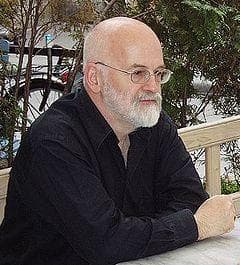
Sir Terence David John Pratchett was an English humorist, satirist, and author of fantasy novels, especially comical works. He is best known for his Discworld series of 41 novels.







