“One thing you should know about me is that I am a wicked man. But I'm not a stupid man. And I'm not a crazy man. And I'm not a suicidal man. I just happen to be very, very good at what I do.”
— Locke reflecting on his nature and skills.

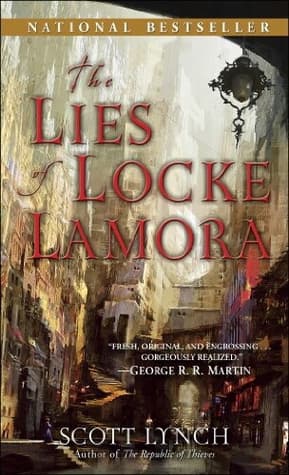
Scott Lynch (2006)
Genre
Fantasy / Mystery
Reading Time
1500 min
Key Themes
See below
Sign in to track this book
In the city of Camorr, a con artist and his crew must outwit a deadly enemy, or their world of lies and thievery will fall apart.
The story begins with a flashback to Locke Lamora's childhood in Camorr, at the Orphanage of the Priory of the Bonded. Locke, a troublesome and cunning orphan, constantly frustrates the priests. Father Chains, a disguised master thief, recognizes Locke's talent for mischief. He buys Locke from the orphanage, not to exploit him, but to train him in thievery, deception, and the 'Gentleman Bastard' philosophy. This starts Locke's education under Chains, where he learns the trade alongside other young orphans like Jean Tannen, developing the skills that will shape his future.
Years later, the story moves to the present. Locke Lamora, now a young adult, leads the Gentleman Bastards, a hidden crew including Jean Tannen, Calo and Galdo Sanza, and Bug. From their secret lair, they run elaborate cons on Camorr's wealthy, always avoiding the attention of Capa Barsavi, the city's crime lord. Their current major operation is a complex scam against Don Salvara, aiming to take a large fortune from him. They carefully plan and execute their deceptions, showing their skill in disguise, acting, and manipulation, while keeping their cover as low-level criminals to Barsavi's organization.
As the Gentleman Bastards continue their scheme against Don Salvara, a new threat appears in Camorr. A mysterious figure called the Gray King, with his enforcer the Falconer, begins to kill Capa Barsavi's people and disrupt the criminal order. The Gray King's methods are brutal and public, often leaving gruesome displays as warnings. This increasing violence creates fear in Camorr's underworld, forcing Barsavi to protect his territory. The Gentleman Bastards, though not directly targeted at first, find their world becoming unstable and dangerous because of this new power.
The Gray King eventually shows he knows the Gentleman Bastards' true identities and their schemes, including the one against Don Salvara. Through the Falconer, he corners Locke and his crew, giving them an ultimatum: work for him to undermine Barsavi, or he will expose them and destroy everything they care about. The Gray King plans to destabilize Barsavi's rule and take control of Camorr's underworld. Locke, seeing the power and ruthlessness of their new enemy, reluctantly agrees, knowing that refusal means certain death for him and his friends. This forced alliance pulls the Gentleman Bastards into a bigger, deadlier game.
Under the Gray King's pressure, Locke and the Gentleman Bastards must execute a series of cons and manipulations to discredit Capa Barsavi. They arrange events to make Barsavi seem incompetent or weak, creating discord among his capos and disrupting his operations. One scheme involves manipulating a shipment of 'garrista' wine, creating a public event that embarrasses Barsavi and spreads rumors of his decline. These actions are difficult for Locke, as he respects the underworld's order, but he sees no other way to protect his crew. Each successful sabotage brings the Gray King closer to his goal of taking Barsavi's power.
The Gray King's plans end in a devastating betrayal. He sets up a false meeting, luring Capa Barsavi and his family, along with many loyal capos, to a supposed peace negotiation. Instead, it is a trap. The Falconer and the Gray King's forces ambush and kill Barsavi, his wife, children, and most of his key lieutenants. The Gentleman Bastards see the horrifying aftermath of this bloody attack, realizing the Gray King's ruthlessness and the destruction he has caused. This event shatters the established order and leaves Locke filled with guilt and a desire for revenge.
Angry and heartbroken by the massacre, Locke and Jean stop their previous cons and focus on avenging Barsavi. They begin to hunt the Gray King and the Falconer, using their con artist skills for tracking and infiltration. Their investigation reveals the Gray King's true identity: Archon, the exiled former leader of the city's secret police, the Eyes of the Archon. His motive is not just power, but a deep desire for revenge against the nobility and the criminal underworld he believes wronged him. He wants to destroy Camorr's entire established order.
During their pursuit, Locke and Jean confront the Falconer. It is revealed that the Falconer is a formidable bondsmage, a user of rare and dangerous elder magic. This discovery increases the threat, as bondsmages can manipulate souls and inflict curses. The Falconer's powers include soul-binding and causing pain and death through touch or will. This makes direct confrontation very dangerous and forces Locke and Jean to rely more on their cunning, as brute force is not enough against such magic. The Falconer is the strength and magic behind Archon's terrifying rule.
Locke plans a daring scheme to expose and defeat Archon and the Falconer. He manipulates events to ensure Archon, believing himself in control, will attend a noble gathering at the Ducal Palace. Locke's intricate plan uses impersonation, misdirection, and planted information to draw Archon into a public confrontation. The goal is not just to kill him, but to discredit him and prevent him from taking power over Camorr. This plan is risky, placing Locke and Jean in the heart of the city's powerful institutions, directly confronting a vengeful bondsmage and a brilliant tactician.
The climax happens at the Ducal Palace. Locke and Jean carry out their plan, revealing Archon's treachery and identity to the assembled nobility. A brutal fight follows with the Falconer, who uses his bondsmage powers. In the chaos, the Gentleman Bastards suffer heavy losses. Calo and Galdo Sanza are killed by the Falconer's magic, and Bug, the youngest, is fatally wounded. Jean Tannen, a strong fighter, seriously wounds the Falconer, but not before the bondsmage takes his toll on their friends. Locke sees his adopted family destroyed, strengthening his desperate resolve.
Despite the heavy losses, Locke, aided by an injured Jean, continues. He confronts Archon, not with violence, but with his talent for deception and psychological manipulation. Locke exposes Archon's deepest fears, shattering his persona and revealing him as a pathetic, vengeful man. He uses Archon's own schemes against him, turning the nobility and remaining criminals against the former Archon. Locke orchestrates Archon's downfall, ensuring his public humiliation and imprisonment, rather than a quick death. The Gray King's reign of terror ends, but at a great personal cost to Locke.
After the Gray King's defeat, Camorr is in disarray. The criminal order is broken, and the nobility is shaken. Locke and Jean, the only surviving Gentleman Bastards, are changed by the ordeal. They mourn the loss of Calo, Galdo, and Bug, the family they built. With their identities compromised and their lives in Camorr altered, they decide to leave the city. They embark on a ship, their future uncertain, carrying their losses and the strong bond of their friendship. Their journey is about survival, grief, and finding a new start away from Camorr's past.
The Protagonist
Locke evolves from a confident, almost arrogant con artist into a grief-stricken survivor, forced to confront the brutal realities of power and loss, leading him to a deeper understanding of vengeance and sacrifice.
The Supporting
Jean remains a pillar of strength and loyalty, but his arc sees him endure immense personal loss, which hardens his resolve and deepens his bond with Locke, forcing him to confront the limits of their world.
The Supporting
Chains' arc is primarily in the past, establishing the foundation for Locke's skills and moral code, serving as the guiding principle that Locke often reflects upon.
The Antagonist
Archon's arc is one of escalating ambition and cruelty, culminating in his dramatic downfall as his carefully constructed schemes are dismantled by Locke's cunning.
The Antagonist
The Falconer's arc is primarily that of a relentless, destructive force, whose power is eventually countered through a combination of brute force and cunning, leading to his defeat.
The Supporting
Barsavi's arc is tragic; he is an established power figure who is abruptly and brutally overthrown, symbolizing the fragility of even the most entrenched authority.
The Supporting
Calo's arc is one of unwavering loyalty and skill, tragically cut short by the violence of the Gray King, serving as a profound loss for Locke and Jean.
The Supporting
Galdo's arc is one of unwavering loyalty and skill, tragically cut short by the violence of the Gray King, serving as a profound loss for Locke and Jean.
The Supporting
Bug's arc is tragically cut short, representing the vulnerability of even the most innocent members of the crew to the brutal realities of the underworld.
The novel explores the idea that family is defined by chosen bonds and loyalty, not just blood. The Gentleman Bastards, orphans trained by Father Chains, form a strong unit. Their devotion to each other drives their actions and is their greatest strength, but also their greatest weakness. The deaths of Calo, Galdo, and Bug show the impact of losing this chosen family, deeply affecting Locke and Jean. Their loyalty is the base of their survival and identity, even when facing danger and grief. Locke's main reason for dealing with the Gray King is to protect his crew.
““There’s no freedom quite like the freedom of being constantly underestimated.””
Deception is an art and a way of life for the Gentleman Bastards. Locke Lamora is a master of illusion, creating elaborate cons that use misdirection, false identities, and psychological manipulation. The entire city of Camorr, with its hidden criminal underworld and the 'Secret Peace,' operates on layers of deception. The Gray King's scheme also uses illusion, using fear and misinformation to destabilize the established order. The story blurs the lines between real and perceived, showing how power can be used through carefully constructed lies, as seen in Locke's ability to appear as a different person for each con.
““We’re the Gentleman Bastards, and we’re going to steal the world.””
Revenge is a strong motivator for both the protagonist and antagonist. The Gray King (Archon) is driven by a desire for revenge against the nobility and underworld that disgraced him. His brutal actions are a direct result of this. Similarly, after the massacre of Capa Barsavi's family and his own crew, Locke Lamora's main goal changes from profit to vengeance. The novel shows the destructive nature of revenge, as it leads to death and suffering, but also presents it as a compelling, though costly, form of justice where official law often fails. Locke's revenge is a personal and emotional response to great loss.
““Someday, Locke Lamora, someday you’re going to wake up in a world where 'threat' is as real as 'tomorrow' and 'tomorrow' is a place that you aren’t.””
The novel shows how power, whether held by nobles, crime lords, or revolutionaries, often leads to corruption and brutality. Capa Barsavi, while maintaining order, is a ruthless crime lord who rules through fear. The nobility, though seemingly legitimate, are often greedy and easily manipulated. Archon, in his quest for power and revenge, becomes extremely cruel, justifying mass murder as a means to an end. Even Locke, in his pursuit of vengeance, makes morally questionable choices, showing how the struggle for control can compromise principles. The 'Secret Peace' itself shows the corrupting influence, where the powerful keep their positions through unspoken, often violent, agreements.
““The only thing that burns in hell is the part of you that won’t let go of your life: your memories, your attachments. They burn them all away, and they’re not punishing you, they’re freeing your soul.””
Sections detailing Locke's childhood and training under Father Chains.
The novel frequently employs 'Interludes' – chapters set in Locke's past, detailing his time as an orphan and his rigorous training under Father Chains. These flashbacks serve multiple purposes: they provide crucial backstory for Locke and the Gentleman Bastards, explaining their unique skills, their bond, and the origins of their criminal philosophy. They also offer a contrasting tone to the grim present narrative, often showing a younger, more innocent (though still mischievous) Locke. Critically, they parallel the themes of the main plot, showing how Chains' lessons prepare Locke for the challenges he faces later, and revealing the emotional weight of the family he eventually loses.
An unspoken agreement between Camorr's nobility and its criminal underworld.
The 'Secret Peace' is an unofficial, unwritten pact that governs the relationship between Camorr's ruling nobility and its powerful criminal syndicates, particularly Capa Barsavi's organization. Under this agreement, criminals are forbidden from preying on the nobility, and in return, the nobility largely ignores the existence of the underworld's operations. This device establishes the intricate social and political ecosystem of Camorr, explaining why the Gentleman Bastards focus on conning the wealthy rather than street crime, and why Barsavi is so powerful. Its violation by the Gray King is a major catalyst for the plot, shattering the fragile balance of power and unleashing chaos upon the city.
Remnants of an ancient, powerful civilization that dot Camorr's architecture.
Elderglass refers to the inexplicable, indestructible glass-like structures that form much of Camorr's architecture and infrastructure. These ancient constructs are impervious to all known forms of damage and their origins are a complete mystery, hinting at a lost, highly advanced civilization. The Elderglass serves as both a backdrop and a subtle plot device. It creates a sense of deep history and mystery in Camorr, suggesting that there are forces and knowledge far beyond the characters' understanding. It also provides practical elements, like the Gentleman Bastards' hidden lair beneath an Elderglass temple, and symbolizes the enduring, inscrutable nature of the city itself, a constant reminder of things unknown and powerful.
The primary method of operation for the Gentleman Bastards.
Disguise and impersonation are central to the Gentleman Bastards' con artistry. Locke and his crew are masters of adopting convincing personas, complete with intricate costumes, mannerisms, and fabricated backstories, to infiltrate the upper echelons of Camorr society. This device allows them to navigate social circles otherwise inaccessible to common criminals and execute elaborate scams. It highlights Locke's genius for acting and psychological manipulation, as well as the meticulous planning required for their operations. It also underscores the theme of deception, showing how appearances can be entirely misleading and how identity itself can be a fluid construct.
“One thing you should know about me is that I am a wicked man. But I'm not a stupid man. And I'm not a crazy man. And I'm not a suicidal man. I just happen to be very, very good at what I do.”
— Locke reflecting on his nature and skills.
“We're going to steal so much money, you'll be able to buy a small country and still have enough left over to bribe the Pope.”
— Locke outlining his ambitious plans to his crew.
“Someday, Locke Lamora, you're going to wake up in a pool of your own blood, surrounded by enemies, and you're going to think to yourself, 'I should have listened to Father Chains.'”
— Father Chains's prophetic warning to a young, reckless Locke.
“Nice guys finish last. If you want to be a nice guy, go work in a bakery.”
— Locke's cynical view on the world and the necessity of ruthlessness.
“Every city is a ghost. Every city is a corpse. Every city is a dream.”
— Locke's philosophical musings on the nature of cities.
“The only difference between a good plan and a bad plan is that when the bad plan goes to hell, it takes everything else with it.”
— Locke explaining the importance of thorough planning.
“You can't have a good story without a good villain.”
— Locke discussing the role of antagonists in any narrative or scheme.
“We're not just thieves, we're artists. And our canvas is the city.”
— Locke's elevated self-perception of the Gentleman Bastards' craft.
“When you're dealing with the rich, you're not just trying to take their money. You're trying to take their dignity.”
— Locke explaining the psychological aspect of conning the wealthy.
“There's no such thing as a perfect crime. Only perfect preparation.”
— Locke emphasizing the critical role of preparation in their schemes.
“The world is a stage, and most of us are just playing bit parts. But every now and then, someone comes along who's meant to be the star.”
— Locke's view on individual destiny and his own role.
“Hope is a powerful thing. Some say it's a thing with feathers. I say it's a thing with teeth.”
— Locke's darker, more pragmatic take on the concept of hope.
“Never trust a man who smiles too much, and never trust a man who doesn't smile at all.”
— Locke's advice on judging character.
“The only way to truly defeat an enemy is to turn him into a friend. Or at least, make him think he's your friend.”
— Locke's manipulative approach to dealing with adversaries.
Ready to see how well you understood this book? Take our interactive quiz with 10 questions.

Biography coming soon.







