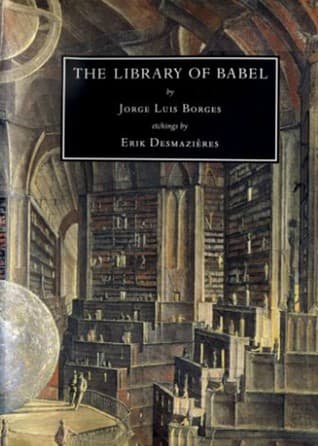
“The universe (which others call the Library) is composed of an indefinite, perhaps infinite, number of hexagonal galleries.”
— Opening sentence, establishing the central metaphor.

Genre
Fantasy / Science Fiction / Philosophy
Reading Time
30 min
Key Themes
See below
Sign in to track this book
In an infinite library of hexagonal rooms, a universe of every possible book exists, driving humanity to madness in its desperate, futile search for meaning and order amidst an overwhelming ocean of random characters.
The narrator, a librarian, begins by describing the Library of Babel. He says the universe (called the Library by others) consists of an unknown, perhaps infinite, number of hexagonal galleries. Each hexagon has a ventilation shaft in the center, surrounded by a low railing. Each wall of every hexagon has five bookshelves, each holding thirty-two books of the same size. These books have 410 pages, each page with 40 lines, each line with 80 characters. The books use twenty-five basic symbols: twenty-two letters, the comma, the period, and the space. The narrator states that the Library is complete and its books contain every possible combination of these symbols, holding all knowledge, all falsehoods, and all that is yet to be known or said.
The narrator explains that while the Library theoretically contains all possible truths, most of its books are gibberish, a chaotic and meaningless mix of characters. He gives examples like 'The Gilded Lightning' or 'The Cramped Ax.' He notes that for every sensible line or even a single word, millions of books contain only nonsense. This overwhelming amount of meaningless content makes finding any truly coherent or valuable text almost impossible. Librarians, who spend their lives searching, often become desperate or mad from this chaos, constantly facing the impossibility of their task.
In the Library's early days, librarians had great hope and enthusiasm. They believed in a 'Crimson Hexagon' – a special room with a summary of all other books – and a 'total book' that would be an index and complete collection of all the Library's contents. Many went on long, dangerous journeys through the Library to find these legendary volumes. This search led to various groups forming, such as the 'Purifiers,' who wanted to destroy meaningless books, and the 'Vindicators,' who believed in a magical book that would disprove all others. These searches often ended in disappointment, violence, and the tragic loss of countless lives, as the Library's vastness consumed their efforts.
The initial hope for discovery eventually turned to deep despair. Some librarians, frustrated, used a 'lottery' system, randomly picking books and hoping for a meaningful one, often with bad results. Others, the 'Vindicators,' thought that if a book contained only gibberish, it must also contain its own refutation within its pages, leading to a kind of fatalistic nihilism. These groups often acted destructively, burning books they thought useless or even attacking other librarians. The narrator describes how this time of chaos and violence resulted in many librarians' deaths and the destruction of countless books, further hiding any possible order.
Amidst the despair, a new belief appeared: the prophecy of a 'Man of the Book.' This person, it was said, would be a librarian able to navigate the Library's endless complexities, find the true books, and ultimately understand its meaning. This belief offered a small hope to some, sustaining them in their otherwise futile lives. However, the narrator notes the irony that many fakes appeared, claiming to be this promised figure, only to be exposed or to mislead their followers, further cementing the Library's reputation for deceptive appearances and unfulfilled promises.
The narrator, with his age and experience, has a more cynical understanding. He realizes that while the Library contains everything, the sheer amount of meaningless text makes any systematic search pointless. He notes that the same book, with a slightly different order of symbols, might be an entirely different book. He also points out that the very definition of 'meaning' becomes fluid; a book of random letters might, by chance, contain a sentence or even a paragraph of deep truth. This realization highlights the inherent chaos and the ultimately unknowable nature of the Library's total knowledge, challenging the idea of order and discoverability.
The narrator considers the idea that the Library, despite seeming endless, might actually be cyclical. He theorizes that if the Library is truly infinite and contains all combinations, then eventually, certain sequences of rooms and books must repeat. This idea offers a strange comfort, suggesting a hidden, though vast, order within the chaos. However, he quickly dismisses this as an unprovable idea, acknowledging that the scale of such a cycle would be so immense as to seem like true infinity to any human observer. The thought is both reassuring and deeply unsettling, implying that even newness is ultimately a repetition.
The narrator describes a librarian's life as one of constant frustration and despair. Their job is to search, to organize, but the Library's scale and randomness make these tasks meaningless. Librarians are born, live, and die in the hexagonal rooms, their lives spent on an impossible quest. They wander the galleries, exchange books, and sometimes find brief moments of joy in discovering a coherent phrase or a single meaningful word. Yet, the overwhelming reality is that their efforts are tiny compared to the Library's totality, leading most to deep sadness and a feeling of their own unimportance.
Despite his bleak outlook, the narrator ends with a faint philosophical hope. He suggests that while the Library appears chaotic and infinite, some underlying, perhaps divine, order or principle must govern its existence. He speculates that somewhere within its vastness, a single, perfect book might exist, or that the Library itself, in its totality, is a kind of divine message. This hope is not based on evidence but on a deep need for meaning in the face of overwhelming absurdity. He suggests that the Library's existence implies a creator, even if that creator's design remains unclear.
In a final, puzzling thought, the narrator suggests that the Library, despite appearing infinite, might actually be circular. He imagines it as a 'spherical Library' whose exact center is any given hexagon, and whose circumference is unreachable. This paradoxical image suggests a universe that is both boundless and contained, infinite in scope but finite in form. This idea, while offering no practical solution to the librarians' problems, provides a deep philosophical reinterpretation of their reality, suggesting that their very existence is a cosmic riddle, an endless maze that may ultimately lead back to its start.
The Protagonist
From a participant in the Library's initial quests for meaning, he evolves into a resigned, yet still philosophically curious, observer of its paradoxes.
The Supporting
They collectively move from initial hopeful exploration to various forms of despair, violence, and eventual resignation.
The Mentioned
Their movement rose and fell, ultimately proving futile and destructive.
The Mentioned
Their movement, like the Purifiers, was ultimately destructive and self-defeating.
The Mentioned
This figure remains a symbol of unfulfilled hope, always sought but never truly found.
The Library of Babel is a strong metaphor for the human condition in an infinite, perhaps meaningless, universe. The librarians, trapped in their hexagonal rooms, represent humanity's struggle to find purpose and knowledge in an overwhelming cosmos. Their despair, their brief hopes, and their eventual acceptance reflect the existential worry of individuals facing the vastness of existence and the limits of human understanding. The story highlights the paradox of endless information leading to endless ignorance.
“The Library is a sphere whose exact center is any one of its hexagons and whose circumference is inaccessible.”
Borges explores what knowledge and meaning actually are. In a library containing every possible book, the difference between sense and nonsense blurs. The sheer volume of gibberish makes truly meaningful texts almost impossible to find, suggesting that unlimited information does not mean understanding. The story asks if meaning is in the text or given by the reader, and if 'truth' can be found when surrounded by endless falsehoods and random arrangements. It challenges the idea that knowledge automatically brings enlightenment.
“For every sensible line, there are millions of nonsensical cacophonies.”
A main tension in the story is the struggle between the desire for order and the reality of overwhelming chaos. The librarians desperately look for patterns, indexes, and a 'total book' to bring order to the Library's seemingly random contents. However, the Library's infinite nature ensures that chaos always wins. This theme reflects humanity's natural drive to categorize and understand the world, and the deep frustration and despair that come when facing systems that defy such attempts. The Library is a universe where the potential for order is swallowed by the presence of all possible disorder.
“The certitude that everything has been written annihilates us, or renders us phantoms.”
The story is a deep reflection on language itself. By limiting the Library's contents to twenty-five basic symbols, Borges shows how a finite set of elements can create an infinite range of combinations, covering all possible expressions. This illustrates language's power and limits: it can build all knowledge, but also all nonsense. The librarians' inability to understand most books highlights the arbitrary nature of meaning and human reliance on shared rules to make sense of symbols. Language, here, is both a tool for communication and a barrier to ultimate understanding.
“The Library is total and its shelves register all the possible combinations of the twenty-odd orthographical symbols.”
The Library's inhabitants create various quasi-religious beliefs and philosophical schools in response to its nature. From the 'Purifiers' who destroy books to the 'Vindicators' who seek refutations, and the hope for a 'Man of the Book,' these groups mirror humanity's historical attempts to find spiritual or intellectual comfort when facing the unknown. The narrator's own philosophical thoughts, especially his final idea about a spherical, cyclical Library, reflect a deeper search for metaphysical truths and a desire for a rational, even if paradoxical, explanation for existence. The Library becomes a stand-in for the universe, prompting theological and existential questions.
“The impious maintain that nonsense is normal in the Library and that the reasonable (and even the humble and pure coherence) is an almost miraculous exception.”
The Library represents the universe and humanity's relationship to knowledge.
The Library of Babel itself is the primary plot device, functioning as an elaborate allegory. It symbolizes the universe, the human mind, or even God. Its infinite nature and the random arrangement of its books reflect the perceived meaninglessness or overwhelming complexity of existence. The librarians' struggles within it mirror humanity's existential search for knowledge, purpose, and order in a seemingly chaotic cosmos. The Library's structure (hexagonal rooms, uniform books) provides a concrete, yet fantastical, setting for abstract philosophical inquiry, making complex ideas tangible.
An aged librarian's reflective voice guides the reader through the Library's concepts.
The entire story is presented as a first-person philosophical monologue by an unnamed, aged librarian. This narrative choice allows Borges to directly explore complex ideas about infinity, knowledge, and meaning without the need for traditional plot or character development. The narrator's detached, contemplative, and slightly resigned tone lends an academic and almost mournful quality to the exploration of the Library's paradoxes. His personal journey from hope to despair and eventual philosophical acceptance frames the reader's understanding of the Library's implications.
The mythical concept of a book that indexes all other books.
The 'Catalog of Catalogs' or 'total book' is a recurring mythical concept among the librarians. It represents the ultimate form of order and understanding within the Library – a single volume that would index and explain all other books. This device highlights humanity's desperate longing for complete knowledge and a master key to unlock all secrets. Its perpetual absence and the futility of searching for it underscore the theme that ultimate order might be an unattainable ideal in an infinite system, or that the very concept is paradoxical.
All books share the same format, characters, and page count.
The strict uniformity of all books (410 pages, 40 lines per page, 80 characters per line, and a fixed set of 25 symbols) is a crucial plot device. This standardization ensures that every possible textual combination exists, making the Library truly 'total.' It also removes any external clues about a book's content, forcing librarians to confront the text itself. This uniformity underscores the democratic nature of information in the Library, where a profound truth looks identical to absolute gibberish, further emphasizing the challenge of discerning meaning.
“The universe (which others call the Library) is composed of an indefinite, perhaps infinite, number of hexagonal galleries.”
— Opening sentence, establishing the central metaphor.
“From these incontrovertible premises he deduced that the Library is total and that its shelves hold all the possible combinations of the twenty-odd orthographical symbols (number, period, comma, the twenty-two letters of the alphabet) a number which, though exceedingly vast, is not infinite.”
— Describing the scope and content of the Library.
“The Library is a sphere whose exact center is any hexagon and whose circumference is inaccessible.”
— Paradoxical description of the Library's shape and extent.
“In the vast Library, there are no two identical books.”
— A key characteristic of the Library's unique contents.
“I say that the Library is an endless, self-repeating encyclopedia, a chaos of identical elements, a mirror of the universe.”
— Reflecting on the nature of the Library's vastness and repetition.
“The certitude that everything has been written negates us, or makes us phantoms.”
— The philosophical implications of a total library.
“To speak is to fall into tautologies.”
— A comment on the limitations of language within the Library.
“The searchers for the Crimson Hexagon were also called inquisitors. They arrived in the Library with the intention of finding a book that would be the justification of all the others.”
— Describing a specific group within the Library and their quest.
“It is not illogical to think that the world is infinite. Those who judge it to be limited, postulate in some remote place, corridors and stairs and hexagons that are unthinkably abolished—which is absurd.”
— Arguing for the infinite nature of the Library/universe.
“No one can write a letter that is not already one of the millions of letters in that Library.”
— Highlighting the pre-existence of all possible texts.
“The unblemished Vindications exist; their readers have to be sought.”
— Suggesting that valuable truths are hidden but present.
“I know of a district whose librarians deny the existence of God and preserve the error by keeping silent.”
— A subtle jab at dogmatism and the suppression of information.
“The Library includes all verbal structures, all variations of the twenty-five orthographic symbols, but not a single absolute absurdity.”
— Distinguishing between meaningless combinations and absolute absurdity.
“The Library is an immense and useless monument to the human imagination.”
— A poignant reflection on the overwhelming nature of the Library.
“But the truth is that no one has yet found a rational argument for the existence of the Library.”
— Underscoring the mysterious and perhaps irrational nature of the Library's existence.
Ready to see how well you understood this book? Take our interactive quiz with 10 questions.
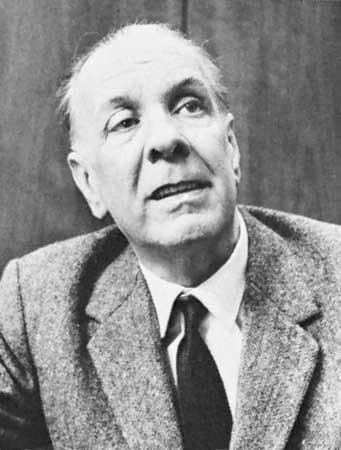
Jorge Francisco Isidoro Luis Borges Acevedo was an Argentine short-story writer, essayist, poet and translator, as well as a key figure in Spanish-language and international literature. His best-known books, Ficciones (Fictions) and El Aleph, published in the 1940s, are collections of short stories exploring themes of dreams, labyrinths, chance, infinity, archives, mirrors, fictional writers and mythology. Borges's works have contributed to philosophical literature and the fantasy genre, and have had a major influence on the magic realist movement in 20th century Latin American literature.







