“Justice is not about getting even. It's about making things right.”
— Evan says this to his sister Jessie, explaining his view on fairness after their lemonade stand money is stolen.

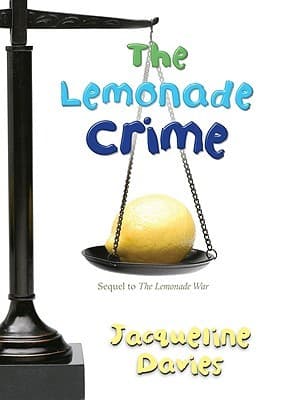
Jacqueline Davies (2011)
Genre
Children's / Mystery / Young Adult
Reading Time
90 min
Key Themes
See below
Sign in to track this book
When a lemonade stand's profits go missing, a fourth-grade class turns their playground into a courtroom, making them deal with justice and the emotional cost of accusation.
The story begins after 'The Lemonade War,' with Evan and Jessie Treski still dealing with their sibling relationship. Jessie, who likes order and rules, is upset when she finds the $208 she earned from her lemonade stand, kept in a red metal box under her bed, is gone. She immediately thinks Scott Spencer, a classmate who was in her room earlier to get a borrowed video game, took it. Evan, at first not believing her, gets more worried when he sees Jessie's true upset and her strong belief that Scott is the thief. This accusation sets up a problem that will involve their whole fourth-grade class.
The next day at school, Jessie is still very upset. Her teacher, Mrs. Peterson, notices and asks what's wrong. Jessie explains that her lemonade money was stolen and she suspects Scott. The class, already knowing about the Treskis' lemonade stand, gets interested in the mystery. Mrs. Peterson, seeing a chance to teach, suggests that instead of just accusing Scott, they could have a mock trial to decide if he is guilty, using the rules of the American legal system. This idea excites the class, especially Jessie, who sees it as a way to get justice, and Evan, who is curious about the legal process.
Mrs. Peterson helps the class set up the trial. They talk about the different roles in a courtroom: judge, prosecutor, defense attorney, jury, bailiff, and witnesses. Evan, surprisingly, offers to be Scott's defense attorney, which upsets Jessie. Jessie takes on the role of the prosecutor. Megan Moriarty is chosen as the judge, known for being fair and calm. Other students are assigned roles as jury members, witnesses, and the bailiff. The children start researching their roles and legal terms, getting ready for a serious courtroom drama on their school playground.
The trial starts on the playground. Jessie, as the prosecutor, presents her case against Scott. She clearly explains the indirect facts: Scott was in her room, he was the only non-family member there, and he had been a bit mischievous before. She calls her younger brother, Sam, as a witness, who says he saw Scott in Jessie's room. Jessie also talks about how hard she worked for the money. Her arguments are logical, but they depend a lot on suspicion rather than direct proof, leading to some doubts among the jury.
Evan, as Scott's defense attorney, tries a different way. He focuses on the lack of clear proof, arguing that suspicion does not mean guilt. He questions Jessie and Sam, trying to show inconsistencies or other reasons for Scott being there. Evan also calls Scott himself to the stand. Scott, though nervous, says he did not steal the money. Evan's plan is to make the jury doubt the case, saying that without absolute proof, Scott should be considered innocent, following the rule of 'innocent until proven guilty.'
During the defense's part, a surprise witness, Anna, comes forward. She says she saw Jessie's younger brother, Sam, playing with a red metal box on the day the money went missing. This brings up a new, unexpected suspect: Sam. The news causes confusion in the courtroom, as Jessie has to consider that her own brother might be involved. Evan uses this new information to make his argument for Scott's innocence stronger, suggesting there are other possible reasons for the money's disappearance.
With Anna's statement and the trial's pressure, Sam finally confesses. He admits to taking the red metal box and the money. However, his reason is not bad. He says he saw Jessie counting her money and wanted to 'help' her by making it disappear, thinking it was a game. He had hidden the money in a secret spot, planning to give it back later. His confession shows his innocent intentions, from a child's misunderstanding rather than theft. This solves the mystery of the missing money, clearing Scott's name.
With Sam's confession, the jury quickly decides: Scott Spencer is 'not guilty.' The trial ends, and Scott is relieved, his name cleared. Jessie is very embarrassed, realizing she had wrongly accused Scott and missed her own brother. Mrs. Peterson uses what happened to teach the class about the justice system, the need for fair process, and the dangers of making quick decisions. The experience affects the students, especially Jessie and Evan, who learn more about fairness, truth, and how people act.
After the trial, Jessie feels guilty. She sincerely apologizes to Scott for accusing him wrongly, and Scott, understanding, accepts her apology. The event teaches Jessie a lesson, as she often thinks she is very logical. Evan, having defended Scott, feels successful and now has a new appreciation for the legal process. The siblings, despite their early disagreements, come to understand each other better and see the importance of looking past surface-level facts. The money is found, and the class learns a valuable lesson in civics and understanding others.
The Protagonist
Jessie learns the hard lesson that logic and suspicion are not always enough for justice, developing a greater understanding of empathy and due process.
The Protagonist
Evan discovers a talent for advocacy and a deeper appreciation for the principles of justice, maturing in his understanding of fairness.
The Supporting
Scott is wrongly accused and then cleared, serving as a catalyst for the class's lesson in justice.
The Supporting
Mrs. Peterson expertly guides her students through a complex social and legal lesson, demonstrating effective teaching.
The Supporting
Megan successfully upholds the role of an impartial judge, demonstrating her inherent fairness.
The Supporting
Sam's innocent actions lead to a complex trial, and his confession brings resolution and teaches a lesson about unintentional consequences.
The Supporting
Anna's testimony provides the key turning point in the trial, demonstrating the power of observation.
The Supporting
The classmates collectively learn about the legal system and the ethics of judgment through their participation in the trial.
The main idea of the book is about justice and what it means to be fair. The mock trial shows how the legal system tries to be fair. Jessie at first thinks justice means getting her money back and punishing Scott. Evan, though, supports fair process and the idea that someone is innocent until proven guilty. When Sam's accidental 'theft' is found, it shows that true justice needs a full investigation and an unbiased approach, not just first suspicions. The book says that fairness means finding the truth and protecting the rights of the accused.
“'Innocent until proven guilty,' Evan said, 'That's the law.'”
The relationship between Jessie and Evan continues to be a main part of the story. Their different personalities—Jessie's logic and Evan's more relaxed way—create conflict. Jessie accusing Scott puts her against Evan, who defends Scott. This problem tests their bond, but their shared experience in the trial helps them understand and respect each other more. The book shows how siblings can have different views but still come together and support each other, even when they disagree.
“Jessie stared at her brother. It was like he was on the other team. And he was.”
The whole idea of 'The Lemonade Crime' is to teach about the American legal system. Mrs. Peterson's decision to have a mock trial teaches children about legal ideas like prosecution, defense, judge, jury, witnesses, evidence, questioning, and the rule of 'innocent until proven guilty.' The book makes these complex ideas clear by putting them in a relatable, child-friendly setting. It shows why a structured process is important for solving problems and making sure justice is done, instead of taking matters into one's own hands or making quick judgments.
“'The law is all about fairness,' Mrs. Peterson explained. 'And finding out the truth.'”
A major idea explored is the danger of judging someone and assuming guilt based on little information or past actions. Jessie's immediate belief that Scott stole her money comes from her observations of his past mischief and his being in her room. This initial bias stops her from seeing other possibilities. The trial makes her, and the readers, see how easy it is to make quick decisions and wrongly accuse someone without clear proof. Sam's innocence shows why it is important to get all the facts and avoid judging too soon, showing the harm of unproven assumptions.
“Jessie felt a hot flush creep up her neck. She had been so sure. So absolutely, positively sure.”
The book explores the difference between what seems true and what is actually true. Jessie's idea of Scott as a thief is based on a series of logical (to her) conclusions. Evan's defense questions this idea, asking for facts that can be checked. The trial slowly shows that what seemed like a clear theft was, in fact, a misunderstanding caused by a younger child's innocent actions. This idea teaches that things may not be what they seem, and a deeper look is often needed to find the full, unbiased truth, rather than relying on surface views or personal biases.
“'Just because it looks like a duck,' Evan said, 'doesn't mean it's a duck.'”
A classroom activity used to resolve a real-life conflict and teach civics.
The mock trial is the central plot device around which the entire story is built. It provides a structured framework for the narrative, allowing for the exploration of legal concepts, character development, and the resolution of the central mystery. By staging a courtroom on the playground, the author creates a relatable and engaging way for young readers to learn about the complexities of justice, evidence, and due process. It also serves as a catalyst for the Treski siblings' ongoing rivalry and eventual reconciliation, as they must take opposing sides in the 'courtroom'.
The story is told from the alternating perspectives of Jessie and Evan.
The novel employs first-person alternating narration, switching between Jessie's and Evan's points of view in different chapters. This device allows the reader to understand the motivations, thoughts, and biases of both protagonists. It highlights their individual struggles and their contrasting approaches to the problem, providing a richer, more nuanced understanding of their sibling dynamic and the unfolding events of the trial. This dual perspective is crucial for exploring themes of fairness and perception, as the reader experiences the 'evidence' and 'arguments' through two very different lenses.
The container for the missing money, serving as a key piece of evidence.
The red metal box is a significant symbolic and plot device. It's not just a container for Jessie's hard-earned lemonade money; it becomes the tangible focus of the 'crime.' Its disappearance and eventual reappearance are central to the mystery. The box itself, and who was last seen with it, becomes a key piece of circumstantial evidence that drives the prosecution's case and eventually leads to the crucial testimony of Anna, which redirects the investigation and ultimately uncovers the truth about Sam's involvement.
Evidence that relies on inference rather than direct observation.
Circumstantial evidence is a key plot device, especially in the prosecution's case. Jessie's entire argument against Scott is built on circumstantial evidence: he was in her room, he knew about the money, and he had a history of minor mischief. The trial effectively demonstrates the limitations and dangers of relying solely on such evidence without direct proof. Evan's defense strategy directly counters this, emphasizing the need for 'reasonable doubt' when only circumstantial evidence is presented, thereby educating the reader on this fundamental legal concept.
“Justice is not about getting even. It's about making things right.”
— Evan says this to his sister Jessie, explaining his view on fairness after their lemonade stand money is stolen.
“Sometimes the truth is like a lemon—it's sour, but it's real.”
— Jessie reflects on the difficulty of uncovering the truth during the investigation.
“A trial isn't about winning or losing. It's about finding out what really happened.”
— Jessie explains the purpose of their backyard trial to determine who stole the money.
“You can't judge a person by what they have, only by what they do.”
— Evan considers the character of the suspect, Scott Spencer, during the trial.
“Friendship is worth more than all the lemonade stands in the world.”
— Evan realizes the value of his friendship with Scott after the conflict.
“Sometimes the hardest thing to do is to admit you were wrong.”
— Reflection on the characters' struggles with accepting mistakes during the mystery.
“A secret is like a seed—it grows and grows until you have to let it out.”
— Jessie describes the burden of keeping secrets during the investigation.
“Money can be replaced, but trust is much harder to earn back.”
— Evan learns about the importance of trust after the theft.
“In a trial, everyone gets a chance to tell their side of the story.”
— Jessie emphasizes fairness during the backyard court proceedings.
“It's not about who's guilty or innocent. It's about understanding why.”
— Jessie tries to see the bigger picture behind the theft.
“A good detective looks at the facts, not just the feelings.”
— Jessie reminds herself to stay objective while solving the mystery.
“Sometimes the answer is right in front of you, but you have to be brave enough to see it.”
— Evan realizes the truth about the theft after overcoming his assumptions.
“Forgiveness is like lemonade—it turns something sour into something sweet.”
— Metaphor used to describe the resolution and healing after the conflict.
“You don't need a gavel to make things fair. You just need to listen.”
— Jessie explains her approach to justice in their makeshift trial.
Ready to see how well you understood this book? Take our interactive quiz with 10 questions.

Dan Gemeinhart
4.5

Kate O'Hearn
4.4

Jeanne Birdsall
4.4

Jen Wang
4.4

Wendelin Van Draanen
4.3

John Marsden
4.3

Chris Van Allsburg
4.3
Jennifer A. Nielsen
4.2