“The wind was blowing, not too hard, but hard enough to make the big cottonwood tree in front of their house sway back and forth like a giant metronome.”
— Describing the weather and the iconic tree in the opening of the novel.

Genre
Children's / Historical Fiction / Young Adult
Reading Time
230 min
Key Themes
See below
Sign in to track this book
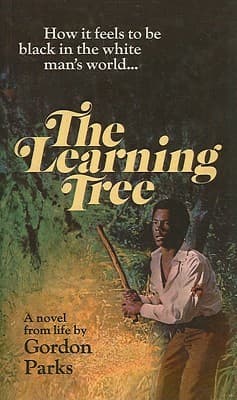
In 1920s rural Kansas, a young Black boy named Newt learns about life's innocence and racism's harshness through his experiences, which his grandfather calls his 'learning tree.'
The story begins in 1920s Cherokee Flats, Kansas, introducing twelve-year-old Newt Winger. Newt is a sensitive and watchful boy, connected to his family and nature. His early life includes both happy times playing with friends and the underlying tensions of racial prejudice and poverty in the community. He sees a storm that destroys a church, goes to a lively picnic where he first meets the volatile Marcus Savage, and experiences his grandmother's death. These early events start to shape Newt's understanding of life, death, and his small town's social dynamics.
Newt's world becomes more complicated because of Jim Horn, a cruel white man who scares the Black community. Newt sees Jim's brutality, including his beating of Big Mabel and his constant threats. One day, Newt and his friends are playing in Jim Horn's cotton patch, which is forbidden, and they are found. Jim violently attacks Newt. Newt, trying to save himself, throws a rock that blinds Jim in one eye. This event deeply affects Newt and marks a turning point, forcing him to face the harshness of violence and injustice.
After the cotton patch incident, Newt struggles with his conscience. Soon after, his friend Sarah, a mentally challenged girl, is found dead in the woods, a victim of sexual assault and murder. Newt, who was near the scene, gets involved in the investigation. He knows that Marcus Savage, a troubled boy from a poor and violent family, was also in the woods and saw something. The town's sheriff, Kirky, questions Newt. Out of fear and confusion, Newt does not tell all the details, especially about Marcus being there. This secret weighs heavily on Newt, adding to his guilt about Jim Horn and the growing danger in his life.
As the investigation into Sarah's murder continues, suspicion falls on Marcus Savage. Under pressure and likely manipulated, Marcus eventually confesses to the crime. However, Newt, who has seen Marcus's erratic behavior and the events around Sarah's death, doubts the confession. He believes Marcus is either covering for someone or is not fully responsible. Newt's inner conflict grows as he tries to match the official story with what he saw and his growing sense of duty to tell the truth, even if it means involving a dangerous person.
Marcus Savage is put on trial for Sarah's murder. The community is divided, with many quick to blame Marcus because of his reputation and family history. During the trial, Newt testifies. Despite his earlier doubts and what he knows, Newt mostly stays silent about everything he saw, especially regarding Marcus's presence and possible innocence. Marcus is found guilty and sent to a reformatory. Newt is deeply bothered by this outcome, feeling like he played a part in an injustice. This experience further shows him how easily truth can be hidden and lives ruined.
Throughout these difficult events, Newt's father, Pappy, provides stability. Pappy offers Newt quiet wisdom and life lessons, telling him to observe, learn, and understand the world, even its harsh parts. He teaches Newt about the 'learning tree' – the experiences, good and bad, that shape a person. Newt continues to deal with the racial tensions of Cherokee Flats, seeing both kindness and open prejudice. He starts to see the hypocrisy and unfairness that underlies much of his community's interactions, increasing his understanding and determination.
Some time later, Marcus Savage escapes from the reformatory and returns to Cherokee Flats. He is even more volatile and dangerous than before, driven by a desire for revenge against those he believes wronged him, including the town's authorities and possibly Newt. His return brings fear to the community, especially for Newt, who knows Marcus's secrets and his potential for violence. The tension in the town increases as Marcus's presence becomes a constant threat, and Newt finds himself more and more caught in a dangerous situation.
Newt eventually learns the truth: Jim Horn, not Marcus, murdered Sarah. Marcus had seen Jim commit the crime and had been forced to confess to protect himself or his family, or out of fear. This revelation confirms Newt's earlier doubts and the grave injustice done to Marcus. The truth, however, puts Newt in direct conflict with Jim Horn. A violent confrontation follows, where Jim, now even more angry and desperate, attacks Newt. Newt must defend himself against the man who has terrorized his community and committed such a terrible act.
The conflict between Newt and Jim Horn reaches its violent end. Jim, armed and dangerous, wants to silence Newt. Marcus Savage, who had returned to Cherokee Flats seeking his own justice or escape, steps in. Marcus confronts Jim Horn, sacrificing himself to save Newt's life. Marcus is killed, but his final act stops Jim Horn. This tragic event deeply affects Newt, showing him the complex web of injustice and sacrifice that has marked his youth in Cherokee Flats.
With Jim Horn defeated and Marcus Savage dead, a grim sense of closure comes to Cherokee Flats. Newt, now older and changed by what he has seen and gone through, decides to leave his hometown. He takes with him the lessons learned from his experiences – about good and evil, justice and injustice, love and loss, and human strength. His departure marks a shift from childhood innocence to a more mature understanding of the world, preparing him for a future where he will continue to learn and grow, carrying the 'learning tree' with him.
The Protagonist
Newt transforms from a naive boy into a thoughtful young man, learning to confront injustice and understand the complexities of human nature through his challenging experiences.
The Supporting
Pappy remains a steadfast figure, his wisdom guiding Newt's moral development without significant personal transformation, serving as a pillar of strength.
The Supporting/Antagonist
Marcus's arc is tragic, marked by injustice and violence, culminating in a redemptive act of self-sacrifice that reveals a hidden moral core.
The Antagonist
Jim Horn remains a consistently cruel and unrepentant character, embodying pure evil, until his ultimate demise.
The Supporting
Mama Winger maintains her role as a loving and supportive mother, her character remaining a constant source of comfort and stability for Newt.
The Supporting
Sheriff Kirky's character remains largely static, representing the flawed justice system of the era, more concerned with expediency than absolute truth.
The Mentioned
Sarah's character arc is cut short by her tragic death, serving primarily as a catalyst for the plot's major conflicts and revelations.
The Supporting
Big Mabel's character remains consistent as a symbol of the community's resilience in the face of oppression.
The Supporting
Reverend Kyle remains a steadfast spiritual leader, providing comfort and moral guidance to his community throughout the narrative.
The novel explores justice, especially the systemic injustice faced by the Black community in 1920s Kansas. Newt sees how racial prejudice and social status affect legal outcomes, most clearly in Marcus Savage's false conviction for Sarah's murder, while the real killer, Jim Horn, is free. Newt's struggle with telling the truth and his discovery of Jim Horn's guilt show the difficult path to true justice in a biased society. Legal justice versus moral justice is a main conflict.
““The learning tree...it's everything that happens to you, good and bad. You learn from it all, son. And it makes you who you are.””
Newt's story is a coming-of-age journey, marked by a gradual and often painful loss of innocence. As he grows from a twelve-year-old boy, he sees death, violence, racism, and sexual assault. Events like the blinding of Jim Horn, Sarah's murder, and Marcus's unjust conviction make Newt face the darker parts of human nature and society. These experiences remove his childhood naivety, changing him into a more mature, understanding, and morally aware young man who can grasp complex truths.
““He had learned much about the tree of life, about its beauty and its thorns, about its good and its evil. And he knew that he would never stop learning.””
The widespread and hidden nature of racial prejudice is a main theme, shaping almost every part of life in Cherokee Flats. The Black community lives under constant threat of violence and discrimination, shown by Jim Horn's unchecked brutality and the biased legal system that convicts Marcus Savage without proper investigation. Newt experiences both subtle and open forms of racism, from segregated social events to constant fear for his safety. The novel clearly shows the social hierarchy and limited chances for Black people during the Jim Crow era.
““You got to be careful, son. This ain't no place for a colored boy to be running around at night.””
Newt's sharp observation skills are important to the story, allowing him to put together truths that others miss or ignore. His ability to notice details, question assumptions, and remember events precisely is what eventually leads him to understand the real circumstances of Sarah's death and Marcus's innocence. This theme shows the importance of looking past surface appearances and challenging accepted stories, even when it is dangerous. Pappy's advice to 'learn from everything' reinforces the value of active observation in telling truth from lies.
““He had seen things that others had not, heard things that others had ignored. And in his mind, he had put them all together.””
Despite outside threats and internal divisions, the strength of family and community bonds is a key theme. The Winger family, with Pappy's wisdom and Mama's care, gives Newt a safe place and a moral foundation. The Black community, though vulnerable, also shows resilience, mutual support, and spiritual strength, especially through the church. These relationships offer comfort, guidance, and a sense of belonging in a difficult world, showing the importance of shared identity and experience in enduring hardship.
““The Wingers were a close family, bound by love and hardship, and by the unspoken knowledge that they had only each other to depend on.””
A central metaphor representing life's experiences as a source of wisdom.
The 'learning tree' is a powerful, overarching metaphor introduced by Newt's father, Pappy. It symbolizes the cumulative effect of all of life's experiences—both good and bad, joyous and tragic—in shaping an individual's character and understanding of the world. Every event, every encounter, every lesson learned is a 'leaf' on this tree. It encourages Newt to be observant, reflective, and to draw wisdom from all situations, even the most painful ones, reinforcing the novel's coming-of-age theme and Newt's personal growth.
Hints and clues that build tension and anticipate future events.
Parks skillfully uses foreshadowing to build suspense and deepen the emotional impact of later events. Early encounters with Marcus Savage, highlighting his volatile nature and difficult family, hint at his future troubles. Newt's initial confrontation with Jim Horn and the blinding incident foreshadows the greater violence and evil Jim represents. The recurring presence of the woods, initially a place of childhood exploration, later becomes associated with danger and death (Sarah's murder), creating a sense of impending doom and guiding the reader's expectations for darker plot developments.
Natural elements reflecting innocence, danger, and the cycle of life.
Nature plays a significant symbolic role in the novel. The idyllic scenes of Newt's childhood spent exploring fields and streams represent innocence and freedom. Conversely, the cotton patch, owned by Jim Horn, symbolizes forbidden territory and the site of violence and loss of innocence. The woods, initially a place of adventure, become a symbol of danger and hidden truths after Sarah's murder. The changing seasons and the resilience of the natural world also mirror the cycles of life, death, and renewal, reflecting the enduring spirit of the community amidst hardship.
Narrative perspective focused primarily through Newt's experiences and perceptions.
The novel is primarily told from a limited omniscient point of view, closely following Newt Winger's experiences, thoughts, and feelings. While the narrator has access to Newt's internal world, they generally do not delve into the minds of other characters, allowing the reader to discover events and truths alongside Newt. This narrative choice immerses the reader in Newt's coming-of-age journey, making his confusion, fear, and eventual understanding deeply personal and impactful. It emphasizes his role as an observer and learner, central to the 'learning tree' theme.
“The wind was blowing, not too hard, but hard enough to make the big cottonwood tree in front of their house sway back and forth like a giant metronome.”
— Describing the weather and the iconic tree in the opening of the novel.
“It was a time of innocence and ignorance, a time when the color of a man's skin could mean the difference between life and death.”
— Reflecting on the racial tensions and dangers of the era.
“He knew that one day he would have to leave this town, this place that was both his haven and his prison.”
— Newt's growing awareness of his future beyond Cherokee Flats.
“There was a certain beauty in the violence, a raw, untamed power that both terrified and fascinated him.”
— Newt witnessing a violent event, grappling with complex emotions.
“His mother’s hands, always busy, always working, were a constant reminder of the strength and resilience of black women.”
— Newt observing his mother's tireless efforts and reflecting on her character.
“The world was full of good and evil, and sometimes it was hard to tell the difference.”
— Newt's internal struggle to understand the complexities of human nature.
“He learned early that laughter could be a weapon, a shield, and sometimes, a bridge between two vastly different worlds.”
— Newt's observations on the power and utility of humor.
“Every secret place, every hidden path, every whispering tree held a story.”
— Newt's deep connection to his environment and its perceived history.
“Fear was a cold hand that gripped his heart, but curiosity was a fire that burned away the chill.”
— Newt's internal conflict between fear and his desire to explore and understand.
“He watched the world, not just with his eyes, but with his whole being, soaking in every detail, every nuance.”
— Describing Newt's observant and sensitive nature.
“The past was not just a memory; it was a living, breathing thing that walked beside them every day.”
— Reflecting on the pervasive influence of history and past events on the present.
“He wanted to capture it all, the beauty and the ugliness, the joy and the sorrow, and hold it up for the world to see.”
— Newt's nascent artistic aspirations and desire to document life.
“The learning tree, as his mother called it, was everywhere. It was in the fields, in the river, in the faces of the people he knew.”
— Explaining the metaphorical significance of the 'learning tree' as life's experiences.
“Sometimes, the strongest people were the ones who cried in silence, those who carried their burdens without a single complaint.”
— Newt's understanding of quiet strength and resilience in others.
Ready to see how well you understood this book? Take our interactive quiz with 10 questions.

Biography coming soon.

Dan Gemeinhart
4.5

Kate O'Hearn
4.4

Jeanne Birdsall
4.4

Jen Wang
4.4
Wendelin Van Draanen
4.3

John Marsden
4.3

Chris Van Allsburg
4.3
Jennifer A. Nielsen
4.2