“Love doesn't just sit there, like a stone, it has to be made, like bread; remade all the time, made new.”
— Heather Lelache's reflection on the nature of love.

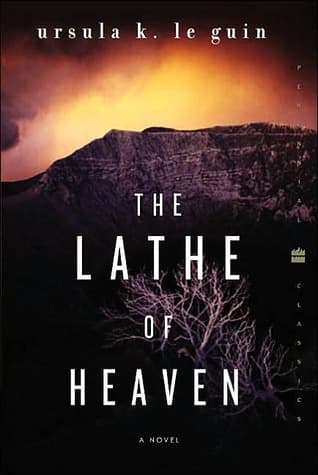
Ursula K. Le Guin (1971)
Genre
Fantasy / Science Fiction
Reading Time
180 min
Key Themes
See below
Sign in to track this book
In a future Portland ravaged by climate change, a man whose dreams reshape reality battles his manipulative psychiatrist, who uses this power to 'improve' humanity, only to unravel existence itself.
George Orr, a man troubled by dreams that literally alter reality, is compelled by the state to seek psychiatric help. He is assigned to Dr. William Haber, a seemingly benevolent and ambitious psychiatrist. George explains his unique affliction: when he dreams, the world subtly but entirely changes, and only George remembers the previous reality. Dr. Haber, initially skeptical, quickly realizes George's immense power. He decides to use George's dreams to 'fix' the world's problems, starting with a seemingly harmless request to dream of a world without overpopulation. George is deeply uneasy, fearing the unpredictable consequences of such interventions, but feels powerless to resist Haber's increasingly insistent suggestions under the guise of therapy.
Following Dr. Haber's suggestion to alleviate global overpopulation, George dreams of a world with fewer people. He wakes to a reality where the world's population is drastically reduced, but not through humane means. Instead, a devastating plague, the 'Green Plague,' has wiped out billions, leaving a traumatized and sparsely populated Earth. George is horrified, remembering a world teeming with life, while everyone else accepts the plague as a natural historical event. Dr. Haber, however, sees this as a success, though with unforeseen side effects, and remains undeterred in his ambition to perfect humanity through George's dreams. This event solidifies George's fear that manipulating reality through his dreams only leads to greater suffering.
To foster global unity and prevent future conflicts, Dr. Haber instructs George to dream of an external threat. George dreams, and the world awakens to the presence of 'Turanian' aliens on the moon. These aliens are immediately perceived as a threat, uniting humanity in a common defense effort, just as Haber intended. However, this unity comes at the cost of constant fear and the diversion of all resources into a prolonged, defensive war against the unseen lunar inhabitants. George meets his lawyer, Heather Lelache, who, like others, believes the Turanian threat is real, further isolating George in his knowledge of the fabricated reality. Haber, despite the ongoing conflict, sees this as progress towards a stronger humanity.
Disturbed by the perpetual war with the Turanians, George, under Haber's direction, dreams for peace. The result is a world where all aggression and conflict are suppressed. Humanity becomes docile and passive, losing its drive and creativity. The Turanians are now friendly, but humanity's spirit is dulled. Heather Lelache, who has been growing closer to George and starting to sense the shifts in reality, finds this new world deeply unsettling, recognizing a loss of vitality. George feels immense guilt, realizing that even well-intentioned dreams have catastrophic, unforeseen consequences, draining the essence of human experience. Haber, however, sees this as a necessary step towards a perfectly ordered society, even if it means sacrificing individual will.
Heather Lelache, George's lawyer and later his lover, starts to experience fragmented memories of the previous realities. These flashes cause her confusion and distress, but she instinctively trusts George's explanations, even though they defy logic. Her ability to retain some memories makes her George's only confidante and ally. She becomes aware of Dr. Haber's manipulations and the dangerous path he is leading George down. Heather's skepticism of Haber's utopian visions grows, and she actively tries to protect George from the psychiatrist's increasing control, sensing the loss of genuine human experience in each 'improved' reality. Her growing awareness makes her a witness to Haber's arrogance.
Driven by his desire to create a perfect world, Dr. Haber develops a machine called the 'Aura,' designed to amplify George's dream-altering abilities. He then makes a fatal miscalculation: he attempts to use the Aura to dream himself. This act of arrogance, trying to grant himself the power he exploits in George, shatters reality. The world begins to fragment, with multiple realities overlapping and collapsing into chaos. Heather and George witness impossible phenomena—buildings appearing and disappearing, people changing forms, and existence itself unraveling. This catastrophic event is the direct consequence of Haber's attempt to seize ultimate control, proving that some powers are not meant for human hands.
As reality unravels around them, George and Heather find themselves in a terrifying, mutable world where the laws of physics and existence are constantly in flux. They encounter various iterations of people and places, remnants of George's past dreams, all jumbled together. Their primary goal becomes finding a stable reality, a place where existence is coherent and enduring. George, now more determined than ever to stop Haber's destructive influence, understands that he must use his dreams not to change, but to *stabilize* the world. Heather's fragmented memories and her trust in George are their only anchors in the swirling chaos, as they try to guide him towards a resolution that won't destroy everything.
Amidst the collapsing realities, George and Heather find themselves in a space that seems to be the epicenter of the disruption, where Haber, now an old, broken man, still sits, muttering about his lost perfection. George realizes that the only way to stop the collapse is to undo Haber's last, most destructive dream. He must dream of a world where Haber *doesn't* have the power to dream or manipulate. This is a crucial moment for George, as he must actively use his power, not to create a 'better' world, but to restore a natural, unmanipulated existence. He is no longer a passive victim but an active agent trying to mend the fabric of reality that Haber so carelessly tore apart.
George uses his dream to stabilize reality, removing Haber's ability to dream effectively and allowing the universe to settle into a new, coherent state. This new world is not perfect; it retains elements of previous alterations, but it is stable and capable of natural progression. The Turanians are now peaceful, integrated into Earth society, and Haber, though stripped of his dangerous influence, is left with his memories and his arrogance, a living reminder of the dangers of unchecked power. George and Heather are together, having survived the ordeal, and George continues to have his effective dreams, but he has learned to fear their power and to use them, if at all, with extreme caution and respect for the natural order of things.
In the aftermath, George and Heather settle into a life together. The world is a strange mix of what was and what George's dreams created, but it is coherent. George still experiences effective dreams, but he is far more cautious, often trying to dream things back to their original state or to simply *not dream* about specific changes. He has learned that interference, even with good intentions, often creates worse problems. Haber, now working in a different capacity, remains a cautionary tale, his ambition leading to his downfall. George and Heather’s relationship is deepened by their shared, unique history, and they navigate this new reality with an understanding of the delicate balance of existence and the potential for both creation and destruction inherent in George's extraordinary gift.
The Protagonist
George transforms from a passive victim of his power and Haber's manipulation into an active agent who, while still fearing his gift, learns to use it responsibly to stabilize reality.
The Antagonist
Haber's arc is a descent from well-intentioned ambition to destructive megalomania, culminating in his self-inflicted downfall as he attempts to seize George's power.
The Supporting
Heather evolves from a skeptical lawyer to George's devoted partner, becoming the only person who truly shares his burden and helps him navigate the collapsing realities.
The Mentioned
The Turanians' role shifts from a perceived threat to a peaceful, integrated species, reflecting the changing realities created by George's dreams.
The Supporting
Kish tries to apply scientific method to chaos, ultimately demonstrating the limits of human understanding in the face of impossible phenomena.
The novel examines the seductive but perilous nature of utopian ideals when pursued through unchecked power. Dr. Haber, with his belief in his ability to 'fix' humanity, repeatedly uses George's dreams to create what he perceives as a better world. Each intervention, however, leads to unforeseen and often horrific consequences, demonstrating that attempts to engineer perfection result in suffering, loss of freedom, or a hollow existence. Haber's ultimate attempt to seize George's power for himself leads to the collapse of reality, illustrating that even benevolent intentions, when coupled with absolute power, can lead to absolute destruction. The constant shifts in reality, each worse than the last, serve as a warning against totalitarian control and the arrogance of human intervention in the natural order.
“''What good is a dream that comes true?''”
Le Guin explores the fluidity and subjectivity of reality. George Orr's dreams constantly reshape the world, yet only he (and later Heather) remembers the previous realities. This creates isolation for George and forces the reader to question what is 'real' if the past can be so easily rewritten. The novel suggests that reality is not a fixed, objective truth but a fragile construct influenced by perception and memory. The collapse of reality in the later chapters shows how tenuous our grasp on existence truly is, and how easily it can be shattered when fundamental truths are altered. The persistent question is whether a reality that no one remembers is truly lost, or if its echoes persist in some unseen way.
“''It is always hard to remember that other people's perceptions are as real as your own.''”
Through Haber's repeated attempts to eliminate suffering, conflict, and even boredom, the novel argues for the value of imperfection and the full spectrum of human experience. When Haber removes overpopulation, a plague ensues. When he removes conflict, humanity becomes passive and devoid of spirit. The novel suggests that pain, struggle, and sorrow are integral to what it means to be human, fostering creativity, growth, and genuine joy. A 'perfect' world, devoid of these elements, is sterile, lifeless, and undesirable. George's reluctance to use his dreams, and his eventual desire to restore a natural, though flawed, world, supports the idea that true flourishing comes from embracing the entirety of existence, not just its pleasant aspects.
“''A world without suffering, George, is a world without love.''”
George Orr's character embodies the burden of responsibility that comes with extraordinary power. He never sought his ability and is terrified of its implications. His passivity and reluctance stem from a deep understanding that any intervention, no matter how well-intentioned, can have catastrophic and unpredictable consequences. The novel highlights the ethical dilemma of wielding god-like power over the lives of billions, even when trying to 'help.' George's journey is one of learning to manage this immense responsibility, not by controlling it, but by understanding its limits and the wisdom of non-intervention. His struggle contrasts sharply with Haber's eagerness to shoulder such a burden, revealing the moral fortitude required to understand the weight of creation and destruction.
“''What George Orr could do, even asleep, was dangerous. It had to be stopped.''”
George Orr's unique ability to alter reality through his dreams.
This is the central plot device. George's dreams are not mere subconscious fantasies; they are literal engines of reality alteration. When George dreams, the world changes to match his dream, and everyone (except George and later Heather) remembers the new reality as if it had always been that way. This device drives the entire narrative, creating the premise for Dr. Haber's manipulation and the subsequent chaotic shifts in the world. It is both a blessing and a curse, representing immense creative power but also profound destructive potential, and it is the source of George's existential dilemma.
George's (and later Heather's) unique ability to remember previous realities.
This device is crucial for establishing George's isolation and for allowing the reader to track the narrative's progress through the constantly shifting realities. Without George's memory, the story would lack coherence, as each new reality would simply be accepted as the norm. Heather's gradual acquisition of fragmented memories serves to validate George's experience and provide him with an ally, transforming his solitary burden into a shared struggle. It underscores the novel's exploration of reality, memory, and subjective truth, making George a unique and unreliable narrator in a world that consistently contradicts his lived experience.
A device created by Dr. Haber to enhance and focus George's dream power.
The Aura machine is a technological plot device that symbolizes Dr. Haber's scientific hubris and his desire to control and amplify George's natural abilities. Initially, it's presented as a therapeutic tool, but it quickly becomes a means for Haber to more efficiently manipulate George's dreams. Its ultimate function is to facilitate Haber's catastrophic attempt to dream himself, leading to the collapse of reality. The machine acts as a catalyst for the story's climax, demonstrating how technological advancement, when combined with unchecked ambition, can lead to profound destruction, rather than progress.
The constant alteration of the world's history, environment, and social structure.
This pervasive device is a direct consequence of George's effective dreams. Each chapter presents a new version of Earth, with altered demographics, geopolitical landscapes, and even biological laws. This constant flux keeps the reader disoriented, mirroring George's own experience of living in a world that is never stable. It allows Le Guin to explore various dystopian scenarios and critique different approaches to societal problems, demonstrating that every 'solution' created by Haber's manipulation carries an unexpected and often negative price. The device highlights the fragility of existence and the profound interconnectedness of all things.
“Love doesn't just sit there, like a stone, it has to be made, like bread; remade all the time, made new.”
— Heather Lelache's reflection on the nature of love.
“The only thing that makes life possible is permanent, intolerable uncertainty: not knowing what comes next.”
— Dr. Haber's philosophical musings on the human condition.
“To make a world is to be a god.”
— A thought about the power of effective dreaming and its consequences.
“We are the only ones who can build the future, and we are the future.”
— Dr. Haber's conviction in humanity's ability to shape its destiny.
“Things don't have purposes, they have only effects.”
— George Orr contemplating the nature of reality and causality.
“It is not enough to be good; you must be good for something.”
— A principle that guides Dr. Haber's actions and ambitions.
“The truth is a matter of the imagination.”
— George Orr's realization about the subjective nature of reality.
“Power is a thing that can be used only once.”
— A warning about the ultimate cost of exercising absolute power.
“What is real? What is not real? It's just a matter of what you're used to.”
— A character's observation on the malleability of perception and reality.
“The dream is a little hidden door in the innermost and most secret recesses of the soul, opening into that cosmic night which was psyche long before there was any ego-consciousness.”
— A quote from Carl Jung used as an epigraph, setting the theme of dreams and the unconscious.
“Evil is a word. We are human beings, and we do what we do.”
— A character's pragmatic view on human actions, eschewing moral labels.
“He wanted to do good. And he did good, to a degree. But the good he did was not the good he intended.”
— Narration reflecting on Dr. Haber's well-intentioned but disastrous efforts.
“The world is not a problem to be solved, but a mystery to be lived.”
— George Orr's growing understanding of the universe's complexity.
“There are no permanent solutions, only permanent human beings.”
— A cynical yet realistic perspective on the nature of problems and human endurance.
“The universe is a dream, and it wants to be dreamt.”
— A profound statement on the active, dynamic nature of reality as perceived through dreams.
Ready to see how well you understood this book? Take our interactive quiz with 10 questions.
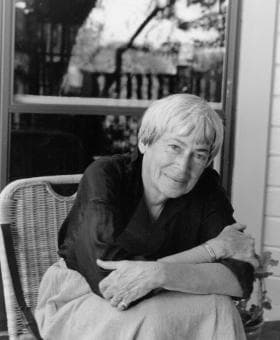
Ursula Kroeber Le Guin was an American author best known for her works of speculative fiction, including science fiction works set in her Hainish universe, and the Earthsea fantasy series. She was first published in 1959, and her literary career spanned nearly sixty years, producing more than twenty novels and over a hundred short stories, in addition to poetry, literary criticism, translations, and children's books. Frequently described as an author of science fiction, Le Guin has also been called a "major voice in American Letters". Le Guin said she would prefer to be known as an "American novelist".







