“I am the last werewolf. There are no others. I am the last of my kind.”
— Jake's opening declaration of his unique and lonely existence.

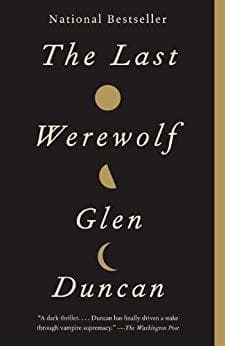
Glen Duncan (2011)
Genre
Fantasy
Reading Time
450 min
Key Themes
See below
Sign in to track this book
Haunted by two centuries of monstrous acts, the last werewolf on Earth plans his demise, only to be pulled back into a bloody, passionate fight for survival and a chance at redemption by a sudden murder and an unexpected encounter.
Jacob Marlowe, a 200-year-old werewolf, is in despair. He believes himself to be the last of his kind, after the recent deaths of his fellow lycanthropes, particularly his long-time friend and lover, Agnes. Tormented by the memory of his first kill and the cyclical violence of his existence, Jacob decides to end his life. He plans to use a silver bullet on the upcoming full moon, ensuring his death will be permanent. His journal entries show his weariness and philosophical thoughts on his condition. As he prepares for his final transformation, news reaches him of a brutal murder in London, with signs of a werewolf attack, which initially puzzles him, believing himself to be unique.
The murder in London, attributed to a werewolf, brings Dr. Talos, the head of the World Organisation for Werewolf Oversight and Control (WOOF), to the scene. He sends a new, highly trained agent, Sonya Walker, to track down and eliminate the killer, whom they believe is Jacob. Meanwhile, Inspector Aickman, a cynical and experienced detective, is assigned to the gruesome murder case. Aickman, despite his initial skepticism, has to confront the impossible nature of the crime, eventually becoming convinced that a supernatural element is at play. Sonya, a capable hunter, quickly picks up Jacob's scent, setting the stage for their meeting.
Jacob, trying to evade Sonya, finds himself drawn to her. Their first real encounter is tense and has a strange, undeniable attraction. Sonya, despite her mission to kill him, is intrigued by Jacob's intelligence and melancholic charm, while Jacob is fascinated by her strength and beauty. During their game, Jacob learns more about WOOF and their long-standing war against werewolves. He also begins to suspect that the recent murder wasn't his doing, meaning there might be another werewolf out there. This unexpected connection with Sonya starts to reignite a desire for life within Jacob, complicating his suicide plans.
Jacob and Sonya, now working in an uneasy alliance, investigate the recent murders. They discover that the killer is not a traditional werewolf like Jacob but a new, more savage and less predictable breed, a 'New World' werewolf, born from a different, more primal lineage. These new werewolves are led by a charismatic and ruthless figure named Kalugin. Kalugin and his pack are actively hunting down the 'Old World' werewolves, aiming to eradicate them and establish their dominance. This revelation shifts Jacob's focus from suicide to survival and the protection of what little remains of his kind, primarily himself.
As Jacob and Sonya learn more about the new werewolves, they become targets for both WOOF, who still consider Jacob a threat, and Kalugin's pack. They are forced to go on the run, moving across Europe. During their desperate flight, their relationship evolves from a tense alliance into a passionate and deeply intimate affair. Sonya struggles with her duty as a hunter and her growing love for Jacob, while Jacob experiences a resurgence of emotions he thought long dead. Their shared danger and mutual vulnerability create a strong bond, making Jacob question his previous desire for death more than ever.
Inspector Aickman, despite warnings from his superiors, continues his investigation into the supernatural murders. He pieces together clues, coming to terms with the existence of werewolves and the secretive organization, WOOF. His pursuit eventually leads him closer to Jacob and Sonya. At the same time, within WOOF, tensions rise. Dr. Talos's authority is challenged by those who disagree with his rigid methods and his focus on exterminating all werewolves, regardless of their nature. Some agents, including Sonya's colleagues, express doubts about the organization's objectives, particularly after Sonya's disappearance and her perceived defection.
Jacob and Sonya are eventually cornered by Kalugin and his pack of New World werewolves. A brutal and bloody confrontation happens. The new werewolves are far more aggressive and less susceptible to traditional weaknesses, making them formidable opponents. Jacob, drawing upon centuries of experience, fights fiercely to protect Sonya and himself. Sonya, in turn, uses her advanced hunting skills to combat the pack. They suffer significant injuries but manage to escape, confirming the immense threat posed by Kalugin and solidifying their resolve to stop him, even if it means sacrificing their own lives.
Recognizing the threat Kalugin poses to both humanity and the few remaining Old World werewolves, Jacob and Sonya create a desperate plan. They decide to confront Kalugin directly, aiming to exploit his weaknesses and destroy his pack. This plan uses Jacob's knowledge of werewolf lore and Sonya's tactical expertise. They understand that this will likely be a suicide mission, but they are determined to prevent Kalugin from unleashing his breed upon the world. Their love for each other intensifies as they prepare for what they believe will be their final battle.
The climactic battle takes place in a secluded, ancient location. Jacob and Sonya, alongside a reluctantly allied Inspector Aickman, confront Kalugin and his remaining pack. The fight is savage and relentless. Jacob, in his transformed state, shows his immense power and primal ferocity, while Sonya, armed with specialized weapons, fights with deadly precision. Many are killed on both sides. In a tragic turn of events, Sonya is mortally wounded during the struggle. Her death fuels Jacob's rage, and he ultimately defeats Kalugin, but at a terrible cost to himself.
After the battle, Jacob is the sole survivor among the werewolves, truly the last of his kind. He is heartbroken by Sonya's death, which leaves him with an even deeper sense of loss than before. However, her love and their shared fight have changed him. He no longer seeks suicide but accepts his existence, albeit with sorrow. Inspector Aickman, having witnessed the impossible, is left to grapple with a world changed forever. Jacob, now bearing the weight of his survival and Sonya's memory, disappears into the world, a solitary figure forever marked by love, loss, and the eternal curse of the werewolf, but with a renewed, painful will to live.
The Protagonist
Jacob transforms from a despairing, suicidal creature into one who, despite profound loss, chooses to live and fight for his existence, finding love and purpose along the way.
The Supporting/Love Interest
Sonya evolves from a duty-bound hunter to a passionate lover and ally, ultimately sacrificing herself for Jacob and the greater good.
The Supporting
Aickman's worldview is shattered and redefined by his exposure to werewolves, transforming him from a skeptic to a reluctant witness of the supernatural.
The Antagonist
Kalugin rises as a dangerous new threat, only to be defeated in a climactic battle, ensuring the survival of neither his nor Jacob's lineage.
The Supporting
Dr. Talos remains steadfast in his mission, his authority challenged but his core beliefs unchanged, serving as a constant antagonistic force against Jacob.
The Mentioned
Her story is complete before the novel begins, serving as a foundational element for Jacob's initial state of mind.
The Supporting
The journal's narrative arc mirrors Jacob's, beginning in despair and ending with a new, albeit melancholic, acceptance of life.
The Mentioned
Their collective arc is to represent the enduring opposition to werewolves, even as their individual roles are minor.
The novel explores what it means to be human and what it means to be a monster. Jacob, despite his werewolf nature, often shows more humanity, introspection, and capacity for love than many human characters. His internal struggle with his 'lunatic appetites' and his thoughts on his existence show the blurred lines between man and beast. The arrival of the 'New World' werewolves complicates this, showing a truly monstrous, instinct-driven identity in contrast to Jacob's more 'civilized' monstrosity. The book questions whether monstrosity is inherent or a product of action.
“Two hundred years of this. Two hundred years of being a monster with a human's heart, or a human with a monster's heart. It hardly matters which.”
Love, particularly the unexpected romance between Jacob and Sonya, is a strong redemptive force. Jacob, initially consumed by despair and a desire for death, finds a renewed will to live through his connection with Sonya. Her love allows him to confront his past and fight for a future. Even after Sonya's tragic death, her memory and the love they shared give Jacob a reason to continue existing, changing his initial suicidal impulses into a painful but resolute acceptance of life. Love offers a temporary escape from his curse and a reason to accept his identity.
“I was dead. Or as good as. And then you came. And now I’m alive. God help me, I’m alive.”
Jacob's 200-year existence is portrayed not as a gift, but as a curse. He has witnessed countless historical events, outlived all his loved ones, and is tormented by the cyclical violence of his transformations. The novel emphasizes the psychological toll of immortality, especially when coupled with the unique isolation of being a werewolf. His initial despair comes directly from this burden of perpetual existence and the loneliness that comes with being the 'last of his kind,' a feeling only partially alleviated by his brief connection with Sonya.
“To live forever is to watch everything you love die. Again and again. It's not a gift; it's a punishment.”
The distinction between Jacob and the 'New World' werewolves, particularly Kalugin, highlights the theme of nature versus nurture. Jacob, an 'Old World' werewolf, is depicted as cultured, introspective, and capable of love, suggesting that centuries of human interaction and philosophical thought have shaped his monstrous nature. In contrast, Kalugin's pack is purely instinctual, savage, and driven by primal urges, representing an untamed, un-nurtured monstrosity. The novel suggests that even within a supernatural species, there can be varying degrees of 'humanity' or 'beastliness' influenced by their experiences and lineage.
“They were not like us. We were beasts in human skin; they were just beasts, in any skin.”
The dynamic between the hunter and the hunted is central to the narrative, primarily through the evolving relationship between Jacob (the hunted werewolf) and Sonya (the human hunter). Initially, their roles are clear, but as their connection deepens, these roles blur. Sonya questions her mission, and Jacob, in turn, becomes a hunter of the new breed of werewolves. This theme explores the moral ambiguities of violence, the nature of predation, and how perspectives can shift when one understands the 'other.' It also highlights the constant struggle for survival against overwhelming odds.
“She was the hunter, I the prey. And then, somehow, we became the same beast, hunting a greater evil.”
Provides deep insight into the protagonist's inner world and historical context.
Jacob's journal serves as a crucial narrative device, breaking up the third-person action with first-person, highly introspective passages. These entries allow the reader direct access to Jacob's philosophical thoughts, his despair, his memories spanning two centuries, and his reflections on his condition. It deepens his character, provides backstory without heavy exposition, and offers a unique, intimate perspective on the werewolf curse, contrasting his internal humanity with his external monstrosity. It also helps to establish the book's melancholic and intellectual tone.
A narrative distinction that drives conflict and explores themes of evolution and savagery.
This device creates a clear division within the werewolf species, providing both an external antagonist (Kalugin's pack) and a thematic exploration of different forms of monstrosity. The 'Old World' werewolves like Jacob are portrayed as more ancient, refined, and capable of introspection, while the 'New World' breed is savage, instinctual, and purely predatory. This distinction raises questions about evolution, the impact of time and civilization on primal urges, and the varying degrees of 'humanity' within supernatural beings, intensifying the stakes for Jacob as he fights for the survival of his unique lineage.
A shadowy organization representing humanity's institutionalized fear and control over the supernatural.
WOOF functions as a primary antagonistic force, representing humanity's organized, scientific, and often ruthless response to the existence of werewolves. It provides the initial conflict for Jacob and Sonya, and its vast resources and long history of hunting werewolves establish the high stakes of their world. WOOF also serves to explore themes of control, secrecy, and the potential for human institutions to become as monstrous as the 'monsters' they hunt, particularly through the character of Dr. Talos and the moral dilemmas faced by agents like Sonya.
A recurring temporal and physical constraint that dictates plot points and character transformations.
The monthly cycle of the full moon is a fundamental plot device, dictating Jacob's physical transformations and serving as a constant reminder of his curse. It creates natural deadlines and heightened tension for various plot points, from Jacob's initial suicide plan to his desperate escapes and confrontations. The moon's influence is not just biological but also psychological, deeply affecting Jacob's emotional state and his philosophical reflections on his dual nature. It grounds the supernatural elements in a predictable, yet terrifying, rhythm.
“I am the last werewolf. There are no others. I am the last of my kind.”
— Jake's opening declaration of his unique and lonely existence.
“The moon doesn't care. The moon is just a rock in the sky.”
— Jake reflecting on the indifference of nature to his curse.
“I've lived two hundred years and I'm tired of it. I'm tired of the moon, the hunger, the killing.”
— Jake expressing his weariness with immortality and violence.
“Love is the only thing that makes immortality bearable.”
— Jake contemplating the role of love in his long life.
“The beast is not a separate entity. It is me. I am the beast.”
— Jake acknowledging the integration of his human and monstrous selves.
“We are all monsters in our own way. Some of us just have sharper teeth.”
— Jake philosophizing on the nature of humanity and monstrosity.
“The hunger is a constant. It is the one thing I can always rely on.”
— Jake describing the relentless drive of his werewolf nature.
“Death is not the enemy. Boredom is.”
— Jake's perspective on the challenges of an endless life.
“I have seen civilizations rise and fall. I have seen empires crumble. And I am still here.”
— Jake reflecting on his longevity and historical perspective.
“The transformation is not a curse. It is a revelation.”
— Jake redefining his experience of becoming a werewolf.
“We are defined by our choices, not our nature.”
— Jake asserting the importance of free will over inherent traits.
“The world is full of hunters. Some hunt with guns, others with words.”
— Jake observing the various forms of predation in society.
“To be alone is to be free. To be free is to be alone.”
— Jake contemplating the paradox of solitude and freedom.
“I have killed, and I have loved. Both with equal passion.”
— Jake comparing the intensity of his violent and emotional experiences.
Ready to see how well you understood this book? Take our interactive quiz with 10 questions.

Biography coming soon.







