“Happy is the man, I thought, who, before dying, succeeds in blessing his soul with all the blessings of the earth.”
— Jesus contemplates the human experience and the desire for fulfillment.


Nikos Kazantzakis (2012)
Genre
Historical Fiction / Spirituality / Philosophy
Reading Time
12-15 hours
Key Themes
See below
Sign in to track this book
Kazantzakis’s controversial masterpiece explores the human struggles of Jesus, who battles doubt, fear, and the appeal of a normal life before accepting his divine sacrifice.
In Nazareth, Jesus, a young carpenter, is troubled by internal conflict and visions. He believes himself a sinner and deliberately builds crosses for the Roman occupiers to crucify Jewish rebels, hoping this act will make God reveal His will. He is shunned by his community, including his mother, Mary, and his friend, Judas Iscariot, who dislike him for helping the oppressors. Judas, a passionate zealot, confronts Jesus, expressing his disappointment and urging him to join the fight for freedom. Jesus, however, feels a different, unexplained calling, a deep sense of responsibility and a terrifying destiny that he struggles to understand and often tries to resist.
Overwhelmed by his internal struggles and his village's condemnation, Jesus leaves carpentry and goes to the desert. He endures extreme fasting, self-punishment, and spiritual torment, wrestling with visions and temptations. During this time, he meets John the Baptist, whose sermons and baptismal rituals appeal to Jesus's desire for purification. John initially sees a unique spiritual power in Jesus but also senses his inner conflict. Jesus accepts John's baptism, a moment that confirms his commitment to a higher path, though its exact nature remains unclear to him.
After his time in the desert, Jesus begins to preach a message of love, forgiveness, and the coming of God's kingdom. His words, though sometimes puzzling, resonate with ordinary people and attract more followers. Among them are fishermen like Peter and Andrew, the tax collector Matthew, and even Judas Iscariot, who, despite his initial dislike, becomes convinced of Jesus's revolutionary potential. Judas, still wanting political liberation, believes Jesus is the Messiah who will overthrow Roman rule. Jesus, however, tries to guide his followers away from worldly power, focusing on spiritual change.
Jesus performs various miracles, healing the sick, casting out demons, and even raising the dead, which strengthens his reputation and attracts larger crowds. These acts, however, often fuel the popular expectation of a political Messiah. His followers, especially Judas, frequently try to push him towards a more active, militant role against the Romans. Jesus, frustrated by their worldly goals, struggles to explain the spiritual nature of his mission. He withdraws regularly for prayer and thought, battling the immense weight of his divine calling and the human desires that still tempt him.
Mary Magdalene, a woman of the streets to whom Jesus has shown kindness, develops a deep affection for him. Jesus, in turn, has a deep, human love for her. He is strongly tempted by the idea of a normal life with Mary, of marriage, family, and home. This temptation represents a significant internal conflict, as it directly opposes the celibacy and self-sacrifice he feels his divine mission requires. He struggles with the powerful appeal of human intimacy and the longing for a simple, earthly life, often retreating to pray for strength to overcome these desires.
As Passover nears, Jesus decides to go to Jerusalem, knowing this journey will lead to his arrest and crucifixion. He tries to prepare his followers for this outcome, but they mostly refuse to accept it, still hoping for a triumphant entry and the establishment of an earthly kingdom. Jesus's inner turmoil grows as he confronts his fear of suffering and death, yet he remains determined to fulfill his perceived destiny. He knows his path is one of ultimate sacrifice, a path he must walk alone.
In Jerusalem, Jesus shares a final meal with his followers, establishing the Eucharist and predicting his betrayal. Judas, convinced that Jesus needs a catalyst to fulfill his messianic role and overthrow the Romans, agrees to hand him over to the authorities for thirty pieces of silver. Judas believes he is forcing Jesus's hand, pushing him towards the political revolution he expects. After the meal, Jesus goes to the Garden of Gethsemane, where he experiences intense anguish and prays for the cup of suffering to pass from him, ultimately submitting to God's will.
After Judas's betrayal, Jesus is arrested in Gethsemane. He undergoes a series of trials, first before the Sanhedrin, where he is accused of blasphemy, and then before Pontius Pilate, the Roman governor, who finds no fault in him. Despite Pilate's attempts to release him, the Jewish crowd, stirred by the religious leaders, demands Jesus's crucifixion. Pilate, fearing an uprising, reluctantly agrees to their demands, washing his hands of the matter. Jesus is scourged, mocked, and condemned to die on the cross, fulfilling the prophecies he had accepted.
Jesus is led to Golgotha, where he is crucified between two thieves. As he hangs on the cross, in agonizing pain and thirst, he experiences a vivid, extended hallucination—the 'last temptation.' In this vision, he descends from the cross, marries Mary Magdalene, has children, and lives a long, ordinary life as a carpenter, surrounded by loved ones. He sees himself growing old, surrounded by grandchildren, having fulfilled all normal human desires. This vision is incredibly appealing, representing the ultimate escape from his suffering and divine burden.
During his 'last temptation,' Jesus is confronted by his followers, now old men, who criticize him for abandoning his mission. Judas, in particular, appears and condemns him for choosing an easy life over his divine destiny. The realization that his vision is a delusion and that he must choose between human happiness and divine purpose dawns on him. With immense effort, Jesus rejects the temptation of a normal life, choosing instead to fully embrace his sacrifice. He cries out, "It is accomplished!" and dies on the cross, having triumphed over his human weakness and fulfilled his divine calling.
The Protagonist
Jesus transforms from a tormented, self-loathing carpenter into a man who fully embraces his divine destiny, ultimately triumphing over his human desires on the cross.
The Supporting/Antagonist (complex)
Judas remains steadfast in his belief that Jesus must be a political liberator, ultimately sacrificing his own reputation and life to try and force Jesus's hand.
The Supporting
Mary Magdalene remains a constant, loving presence, symbolizing the human life Jesus ultimately rejects for his divine mission.
The Supporting
Mary endures the suffering of her son's public life and death, ultimately accepting his extraordinary destiny, though never fully comprehending it.
The Supporting
Peter's faith is tested and refined, showing growth from impulsive follower to a foundational figure, despite his moments of weakness.
The Supporting
John fulfills his role as a precursor, paving the way for Jesus's ministry and recognizing his divine significance.
The Mentioned
Pilate, despite his personal misgivings, makes a political decision that seals Jesus's fate.
Kazantzakis's main theme is the intense struggle within Jesus between his humanity and his divinity. Jesus is shown as fully human, prone to fear, doubt, desire, and the longing for a normal life. His divinity is not an easy state but a terrifying burden, a constant battle against his human instincts. The 'last temptation' on the cross clearly shows this conflict, displaying Jesus's powerful yearning for a wife, children, and a domestic life. His ultimate victory is not the absence of human desire, but the conscious, difficult choice to overcome it for a higher, divine purpose.
“Every moment of His life on earth was a conflict, a battle. He came to know the full extent of human frailty and the infinite power of God. The two struggled within Him, and it was His struggle that made Him Christ.”
The novel explores the deep meaning of sacrifice as the path to redemption. Jesus's life is a continuous act of self-denial and suffering, ending in his crucifixion. His sacrifice is not passive but an active, conscious choice to give his life, not just for humanity's sins, but to free humanity from the fear of death and to show the path to spiritual freedom. Judas's 'betrayal' is reinterpreted as a necessary sacrifice, a painful act done to push Jesus towards his destiny, making him a reluctant helper in the divine plan. Redemption comes through the ultimate surrender of the self.
“The greatest joy is to sacrifice everything for the sake of God.”
Temptation in the novel is not just external evil but an internal struggle, especially the temptation of a 'normal' life. Jesus is tempted by the comforts of home, the love of a woman, and avoiding suffering. The 'last temptation' is the most powerful: the vision of a long, happy, ordinary life, free from the cross. This shows that the most difficult temptations often offer legitimate human happiness, making the choice for the divine path even harder and more heroic. It is a temptation to choose the good over the best, the human over the divine calling.
“God's will is never easy. If it were, it would not be His will.”
Jesus experiences deep isolation because of his unique calling and the inability of others, even his closest followers, to fully understand his mission. His mother, his followers, and especially Judas, constantly project their own worldly desires and expectations onto him. They want a political Messiah, a king, while Jesus speaks of a spiritual kingdom. This constant misunderstanding deepens his solitude and emphasizes the unique burden of his divine knowledge. His path is one he must walk alone, despite being surrounded by followers.
“Lord, if only you had been a king! If only you had taken the sword and overthrown the Romans!”
The novel explores different aspects of love. Jesus's love for humanity is vast, yet his human love for Mary Magdalene is also a powerful force. This love, however, represents a form of earthly attachment that he must go beyond to achieve true spiritual freedom. Freedom, in Kazantzakis's view, is not the absence of limits, but the liberation from human desires and the willing acceptance of God's will. It is achieved through self-conquest and the surrender of the individual ego to a higher purpose, leading to a deeper, more profound form of love.
“I will give my body, I will give my blood, I will give my life. But I will not give my freedom.”
Reveals Jesus's profound inner turmoil and wrestling with his destiny.
Kazantzakis extensively uses internal monologue to immerse the reader in Jesus's mind. This device allows for a deep exploration of his doubts, fears, desires, and spiritual struggles. It highlights his humanity by presenting his raw, unfiltered thoughts and emotions as he grapples with his terrifying divine calling, his longing for a normal life, and the immense burden of his suffering. This makes his eventual acceptance of his fate a conscious, hard-won victory rather than a predetermined act.
A vivid, extended vision of an ordinary life on the cross.
This is the pivotal plot device of the novel. As Jesus hangs dying on the cross, he experiences a prolonged hallucination where he descends, marries Mary Magdalene, has children, and lives a long, ordinary life. This vision represents the ultimate human temptation – the desire for a simple, joyful existence free from suffering and divine burden. Its vividness and appeal make Jesus's ultimate rejection of it profoundly impactful, underscoring his conscious choice to embrace his sacrifice and fulfill his divine purpose, even at the cost of his deepest human longings.
Judas's betrayal is reinterpreted as a necessary, albeit misguided, act to fulfill Jesus's destiny.
Kazantzakis reimagines Judas not as a simple villain, but as a complex figure who believes he is forcing Jesus's hand towards his true messianic role – that of a political liberator. Judas's 'betrayal' is presented as a painful, self-sacrificing act, intended to push Jesus towards revolution. This device shifts the moral ambiguity, making Judas an unwitting instrument of God's plan, albeit through a profound misunderstanding of Jesus's spiritual mission. It highlights the theme of sacrifice and destiny from a different perspective.
Represents both suffering and the burden of divine purpose.
The cross is a pervasive symbol throughout the novel, not just as an instrument of execution, but as a representation of Jesus's entire life's burden. From his early days carving crosses, believing himself a sinner, to his ultimate crucifixion, the cross symbolizes the suffering, sacrifice, and the heavy weight of his divine destiny. It is the ultimate test, the point where his human desires and divine calling clash most violently, and where he ultimately achieves triumph through conscious surrender.
“Happy is the man, I thought, who, before dying, succeeds in blessing his soul with all the blessings of the earth.”
— Jesus contemplates the human experience and the desire for fulfillment.
“My God, my God, why hast thou forsaken me?”
— Jesus's cry from the cross, reflecting his moment of ultimate human doubt and suffering.
“Each man has his own Christ, and his own cross.”
— A reflection on the personal nature of spiritual struggle and sacrifice.
“To love means to give up your life for the one you love.”
— Jesus's understanding of profound love and its ultimate sacrifice.
“The greatest danger for a man is to lose his soul, to become a mere machine.”
— A warning about the dehumanizing aspects of life without spiritual depth.
“The human heart is a labyrinth of passions.”
— Observation on the complex and often contradictory nature of human emotions.
“Blessed are the peacemakers, for they shall be called the children of God.”
— A direct quote from the Sermon on the Mount, emphasizing the importance of peace.
“Every man has a mission, and a cross.”
— Echoes the idea of personal destiny and the burdens that come with it.
“The soul must be made free, for it is the soul that saves or damns us.”
— Emphasizing the agency and importance of the individual's spiritual journey.
“Love is not a consolation, it is a light.”
— A profound statement on the active and illuminating nature of love.
“The greatest struggle is not against others, but against oneself.”
— Jesus's internal battle with his destiny and human desires.
“To reach God, you must not be afraid to be a man.”
— Paradoxical advice suggesting that embracing humanity is key to divinity.
“The truth is a ladder, and we must climb it rung by rung.”
— Metaphor for the gradual and arduous process of seeking understanding and enlightenment.
“What do I want? To be saved, or to save?”
— Jesus's internal dilemma between personal salvation and his divine mission.
Ready to see how well you understood this book? Take our interactive quiz with 10 questions.
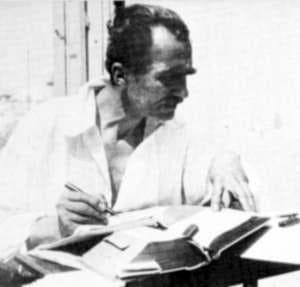
Nikos Kazantzakis was a Greek writer. Widely considered a giant of modern Greek literature, he was nominated for the Nobel Prize in Literature in nine different years.