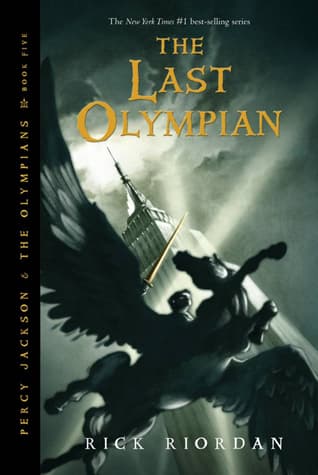
“The end of the world started when a pegasus landed on the hood of my car.”
— Opening line of the novel, setting the tone for the impending battle.

Rick Riordan (2009)
Genre
Fantasy / Children's / Young Adult
Reading Time
381 min
Key Themes
See below
Sign in to track this book
As Kronos's army attacks an unguarded Mount Olympus in New York City, Percy Jackson must gather young demigods to defend Western civilization. He also faces the chance that his own fate might lead to its destruction.
The story starts with Percy Jackson and Rachel Elizabeth Dare on a beach. They talk about Percy's upcoming sixteenth birthday and the scary Great Prophecy. Suddenly, Percy's father, Poseidon, pulls him into the ocean. Poseidon's underwater kingdom is under attack by the Titan Oceanus, and the monster Typhon has escaped from Tartarus. Typhon is destroying America, pulling the gods away from Olympus to fight him. Poseidon tells Percy to warn the Olympians and get ready for battle, because Kronos is expected to attack New York City, where Mount Olympus is, while the gods are busy. Percy goes back to Camp Half-Blood, where he sees the camp preparing for war. New demigods arrive, and old friends like Annabeth Chase and Grover Underwood are ready for the last fight.
After returning to Camp Half-Blood, Percy learns that Luke Castellan, taken over by Kronos, is leading his forces towards Manhattan. Remembering the prophecy's line about a hero's curse, Percy decides he must become unkillable, just like Luke. He goes to the Underworld with Nico di Angelo, who leads him to the River Styx. Nico warns him about the pain and the risk of losing his humanity, but Percy still jumps into the toxic river. He focuses on Annabeth to stay connected to the mortal world. The process is very painful, and he comes out with only one mortal spot: a small area on his lower back, like Achilles' heel. This new ability to resist harm, however, makes him more distant and powerful.
With the gods fighting Typhon across the country, Kronos begins his attack on New York City. He puts a strong sleeping spell on all mortals in Manhattan, making the whole island eerily quiet. Percy, Annabeth, Grover, Thalia Grace, and the other demigods, along with the Hunters of Artemis and the Party Ponies (centaurs), set up defenses around the Empire State Building, the entrance to Olympus. They face a large army of monsters, demigods loyal to Kronos, and even Titans. The battle is harsh and continuous, with many losses on both sides. Percy, now almost unkillable, becomes a strong fighter, but Kronos's army might overwhelm them with its numbers.
During the battle, the Ares cabin, led by Clarisse La Rue, first refuses to join the fight. This is because of an old argument with Apollo's cabin over a stolen chariot. This leaves the demigods badly outnumbered. However, at a critical moment when a drakon is about to destroy the defenders, Silena Beauregard, pretending to be Clarisse, bravely attacks the monster. She gets a fatal wound, but her sacrifice inspires the Ares cabin. They arrive in full force, led by the real Clarisse, to get revenge for Silena. Before she dies, Silena reveals that she was Kronos's spy, forced into it by Luke. Her death, though sad, brings the demigods together and helps them win that part of the fight.
As the battle continues, Annabeth remembers something from Daedalus's workshop in the Labyrinth. She realizes that Daedalus had a laptop with all his inventions and plans. They get the laptop and find designs for automatons and other devices. Using this information, Charles Beckendorf's siblings from the Hephaestus cabin manage to restart some of Daedalus's automatons, turning them against Kronos's forces. This gives them a needed advantage, helping to reduce enemy numbers and protect key spots around Olympus. It shows how old knowledge and cleverness are important in modern war.
In the middle of the fighting, Rachel Elizabeth Dare reappears, drawn to the conflict. She tells Percy that she has a deeper connection to old powers than she knew before. She says that she is a clear-sighted mortal and could become the next Oracle of Delphi, a role currently held by a mummified spirit. This news adds another layer to the prophecy. It suggests that the future is not completely set and that new paths can appear even in the worst times. Her presence shows a change in how prophecy works and in the demigod world.
Just as the demigods are about to be defeated, the gods, led by Poseidon, finally beat Typhon. Poseidon, recovered from his fight with Oceanus, delivers the final blow. Their return to New York City changes the course of the battle for Manhattan. The arrival of all the Olympian gods, though late, provides important help. Their combined power starts to push back Kronos's forces, giving the tired demigods a break and new hope. However, Kronos himself, still in Luke's body, remains a strong danger, having reached the throne room of Olympus.
Percy, Annabeth, Grover, and Thalia rush to the Olympus throne room, where Kronos is already causing destruction. Kronos, in Luke's body, is very powerful, using his scythe and breaking the old thrones. Percy, using his ability to resist harm, fights Kronos in a desperate duel. During the fight, Annabeth steps in, reminding Luke of his true self and their past. This brief distraction gives Percy a chance to try and talk to the bit of Luke's mind still inside Kronos. The fight is not just physical; it is also a fight for Luke's soul, as Kronos tries to fully take over his host.
In the final fight, as Kronos gets ready to hit Percy, Annabeth jumps in front of Percy, taking a painful hit. Seeing Annabeth hurt, and hearing her pleas for him to remember who he is, Luke's true self briefly returns. He realizes how much he was used and how terrible he has become. In a brave act of self-sacrifice, Luke grabs Annabeth's knife, which Percy had given him, and stabs himself in his mortal point – the same spot Percy had chosen on his back. This act destroys Kronos, completing the prophecy's unclear line about the hero's curse and saving Olympus, but it costs Luke his life.
With Kronos defeated, the Olympians return to a damaged but safe Olympus. They offer Percy Jackson godhood and eternal life as a reward for his bravery. However, Percy, remembering Luke's sad fate and his wish for the gods to pay more attention to their demigod children, politely declines. Instead, he asks the gods to claim all their demigod children, build new cabins for the minor gods, and pardon peaceful Titans and their children. He also asks that Hades and other minor gods be recognized properly. The gods, humbled by the war and Percy's lack of selfishness, agree to his terms. This begins a new time of greater fairness and recognition for all demigods.
After Percy refuses eternal life, Rachel Elizabeth Dare accepts the role of the Oracle of Delphi. She performs the ritual, and the spirit of the Oracle enters her, making her the new voice of prophecy. Her first prophecy speaks of a new quest involving the children of the 'Big Three,' setting the stage for future stories. With the war over and Olympus safe, Percy and Annabeth finally show their feelings for each other. They share a long-awaited kiss, symbolizing the start of their relationship and a hopeful future for the demigod world, free from Kronos's immediate danger.
The Protagonist
Percy evolves from a reluctant hero into a selfless leader, culminating in his choice to prioritize justice and recognition for all demigods over personal glory or godhood.
The Supporting
Annabeth grapples with her past with Luke and her growing feelings for Percy, ultimately finding clarity and accepting her role as Percy's partner and intellectual equal.
The Antagonist
Luke's arc is one of tragic fall and ultimate redemption, as he succumbs to Kronos's influence but ultimately reclaims his agency to save Olympus, fulfilling the prophecy in an unexpected way.
The Supporting
Grover matures into a confident and powerful leader among satyrs, fully embracing his role as the Lord of the Wild and a crucial ally in the war.
The Supporting
Rachel transitions from a quirky mortal friend to a pivotal figure in the demigod world, accepting her destiny as the new Oracle of Delphi.
The Supporting
Nico overcomes his isolation and resentment, choosing to fight alongside the demigods and reconcile with his father, solidifying his place as a hero.
The Supporting
Thalia reinforces her commitment to the Hunters and her friends, fighting bravely for Olympus despite her personal connection to Luke.
The Supporting
Silena's arc is one of tragic redemption, moving from a reluctant spy to a selfless hero who sacrifices her life for her friends.
The Supporting
Clarisse overcomes her stubbornness and personal pride, leading her cabin with renewed purpose and honor in the final battle.
This theme looks at how characters define themselves by their choices and their willingness to give things up for others. Percy deals with the prophecy and the offer of eternal life. He chooses a mortal life to speak up for demigods, showing his identity through his kindness. Luke's sad story is central; he takes back his identity from Kronos through a heroic act of self-sacrifice, showing that even bad people can choose to do good. Silena Beauregard's sacrifice, where she is revealed as the spy, shows how past mistakes can be made right through selfless acts. This proves that who you truly are is found in your final choices.
“"He was a hero. He just made a bad choice." ”
The Great Prophecy drives the whole series, and 'The Last Olympian' shows how it is fulfilled in complex and often unclear ways. The prophecy is not a fixed future but a set of possibilities influenced by choices. Percy's decision to refuse godhood, Rachel's acceptance of the Oracle, and Luke's final act of redemption all show that destiny is not fully set. It can be shaped by free will. The 'hero's curse' eventually refers to Luke's ability to resist harm and his self-inflicted wound, showing how prophecies often have unexpected meanings. This highlights human action over rigid fate.
“"You are not your father, Percy. You are not your destiny. You are you." ”
Loyalty is a main value among the demigods, especially between Percy, Annabeth, and Grover. The war tests these bonds, with Luke's betrayal being a main conflict. This theme also applies to the gods' difficult family, whose neglect of their children fuels Luke's anger. Percy's demand for the gods to recognize all their children shows how important family responsibility is. Silena's forced betrayal and later sacrifice, driven by love and loyalty to Beckendorf, show how these themes interact and how choosing loyalty in the end can lead to good.
“"Family. You promised you would never let me go." ”
The choice between living a normal life and living forever is a central theme, especially for Percy. The gods offer him eternal life, a tempting way to avoid pain and loss. However, Percy sees the gods' distance and Luke's sad path, driven by the wish for endless fame. This leads him to choose a normal life. He believes that true heroism and connection are found in human experience, including its limits. His choice to stay mortal and speak for the ignored demigods suggests that a meaningful, limited life dedicated to fairness can be more effective than eternal, distant power. This challenges common ideas of heroism.
“"No, I want things to change... I want you to properly claim your children. All of them, at an age no older than thirteen." ”
Grover's role as the Lord of the Wild brings environmental worries to the front. The destruction caused by Typhon and Kronos's forces shows how fragile the natural world is. Grover's panic attack ability, which comes from nature's power, becomes a weapon against the Titans, showing nature fighting back. Percy's connection to the ocean and his father Poseidon further shows the need to protect the environment. The war acts as a symbol for humanity's disregard for nature, and the demigods' fight for Olympus is also a fight to keep the balance of the planet, which is tied to the gods' power.
“"The wild is not just trees and animals, Percy. It's the spirit of the world, and it's suffering." ”
The overarching prophecy that drives the entire series' plot
The Great Prophecy is a cryptic verse delivered by the Oracle of Delphi that foretells a demigod of the Big Three reaching sixteen, making a choice, and either saving or dooming Olympus. In 'The Last Olympian,' it acts as the central plot device, dictating events and character motivations. Its ambiguity allows for multiple interpretations, ultimately being fulfilled in an unexpected way through Luke's self-sacrifice rather than Percy's direct action, highlighting the nuances of fate and free will. It serves to build suspense and provide a narrative framework for the entire series' climax.
A magical bath granting near-invulnerability, with a single mortal point
This plot device is directly inspired by the myth of Achilles. Percy's decision to bathe in the River Styx makes him almost invincible, but leaves one tiny, vulnerable spot on his lower back. This creates high stakes in every combat scene, as Percy must protect his weak point. It also serves as a parallel to Luke's similar act, highlighting their shared path and the 'hero's curse.' The physical power comes with a mental detachment, adding a psychological layer to Percy's character and making his final confrontation with Kronos more dangerous.
Kronos's magical enchantment that incapacitates all mortals in New York City
This device effectively removes mortals from the battlefield, allowing the demigods and monsters to wage war openly in a major urban center without massive civilian casualties or widespread mortal panic. It isolates the conflict to the supernatural realm, creating an eerie, deserted backdrop for the final battle. This also emphasizes the gods' power and their disregard for mortal lives, as they are unable (or unwilling) to lift the spell, leaving the demigods as humanity's sole protectors. It heightens the sense of urgency and the scale of the threat.
The source of prophecies, represented by a mummified spirit and later Rachel Dare
The Oracle provides the prophecies that guide and often confuse the demigods. Its initial state as a mummified spirit emphasizes the ancient, unchanging nature of fate. Rachel Elizabeth Dare becoming the new Oracle signifies a shift: a more human, accessible, and potentially more hopeful future for prophecy. This device allows for the introduction of new narrative directions for future series, as Rachel's first prophecy sets up the next major quest, acting as a bridge to new adventures and a symbol of evolving tradition.
The gods' consistent failure to acknowledge and care for their demigod children
While not a physical object, the gods' neglect is a pervasive plot device that drives much of the conflict. Luke's resentment, the understaffing of Camp Half-Blood, and the general vulnerability of demigods all stem from this. Percy's refusal of godhood and his subsequent demands for the gods to claim all their children directly addresses this systemic issue. It serves as a strong moral argument within the narrative, highlighting the consequences of parental abandonment and advocating for greater empathy and responsibility from those in power.
“The end of the world started when a pegasus landed on the hood of my car.”
— Opening line of the novel, setting the tone for the impending battle.
“Even strength must bow to wisdom sometimes.”
— Annabeth Chase advising Percy on strategy during the war.
“Families are messy. Immortal families are eternally messy.”
— Percy reflecting on the dysfunctional relationships among the gods.
“If my life is going to mean anything, I have to live it myself.”
— Percy deciding to reject immortality and stay mortal.
“Being a hero doesn't mean you're invincible. It just means that you're brave enough to stand up and do what's needed.”
— Percy encouraging his friends during the defense of Manhattan.
“The real world is where the monsters are.”
— Luke Castellan explaining his motivations before his final act.
“Love is no game! It is no flowery softness! It is hard work—it demands everything from you—especially the truth.”
— Hestia, goddess of the hearth, speaking to Percy about relationships.
“Sometimes you have to do something even if it's dangerous. Otherwise you're not really living, you're just waiting to die.”
— Rachel Elizabeth Dare encouraging Percy to take risks.
“A single thread in a tapestry, though its color brightly shines, can never see its purpose in the pattern of the grand design.”
— The Oracle delivering a prophecy about the role of demigods.
“We're staying together. You're not getting away from me. Never again.”
— Percy to Annabeth, declaring their commitment during the battle.
“The gods are immortal. They can afford to wait. We can't.”
— Percy arguing for immediate action against the Titans.
“Hope survives best at the hearth.”
— Hestia explaining why she tends the Olympian hearth.
“You deal with mythological stuff for a few years, you learn that paradises are usually places where you get killed.”
— Percy's cynical thought about seemingly perfect situations.
“I am never, ever going to make things easy for you, Seaweed Brain. Get used to it.”
— Annabeth teasing Percy about their relationship.
Ready to see how well you understood this book? Take our interactive quiz with 10 questions.
Biography coming soon.







