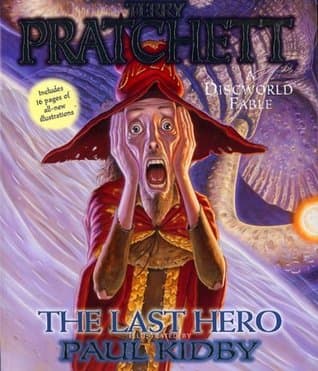
The Last Quest of Cohen the Barbarian
The story begins with news spreading across Discworld: Cohen the Barbarian, now an old man, has gathered his equally old friends, the Silver Horde, for one final, bold quest. Their goal is to return fire to the gods on Cori Celesti, the highest mountain and home of the gods. This act, meant to repay the gods for the theft of fire by the first hero, Prometheus, is said to destroy Discworld. The news causes panic among the wizards of Unseen University and Lord Vetinari, who realize the terrible results of Cohen's plan. They immediately try to find a way to stop him before it is too late, despite the great difficulty of reaching the gods' home.
The Patrician's Dilemma and the Wizards' Intervention
Lord Vetinari, always practical, meets with Archchancellor Mustrum Ridcully and the senior faculty of Unseen University. He asks them to stop Cohen's world-ending mission. Realizing it is impossible to physically stop Cohen and his Horde, and seeing the magical risks of directly fighting the gods, they decide on a more subtle approach. Vetinari asks the inventor and artist, Leonard of Quirm, to build a flying machine that can reach Cori Celesti. The mission to fly this craft and convince Cohen to give up his quest goes to the always scared and clumsy wizard, Rincewind, along with the Librarian and the inventor himself.
The Flying Machine Takes Flight
Leonard of Quirm reveals his flying machine, a device powered by a mix of magic and science, designed to work in the thin air near the gods' home. Rincewind, despite his great fear and constant wish to run, is forced to join the crew, as his magical clumsiness ironically makes him less open to certain divine influences. The Librarian, an orangutan whose great strength and practical skills are very useful, also joins them. As they climb, the journey is full of danger, including strong winds, freezing temperatures, and the increasing strangeness of the upper atmosphere, testing both the machine and its crew.
Encountering the Gods' Domain
As the flying machine nears Cori Celesti, the environment becomes more surreal and dangerous. They pass through clouds that are actually solid thoughts and feelings, and meet strange, partly thinking beings. The air itself seems to shimmer with divine power, and reality becomes fluid. Rincewind, especially, struggles with the mental effect of being so close to the gods, feeling their indifference and great power. Leonard, however, stays focused on the technical problems, while the Librarian uses his strength and agility to keep the craft steady amid the chaos, pushing them closer to their goal.
Cohen's Ascent and the Gods' Indifference
Meanwhile, Cohen and the Silver Horde – Caleb, Truckle the Uncivil, and the surprisingly quick Evil Harry Dread – are making their own hard climb up Cori Celesti. They face mythical creatures, dangerous land, and the physical challenge of their age, but their legendary toughness keeps them going. The gods, watching from their high spot, seem mostly uncaring about the coming disaster. They are more concerned with their small arguments, games, and the endless cycle of creation and destruction, seeing mortals as mere toys or background noise. Their lack of concern shows their great power and distance from Discworld's fate.
The Meeting on the Summit
Rincewind, Leonard, and the Librarian finally reach the top of Cori Celesti, finding Cohen and the Silver Horde ready for their final act. Cohen, carrying a barrel of very flammable oil, plans to set fire to the gods' home, returning the spark of life they stole. Rincewind, terrified but driven by the coming doom, tries to reason with Cohen, explaining the terrible results for Discworld. However, Cohen, full of ancient heroic traditions, is firm in his mission, believing it is the only proper end for a hero. The tension is clear as Discworld's fate hangs in the balance, with only Rincewind's desperate pleas stopping global destruction.
The Revelation of the Fire
In a key moment, Cohen explains his true intention. He is not planning to light a literal fire that would burn Discworld. Instead, he plans to destroy the *fire* of inspiration and creativity that the gods 'stole' from humanity and then only sometimes give. He believes that true heroism comes from inside, not from divine help or pre-set destiny. This revelation changes the understanding of his quest completely, turning it from an act of angry destruction into a philosophical statement about free will and the nature of heroism. The gods, now paying closer attention, are momentarily confused by this unexpected challenge to their power.
A Hero's Choice and the Gods' Response
Cohen faces the gods directly, not with violence, but with the strength of his belief. He argues that humanity should make its own destiny, make its own mistakes, and find its own heroes without the gods' interference. He questions their right to dictate history and inspire (or fail to inspire) mortals. The gods, at first amused, then annoyed, start to feel a real challenge to their old power. They are used to being worshipped or ignored, but not directly confronted by a mortal who questions their very purpose. This philosophical stand is far more dangerous to them than any physical threat.
The Librarian's Intervention and the Cosmic Scale
As the situation grows, the Librarian, watching the subtle magical energies and divine reactions, plays an important role. His unique view as an orangutan, free from human ideas about gods, lets him see certain truths. He helps understand the true nature of the 'fire' Cohen seeks to destroy. The cosmic scale of Cohen's actions begins to show, as the very fabric of belief and story that supports Discworld is threatened. The gods, realizing the depth of Cohen's challenge, are forced to rethink their relationship with humanity and the possibility of a world without their direct influence.
The Last Hero's Departure
After his statement and a brief, almost quiet interaction with the gods, Cohen and the Silver Horde, having won a philosophical victory rather than one of brute force, decide their work is done. They do not return to Discworld. Instead, they ride off into the 'sunset' of the universe, choosing to continue their adventures in the vast, unknown cosmos. They leave the gods to think about their new reality and Discworld to make its own path. Their departure means the end of an era of obvious heroic involvement and the start of a more self-reliant age for humanity. Discworld is saved, but forever changed by their final act.
The Gods' Aftermath and Humanity's Future
Afterward, the gods are in a state of change. Cohen's challenge has forced them to face their own outdatedness and the growing independence of mortals. While they still exist, their direct influence on Discworld is much less. They begin to try new ways of interacting with humanity, often with funny and slightly sad results. On Discworld, life continues, but with a subtle change. The age of grand, divinely ordered heroes is over, replaced by a world where individuals must find their own courage and make their own choices. The future, while unclear, is now truly in humanity's hands.