“The past is a monster. It will always find a way to drag you back.”
— Niels is reflecting on the inescapable nature of past traumas and mistakes.

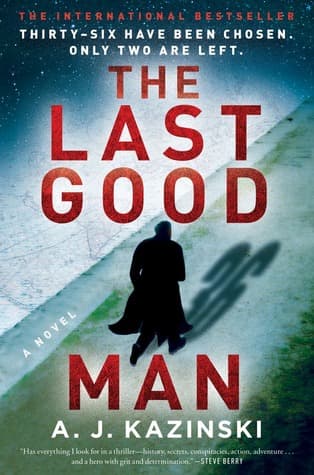
A.J. Kazinski (2012)
Genre
Thriller / Mystery
Reading Time
960 min
Key Themes
See below
Sign in to track this book
A cynical detective, tasked with protecting Denmark's 'good people' from a global assassin targeting the righteous, must overcome his own jaded view of humanity and team up with a grieving astrophysicist to stop the final two murders of the legendary '36 Just Men' before the world plunges into chaos.
The novel starts with a series of unexplained deaths worldwide. In Beijing, a respected monk collapses, a fiery mark appearing on his back. Similar deaths follow in Mumbai, where a charitable economist dies, and in other major cities. All victims are humanitarians or people of high moral standing. Each body bears the same distinct, spreading mark. These seemingly unrelated incidents soon get Interpol's attention, which sends an alert to police forces globally, noting the strange pattern and shared traits of the victims. The deaths are not random; they target individuals considered 'good people,' suggesting a sinister, coordinated plot.
In Copenhagen, preparations are underway for a world climate summit. Amid this, veteran detective Niels Bentzon receives the Interpol alert. His superiors give him the difficult task of identifying Denmark's 'good people' and warning them. This task is ironic given Bentzon's cynicism and his training to find flaws and darkness in human nature. Bentzon struggles with this assignment. His investigative instincts constantly lead him to uncover the hidden vices and imperfections of those he interviews, making it nearly impossible for him to believe anyone is 'good' enough to fit the victim profile.
Just as Bentzon is about to give up on his impossible task, he meets Hannah Lund, a brilliant astrophysicist. Hannah is dealing with a deep personal loss, mourning her son's recent death and the collapse of her marriage. Despite her own pain, she has a unique way of looking at the world, a scientific mind combined with an openness to abstract ideas. Her perspective offers a needed contrast to Bentzon's jaded view, giving him a new approach to understanding the 'good people' and the larger mystery surrounding their deaths.
Hannah Lund, using her academic background and interest in various belief systems, introduces Bentzon to the ancient Jewish legend of the Lamed Vav Tzaddikim, or the 'thirty-six righteous people.' According to this legend, there are always thirty-six anonymous, righteous individuals in the world whose existence alone prevents humanity's destruction. These individuals are unaware of their special status. This legend immediately connects with the pattern of the global murders. It suggests that the victims are precisely these 'good people' and that the killer is systematically eliminating them, possibly to cause a global catastrophe.
With the legend in hand, Bentzon and Hannah begin to connect the seemingly disparate clues. They realize the killer is not just targeting 'good people' but specifically those who fit the description of the Lamed Vav Tzaddikim. The fiery mark on the victims' backs, initially confusing, is now understood as the killer's signature, a symbolic 'erasure' or 'branding' of these chosen individuals. They deduce that the killer is meticulously following the legend, aiming to eliminate all thirty-six, and that the previous deaths represent thirty-four of them, meaning only two remain.
By analyzing the geographical spread, timing, and profiles of the previous thirty-four victims, Bentzon and Hannah establish a chillingly precise pattern. This pattern allows them to predict the locations and timings of the final two murders. Their calculations point to Venice and Copenhagen as the next targets, and the time is near. This realization adds desperate urgency to their investigation. They now have a concrete timeline to prevent further bloodshed and potentially avert a global disaster as envisioned by the killer.
With time running out, Bentzon and Hannah, along with the Italian policeman from Venice who first linked the deaths, rush to Venice. They believe the next victim, the thirty-fifth Lamed Vav, will be found there. The city, known for its canals and old buildings, becomes a tense setting for their frantic search. They must not only identify who the next target might be but also find the killer before he can strike again, facing the challenge of identifying a 'good person' among a population, all while being hunted by the perpetrator.
In Venice, the investigation ends in a dramatic confrontation with the killer. His identity is revealed to be someone unexpected, driven by a twisted ideology and deep disappointment with humanity. The killer believes that by eliminating the thirty-six righteous, he is not destroying the world, but cleansing it, forcing humanity to face its own inherent evil and rebuild from scratch. The motive is revealed to be a misguided attempt at a reset, a dark interpretation of the legend, believing that only through utter destruction can true good emerge.
After the events in Venice, the final predicted murder is set to happen in Copenhagen, at the same time as the world climate summit. The killer, having avoided capture or preparing for his last act, targets the last Lamed Vav Tzaddik. Bentzon and Hannah return to Copenhagen, now fully aware of the killer's methods and motives. The city, already buzzing with global leaders, becomes the stage for the final confrontation. The fate of the last righteous person, and potentially the world, depends on their ability to stop the killer before he completes his macabre mission.
The climax in Copenhagen shows Bentzon and Hannah making a desperate attempt to protect the last 'good person.' The outcome of this final struggle is critical, deciding whether the killer's plan succeeds or fails. Afterwards, the profound experience forces Bentzon to confront his deep cynicism. His journey with Hannah, and the realization that true goodness does exist, though often hidden, begins to erode his jaded perspective, offering a glimmer of hope for his own future and a deeper understanding of humanity's complexities.
The Protagonist
Bentzon begins as a hardened cynic but through his partnership with Hannah and the unfolding events, he starts to question his worldview and acknowledge the existence of genuine good.
The Supporting
Hannah, while helping Bentzon solve the mystery, also finds a path towards healing and purpose through her involvement in the investigation.
The Antagonist
The killer's arc is one of escalating conviction in his destructive mission, culminating in a final, desperate attempt to complete his plan.
The Supporting
His arc primarily involves his initial discovery and subsequent collaboration, contributing to the broader investigation.
The Mentioned
Their collective 'arc' is one of being systematically targeted and extinguished, driving the central conflict.
The novel explores what makes someone 'good' or 'evil,' especially through Bentzon's cynical view versus Hannah's more open one. The killer's actions force a re-evaluation of these ideas, suggesting that 'good' might be hidden or imperfect, yet essential. The legend of the Lamed Vav Tzaddikim directly frames this theme, suggesting that a small amount of pure goodness is vital for humanity's survival. The victims, though flawed in Bentzon's eyes, are ultimately seen as 'good' by the killer's standards, highlighting how subjective these definitions are. The story questions whether true goodness can exist without recognition or if it's always tainted by human imperfection.
“Bentzon had spent his life looking for the cracks, the flaws, the dark corners of the human soul. How could he now be expected to find its light?”
This theme is shown through the different worldviews of Niels Bentzon and Hannah Lund. Bentzon's deep cynicism, from years of police work, makes him initially unable to identify truly 'good' people. Hannah, despite her personal tragedy, offers intellectual curiosity and hope, even in despair. Their partnership forces Bentzon to confront his own jadedness, suggesting that hope, even a fragile one, is necessary for navigating a complex and often dark world. The story follows Bentzon's slow move away from absolute cynicism.
“Sometimes, Niels, the greatest good isn't obvious. It's quiet, unassuming, almost invisible. That doesn't make it any less potent.”
The entire plot depends on the ancient Jewish legend of the Lamed Vav Tzaddikim. The killer's actions are directly motivated and structured by this legend, giving it a real, terrifying power in the story. Hannah's introduction of the legend changes the investigation, providing the key to understanding the killer's motive and predicting his next moves. This theme explores how ancient stories, even if seen as myths, can deeply influence human actions and perceptions, shaping reality and driving events with devastating results. It highlights the human need to find meaning, even if twisted, in narratives.
“Thirty-six. Without them, the world would unravel. A beautiful, terrible thought.”
The novel shows global connections through the worldwide murders. Deaths in Beijing, Mumbai, Venice, and Copenhagen highlight how seemingly isolated events are part of a larger, sinister pattern. Interpol's involvement and international police cooperation emphasize this. Conversely, the theme also touches on isolation: the 'good people' are unaware of their shared status, and Bentzon himself is initially isolated by his cynicism. Hannah's personal grief also represents a type of isolation. The story ultimately suggests that while humanity is connected, individual experiences of good and evil, and the struggle to understand them, can be deeply isolating.
“The world was a tapestry, and someone was systematically pulling out the threads that held it together.”
An ancient legend that drives the entire plot and the killer's motivations.
The legend of the thirty-six righteous individuals (Lamed Vav Tzaddikim) serves as the central MacGuffin. It is the core concept that the killer bases his actions upon, and it is the key that allows Bentzon and Hannah to understand the pattern of the murders. The legend itself is not fully explained or confirmed as factual within the narrative, but its existence and the characters' belief in its relevance are what propel the plot forward, giving meaning to the seemingly random global deaths and providing the framework for the investigation.
The finite number of victims and the predicted final murders create intense urgency.
The 'ticking clock' device is crucial to the thriller aspect of the novel. Once Bentzon and Hannah deduce that there are only thirty-six Lamed Vav Tzaddikim and that thirty-four have already been killed, the remaining two become critical. The ability to predict the time and location of the final two murders (Venice and Copenhagen) creates immense pressure and a desperate race against time. This device heightens suspense, forcing the protagonists into immediate action and making every decision carry significant weight, as the fate of the remaining 'good people' and potentially humanity itself hangs in the balance.
Bentzon's cynical worldview initially blinds him to the true nature of the victims.
While not a literal unreliable narrator in terms of recounting events, Bentzon's deeply cynical perspective functions as a form of unreliability in interpreting the 'goodness' of the victims. His professional training to find flaws makes him initially doubt anyone could be truly righteous, leading him to misjudge potential targets. This device creates internal conflict for Bentzon and influences the initial direction of the investigation, forcing the reader to question assumptions about human nature. It is only through Hannah's intervention that a more 'reliable' understanding of goodness emerges, challenging Bentzon's ingrained bias.
The fiery, spreading mark on the victims' bodies serves as the killer's signature.
The distinctive fiery mark found on the backs of all the victims is a crucial symbolic plot device. It acts as the killer's signature, linking the seemingly disparate global deaths and giving the investigators a concrete piece of evidence to connect the cases. Beyond its evidentiary function, the mark is symbolic of the killer's intent – a branding or 'erasure' of the righteous, a physical manifestation of their removal from the world. Its mysterious nature initially baffles the police, adding to the enigma, before its significance is understood in the context of the legend.
“The past is a monster. It will always find a way to drag you back.”
— Niels is reflecting on the inescapable nature of past traumas and mistakes.
“Sometimes, the only way to find the truth is to get lost in the lies.”
— Niels delves deeper into the convoluted web of deception surrounding the case.
“A good man in a bad world is just a target.”
— A cynical observation about the vulnerability of moral individuals in corrupt environments.
“Fear is a powerful tool. It can make you do things you never thought possible, both good and bad.”
— Niels considers the motivations behind extreme actions, driven by fear.
“The dead don't tell tales, but their silence speaks volumes.”
— Niels examines a crime scene, interpreting the absence of direct testimony.
“Every secret has a shelf life. Eventually, it spoils.”
— As secrets begin to unravel, revealing hidden truths.
“Justice isn't always fair, but it demands to be served.”
— Niels grapples with the complexities of achieving justice in a flawed system.
“The line between hero and villain is often just a matter of perspective.”
— A reflection on the moral ambiguity of characters and their actions.
“You can outrun your past, but you can never escape it.”
— Niels' personal struggles intertwine with the investigation, highlighting the inescapable nature of his own history.
“The most dangerous lies are the ones we tell ourselves.”
— A character's self-deception contributes to the unfolding mystery.
“Sometimes, the answers you seek are buried in the questions you refuse to ask.”
— Niels realizes he needs to confront uncomfortable truths to solve the case.
“The city has a memory, and it never forgets a crime.”
— Niels senses the lingering presence of past events within the urban landscape.
“Hope is a fragile thing, easily shattered, but impossible to live without.”
— Niels experiences moments of despair and renewed determination during the investigation.
“Every choice leaves a scar, some visible, some hidden deep within.”
— A character reflects on the lasting impact of their decisions.
Ready to see how well you understood this book? Take our interactive quiz with 10 questions.







