“It was one of those perfect Montana August nights, cool and clear, with a million stars scattered across the black sky like diamonds on velvet.”
— Describing the setting of a Montana night, often before or after a violent event.

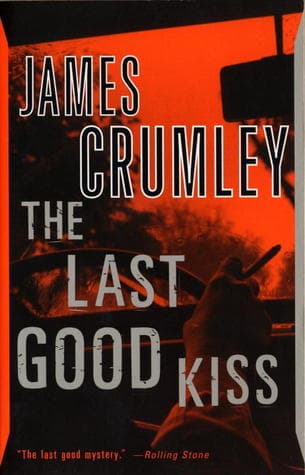
James Crumley (1978)
Genre
Thriller / Mystery
Reading Time
244 min
Key Themes
See below
Sign in to track this book
A Montana detective who moonlights at a topless bar is drawn into a decade-old missing persons case, leading him on an obsessive, haunting journey through the Haight-Ashbury's darkest corners and the underbelly of America's sleaziest nightmares.
C.W. Sughrue, a Montana private investigator with a penchant for drink and working part-time at a topless bar, is hired by a literary agent, Barnaby French, to locate the once-celebrated author Abraham Trahearne. Trahearne, known for his classic novel 'The Last Good Kiss', has become a recluse and an alcoholic, last seen in Sausalito. Sughrue finds Trahearne in a rundown hotel, mostly incoherent. While trying to get information from him, Sughrue discovers a photograph of a young woman named Betty Sue Flowers, a girl Trahearne claims to have known who went missing ten years prior in San Francisco's Haight-Ashbury district. This discovery makes Sughrue investigate Betty Sue's disappearance alongside his primary task.
Sughrue takes Trahearne with him to San Francisco, specifically the Haight-Ashbury district, to retrace Betty Sue Flowers' last known steps. He interviews various colorful, often drug-addled, characters who knew Betty Sue a decade ago. He learns she was a free spirit, involved in the counterculture scene, and had connections to small-time drug dealing. Sughrue meets people like 'The Reverend' and other remnants of the 1960s, piecing together a fragmented picture of Betty Sue's life and the circumstances surrounding her disappearance. The investigation becomes increasingly complex as many witnesses are unreliable, either due to memory loss, drug use, or a reluctance to talk about the past. Sughrue begins to suspect that Betty Sue's disappearance was not a simple runaway case.
As Sughrue digs deeper, he uncovers information suggesting Betty Sue might have been involved with more dangerous individuals than initially thought. The trail leads him and a somewhat reluctant Trahearne down to Southern California, specifically the seedier parts of Los Angeles and San Diego. They encounter a network of people connected to drug trafficking, prostitution, and a more organized criminal element that Betty Sue may have inadvertently stumbled upon. Sughrue's methods are often unorthodox and violent, as he confronts reluctant witnesses and thugs, slowly unraveling the decade-old mystery. Trahearne, though often a burden, occasionally offers cryptic insights or recognizes people from his past, aiding Sughrue's progress.
Through his relentless questioning and confrontations, Sughrue learns about a shadowy figure known only as 'The Dutchman'. This individual is described as a ruthless and influential criminal who had dealings in the drug trade and other illicit activities in Southern California during the time Betty Sue disappeared. It becomes clear that Betty Sue had some form of interaction or connection with The Dutchman, making him a primary suspect in her disappearance. Sughrue's pursuit of The Dutchman puts him in increasingly perilous situations, as he is now dealing with professional criminals who are not afraid to use violence to protect their secrets. The stakes escalate significantly as Sughrue closes in on the truth.
The investigation takes a grim turn when Sughrue uncovers a hidden audiotape. This tape contains a recording of Betty Sue Flowers' final moments, revealing she was murdered. The recording implicates The Dutchman and his associates, detailing a brutal and senseless killing. This discovery solidifies Sughrue's resolve to bring Betty Sue's killers to justice, turning his investigation into a personal vendetta. The tape also sheds light on the motive, which appears to be related to a botched drug deal or a betrayal within The Dutchman's network that Betty Sue witnessed or was involved in. The emotional impact of the tape on Sughrue is significant, driving him to increasingly desperate measures.
As the truth about Betty Sue's death becomes undeniable, Abraham Trahearne, shaken and sobered by the revelations, finally confesses his full involvement. He admits that he was romantically involved with Betty Sue and was present, albeit in a drunken stupor, during the events leading to her murder. He reveals his guilt and the trauma he has carried for a decade, which contributed to his descent into alcoholism and reclusiveness. Trahearne's confession adds a profound layer of tragedy to the story, highlighting the devastating impact of Betty Sue's death on those who cared for her. His testimony becomes crucial in Sughrue's understanding of the full scope of the crime and the identities of those responsible.
Armed with the truth and Trahearne's confession, Sughrue tracks down The Dutchman and his remaining henchmen. A violent confrontation ensues, characteristic of Sughrue's brutal investigative style. He engages in several brutal fights, showing his willingness to use extreme force to achieve justice. The encounters are bloody and chaotic, as Sughrue, driven by a fierce sense of retribution for Betty Sue, systematically incapacitates or kills those responsible for her death. The scenes are intense, highlighting the raw, visceral nature of the criminal underworld and Sughrue's own capacity for violence when pushed to his limits. He is unyielding in his pursuit, leaving a trail of destruction in his wake.
Sughrue's pursuit culminates in a brutal and decisive act of vengeance. He corners The Dutchman and his remaining accomplices, ensuring they pay for their crimes in a manner that falls outside the bounds of the legal system. Sughrue's justice is swift and merciless, reflecting his cynical view of the world and his belief that some wrongs can only be righted through direct, personal retribution. The resolution of the murder case is not a neat, police-procedural outcome, but rather a violent, almost primal settling of scores. Sughrue closes the book on Betty Sue's disappearance by eliminating the perpetrators, ensuring they can never harm anyone else.
In the aftermath of the violent confrontations, Sughrue is left to deal with the physical and emotional toll of his investigation. He has achieved a form of justice for Betty Sue Flowers, but at a significant personal cost. The journey through the underbelly of America has left him more jaded and world-weary. Abraham Trahearne, somewhat redeemed but still deeply scarred, is left to grapple with his own past and the future of his literary career. Sughrue, ever the wanderer, contemplates his next move, perhaps returning to Montana or finding another case to lose himself in. The ending is not one of triumph, but of weary continuation, characteristic of the hardboiled detective genre.
Despite the violence and despair that permeate his life, Sughrue occasionally finds small, fleeting moments of connection or peace. These are often with unexpected characters, like a sympathetic waitress or a fellow traveler, offering a brief respite from the grim reality of his work. These moments, though rare, highlight a glimmer of humanity within Sughrue, suggesting that he is not entirely consumed by the darkness he navigates. They serve as a contrast to the brutal world he inhabits, emphasizing his underlying, albeit buried, capacity for empathy and connection, even if only for a fleeting instant before he returns to his solitary, dangerous existence.
The Protagonist
Sughrue starts as a disillusioned PI taking a mundane case, but becomes personally invested in Betty Sue's disappearance, finding a sense of purpose in seeking justice for her. He confronts his own demons while navigating the darkness of others.
The Supporting
Trahearne goes from a drunken, evasive wreck to a man who, through Sughrue's relentless pursuit, is forced to confront his past and reveal the truth, finding a measure of redemption.
The Mentioned
Her arc is revealed posthumously as Sughrue uncovers the circumstances of her life and death, evolving from a simple missing person to a victim of a brutal crime.
The Supporting
He remains relatively static, representing the external force that sets Sughrue's journey in motion.
The Antagonist
He serves as the ultimate target of Sughrue's justice, leading to his violent downfall.
The Supporting
He serves as a conduit of information, revealing aspects of Betty Sue's past.
The novel portrays the demise of the optimistic 1960s counterculture and the subsequent disillusionment. Haight-Ashbury, once a symbol of peace and love, is shown as a decaying shell, home to drug addicts and forgotten dreams. Betty Sue Flowers herself embodies this theme, a young woman drawn to the promise of freedom who ultimately becomes a victim of the era's darker underbelly. Sughrue's journey through this landscape reflects a broader loss of innocence in America, where the idealism of the past has given way to cynicism and corruption, as seen in the brutal realities he uncovers.
“''The Haight was a ghost town, a bad joke, a place where people came to die, not live.'”
A central theme is Sughrue's unwavering commitment to his own brutal code of justice, which often operates outside the confines of the law. He doesn't rely on police or legal systems, instead using violence and intimidation to extract truth and deliver retribution. The novel suggests that for certain crimes, particularly those involving forgotten victims like Betty Sue, conventional law enforcement is inadequate or simply doesn't care. Sughrue's actions, while morally ambiguous, are presented as the only effective way to right profound wrongs, culminating in his personal, violent execution of 'justice' for Betty Sue's murder.
“'Justice was a whore with a price, and Sughrue was willing to pay.'”
The past hangs heavy over every character and location in the novel. Abraham Trahearne is crippled by guilt and alcoholism stemming from his past connection to Betty Sue's disappearance. The Haight-Ashbury district is haunted by the ghosts of its former glory. Sughrue himself is a product of a hard life, and his investigation constantly forces characters to confront long-buried secrets and painful memories. The novel argues that the past is never truly gone, but continues to influence and shape the present, often with devastating consequences, as evidenced by the decade-long reverberations of Betty Sue's fate.
“'The past was a loaded gun, and somebody always got shot.'”
Alcohol and drug addiction are pervasive forces throughout the narrative, contributing to the characters' downfalls and obscuring the truth. Abraham Trahearne's alcoholism is both a symptom and a cause of his inability to confront his past. Many of the witnesses Sughrue encounters in Haight-Ashbury are lost to drug abuse, their memories fragmented and unreliable. Sughrue himself battles his own demons with alcohol, using it as a coping mechanism in a brutal world. This theme highlights how addiction can destroy lives, distort reality, and prevent healing, trapping individuals in cycles of self-destruction.
“'He drank to remember, and he drank to forget, and mostly he just drank.'”
Information is often filtered through the subjective and flawed perspectives of characters.
Sughrue's investigation is constantly hampered by unreliable witnesses, many of whom are alcoholics or drug addicts with fragmented memories. This forces Sughrue to piece together the truth from conflicting accounts, adding layers of difficulty and suspense. The subjective nature of memory and perception becomes a key challenge, reflecting the chaotic and morally ambiguous world Sughrue inhabits. It also mirrors the broader theme of a lost past, where definitive answers are hard to come by, making the detective's job even more arduous and dangerous.
A plot device that drives the story, though its true nature is revealed later.
Initially, Betty Sue Flowers is presented as a simple missing person, a secondary aspect to Sughrue's primary task of finding Abraham Trahearne. Her disappearance serves as the initial 'MacGuffin,' a narrative hook that sets the plot in motion. However, as Sughrue digs deeper, Betty Sue evolves from a mere plot device into a fully realized tragic figure whose story becomes the heart of the novel, revealing the depth of the crime and the moral decay of the world Sughrue investigates. Her fate drives Sughrue's personal vendetta, transcending her initial role as a simple catalyst.
C.W. Sughrue embodies the classic traits of the genre's protagonist.
C.W. Sughrue is a quintessential hardboiled detective: cynical, violent, morally ambiguous, and operating outside the traditional legal system. He drinks heavily, is fiercely independent, and possesses a personal code of ethics that often clashes with societal norms. This archetype allows the author to explore themes of individual justice versus systemic corruption, and the toll that such a life takes on a person. Sughrue's character grounds the narrative in a familiar yet distinct genre tradition, while his unique personality adds a fresh, gritty layer to the archetype, making him memorable.
Sughrue's physical journey mirrors a descent into America's dark underbelly.
Sughrue's physical journey from the relative calm of Montana, through the decaying idealism of Haight-Ashbury, and into the violent, corrupt landscapes of Southern California, serves as a symbolic descent. Each location represents a different layer of American society's decline and moral decay. The journey is not just about finding Betty Sue, but about exploring the forgotten, the broken, and the brutal aspects of the American Dream. It reflects a pilgrimage through the dark heart of the nation, exposing its hidden horrors and the lingering shadows of past choices.
“It was one of those perfect Montana August nights, cool and clear, with a million stars scattered across the black sky like diamonds on velvet.”
— Describing the setting of a Montana night, often before or after a violent event.
“The past is a foreign country; they do things differently there.”
— A general reflection on the nature of memory and how past events shape the present.
“There are only two kinds of people who can look you in the eye with a straight face and lie: children and politicians.”
— Milo Milodragov's cynical observation on human nature and deceit.
“Every man has his breaking point. Some just take longer to find it.”
— Reflecting on the resilience and eventual collapse of individuals under pressure.
“The best way to keep a secret is to pretend it isn't one.”
— A piece of advice or observation about the art of concealment.
“Some nights you just want to get lost in the bottom of a bottle, and some nights you just want to find yourself there.”
— Milo's internal thoughts on his relationship with alcohol and self-reflection.
“The truth is a funny thing. It can set you free, or it can bury you alive.”
— Contemplating the dual nature and consequences of discovering or revealing truth.
“Violence is a language that everyone understands, even if they pretend not to.”
— A grim observation on the universality and impact of violence.
“You can never go home again, but you can always go back to the places where you were happy.”
— A nuanced reflection on nostalgia and the impossibility of fully recapturing the past.
“Justice is what you get when you can afford it.”
— Milo's cynical view on the legal system and its biases.
“There’s a thin line between a good memory and a haunting one.”
— Exploring the subjective and often painful nature of memories.
“The world is full of broken people looking for something to fix them.”
— A commentary on the universal human condition of seeking solace or repair.
“Sometimes the only way to find out who you are is to get completely lost.”
— A paradoxical thought on self-discovery through disorientation and hardship.
“Every man carries his own hell with him.”
— Milo's reflection on personal demons and internal struggles.
Ready to see how well you understood this book? Take our interactive quiz with 10 questions.

Biography coming soon.







