“It was the last full measure of devotion, and it was given freely, by so many.”
— Reflecting on the immense sacrifice of soldiers during the war.

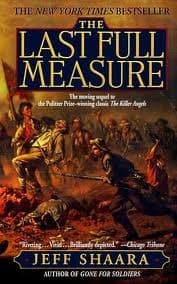
Jeff Shaara (1998)
Genre
Historical Fiction
Reading Time
1280 min
Key Themes
See below
Sign in to track this book
Through the eyes of Grant, Lee, and Chamberlain, 'The Last Full Measure' shows the brutal, culminating two years of the Civil War, from the Wilderness to Appomattox, as the Confederacy's last breaths are drawn against the Union's relentless advance.
In March 1864, after the Union's costly victory at Gettysburg and continued frustration with Potomac Army leadership, President Abraham Lincoln appoints Major General Ulysses S. Grant as Lieutenant General and General-in-Chief of all Union armies. Grant, fresh from his successes in the Western Theater, arrives in Washington D.C. and immediately assesses the strategic situation. He meets with Lincoln and then with Major General George Meade, commander of the Army of the Potomac, to outline his aggressive new vision: a coordinated, relentless advance on all fronts to overwhelm the Confederacy. Grant's plan is to keep constant pressure on Robert E. Lee's Army of Northern Virginia, preventing them from maneuvering or reinforcing other Southern armies, essentially turning the war into a grind of attrition.
In May 1864, Grant's offensive begins with the Battle of the Wilderness. The Union Army of the Potomac, under Grant's direct supervision, moves into the dense, tangled woods south of the Rapidan River, a terrain that negates their numerical superiority in artillery. Robert E. Lee, anticipating Grant's move, positions his Army of Northern Virginia to intercept. The battle quickly becomes a chaotic, blind struggle amidst burning underbrush, with heavy casualties on both sides. Despite the immense losses and the tactical stalemate, Grant, unlike his predecessors, refuses to retreat. Instead, he orders his army to disengage and march southward, aiming to outflank Lee and continue the offensive, a clear signal of his new, unyielding strategy.
Following the Wilderness, Grant continues his flanking maneuvers, leading to the Battle of Spotsylvania Court House. Lee, anticipating Grant's movements, entrenches his army in defensive positions. The fighting culminates in a horrific engagement at the 'Bloody Angle,' a salient in the Confederate lines known as the Mule Shoe. Union troops, including elements led by Colonel Joshua Chamberlain, launch a massive assault, resulting in hours of brutal, close-quarters combat in a driving rainstorm. The fighting is some of the most savage of the war, with men bayoneting and clubbing each other across earthworks. Though the Union eventually breaches parts of the line, the Confederates form new defenses, and the battle ends in another bloody stalemate, but Grant again refuses to withdraw.
After Spotsylvania, Grant again attempts to maneuver around Lee's flank, leading to the Battle of Cold Harbor in early June 1864. Lee's army has once more dug in, creating an almost impregnable line of trenches and earthworks. Overconfident and underestimating the strength of the Confederate defenses, Grant orders a direct frontal assault on June 3rd. The attack is a catastrophic failure, with thousands of Union soldiers mowed down in minutes by concentrated Confederate fire. The Union suffers an estimated 7,000 casualties in less than an hour, while Confederate losses are minimal. Grant later expressed regret for this decision, marking it as one of his greatest tactical errors, but he still holds the initiative.
Following the losses at Cold Harbor, Grant makes a bold strategic decision. Instead of continuing frontal assaults, he orchestrates a massive, skillful crossing of the James River, aiming to cut off Richmond's supply lines by capturing Petersburg, a key railway hub. However, initial Union attacks on Petersburg in mid-June are poorly coordinated and fail to break through the thinly held Confederate defenses. Realizing the strength of the Confederate works, Grant settles his army into a long siege. This marks a significant shift in the war in the East, moving from open-field battles to static trench warfare, a precursor to World War I, and signaling the beginning of the end for the Confederacy's ability to maneuver.
During the siege of Petersburg, a unique plan is proposed by Pennsylvania coal miners in Ambrose Burnside's IX Corps: dig a tunnel under the Confederate lines and detonate explosives. The mine is successfully dug and filled with gunpowder. On July 30, 1864, the charge is detonated, creating a massive crater and a gap in the Confederate defenses. However, the subsequent Union assault is poorly executed; troops are ill-prepared, poorly led, and many simply pile into the crater itself, becoming trapped and easy targets for the regrouping Confederates. The attack turns into a bloody fiasco, with thousands of Union soldiers killed, wounded, or captured, further entrenching the stalemate around Petersburg and demoralizing Union troops.
While Grant's army is bogged down at Petersburg, Major General William Tecumseh Sherman, Grant's trusted subordinate, leads his Union armies on a devastating campaign through Georgia. After capturing Atlanta in September 1864, Sherman embarks on his 'March to the Sea' in November. His army cuts a wide swath of destruction from Atlanta to Savannah, destroying railroads, factories, and crops, and seizing supplies. This campaign of 'total war' is designed to break the Confederacy's economic and psychological capacity to fight, showing the Southern populace that their government cannot protect them. The march is a massive success, culminating in the capture of Savannah in December, significantly weakening the Confederacy.
By early 1865, the situation for the Confederacy is dire. Petersburg is under siege, Richmond is isolated, and Sherman is advancing through the Carolinas. Robert E. Lee, knowing his army is dwindling and supplies are critically low, attempts a desperate offensive to break the Union lines at Petersburg. On March 25, 1865, Confederate forces launch a surprise attack on Fort Stedman, a key Union strongpoint. Initially, the Confederates achieve some success, breaching the Union perimeter. However, a swift and determined Union counterattack, combined with heavy artillery fire, quickly repels the assault. The attack fails, resulting in significant Confederate losses that Lee's army can ill afford, further weakening his already depleted forces.
Following the failed Fort Stedman attack, Grant launches a decisive offensive to break Lee's lines. On April 1, 1865, Major General Philip Sheridan's cavalry, reinforced by infantry, decisively defeats Confederate forces under Major General George Pickett at the Battle of Five Forks. This victory cuts off the last remaining supply line to Petersburg and Richmond, making both cities untenable. Lee recognizes the gravity of the situation and, with his lines shattered and his forces outflanked, orders the evacuation of Petersburg and Richmond on the night of April 2-3. The long siege is over, and the Confederate government is forced to flee its capital, signaling the impending collapse of the Confederacy.
After abandoning Petersburg and Richmond, Robert E. Lee's Army of Northern Virginia begins a desperate westward retreat, hoping to link up with General Joseph E. Johnston's forces in North Carolina and resupply his exhausted troops. However, Grant's Union armies, including Sheridan's cavalry, are in relentless pursuit, constantly harassing Lee's flanks and front. The Confederate soldiers, many starving and demoralized, are pushed to their limits. Skirmishes erupt daily, and Union forces manage to cut off several escape routes. Lee's options dwindle rapidly as his army shrinks through desertion and capture, and his men become increasingly surrounded and cut off from supplies.
During the final days of Lee's retreat, Colonel Joshua Chamberlain, now a Brigadier General, finds himself in a critical position. His Union troops are tasked with blocking a desperate Confederate attempt to break through near Appomattox. In a final, desperate charge, elements of Lee's army, including units under Major General John B. Gordon, launch a fierce attack. Chamberlain's forces hold firm, engaging in heavy fighting that shows the final, brutal moments of the war. Despite the Confederates' courage, they are ultimately repelled by the overwhelming Union numbers and determined resistance. This engagement highlights Chamberlain's resolve and courage, marking his presence at the very end of the conflict.
On April 9, 1865, completely surrounded and with no hope of escape or resupply, Robert E. Lee sends a message to Ulysses S. Grant requesting a meeting to discuss terms of surrender. The two generals meet at the McLean House in Appomattox Court House, Virginia. Grant, showing magnanimity and a desire for reconciliation, offers generous terms: Confederate soldiers would be paroled and allowed to return home, keeping their horses and sidearms. Officers could retain their swords. Lee accepts the terms, and the formal surrender of the Army of Northern Virginia takes place. This historic event effectively marks the end of the American Civil War, though scattered fighting continues for a short time.
Following the surrender at Appomattox, the Union Army, led by generals like Joshua Chamberlain, oversees the formal stacking of arms by the Confederate soldiers. In a poignant moment, Chamberlain orders his Union troops to salute the surrendering Confederates, a gesture of respect and a symbol of the war's conclusion and the beginning of the healing process. The Confederate soldiers, though defeated, march with dignity. The scene encapsulates the mixture of sorrow, relief, and the daunting task of rebuilding a fractured nation. The generals, both victorious and vanquished, reflect on the immense cost of the war and the future of a reunited America, understanding the historical significance of the moment.
The Protagonist
Grant evolves from a successful Western commander to the General-in-Chief, demonstrating his strategic genius and unyielding will, ultimately achieving victory through attrition.
The Antagonist
Lee's arc is one of tragic decline, as he grapples with the increasing impossibility of victory while maintaining his dignity and devotion to his men until the bitter end.
The Supporting
Chamberlain progresses from a courageous colonel to a respected general, demonstrating consistent bravery and compassion, culminating in his dignified role at Appomattox.
The Supporting
Longstreet remains a steadfast and loyal subordinate to Lee, his pragmatic advice often overlooked as the Confederacy faces insurmountable odds.
The Supporting
Lincoln's arc is defined by his unwavering resolve to find the right general and see the war through to its victorious, albeit costly, conclusion.
The Supporting
Sheridan rises as a dynamic and decisive cavalry commander, playing a crucial role in the Union's final victories.
The Supporting
Hill's arc is one of persistent loyalty and bravery despite declining health, culminating in his death shortly before the final surrender.
The Supporting
Sherman successfully executes his strategy of total war, effectively crippling the Confederacy's ability to wage war and contributing significantly to the Union victory.
The novel portrays the devastating human cost of Grant's strategy of attrition. Unlike earlier Civil War narratives that focused on grand maneuvers, *The Last Full Measure* emphasizes the relentless grind, the daily horrors of trench warfare, and the sheer volume of casualties. Scenes like the Bloody Angle at Spotsylvania, where men fight hand-to-hand for hours in the rain, or the catastrophic frontal assault at Cold Harbor, where thousands die in minutes, highlight the impersonal and gruesome nature of this new form of warfare. The descriptions of the wounded, the constant shelling, and the psychological toll on soldiers on both sides underscore that victory came at an immense and agonizing price.
“I can't spare the men, but I can't spare the time either. We must keep pressing.”
The novel explores the immense pressure faced by both Union and Confederate commanders. Grant must contend with political interference, public opinion, and the immense casualties his strategy incurs, yet he remains resolute. Lee, on the other hand, faces the crushing reality of dwindling resources, desertion, and inevitable defeat, while trying to maintain the morale of his devoted but exhausted army. Their internal thoughts reveal their doubts, fears, and the heavy burden of responsibility for thousands of lives and the fate of their respective nations. The contrast between Grant's relentless drive and Lee's dignified resignation under impossible circumstances forms the core of this theme.
“My army is melting away. I have no more options. It is over.”
This theme is strong in the Confederate characters, particularly Robert E. Lee and his men. Despite facing overwhelming odds, starvation, and the clear signs of impending defeat, many Confederate soldiers and officers continue to fight out of a strong sense of duty, loyalty to their general, and belief in their cause. Lee himself embodies this struggle, knowing the war is lost but feeling bound by honor to continue until the very end. The novel contrasts this with the growing despair and exhaustion that leads to widespread desertion, highlighting the internal conflict within the Southern ranks as the war drags on. For the Union, duty is tied to preserving the nation, pushing through despite the horrific cost.
“There is nothing left but to go on. And if we must fall, then we will fall with honor.”
The novel concludes with the surrender at Appomattox, emphasizing not just the end of the fighting but the beginning of the long road to national reconciliation. The depiction of Joshua Chamberlain ordering his Union troops to salute the surrendering Confederates is a powerful symbol of this theme. While the Union achieves victory, the cost is staggering, both in lives and the deep scars left on the nation. The narrative suggests that true victory lies not just in military triumph but in the ability to heal and reunite. The generosity of Grant's surrender terms also reflects a forward-looking perspective, aiming to bind the wounds of war rather than deepen them.
“We are one country now. Let us not forget that.”
The final years of the Civil War, as depicted in the book, show a significant shift in military strategy from maneuver-based campaigns to a more modern, total war approach. Grant's relentless pursuit and use of attrition, coupled with Sherman's devastating march through Georgia, demonstrate a willingness to target the enemy's infrastructure and civilian morale alongside its armies. The extensive use of trenches and fortifications around Petersburg also foreshadows the static, entrenched warfare of future conflicts. This theme highlights how the Civil War evolved into a more brutal and comprehensive conflict, setting precedents for future military engagements and reflecting a grim reality of modern industrial warfare.
“It will be a fight to the finish, and we are prepared to pay the price.”
Shifting viewpoints among key generals to provide comprehensive insight.
The novel utilizes multiple third-person limited perspectives, primarily focusing on the thoughts and experiences of key generals such as Grant, Lee, and Chamberlain. This device allows the reader to understand the strategic considerations, emotional toll, and personal dilemmas faced by leaders on both sides of the conflict. It provides a balanced and nuanced view of the war's final years, avoiding a singular heroic narrative and instead presenting the complex realities of command and sacrifice from different vantage points, enriching the historical context and character depth.
Character's inner thoughts reveal their motivations, fears, and strategic reasoning.
Extensive use of internal monologue allows readers deep access into the minds of the characters. Grant's practical calculations and unwavering resolve, Lee's agonizing awareness of his army's dwindling strength and his duty, and Chamberlain's philosophical reflections on war and humanity are all revealed through their thoughts. This device adds psychological depth, humanizing these historical figures and illustrating the immense mental and emotional burdens they carried. It makes their decisions, triumphs, and failures more understandable and relatable to the reader.
Early hints and descriptions of Grant's strategy and its inevitable, brutal consequences.
From the moment Grant takes command, there is a clear foreshadowing of the attritional nature of the upcoming campaigns. Discussions among generals, Grant's own strategic pronouncements, and the descriptions of the Union's numerical superiority all hint at a war that will be won through sheer force and grinding down the enemy, regardless of the cost. This device builds a sense of grim inevitability, preparing the reader for the immense casualties and the relentless, bloody nature of the battles that follow, such as the Wilderness and Spotsylvania.
The final surrender as a symbol of both defeat and the potential for reconciliation.
The surrender at Appomattox Court House is presented not just as a historical event but as a powerful symbol. It represents the ultimate defeat of the Confederacy and the end of the Civil War, but more importantly, it symbolizes the potential for national healing and reconciliation. Grant's generous terms and Chamberlain's respectful salute to the Confederate soldiers are symbolic gestures that look beyond the immediate conflict towards the future of a reunited nation, conveying a message of hope amidst the profound tragedy and division that defined the war.
“It was the last full measure of devotion, and it was given freely, by so many.”
— Reflecting on the immense sacrifice of soldiers during the war.
“The war was not just fought on battlefields, but in the hearts and minds of every man, woman, and child.”
— Highlighting the pervasive impact of the war on society.
“Victory has a thousand fathers, but defeat is an orphan.”
— General Grant's cynical view on how credit and blame are assigned.
“You cannot conquer a country with an army; you have to conquer the spirit of the people.”
— Sherman's philosophy on total war and breaking the Confederacy's will.
“There are times when a man must simply do what is right, regardless of the cost.”
— A character grappling with a difficult moral decision.
“The cost of freedom is always high, but the price of not fighting for it is immeasurable.”
— A reflection on the sacrifices made for the Union cause.
“War strips away all pretense, all comfort, and leaves only the raw truth of a man.”
— Observing the transformative and revealing nature of combat.
“Hope is a dangerous thing in war. It can make you reckless, or it can keep you alive.”
— A soldier's conflicted view on the role of hope on the battlefield.
“The weight of command is not in the orders you give, but in the lives that depend on them.”
— A general contemplating the immense responsibility of his position.
“To surrender is not to be a coward, but sometimes, to live to fight another day.”
— A discussion among soldiers about the difficult decision of surrender.
“The smell of gunpowder and blood, once experienced, is never truly forgotten.”
— A vivid sensory memory of the battlefield.
“History would judge them, not by their intentions, but by the outcome of their actions.”
— A character's awareness of the long-term historical perspective.
“Even in the darkest hours, the human spirit finds a way to endure, to resist, to hope.”
— A reflection on the resilience of individuals amidst hardship.
“A good soldier fights not because he hates what is in front of him, but because he loves what is behind him.”
— A soldier's motivation for fighting, emphasizing patriotism and protection.
Ready to see how well you understood this book? Take our interactive quiz with 10 questions.

Biography coming soon.







