“Every villain is a hero in his own story.”
— A recurring theme about perspective.

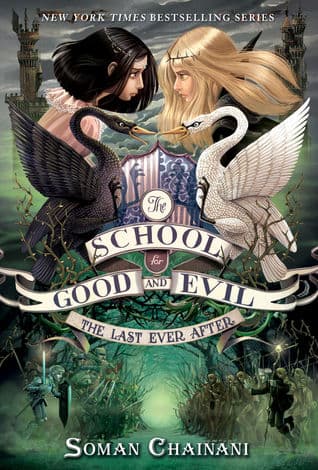
Soman Chainani (2015)
Genre
Fantasy / Children's / Young Adult / Romance
Reading Time
12-15 hours
Key Themes
See below
Sign in to track this book
Sophie and Agatha must confront the past and each other to reclaim their stories before all tales are twisted beyond recognition.
After 'A World Without Princes,' Agatha and Tedros return to Gavaldon, seemingly to live their 'Ever After.' Agatha, however, feels an emptiness and unease, sensing something is wrong. Meanwhile, Sophie lives in the School for Good, now the School for Girls, with the young School Master, Rafal. She believes she has found her happy ending, but Rafal is distant and busy, constantly fighting the growing darkness that threatens the fairy tale world. He struggles to keep the balance between Good and Evil, which the previous book's ending, separating boys and girls into opposing schools, severely disrupted.
Agatha becomes more worried about the imbalance and Gavaldon's fading magic. She realizes that separating boys and girls has caused a catastrophic chain reaction. She finds that the School for Evil, now the School for Boys, has reopened, but its students are no longer the princes she knew. Instead, they are grotesque, beast-like creatures, driven by primal instincts and a desire for blood. This change is a direct result of the School Master's decision to divide the sexes, corrupting the core of Good and Evil and turning potential heroes into villains.
Realizing the world is collapsing, Agatha, with a reluctant Tedros and a few loyal girls from the School for Good, decides to enter the School for Boys. Her goal is to understand what happened and find a way to restore balance. Tedros, though at first angry at Agatha for choosing Sophie over him, must face the monstrous state of his former classmates and the seriousness of the situation. Their journey is dangerous, as the forest itself has become a twisted, threatening place, reflecting the world's decaying magic.
Sophie, at first happy with Rafal, grows increasingly suspicious of his behavior. She discovers that he is not truly in love with her but is using her to keep his own power and the schools as they are. Rafal reveals his ultimate plan: to erase all existing fairy tales and create a new, 'perfect' Ever After where he is the only author. He believes that by destroying the old stories, he can prevent pain and disappointment, but in doing so, he threatens to destroy the very fabric of their world and everyone's identities.
As the world falls further into chaos, the Coven of Witches, led by powerful figures from the past, reappears. These witches, once defeated and banished, are now stronger because of the imbalance of Good and Evil. They seek to rewrite their own stories, turning past defeats into victories and getting revenge on those who wronged them. Their return adds more complexity and danger to Agatha and Sophie's quest, as the girls find themselves fighting not only the School Master's twisted vision but also the vengeful spirits of history.
Inside the corrupted School for Boys, Agatha and Tedros try to talk to the monstrous students. They realize that the boys' true selves are still trapped beneath their beastly appearances. They discover that the boys' transformation is not permanent but requires an act of true love and sacrifice to break the curse. This forces Tedros to confront his own biases and his responsibility for his former friends, while Agatha's strong belief in Good struggles against the overwhelming evidence of Evil's victory.
Sophie, having fully understood Rafal's manipulation and the danger he poses, makes a key decision. She realizes her true loyalty is to Agatha and to preserving their world, not to a twisted version of an Ever After. She turns against Rafal, using her unique connection to both Good and Evil to try and stop his plans. This moment is a turning point in Sophie's character arc, as she moves past her self-serving desires to a more selfless path, fighting for the greater good.
The story's climax sees Agatha, Sophie, Tedros, and their allies facing Rafal in a desperate battle to stop him from erasing all existing fairy tales. Rafal's power is immense, as he holds the pen that writes and unwrites destinies. The fight is not just physical; it is a struggle over the meaning of storytelling and Ever After. Characters from various fairy tales, both Good and Evil, are drawn into the conflict, their fates uncertain as Rafal tries to rewrite their histories.
During the battle, Sophie and Agatha discover that the only way to defeat Rafal and save their world is to make a final choice about the 'Storian' – the magical pen that writes all stories. This choice is deeply personal and involves sacrificing their own desires for a perfect Ever After to restore balance. The decision forces them to confront their past mistakes, their complicated friendship, and their individual destinies, ultimately determining if the world will be saved or lost forever to Rafal's twisted vision.
The choice Sophie and Agatha make causes a big shift in the fairy tale world. While not everyone gets their desired 'Ever After' in the traditional sense, a new balance is set, and Rafal's threat is removed. The ending is bittersweet, showing life's complexities and the idea that true happiness does not always come as a perfect, pre-written story. It leaves room for future possibilities, suggesting that self-discovery and friendship are more important than any predetermined ending.
The Protagonist
Agatha evolves from a hesitant hero to a decisive leader, understanding that true Ever Afters are forged through sacrifice and genuine connection, not predetermined roles.
The Protagonist
Sophie transforms from a self-absorbed princess-wannabe to a self-sacrificing hero, choosing love and friendship over personal glory and a twisted Ever After.
The Antagonist
Rafal remains steadfast in his villainous goal, ultimately facing defeat as his twisted vision is rejected by those who believe in true choice and sacrifice.
The Supporting
Tedros grows from a traditional prince to a more mature and understanding leader, willing to fight alongside his friends for a more complex version of Good.
The Supporting
Hort's loyalty to Sophie and his inherent goodness are tested, but ultimately his true self shines through, proving that Evil can possess heroic qualities.
The Supporting
Dot remains a steadfast and loyal friend, her unwavering kindness proving valuable amidst the chaos.
The Supporting
Kiko's perspective shifts as the world unravels, showing her evolving understanding of what it means to be 'Good.'
The Antagonists
The Coven acts as a formidable obstacle, their reemergence reinforcing the chaotic nature of a world without balance.
The book explores what 'Ever After' truly means. Sophie first thinks it is about being a beautiful princess with a prince, while Agatha wants a simpler, real happiness. Rafal's twisted idea of a 'perfect' Ever After, achieved by erasing all stories, forces a re-evaluation. The story suggests that true Ever After is not a pre-written, perfect ending, but a continuous journey of choice, sacrifice, and real connection, even if it is messy. This is clear in Sophie's choice to fight Rafal, sacrificing her dream of a perfect prince to save her friend and the world, and Agatha's realization that love and friendship are more lasting than any fairy tale ending.
“''An Ever After isn't a destination. It's a choice.'”
A central theme is the conflict between predetermined destiny (written by the Storian) and individual choice. Characters constantly fight against the expectations of their fairy tale roles. Rafal tries to remove all choice by rewriting stories, while Sophie and Agatha's journey is about taking control of their own narratives. Sophie's decision to betray Rafal, despite their romance, is a strong act of choice, as is Agatha's willingness to sacrifice her own happiness for the greater good. The book argues that true heroism is choosing one's path, even if it differs from the 'script.'
“'The Storian doesn't write your story. You do.'”
The novel highlights the crucial connection between Good and Evil, arguing that neither can exist without the other. Separating boys and girls into different schools, meant to create 'pure' Good and Evil, instead causes corruption and imbalance. The boys become monstrous without the girls' calming influence, and the girls' world becomes stagnant and incomplete. The return of the Coven and the overall decay of the fairy tale world show that a healthy system needs both forces in harmony, not in total opposition. The main characters' quest is largely about restoring this delicate balance.
“'Good needs Evil, and Evil needs Good. Without one, the other withers and dies.'”
The complex friendship between Sophie and Agatha is the emotional center of the series, and this book deeply explores its lasting power. Their bond goes beyond romantic love and challenges traditional fairy tale ideas. While romantic relationships (Agatha-Tedros, Sophie-Rafal) are present, the story ultimately prioritizes the strength of their platonic, yet deeply connected, bond. Their willingness to sacrifice for each other, despite past betrayals and rivalries, shows that love comes in many forms, and friendship can be the most powerful force for change and salvation. This is shown in their final joint decision, which is rooted in their shared history and love.
“'It wasn't a prince who saved her. It was her best friend.'”
Characters deal with their identities, often feeling limited by their roles as 'Ever' or 'Never.' Sophie struggles with her natural leanings towards Evil despite wanting a Good Ever After, while Agatha constantly questions if she truly belongs in either world. The boys' transformation into monsters forces them to confront their own definitions of self and what it means to be a hero or a villain. The journey towards self-acceptance, embracing one's true nature rather than conforming to outside expectations, is a key element, especially for Sophie's redemption.
“'You are who you choose to be, not who the Storian says you are.'”
The magical pen that writes all fairy tale stories.
The Storian is the omnipotent magical pen that records and dictates the destinies of all fairy tale characters. It serves as a literal manifestation of destiny and the overarching narrative. In 'The Last Ever After,' it becomes a central plot device as Rafal wields its power to rewrite and erase stories, making it a weapon of ultimate control. The protagonists' goal is not just to defeat Rafal, but to reclaim the Storian's rightful, impartial function and prevent the destruction of all existing narratives, thereby asserting the importance of free will over predetermined fate.
A locket containing the School Master's heart, symbolizing his power and vulnerability.
The School Master's locket, which contains his heart, is a crucial plot device that represents Rafal's power and his ultimate weakness. Its existence is a secret Sophie uncovers, and it becomes the key to potentially defeating him. The locket symbolizes the source of his life and magic, and its vulnerability highlights that even the most powerful villains have a core weakness. It also represents a piece of the original School Master, hinting at the enduring legacy and cyclical nature of power and corruption within the schools.
The once magical woods become a dangerous, twisted reflection of the world's imbalance.
The Woods Beyond, once a path between worlds and a place of magical encounter, becomes a corrupted and dangerous landscape. This serves as an environmental plot device, reflecting the decaying state of the fairy tale world due to the imbalance of Good and Evil. Its twisted trees, menacing creatures, and treacherous paths physically embody the narrative's central conflict. Navigating the corrupted forest becomes a perilous journey for Agatha and her allies, symbolizing the internal and external struggles they face in a world that has lost its way and become a distorted version of its former self.
A magical trial designed to reveal a character's true Ever After.
The 'Ever After' Test is a magical trial or series of challenges that characters must undergo, designed to reveal their true, destined Ever After. This device acts as both a narrative driver and a thematic exploration. It forces characters to confront their deepest desires and fears, often revealing that their perceived 'Ever After' is not what they truly need or are meant for. In 'The Last Ever After,' the idea of an 'Ever After' is constantly challenged and redefined, making any such test a potentially misleading or manipulative tool, especially under Rafal's influence. It underscores the theme that true happiness is not externally granted but internally chosen.
“Every villain is a hero in his own story.”
— A recurring theme about perspective.
“The price of a happy ending is the battle that earns it.”
— Reflecting on the struggles to achieve a desired outcome.
“Good and Evil are two sides of the same coin, and sometimes, it's hard to tell which is which.”
— Discussing the blurred lines between morality.
“A true princess doesn't need a prince to save her. She saves herself.”
— Challenging traditional fairy tale tropes.
“Love isn't about finding the perfect person, it's about seeing an imperfect person perfectly.”
— Reflecting on the nature of love and acceptance.
“The greatest stories aren't about what happens, but about who it happens to.”
— Emphasizing character over plot.
“Sometimes, the only way to find your true path is to get lost.”
— About the necessity of exploration and misdirection for self-discovery.
“Fairy tales don't tell children that dragons exist. Children already know that dragons exist. Fairy tales tell children that dragons can be killed.”
— Highlighting the purpose and comfort of fairy tales.
“No one is born evil. They just choose the wrong path, again and again.”
— Exploring the origins of villainy as a series of choices.
“The End is just the beginning of a new story.”
— A hopeful outlook on endings and new possibilities.
“What makes a hero isn't the power they have, but the choices they make.”
— Defining heroism through actions and decisions.
“The world isn't black and white. It's a million shades of gray.”
— About the complexity and nuances of life and morality.
“Sometimes, the greatest strength is knowing when to ask for help.”
— Underscoring the importance of vulnerability and community.
“A true story never really ends, it just waits for someone new to tell it.”
— Reflecting on the enduring nature of narratives and legacies.
Ready to see how well you understood this book? Take our interactive quiz with 10 questions.

Biography coming soon.







