“When the will of Heaven is for you to rule, no one can stop you. When the will of Heaven is against you, no one can help you.”
— Empress Dowager Cixi reflecting on her early rise to power and the unpredictable nature of fate.

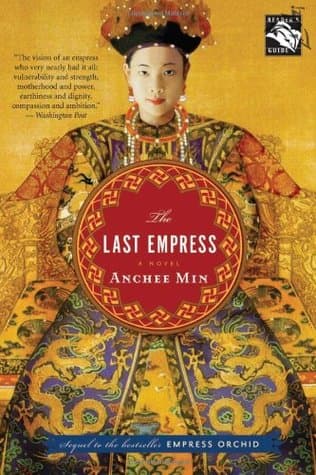
Anchee Min (2007)
Genre
Historical Fiction / Romance
Reading Time
308 min
Key Themes
See below
Sign in to track this book
From a concubine to empress, Tzu Hsi navigates the violent end of the Qing Dynasty, battling invaders, rebellions, and personal losses to protect a crumbling empire and her loved ones.
The novel opens with Empress Orchid, formerly Lady Yehonala, navigating the complex politics of the Forbidden City. Her son, Emperor Tongzhi, is nearing adulthood and preparing to assume full power, which will move Orchid to a less influential, though still respected, position as Empress Dowager. Orchid worries about Tongzhi's frivolous nature and lack of interest in governance. She believes him unprepared for the throne's immense responsibilities. She also faces scrutiny from conservative Manchu elders and the lingering influence of Empress Nuharoo, Emperor Xianfeng's former primary wife. Orchid's past decisions, especially her role in the coup that brought her to power, continue to cast a long shadow, making her aware of the dangers around her and her son.
As Emperor Tongzhi comes of age, he increasingly resents his mother's continued guidance and the Grand Council's influence. He asserts his authority by making impulsive decisions, including favoring a concubine over his empress and engaging in illicit activities outside the palace. Orchid, despite her deep love for him, finds herself in a difficult position. She is torn between allowing him to rule independently and protecting the dynasty from his perceived recklessness. Tongzhi's defiance and rumored visits to brothels lead to him contracting smallpox (or syphilis, as hinted), a disease that quickly incapacitates him. His death devastates Orchid and leaves the empire without a direct heir, causing a succession crisis.
Following Tongzhi's death, the Manchu clan faces a severe succession problem. Custom dictates that the new emperor must be of the next generation to properly honor the deceased emperor. However, Orchid, determined to maintain stability and her influence, makes the controversial decision to adopt her nephew, Zaitian (later Emperor Guangxu), as her son and install him as emperor. This move violates Manchu tradition but is supported by powerful figures like Prince Gong, who recognize the need for strong leadership during a turbulent period. Orchid's decision secures her position as co-regent with Empress Nuharoo, consolidating her power while creating a complex family dynamic within the imperial court.
Empress Nuharoo, Orchid's co-regent and Emperor Xianfeng's former primary wife, eventually dies from illness. Her death removes a significant political rival and a constant source of tension for Orchid. While Nuharoo often opposed Orchid, her presence also provided a balance of power within the regency. With Nuharoo gone, Orchid becomes the sole Empress Dowager Regent, taking on the full weight of governing a vast and troubled empire. This transition marks a turning point, as Orchid must now navigate internal politics and external threats without Nuharoo's buffer or challenge. The burden of leadership, already immense, now rests entirely on her.
Throughout her regency, Empress Orchid faces continuous challenges from Western powers – Britain, France, Russia, Japan, and the United States – who demand trade concessions, extraterritorial rights, and territorial leases. The Opium Wars and subsequent treaties have weakened China, and foreign gunboats frequently threaten the coast. At the same time, internal rebellions, such as the Taiping Rebellion (which was largely suppressed earlier but its aftermath still resonates) and smaller uprisings, plague the countryside. These show deep discontent among the people. Orchid struggles to modernize China's military and infrastructure while resisting foreign encroachment without provoking full-scale war. This delicate balancing act often pits conservatives against progressives within her own court.
Empress Orchid dedicates herself to Emperor Guangxu's education, ensuring he receives instruction in both traditional Manchu customs and modern subjects. She selects tutors and oversees his studies with meticulous care, hoping to mold him into a capable ruler. However, as Guangxu matures, he becomes influenced by progressive thinkers and reformist ideas, particularly those advocating for Western-style modernization. This intellectual awakening creates a growing ideological divide between Guangxu and Orchid. While Orchid recognizes the need for some reform, she is more cautious and traditional, prioritizing the Manchu dynasty's stability over radical change. Their differing visions for China begin to create tension in their relationship.
Emperor Guangxu, inspired by Kang Youwei and Liang Qichao, launches the Hundred Days' Reform in 1898. He issues numerous edicts aimed at modernizing China's government, education, and military. These reforms threaten the power of conservative Manchu officials and eunuchs, who appeal to Empress Orchid. Seeing the reforms as too radical, too fast, and a direct challenge to her authority and the Manchu dynasty's foundations, Orchid, with the support of powerful conservative generals like Ronglu, stages a counter-coup. She quickly reverses Guangxu's edicts, imprisons or executes the reformers, and places Guangxu under house arrest. This reasserts her absolute control over the empire. This event marks the end of Guangxu's political autonomy.
Frustrated by foreign aggression and the imperial government's perceived weakness, a xenophobic peasant movement known as the Boxers rises in northern China. Empress Orchid, swayed by anti-foreign sentiment and the Boxers' claims of supernatural protection, initially supports them. She even issues an edict declaring war on all foreign powers. This catastrophic decision leads to the siege of the foreign legations in Beijing and a swift, brutal military intervention by an Eight-Nation Alliance. As foreign troops march on the capital, Orchid, along with Emperor Guangxu and the imperial court, is forced to flee Beijing in disguise to Xi'an. This is a humiliating experience that exposes the dynasty's vulnerability and her misjudgment.
Following the signing of the humiliating Boxer Protocol, which imposed heavy indemnities and allowed foreign troops to be stationed in Beijing, Empress Orchid and the imperial court return to the capital. The experience of exile and the crushing defeat by foreign powers force Orchid to recognize the urgent need for modernization. She begins a new, more comprehensive reform program, known as the New Policies. This includes abolishing the imperial examination system, establishing modern schools, creating a new army, and even promising a constitutional monarchy. These reforms are far-reaching and, ironically, mirror many of the changes Guangxu had attempted years earlier, showing Orchid's ability to adapt, even if it came late.
Despite her reform efforts, the relationship between Empress Orchid and Emperor Guangxu remains strained and marked by deep resentment. Guangxu, essentially her prisoner, never forgives her for crushing his reforms and limiting his power. He becomes increasingly frail and sickly, a shadow of his former self. Orchid, though she holds all the power, is haunted by the knowledge of his unhappiness and their bond's tragic course. She is torn between her love for him as a son and her conviction that her actions were necessary to preserve the dynasty. Their complex, often agonizing relationship is a central emotional thread throughout this period. It culminates in a final, tragic twist.
In November 1908, Emperor Guangxu dies suddenly and mysteriously, just one day before Empress Orchid's own death. The timing raises immediate suspicions of foul play, with many believing Orchid, fearing Guangxu might regain power after her death, ordered his poisoning. Orchid herself dies shortly after, having designated the infant Puyi as the next emperor, with Prince Chun (Puyi's father) as regent. Her death marks the end of her extraordinary and tumultuous reign, a period characterized by challenges and her unwavering, often ruthless, determination to preserve the Manchu dynasty. Her final act of succession planning, however, proved to be a temporary solution for a dynasty already on the brink of collapse.
The Protagonist
Orchid transforms from a young, ambitious mother into a seasoned, often autocratic ruler, forced to make increasingly difficult decisions to protect her empire, ultimately recognizing the need for change while struggling to implement it effectively.
The Supporting
Tongzhi attempts to assert his independence from his mother's regency but ultimately succumbs to illness, never fully realizing his potential as an emperor.
The Supporting
Guangxu transitions from a hopeful, reformist emperor to a disillusioned and powerless figure, a victim of his own progressive ideals and Orchid's strong will.
The Supporting
Nuharoo maintains her traditional influence as co-regent until her death, which leaves Orchid as the sole, undisputed power.
The Supporting
Prince Gong consistently advocates for modernization and supports Orchid's regency, serving as a vital, if sometimes challenging, advisor.
The Supporting
Ronglu remains a steadfast and loyal protector of Orchid and the Manchu dynasty throughout his life, ensuring her political survival.
The Mentioned
Kang Youwei inspires the Hundred Days' Reform but is forced into exile after its suppression.
The Mentioned
Liang Qichao is a key participant in the Hundred Days' Reform and subsequently escapes into exile.
The novel explores the personal and moral costs of leadership, especially for Empress Orchid. She is shown as a woman who constantly sacrifices personal happiness, family relationships, and her reputation to protect the Manchu dynasty and what she believes is best for China. Her decisions, whether with her sons, Nuharoo, or foreign powers, are almost always driven by this strong sense of duty. The isolation that comes with her power, and the internal struggle to make unpopular but necessary choices, is a recurring idea, highlighting the heavy price of her reign. For example, her decision to crush Guangxu's reforms, though presented as a painful necessity, leads to his lifelong suffering.
“A leader must not be loved, but feared. Only then can order be maintained.”
A central conflict in the novel is the tension between China's deep traditions and the urgent need for modernization in the face of Western intrusion. Empress Orchid, while a practical reformer, is bound by the conservative Manchu clan's customs and imperial history. Her son, Guangxu, represents the strong desire for rapid, Western-style reform. The clash between these two ideas is most clear during the Hundred Days' Reform, where Guangxu's radical changes are brutally suppressed by Orchid, who fears they will destabilize the dynasty. However, even Orchid eventually implements similar reforms, showing a slow, painful recognition that tradition alone cannot save China.
“The past is a heavy cloak, but the future demands we shed it, piece by painful piece.”
The novel shows the challenges faced by a woman with ultimate power in a patriarchal society. Empress Orchid constantly battles against the expectations and limitations placed on her gender. She must be more cunning, ruthless, and capable than her male counterparts to maintain authority. Her gender is often used against her by critics, who call her the 'Dragon Lady.' The story explores how she manipulates, persuades, and sometimes intimidates to assert her will, often working through male figures like Prince Gong or Ronglu. Her ability to rise and rule for decades shows her extraordinary will, but also highlights the immense societal barriers she had to overcome.
“They call me Dragon Lady. They forget that a dragon, even a female one, can breathe fire.”
Empress Orchid's role as a mother is explored, especially through her relationships with her biological son, Tongzhi, and her adopted son, Guangxu. She loves them fiercely but also sees them as tools for the dynasty's survival. Her attempts to guide Tongzhi are met with rebellion and tragedy, while her efforts to control Guangxu's reforms lead to a profound and tragic separation. The novel explores the complexities of a mother's love when mixed with the demands of imperial power, showing how personal affection can clash with political necessity, leading to heartbreak and difficult choices. Her final acts, including Puyi's succession, are still rooted in a desire to protect her lineage.
“A mother's love is a heavy crown, especially when that mother is also an Empress.”
A pervasive theme is the sense of an empire in decline, facing an inevitable end despite its strongest ruler's efforts. Even Empress Orchid's strong will and strategic mind cannot reverse history's tide. The constant pressure from foreign powers, internal corruption, and the dynastic system's weaknesses all point towards an inescapable end. The Boxer Rebellion and the subsequent flight to Xi'an symbolize the empire's vulnerability and humiliation. Despite Orchid's late reforms, the seeds of revolution are already sown, suggesting that her reign, however long and powerful, was ultimately a holding action against a preordained collapse.
“We are a dying empire, and I am merely holding back the flood with my bare hands.”
Retelling a maligned historical figure's story with a sympathetic and humanizing perspective.
Anchee Min's novel directly challenges the prevailing Western narrative of Empress Tzu Hsi as the 'Dragon Lady' – a cruel, manipulative, and power-hungry tyrant. Instead, it presents her as a complex, pragmatic, and deeply human leader driven by a fierce loyalty to her family and empire. This device allows readers to reconsider a historical figure often demonized, offering a nuanced view of her motivations, struggles, and the impossible choices she faced. The author uses extensive research to create a plausible, empathetic portrait that counters decades of negative propaganda, inviting a re-evaluation of her legacy.
Providing deep insight into Empress Orchid's thoughts and emotional landscape.
The narrative frequently employs internal monologues, allowing readers direct access to Empress Orchid's thoughts, fears, justifications, and emotional turmoil. This device is crucial for humanizing a figure often portrayed as cold and calculating. It reveals her inner conflicts, her love for her children, her anxieties about the empire, and her personal sacrifices. By showing the world through her eyes, the novel builds empathy and provides a richer understanding of her complex decisions, particularly in moments of political crisis or personal tragedy, such as her grief over Tongzhi or her conflicted feelings about Guangxu's imprisonment.
Subtly hinting at the inevitable collapse of the Manchu dynasty throughout the narrative.
The novel uses various forms of foreshadowing to convey the impending doom of the Manchu dynasty, even amidst Empress Orchid's strong rule. This includes constant references to foreign incursions, the weakness of the imperial system, and the growing discontent among the populace. Events like the humiliating Boxer Protocol and the flight to Xi'an serve as stark warnings of the empire's fragility. The early deaths of emperors and the succession crises also hint at instability. This device creates a sense of tragic inevitability, underscoring that even the most powerful ruler cannot indefinitely hold back the tide of historical change, building a melancholic tone throughout the story.
“When the will of Heaven is for you to rule, no one can stop you. When the will of Heaven is against you, no one can help you.”
— Empress Dowager Cixi reflecting on her early rise to power and the unpredictable nature of fate.
“A woman's place is in the home, but a woman's mind can rule an empire.”
— Cixi's internal monologue about defying traditional gender roles while secretly holding ultimate authority.
“To be an empress is to be a ghost in a gilded cage.”
— Cixi's melancholic realization about the isolation and constraints of her position despite its grandeur.
“The greatest weapon a woman possesses is her intelligence, not her beauty.”
— Cixi's advice to a younger lady-in-waiting, emphasizing the importance of wit over superficial charm.
“History is written by the victors, and I intend to be one of them.”
— Cixi's determination to shape her legacy and control the narrative of her reign.
“Love is a luxury I cannot afford, nor do I have time for it.”
— Cixi's pragmatic view on personal relationships, prioritizing her duties and political survival.
“Beneath the Dragon Robe, the heart of a woman still beats, longing for what could never be.”
— Cixi's secret yearning for a normal life and personal happiness, hidden by her imperial facade.
“A good ruler must sometimes make unpopular decisions for the good of the nation.”
— Cixi justifying a difficult political choice that was met with public disapproval.
“The whispers of eunuchs are more dangerous than the shouts of soldiers.”
— Cixi's awareness of the pervasive intrigue and hidden dangers within the Forbidden City.
“To reform is to risk everything, but to stand still is to guarantee ruin.”
— Cixi contemplating the necessity and perils of modernizing China in the face of conservative opposition.
“My greatest sorrow is not my enemies, but the weakness of my own people.”
— Cixi's frustration with the internal divisions and lack of unity within China, hindering its progress.
“The Forbidden City is a place of immense beauty and crushing loneliness.”
— Cixi's reflection on the contradictory nature of her opulent yet isolated existence.
“Even an empress must sometimes bow to the inevitable.”
— Cixi acknowledging the limits of her power in the face of insurmountable challenges or personal loss.
“I will not be remembered as a concubine, but as the woman who saved an empire.”
— Cixi's fierce determination to control her historical narrative and defy the derogatory labels placed upon her.
Ready to see how well you understood this book? Take our interactive quiz with 10 questions.

Anchee Min is a Chinese-born American author celebrated for her historical fiction novels, particularly those focusing on Chinese empresses. Her notable works, "The Last Empress" and "Empress Orchid," offer vivid portrayals of imperial China's powerful women. Min's writing is known for its immersive detail and compelling narratives, drawing from her own experiences and extensive research.







