“The future is not a gift. It is an achievement.”
— Narrator reflecting on the nature of progress and innovation.

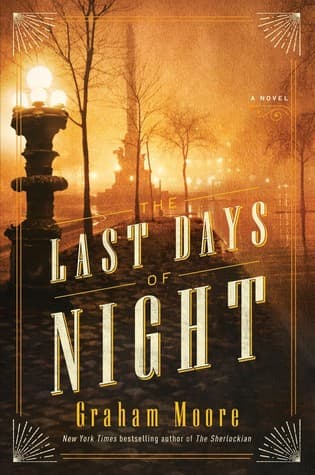
Graham Moore (2016)
Genre
Thriller / Historical Fiction / Mystery
Reading Time
10-12 hours
Key Themes
See below
Sign in to track this book
In a city ready for electric light, a young lawyer risks everything to defend George Westinghouse against Thomas Edison, uncovering ambition, espionage, and invention where everyone has a shocking secret.
In New York City, 1888, Paul Cravath, a recent Columbia Law School graduate with a perfect record, is asked by George Westinghouse to defend him against a patent lawsuit by Thomas Edison. Edison claims Westinghouse's use of AC (alternating current) technology for electric lighting copies his DC (direct current) patents. The stakes are huge, possibly deciding who will control America's electric power future. Despite the challenge of facing Edison, a national hero backed by J.P. Morgan, Paul accepts the case, driven by his ambition and a desire to prove himself. He soon learns the legal battle will go beyond the courtroom, involving public opinion, political moves, and industrial spying.
Paul starts to learn about electricity, understanding the differences between Edison's DC system and Westinghouse's AC system. He learns that while Edison's DC is safer for short distances, Westinghouse's AC is much better for long-distance transmission, making it the better technology for widespread electricity. Edison, however, starts a bad campaign, calling AC 'death current' and publicly showing its dangers, even supporting its use in the electric chair. Paul tries to fight this bad publicity, realizing that the 'War of the Currents' is not just a legal battle but a fight for public opinion and the future of technology.
Paul needs a science expert to counter Edison's claims, so he finds Nikola Tesla, a former Edison employee now working with Westinghouse. Tesla, a smart but socially awkward inventor, is at first unwilling to testify, having his own history with Edison. Paul eventually persuades Tesla, who agrees to give key information about the AC motor and its separate invention. Tesla is clearly a genius, but his odd ways and changing personality make problems for Paul, who must manage the inventor's unpredictable nature while getting him ready for the courtroom's intense look.
Paul's legal work often puts him in contact with high society, where he meets Agnes Huntington, a beautiful opera singer. Agnes quickly gets involved in Paul's world, giving him a view of the social and political moves around the trial. She is smart, observant, and seems to care for Paul, but her connections are deep, including to J.P. Morgan and other important people. Paul feels drawn to Agnes, but also careful of her reasons, thinking she might be playing a more complex game than she shows, possibly even giving information to the other side.
As the trial goes on, Edison's methods become more aggressive. His agents spy on industry, trying to steal Westinghouse's patents and stop his work. Paul himself gets quiet threats, and his personal life is watched. Edison uses his control over newspapers to spread false information and hurt Westinghouse's name. Pressure builds on Paul, who must not only prepare his legal arguments but also protect his client and himself from Edison's constant tries to ruin their efforts. He learns that Edison is not just a smart inventor but a tough businessman willing to use any means to win.
The public talk about AC safety ends with the first execution by electric chair, a device made by Harold Brown and paid for by Edison, using Westinghouse's AC current to link it with death. The execution of William Kemmler goes wrong, creating a terrible sight that Edison's friends use to further make AC seem bad. Paul and Westinghouse are horrified by the event, which they see as a desperate and wrong attempt by Edison to turn public opinion against AC. The incident shows the moral stakes of the 'War of the Currents' and how far Edison will go.
As Paul digs deeper, he starts to uncover the alliances and betrayals. He finds that Agnes Huntington, while genuinely caring for him, is connected to J.P. Morgan and has been passing information, though subtly. He also learns about the financial interests, realizing that Morgan's involvement is more than just backing Edison's patents; he wants to gain power in the new electric industry. Paul understands that many people are not simply loyal to one side but are working for their own benefit, making it hard to tell true allies from those looking for chances.
Under the pressure of the lawsuit and his own problems, Nikola Tesla has a mental breakdown. His odd ways get worse, making him harder to manage and threatening his ability to testify well. Paul, seeing Tesla's genius and weakness, acts as his protector and confidante, keeping him from the public and making sure he gets the care he needs. This personal crisis for Tesla shows the human cost of the 'War of the Currents' and helps Paul understand the smart but fragile inventor more.
Despite Edison's resources and public relations, Paul starts to find weaknesses in his case. Through careful research and questioning, Paul uncovers problems in Edison's patent claims and questions the originality of some of his supposed inventions. The testimony of experts, including Tesla (after he recovers), starts to weaken Edison's strong position. The situation slowly changes, as Paul shows that Westinghouse's AC system is not just a copy but a separate and better technological advance, different from Edison's DC patents.
The 'War of the Currents' ends not with a courtroom win but through a strategic move by J.P. Morgan. Seeing that AC was becoming more useful and the endless lawsuits were a financial drain, Morgan arranges a deal: General Electric, made from the merger of Edison General Electric and Thomson-Houston Electric Company, buys Westinghouse's AC patents, ending the direct legal fight. Paul, though not getting a clear legal win, sees this as a strategic success, as it proves AC technology and secures Westinghouse's future. The resolution shows the power of money over legal arguments.
Afterward, Paul thinks about the moral questions and personal deals he made during the case. He achieved success for Westinghouse and helped AC win, but at what cost? He deals with the harsh methods used by both sides, the manipulation of public opinion, and the human toll of the industrial revolution. His relationship with Agnes Huntington ends, a result of the deceptions and conflicting loyalties. Paul leaves the experience a seasoned lawyer, but also with a deeper, more skeptical understanding of power, ambition, and the often unclear lines between right and wrong in pursuing progress.
The Protagonist
Paul transforms from an idealistic young lawyer to a seasoned and morally complex professional who understands the true cost of 'winning' in a world of cutthroat ambition.
The Antagonist
Edison remains largely unchanged, a steadfast and formidable opponent whose methods highlight the moral ambiguities of technological progress.
The Supporting
Westinghouse endures intense legal and public scrutiny, ultimately seeing his vision for AC power validated through a complex business resolution rather than a clear legal victory.
The Supporting
Tesla's arc shows the vulnerability of pure genius in a cutthroat commercial world, highlighting his contributions despite personal struggles.
The Supporting
Agnes's true loyalties and motivations are gradually revealed, showing her as a manipulator navigating a complex social landscape.
The Supporting
Morgan remains a constant, influential force, ultimately dictating the outcome of the conflict through his financial power.
The Mentioned
Sprague's career trajectory reflects the broader shift in the industry towards AC technology.
The Mentioned
Brown's role is primarily to serve Edison's agenda, showcasing the dark side of the 'War of the Currents'.
The novel explores the link between scientific invention and the personal ambition and tough business methods that often come with it. While inventors like Tesla and Westinghouse want technological advancement for everyone, figures like Edison and Morgan are driven by profit, power, and personal legacy. The 'War of the Currents' is where the purity of invention is often overshadowed by the desire to control the market and the future of an important industry, making Paul Cravath deal with his ideals and the realities of human greed.
“What mattered was not who was right, but who could convince the world they were right.”
The book shows how truth can be changed by powerful forces, especially through the media. Edison's campaign against AC, calling it 'death current' and using the electric chair as a display, shows the power of propaganda over scientific fact. Paul Cravath constantly fights not just legal arguments but also the popular public story, realizing that winning the case often means winning public support, regardless of objective truth. This theme shows how easily perception can shape reality.
“There was no such thing as an objective truth, only the truth you could make people believe.”
Paul Cravath, at first an idealistic young lawyer, has to face and make many moral compromises during the case. He sees and sometimes takes part in methods that blur ethical lines, from industrial spying to changing public opinion. The novel asks if 'winning at all costs' is right, especially when the costs involve human suffering (like the electric chair) or losing integrity. Paul's journey is one of ethical thinking, as he works in a world where even the 'good guys' must sometimes use less-than-honorable ways to reach their goals, leaving him with a skeptical view of justice.
“Justice, he was learning, was not a matter of right and wrong. It was a matter of who had the better story.”
The novel shows different forms of power: the power of invention (Edison, Tesla), the power of industry (Westinghouse), the power of law (Cravath), and most importantly, the power of finance (J.P. Morgan). The 'War of the Currents' is finally settled not by a judge but by Morgan's financial moves, showing that money often decides the path of technological and societal change. The influence of powerful people over public opinion, government, and even the legal system is a repeated idea, showing how different powers meet and clash.
“Money was not merely a means to an end; it was the engine, the fuel, and the destination.”
While celebrating the start of electric light, the book also shows the human cost behind this progress. The intense pressure affects people like Nikola Tesla, leading to mental health problems. The harshness of the competition leads to wrong practices, public fear, and the electric chair. Paul Cravath's own ideals are worn down, leaving him with a more cynical view of humanity. The novel suggests that while technology can bring great benefits, it often comes with a cost to individual well-being and moral integrity, showing the sacrifices made in the rush of progress.
“The future was forged not by gentle hands, but by those willing to get dirty.”
The central conflict between Edison's DC and Westinghouse's AC systems.
This real-life historical conflict serves as the primary plot driver. It's not just a technical debate but a battle for public perception, patent rights, and the control of the burgeoning electric industry. The 'War of the Currents' allows the author to explore themes of innovation, ambition, and the ethical dilemmas of progress, shaping the actions of all major characters and influencing the entire narrative arc. It provides a high-stakes backdrop against which Paul Cravath's personal and professional journey unfolds.
Using real historical personalities to drive a fictionalized plot.
The novel takes well-known historical figures like Thomas Edison, George Westinghouse, Nikola Tesla, and J.P. Morgan, and imbues them with fictionalized dialogue, motivations, and internal lives. This device allows the author to explore the human drama behind historical events, making the 'War of the Currents' more personal and engaging. It blends historical fact with speculative fiction, providing a richer understanding of the era and the personalities involved, while still adhering to the known outcomes of their struggles.
A symbolic and literal weapon in Edison's campaign against AC.
The development and first use of the electric chair, deliberately designed by Edison's allies to use AC current, is a powerful and disturbing plot device. It serves as a stark symbol of Edison's ruthless tactics and his willingness to associate his rival's technology with death and cruelty. It heightens the moral stakes of the 'War of the Currents,' creating a tangible and gruesome manifestation of the dangers Edison claims AC poses, and significantly impacts public opinion and Paul's ethical considerations.
The legal proceedings as a stage for conflict and character development.
While the resolution of the 'War of the Currents' ultimately happens outside the courtroom, the legal battle itself is a crucial plot device. It provides a structured framework for Paul Cravath's investigation, his confrontations with Edison's legal team, and the introduction of key witnesses like Tesla. The courtroom scenes allow for intellectual sparring, reveal character through testimony, and serve as a microcosm of the larger societal struggle, even as the narrative acknowledges the limitations of legal justice against powerful financial interests.
“The future is not a gift. It is an achievement.”
— Narrator reflecting on the nature of progress and innovation.
“Every great invention begins as a heresy.”
— Paul Cravath contemplating the disruptive nature of new technologies.
“The law is not about justice. It's about winning.”
— Paul Cravath's realization during the legal battles over electricity patents.
“Genius is not a light in the dark, but a darkness in the light.”
— Description of Thomas Edison's complex and often ruthless character.
“We are all just stories in the end.”
— Reflection on how history remembers figures like Edison, Tesla, and Westinghouse.
“The truth is rarely pure and never simple.”
— Paul Cravath navigating the murky details of the patent wars.
“Power is not about having the most, but controlling the flow.”
— Discussion about the battle between AC and DC electrical systems.
“Invention is the mother of necessity.”
— Twist on the common phrase, highlighting how new creations drive demand.
“The greatest trick the devil ever pulled was convincing the world he didn't exist. The greatest trick an inventor ever pulled was convincing the world his idea was original.”
— Commentary on the nature of innovation and intellectual property.
“History is written by the victors, but technology is built by the obsessed.”
— Observation on the driven personalities behind technological advances.
“A lawsuit is a war fought with paper instead of bullets.”
— Paul Cravath describing the intense legal battles of the era.
“Light is just electricity made visible. And so is darkness.”
— Poetic reflection on the dual nature of electrical power and innovation.
“The only thing more dangerous than a man with nothing to lose is a man with everything to gain.”
— Describing the high stakes for inventors and businessmen in the Gilded Age.
“We don't fear the dark because of what we can't see. We fear it because of what we imagine.”
— Metaphor for the unknown possibilities and dangers of new technology.
Ready to see how well you understood this book? Take our interactive quiz with 10 questions.

Biography coming soon.







