“The past is never dead. It's not even past.”
— A character reflecting on the enduring impact of history and personal experiences.

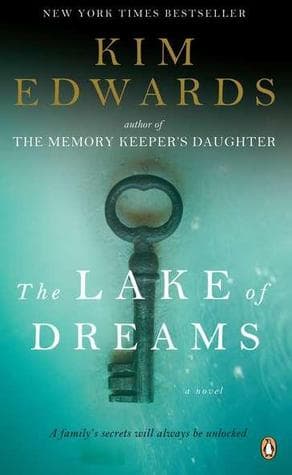
Kim Edwards (2011)
Genre
Historical Fiction / Mystery
Reading Time
500 min
Key Themes
See below
Sign in to track this book
Haunted by her father's death, Lucy finds forgotten objects in her childhood home, uncovering a dark family secret that will redefine her past and future in the mysterious Lake of Dreams.
Lucy Jarrett, in her thirties, has spent the last ten years teaching English in Japan. She finds herself at a personal turning point. Her long-term relationship has ended, and she feels a general sense of aimlessness. She returns to her family home in Upstate New York, a place she associates with her father's death a decade earlier. Lucy seeks refuge and perhaps answers. Her mother, Joan, and sister, Anne, still live there, keeping the house and its quiet routines. Lucy's return brings a subtle tension as she deals with her past and an uncertain future, while also navigating her family's familiar yet changed dynamics.
One late night, restless and feeling her father's absence, Lucy goes to a forgotten window seat in the family home. Driven by a sudden impulse, she opens its old, locked lid. Inside, she discovers a collection of different objects: a faded photograph of a young woman she doesn't know, a hand-stitched sampler with an unusual design, a silver locket, and a small, leather-bound journal. These items are clearly old and hold a sense of mystery, immediately making Lucy curious and suspicious that they are more than just old things.
The most interesting item from the window seat is the photograph of a beautiful, serious young woman. Lucy shows it to her mother, Joan, and sister, Anne, but neither recognizes her, saying they've never seen her. This denial strengthens Lucy's resolve to find out who the woman is. She looks through old family albums and local historical records, eventually discovering that the woman is Anna, her paternal grandmother. The family had believed Anna died young and tragically. This discovery is a shock, as Anna's existence and story had been completely hidden by the family.
Through research in local archives, talks with elderly town residents, and deciphering entries in the hidden journal, Lucy slowly puts together Anna's life. She discovers that Anna was an artist, involved in a radical utopian community near The Lake of Dreams in the early 20th century. This community was known for its progressive ideas and unconventional lifestyles. Anna fell in love with David, a fellow artist and community member. Their relationship was passionate but faced challenges as their ideals clashed with social expectations and family pressures.
Lucy looks deeper into the history of the utopian community, learning about its founder, members, and the progressive, often controversial, ideas they held. She discovers that the community faced significant external opposition and internal conflict. The journal entries and old newspaper clippings hint at a major scandal involving Anna, which led to her sudden departure and the community's eventual end. This scandal, hidden for decades, seems to be the key to understanding why Anna's story was removed from the family narrative.
The journal reveals the truth: Anna and David had a child together. Facing social disapproval and pressure from her conservative family, Anna was forced to give up her infant son. Her sister then adopted him and raised him as her own. This child, Lucy's grandfather, grew up unaware of his true parents. Anna did not die as the family story suggested; instead, she was exiled and separated from her son and the man she loved. This revelation shatters Lucy's understanding of her family's history.
With Anna and David's full story, Lucy confronts her mother, Joan, and sister, Anne. Joan, at first resistant and defensive, eventually admits she knew parts of the truth but promised her own mother (Anna's sister) to keep the secret. Anne is equally shocked and troubled by the revelations. The confession causes significant upheaval within the family, forcing them to deal with the generational trauma and the long-held deception that has shaped their identities.
The revelation of Anna's story forces Joan, Anne, and Lucy to confront the deep patterns of secrecy and silence that have been in their family for generations. Lucy realizes that her father's distant manner and death were likely connected to the unspoken family history. The secrets have shaped not only their past but also their current relationships and individual struggles, including Lucy's own displacement and her father's sadness. The family must now decide how to include this painful truth in their understanding of themselves.
Inspired by Anna's artistic spirit, courage, and love, Lucy begins to rethink her own life choices. She finds a new sense of purpose, especially in her own artistic interests, which she had long ignored. The unfolding of Anna's story helps Lucy confront her own fears and make decisions that align with her true self, rather than giving in to social or family expectations. She begins to pursue her passions and redefine her future.
The initial shock and conflict within the Jarrett family slowly become reconciliation and healing. Joan, Anne, and Lucy begin to communicate more openly, sharing their feelings and experiences. They realize how much the secrets affected their lives and commit to building a more honest future. Anna's legacy, once a source of shame and silence, becomes a story of resilience, love, and the enduring power of truth. The family begins to understand that accepting their complex past is important for their collective and individual well-being.
Having uncovered and processed the family secrets, Lucy no longer sees The Lake of Dreams only as a place of unresolved grief. Instead, it becomes a symbol of her family's rich, though complicated, history, and a source of inspiration. She feels a deeper connection to the land, the lake, and the generations before her, including Anna. The lake, which once represented an escape, now grounds her, providing a sense of belonging and continuity she previously lacked.
The Protagonist
Lucy transforms from a drifting, uncertain individual into a woman grounded in her identity and purpose, empowered by understanding her family's complex history.
The Supporting
Joan moves from guarded secrecy to a painful but ultimately liberating acceptance and sharing of the family's truth, leading to reconciliation with her daughters.
The Supporting
Anne's understanding of her family's history deepens, allowing her to connect more authentically with her mother and sister.
The Supporting (historical)
Anna's story, though historical, reveals her arc from a hopeful, unconventional artist to a woman broken by societal judgment but resilient in spirit, leaving a legacy that eventually liberates her descendants.
The Supporting (historical)
David's arc is largely unseen, but his love for Anna and his ideals represent a path not taken for the family, a symbol of freedom and artistic expression that was suppressed.
The Mentioned
Though deceased, his character's implicit arc is one of a man silently burdened by family history, whose lasting impact prompts his daughter's journey of discovery.
The novel explores how generational secrets, especially those involving shame, can quietly shape family dynamics and individual lives for decades. Hiding Anna's story leads to unspoken grief and unease within the Jarrett family, affecting Lucy's father's personality and Lucy's own aimlessness. The discovery of the window seat's contents forces the family to confront the emotional cost of their silence, showing how truth, however painful, is important for real connection and healing. For example, Joan's initial reluctance to discuss Anna shows the ingrained habit of silence.
“Secrets, like rivers, run deepest where the ground is softest, eroding the very foundations of what holds us together.”
Lucy's journey to uncover Anna's story links to her own search for identity and belonging. Feeling lost, Lucy's discovery of her grandmother's artistic and unconventional past gives her a lineage she never knew existed. Understanding Anna's struggles and resilience helps Lucy accept her own artistic interests and make peace with her unique path. The novel suggests that fully understanding one's heritage, including its painful parts, is important for forming a clear and authentic sense of self. Lucy's initial rootlessness contrasts with her eventual grounding in her family's complex history.
“Perhaps to know where you were going, you first had to understand where you truly came from, even the hidden parts.”
Art is an important form of expression and a way to preserve truth throughout the novel. Anna's journal entries, her art, and the sampler she created are the main ways her story is revealed to Lucy. These artistic items give a voice to the voiceless and allow a connection across generations. For Lucy, finding her grandmother's artistic spirit inspires her to embrace her own creative impulses, suggesting that art can be a powerful tool for healing, self-discovery, and challenging social norms. The utopian community's focus on artistic freedom further supports this theme.
“The stories we tell, and the art we make, are the only true immortality we can hope for.”
The conflict between social expectations and individual desires is a central theme, especially through Anna's story. Her involvement in a utopian community and her love affair with David represent a rejection of early 20th-century norms. The tragic consequences she faces—being ostracized and losing her child—show the severe penalties for not conforming. This theme connects with Lucy's own struggles to define her life outside of traditional expectations, suggesting a recurring tension between the pressure to conform and the desire for authentic self-expression. The community itself was a direct challenge to social conformity.
“There was a fierce beauty in living on the edge of what was allowed, but the fall, when it came, was steep.”
Love and loss are woven throughout the narrative, connecting generations. Anna's deep love for David and her child, and the devastating loss she experiences, echo through time. Lucy's own unresolved grief for her father and her search for meaningful connection are central to her character arc. The novel shows that love, even lost love, leaves a lasting mark and continues to influence lives. Uncovering the secrets allows the family to finally mourn and honor lost loves, bringing a sense of closure and continuity. The silver locket found in the window seat symbolizes enduring, though painful, love.
“Love, like the lake itself, could hold depths unseen, and sometimes, those depths held both beauty and sorrow.”
A physical compartment that serves as a portal to the past.
The locked window seat acts as a literal and metaphorical container of secrets. Its discovery by Lucy is the inciting incident of the entire plot, initiating her journey into the family's hidden history. The objects within – the photograph, journal, and sampler – are the tangible clues that allow Lucy to piece together Anna's story. It symbolizes the buried truths within the family home and the subconscious desire for these secrets to eventually come to light, waiting for the right moment and person to unlock them.
A primary source of historical information and emotional insight.
Anna's journal is a crucial plot device, serving as the direct voice of the past. Its entries provide Lucy (and the reader) with firsthand accounts of Anna's experiences, thoughts, and feelings, detailing her life in the utopian community, her love for David, and the tragic circumstances of her exile. Without the journal, much of Anna's story would remain speculative or lost to time. It allows for a deep emotional connection to a character who is otherwise only known through fragmented records, making the historical narrative intimate and compelling.
A visual catalyst that sparks Lucy's initial curiosity and investigation.
The faded photograph of the unknown young woman found in the window seat is the initial visual mystery that propels Lucy's investigation. The fact that neither Joan nor Anne recognizes her immediately signals that a significant secret is being withheld. It represents the visual evidence of a suppressed past, a face that demands to be identified and a story that demands to be told. The photograph serves as a constant reminder of the unanswered questions and fuels Lucy's determination to uncover the truth.
The physical setting that embodies both natural beauty and hidden depths.
The Lake of Dreams, as the titular setting, functions as more than just a backdrop; it is a powerful symbol. It represents both the idyllic beauty and tranquility that can mask deeper, darker currents. The lake's depths mirror the hidden complexities and secrets within the Jarrett family. Its enduring presence over generations signifies continuity and the way history, like water, can shape the landscape and lives. The utopian community's proximity to the lake further links it to ideals and dreams that, like reflections on water, can be both beautiful and elusive.
“The past is never dead. It's not even past.”
— A character reflecting on the enduring impact of history and personal experiences.
“Sometimes the things we think we know best are the things we understand the least.”
— A realization about the complexities of family secrets and hidden truths.
“A house holds more than just people; it holds their stories, their echoes.”
— The protagonist's feelings about her ancestral home and its connection to her family's past.
“Grief is a landscape you have to walk through, not around.”
— A character grappling with loss and the necessity of confronting sorrow.
“The truth, like water, always finds a way to the surface.”
— A metaphor for the eventual revelation of long-buried family secrets.
“It's not the secrets that break you, but the weight of carrying them alone.”
— A character discussing the burden of isolated knowledge and unspoken truths.
“Every family has its ghosts, some more literal than others.”
— A reflection on the lingering presence of past generations and their influence.
“To forget is to lose a part of yourself, a piece of your own story.”
— The importance of remembering personal and familial history, even the painful parts.
“Sometimes the greatest courage lies in facing what you've always run from.”
— The protagonist's journey of confronting her past and family history.
“The quiet spaces between words often hold the most meaning.”
— A character observing unspoken tensions and hidden messages within conversations.
“Love, like a well-tended garden, requires constant care and weeding.”
— A character reflecting on the effort required to maintain relationships.
“There are some wounds time doesn't heal, only makes less raw.”
— A character acknowledging the lasting impact of deep emotional pain.
“The past isn't just something that happened; it's something that continues to happen to us.”
— Another perspective on how historical events and personal pasts actively shape the present.
“Water remembers everything, if you know how to listen.”
— A symbolic statement about the lake as a repository of memories and secrets.
Ready to see how well you understood this book? Take our interactive quiz with 10 questions.

Biography coming soon.







