“The sea has a strange power over me. It is as if I belonged to it.”
— Ellida expresses her deep, mystical connection to the sea.

Henrik Ibsen (1890)
Genre
Historical Fiction / Romance
Reading Time
90 min
Key Themes
See below
Sign in to track this book
A woman on the Norwegian coast is caught between societal expectations and a past love. She longs for the wild sea and an enigmatic stranger, which threatens her quiet life.
The play starts on a warm summer day at Doctor Wangel's home by a fjord. Ballested, a painter, prepares to work. Bolette Wangel, Dr. Wangel's older daughter, arranges flowers, showing a normal home life. Dr. Wangel and his younger daughter, Hilda, appear. The family talks about summer plans, but it is clear that Ellida Wangel, Dr. Wangel's second wife and the stepmother to Bolette and Hilda, is not there. Her absence and Dr. Wangel's worry suggest her emotional distance. When Ellida appears, her strong connection to the sea and her restless nature are clear, creating a feeling of unease in the peaceful setting. She speaks of the sea's call and her difficulty feeling at home inland, a feeling made worse by the recent death of the lighthouse keeper's wife, which affects her deeply.
Ellida and Dr. Wangel discuss her sadness and her feeling of being a 'stranger' in their home. Ellida explains her main problem: years ago, before marrying Wangel, she had an intense, almost mystical meeting with a sailor, called 'the Stranger,' who promised to return for her. They exchanged rings and pledged themselves to each other. Ellida sees this bond as sacred and unbreakable, despite her later marriage to Wangel. She believes this man, though absent for a long time, still has a claim on her soul and that his spiritual presence keeps her from fully committing to Wangel and their life together. Wangel, though loving and patient, struggles to understand her strong, almost supernatural belief.
Judge Arnholm, Bolette's former tutor, visits. His return sparks a quiet hope in Bolette, who feels limited by her home duties and her stepmother's emotions. She wants intellectual stimulation and a life beyond the fjord. She tells Arnholm her wish to study and see the world, expressing her frustration at being stuck. Arnholm, unmarried, likes Bolette and sees her potential. Their talks quietly show Bolette's unfulfilled goals and her role as a caretaker, contrasting with Ellida's more dramatic, but equally limiting, inner struggles.
Hilda, the younger, more cynical daughter, makes sharp comments about Ellida's behavior and the family. She often sees through polite talk. She mostly dismisses Ellida's 'sea sickness.' Lyngstrand, a young, sick sculptor, is also present. He often talks romantically about his art and his future. He tells Hilda his plans to make a sculpture of a drowned woman waiting for her husband. This theme oddly matches Ellida's situation and her wait for the 'Stranger.' Lyngstrand's presence adds a touch of youthful, artistic idealism that contrasts with the more real, but troubled, lives of the Wangel household.
The tension ends with a mysterious man's sudden appearance. He is 'the Stranger,' the sailor Ellida pledged herself to years ago. His arrival is dramatic and unsettling, confirming Ellida's deepest fears and wishes. He has returned, as promised, to claim her. His presence is strong and almost mesmerizing, confirming the deep, almost supernatural bond Ellida feels with him. He demands she leave Wangel and their life to join him, fulfilling their old vow. This forces Ellida to make a choice, pulling her between her past mystical promise and her current life with Wangel.
Ellida feels a deep inner conflict. The Stranger's presence awakens the wild, untamed part of her soul that desires the freedom and mystery of the sea. She feels a strong pull towards him, believing it is her destiny. Dr. Wangel, seeing her pain, tries to reason with her, to understand her bond with the Stranger. He asks her to stay, highlighting their shared life, their daughter, and his deep love. He offers her freedom within their marriage, promising to let her choose. He hopes that by freeing her from obligation, she might freely choose him.
In a dramatic talk, Wangel realizes he cannot hold Ellida by force or duty. He makes a radical decision. He declares he will release her from all marriage bonds and duties, giving her complete freedom to choose between him and the Stranger. He says that true love and commitment can only exist when chosen freely, without force. This act of deep trust and selflessness is a turning point. It changes Ellida's view from feeling bound by fate or a past vow to realizing she has power to decide her own future. The Stranger gives her a deadline to choose.
Given Wangel's unconditional freedom, Ellida changes deeply. The 'Stranger' represents a wild, untamed, and finally destructive freedom. Wangel's offer represents a different kind of freedom – the freedom to choose love and belonging. When the Stranger returns to claim her, Ellida, now free from the compulsion she felt, realizes her true desire is to stay with Wangel. The spell is broken; the 'sea sickness' disappears. She chooses the stability, love, and human connection of her life with Wangel and his family. She finds peace inland, finally understanding that her 'home' is where she chooses it to be.
After Ellida's decision, Bolette also makes a choice about her future. Arnholm, who had shown affection for her, proposes marriage. This offers her a chance to leave the fjord and follow her intellectual goals. Bolette, though unsure, accepts. She sees it as her only escape from a life of home duties and unfulfilled potential, even if she does not deeply love Arnholm. Meanwhile, Lyngstrand's health worsens. He still dreams of his sculpture and a future with Hilda, not knowing he will soon die. This adds a sad note to the play's ending. Hilda, in her usual direct way, comments on his innocence.
The Protagonist
Ellida moves from a state of internal bondage and longing for an unknown freedom to choosing a conscious, self-determined life of love and commitment with Wangel.
The Supporting
Wangel evolves from a man trying to 'cure' his wife to one who recognizes and respects her need for personal freedom and self-determination.
The Antagonist/Catalyst
The Stranger remains static in his desire to claim Ellida, serving as an external force that challenges her and ultimately helps her define herself.
The Supporting
Bolette moves from feeling confined and yearning for escape to making a practical, though perhaps not passionate, choice for her future.
The Supporting
Hilda remains largely static, serving as an observant, critical voice throughout the play.
The Supporting
Arnholm's arc involves realizing Bolette's desires and offering her a pragmatic solution to her confinement.
The Supporting
Lyngstrand's arc is tragic, as his dreams remain unfulfilled due to his illness.
The Mentioned
Ballested remains a static, observant character, providing background and commentary.
This is the main theme, seen through Ellida and Bolette. Ellida's 'sea sickness' symbolizes her lack of spiritual freedom, her feeling of being tied by a past promise and social expectations. Her final choice, made possible by Wangel's act of release, shows true self-determination. Bolette also wants freedom from home life and intellectual limits, seeking escape through marriage. The play suggests that real love and happiness come only when people are free to choose their own path, not when forced by duty or past promises.
“But what is the good of freedom if you can't use it to choose what you want?”
The contrast between the wild, mysterious sea and the stable, conventional inland life is central to Ellida's struggle. The sea represents passion, danger, the unknown, and a natural connection, shown by the Stranger. Inland life, shown by Wangel and his home, offers security, love, and domesticity. Ellida feels pulled between these two worlds, at first believing she belongs to the sea. Her journey is about bringing these two parts of herself together, finally choosing a home life she freely accepts, calming her wild spirit without suppressing it.
“I belong to the sea. To the sea alone. It calls to me.”
Ibsen questions common ideas of marriage as a duty or social agreement. Wangel's act of giving Ellida complete freedom changes their relationship. He understands that true love cannot be forced; it must be a free choice. Ellida's decision to stay with Wangel, made when she is no longer bound, changes their marriage into a union based on mutual respect, understanding, and freely given affection. Bolette's marriage to Arnholm, however, shows a more practical, less romantic view of marriage as a way to achieve a goal (freedom from being confined).
“If you are to live with me, you must do so as a free, willing human being.”
Ellida is troubled by her past, especially the promise made to the Stranger, which she sees as an unbreakable spiritual bond. This past keeps her from fully living in the present and committing to her current life with Wangel. The Stranger's arrival forces a confrontation between her past duties and her present reality. She finds resolution when she realizes that the past only controls her if she lets it, and that she has the power to choose her present and future, freeing herself from the past's hold. This theme also touches on how psychological 'ghosts' can stop one from moving forward.
“It is the past that holds me fast. The dead hand of the past.”
Represents freedom, the wild, the unknown, and Ellida's subconscious desires.
The sea is the most potent symbol in the play. For Ellida, it embodies her true nature, her longing for boundless freedom, and the spiritual bond with the Stranger. It represents the untamed, the mysterious, and the subconscious. Her 'sea sickness' is a metaphor for her soul's yearning for the ocean's vastness and her inability to adapt to the constrained inland life. The sea also symbolizes the dangerous allure of the unknown and the potential for both liberation and destruction. Its constant presence in the background underscores Ellida's internal conflict.
Embodies Ellida's past, fate, and the irresistible call of the wild.
The Stranger is more than just a character; he is a symbolic embodiment of Ellida's past, her sense of destiny, and the primal, untamed aspects of her own psyche. He represents the 'call of the wild' that Ellida feels so strongly. His almost hypnotic power over her is not just personal but also symbolic of a larger, almost supernatural force. By choosing to reject the Stranger, Ellida is not merely rejecting a man, but consciously choosing to integrate her wildness within a framework of human connection and free will, rather than being driven by an external, fated compulsion.
Represents a liminal space, a compromise between the sea and inland.
The fjord, where the Wangel family lives, is a crucial setting that acts as a liminal space – neither fully open sea nor completely enclosed land. It symbolizes Ellida's trapped existence, a compromise that fails to satisfy her longing for the open ocean. It is a place where the wildness of the sea is contained and diluted. The fjord underscores the theme of confinement and the blurred boundaries between different states of being, reflecting Ellida's own internal state of being caught between two worlds and two selves.
Foreshadows Ellida's dilemma and symbolizes romanticized longing.
Lyngstrand's artistic idea for a sculpture of a drowned woman waiting faithfully for her husband serves as a subtle piece of foreshadowing and symbolism. It directly mirrors Ellida's situation – a woman bound to a distant sailor, waiting for his return. However, Lyngstrand's romanticized vision contrasts sharply with the complex psychological reality of Ellida's torment. It highlights the difference between an idealized, perhaps naive, understanding of loyalty and the profound, almost destructive, nature of Ellida's spiritual bond, while also hinting at the potential for tragic outcomes.
“The sea has a strange power over me. It is as if I belonged to it.”
— Ellida expresses her deep, mystical connection to the sea.
“I am not free. I am bound by a promise.”
— Ellida discusses her sense of entrapment in her marriage.
“The unknown is always more attractive than the known.”
— Ellida reflects on her fascination with the Stranger.
“A woman cannot be herself in the society of the present day.”
— Ellida critiques societal constraints on women.
“I have a right to my own life.”
— Ellida asserts her autonomy and personal freedom.
“The sea calls to me, and I must answer.”
— Ellida feels compelled by the sea's allure.
“Love is not enough; there must be freedom.”
— Ellida argues that love requires liberty to thrive.
“I am like a bird in a cage, longing for the open sky.”
— Ellida uses metaphor to describe her confinement.
“The past has a hold on me that I cannot break.”
— Ellida speaks of her unresolved history with the Stranger.
“To be truly alive, one must risk everything.”
— Ellida contemplates the necessity of risk for fulfillment.
“I have chosen my own path, and I will follow it.”
— Ellida declares her decision to embrace her destiny.
“The sea is both my prison and my salvation.”
— Ellida describes the dual nature of her connection to the sea.
“A promise made under duress is no promise at all.”
— Ellida questions the validity of her marital vows.
“I am not afraid of the unknown; I am afraid of the known.”
— Ellida reveals her fear of a predictable, constrained life.
Ready to see how well you understood this book? Take our interactive quiz with 10 questions.
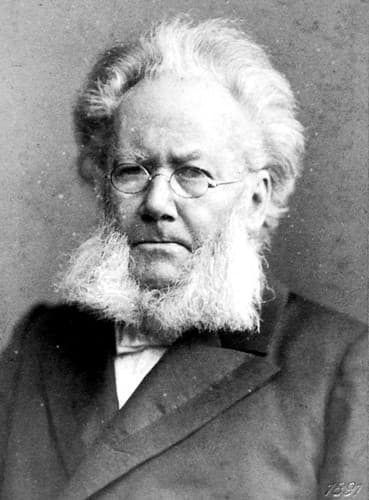
Henrik Johan Ibsen was a Norwegian playwright and theatre director. As one of the founders of modernism in theatre, Ibsen is often referred to as "the father of realism" and one of the most influential playwrights of his time. His major works include Brand, Peer Gynt, An Enemy of the People, Emperor and Galilean, A Doll's House, Hedda Gabler, Ghosts, The Wild Duck, When We Dead Awaken, Rosmersholm, and The Master Builder. Ibsen is the most frequently performed dramatist in the world after Shakespeare, and A Doll's House was the world's most performed play in 2006.







