“The past is a lace curtain, intricately woven, and sometimes, if you hold it up to the light just right, you can see through it.”
— Main character Towner Whitney reflecting on memory and history.

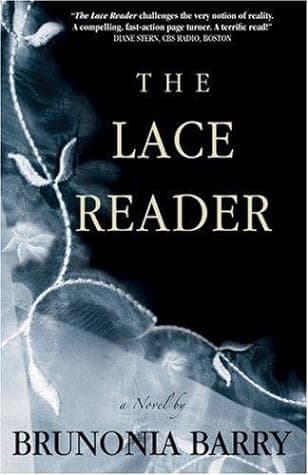
Brunonia Barry (2006)
Genre
Fantasy / Historical Fiction / Mystery
Reading Time
9-12 hours
Key Themes
See below
Sign in to track this book
In a town known for witchcraft, a woman who can read the future in lace must face her past and uncertain mind to solve her aunt's disappearance, while a skeptical detective tries to find the truth among unreliable family stories.
Towner Whitney, a woman marked by a past tragedy linked to her family's ability to 'read' the future in lace, reluctantly returns to her ancestral home in Salem, Massachusetts. Her return is because of her Great Aunt Eva's disappearance, the family's matriarch and original Lace Reader. Towner has spent years trying to escape her family's psychic gifts and overwhelming history, especially after an event in her youth led to her sister's death and her own breakdown. Her arrival brings back the familiar, uneasy atmosphere of Salem, a town tied to its witch trial history and the Whitney women's reputation.
Detective John Rafferty, a straightforward New York City detective who moved to Salem for a quieter life, is assigned to Great Aunt Eva's disappearance. He approaches the case logically, which immediately conflicts with the Whitney women's mystical explanations and their belief in lace reading. Rafferty struggles to understand their world, where visions and the supernatural are common. His investigation is hindered by the family's reluctance to share information and their insistence that Eva's fate relates to the lace, not conventional evidence, creating tension and distrust between him and Towner.
The story is told through Towner Whitney's and Detective John Rafferty's alternating viewpoints, often giving different accounts of the same events. Towner's memories are broken and unreliable, especially about the traumatic event that led to her sister's death and her time in an institution. She often questions her own sanity and what she sees. Rafferty, on the other hand, dismisses much of what the Whitney women say as delusion, constantly looking for rational explanations. This dual narration makes the reader question the truth and piece together a timeline from partial and biased information, mirroring Towner's own search for clarity.
Flashbacks slowly reveal details of Towner's traumatic past, specifically the death of her twin sister, Lyra. It becomes clear that Lyra was also a Lace Reader, and her death was directly linked to a lace reading Towner performed, or believed she performed. The guilt and horror of this event have haunted Towner for years, causing her to suppress her abilities and avoid lace. The memories are painful and often unclear, suggesting a deep psychological wound that has never healed. This past tragedy is a main mystery, and its full meaning is gradually uncovered as Towner faces her repressed memories.
While searching Eva's house, Towner finds her great aunt's hidden journal. The entries are vague but reveal parts of Eva's life, her experiences as a Lace Reader, and hints of an old conflict or curse affecting the Whitney women. The journal suggests that Eva was investigating a powerful, harmful force, possibly connected to another Salem family, and that her disappearance might relate to this struggle. The entries also mention a secret society or a hidden aspect of the lace reading tradition, adding complexity to the mystery.
Towner struggles with the pressure of being a Whitney woman, especially the expectation to use her lace reading abilities, despite her fear and past trauma. Her mother, May, and other family members subtly or openly encourage her to reconnect with her gift, believing it is the only way to find Eva. Towner resists, fearing a return to the mental instability she experienced after Lyra's death. The family's history in Salem, their connection to the witch trials, and their powers form a heavy legacy that Towner tries to escape but finds herself increasingly drawn back into.
As Rafferty investigates, he uncovers an unexpected personal link to the Whitney family and Salem's history. Hints suggest his own ancestors might have been involved in the Salem witch trials, possibly as persecutors, creating a karmic tie to the Whitney women. This revelation challenges his rational view and makes him consider the possibility of inherited trauma or mystical forces. His initial skepticism begins to fade as he finds evidence that defies conventional explanation, drawing him deeper into the world of the Lace Readers.
One of the most significant twists reveals that Lyra, Towner's twin sister, did not die as Towner remembers. Instead, Lyra has been alive and in an institution, suffering from a severe mental illness that caused visions and a distorted view of reality, often triggered by lace. Towner's repressed memories, combined with her own fragile mental state, led her to believe Lyra was dead and that she was responsible. This revelation completely changes the past tragedy and Towner's guilt, showing the extent of the family's secrets and the psychological toll of their abilities.
Towner finally begins to understand the complex and often dangerous nature of the Whitney family's lace reading ability. It is not just about seeing the future; it is about interpreting patterns, understanding historical echoes, and sometimes, witnessing traumatic past events. She learns that lace can be a path to both truth and madness, and that 'readings' are subjective and easily misunderstood, especially for those who are mentally vulnerable. This understanding deepens her empathy for Lyra and helps her accept her own gift.
With her memories clear and her understanding of lace reading deeper, Towner confronts her past trauma and pieces together clues about Eva's disappearance. She realizes that Eva was not necessarily 'missing' but had intentionally withdrawn, possibly to protect herself, to seek a deeper understanding of the lace's power, or to hide a family secret. The resolution involves Towner embracing her abilities, not as a curse, but as a tool for understanding and healing, ultimately leading her to a deep, if not always literal, connection with Eva.
By the novel's end, Towner has come to terms with her past, her sister's fate, and her identity as a Lace Reader. She makes peace with her family, especially her mother, as the full truth of their shared history emerges. While not all mysteries are fully resolved, Towner finds peace and a sense of purpose. She chooses to accept her unique heritage, understanding that lace, though dangerous, is also a source of connection and insight. Her relationship with Rafferty, though complicated, suggests a future where two very different worlds might find common ground.
The Protagonist
Towner evolves from a mentally fragile, guilt-ridden woman who denies her powers to one who embraces her unique abilities and finds clarity and acceptance regarding her past.
The Supporting/Love Interest
Rafferty begins as a staunch skeptic, but through his investigation and growing connection with Towner, he becomes more open-minded and accepting of the inexplicable, even discovering a personal link to Salem's past.
The Supporting/Catalyst
Eva's arc is revealed through flashbacks and discoveries, showing her as a powerful figure who grappled with the responsibilities and dangers of her gift, ultimately making a deliberate choice regarding her fate.
The Supporting/Antagonist (initially perceived)
Lyra's arc is largely in the past, her 'death' and later revelation as alive but ill serving to redefine Towner's understanding of herself and her family's powers.
The Supporting
May's arc involves the gradual unveiling of her past actions and motivations, revealing her as a protective figure who made difficult choices, ultimately leading to a strained but more honest relationship with Towner.
The Mentioned
Callie's role is primarily symbolic, representing the potential future of the lace reading tradition.
The Supporting/Plot Device
The lace's role remains constant as a powerful conduit, but its interpretation and understanding evolve through Towner's journey.
The novel blurs the line between real and imagined, especially through Towner's unreliable narration and the mystical lace reading. Readers must question the validity of events and character perceptions, much like Towner herself. This theme appears in the conflicting accounts of Lyra's death, Towner's fragmented memories, and Rafferty's struggle to reconcile logic with the supernatural. The 'truth' is presented not as a single fact, but as a mix of subjective experiences and interpretations, often shaped by belief and mental state.
“Can you read your future in a piece of lace? All of the Whitney women can. But the last time Towner read, it killed her sister and nearly robbed Towner of her own sanity.”
Towner's inability to fully recall her sister Lyra's death, along with her deep guilt, forms the story's emotional center. The narrative explores how trauma can break memory, leading to repression and self-deception. Her journey involves facing repressed memories and understanding how past events shaped her current mental state. The theme also extends to the Whitney family's collective trauma, from their abilities and connection to Salem's witch trial history, suggesting an inherited burden of guilt and fear.
“The problem with memory is that it's a living thing, always changing, always shifting. You think you remember something, but it's really just a story you've told yourself so many times that it feels real.”
The Whitney women inherit a powerful, yet dangerous, psychic gift: the ability to read the future and past in lace. This gift is both a source of pride and a heavy burden, often leading to madness, isolation, and tragedy, as seen in Lyra's fate and Towner's struggles. The novel explores the conflict between accepting one's heritage and wanting a 'normal' life, and the pressure on individuals to fulfill ancestral roles. The history of the Salem witch trials further increases this burden, casting a shadow of persecution and misunderstanding over the family's unique abilities.
“We are born to it, all of us. And some of us break under the weight of it.”
The conflict between belief and skepticism is central to the narrative, mainly shown through Towner's internal struggle and her dynamic with Detective Rafferty. Towner moves between believing in her abilities and questioning her sanity, while Rafferty sticks to a rational, evidence-based worldview. The story challenges the reader to consider the limits of logic and the power of intuition and faith, even when faced with the inexplicable. It suggests that belief itself can shape reality, and that dismissing the unknown can blind one to deeper truths.
“He believed in facts, in evidence, in things he could touch and measure. I believed in patterns, in whispers, in things that existed between the threads.”
The story is told through the subjective and often contradictory perspectives of Towner Whitney and John Rafferty.
Towner Whitney serves as a primary unreliable narrator due to her history of mental instability, fragmented memories, and her struggle to differentiate reality from delusion. Her account of past events, particularly her sister's death, is constantly called into question, forcing the reader to piece together the truth. Detective Rafferty's perspective, while seemingly more grounded, is also limited by his staunch skepticism and inability to fully comprehend the mystical world of the Whitney women, making his narration unreliable in its dismissal of crucial elements. This device creates suspense and forces active reader engagement in discerning the 'truth'.
Past traumatic events are revealed gradually through Towner's fragmented recollections.
The narrative frequently employs flashbacks, particularly concerning Towner's childhood and the incident involving her sister, Lyra. These flashbacks are often disjointed and initially unclear, mirroring Towner's own repressed and fractured memories. As the story progresses, these fragments coalesce, gradually revealing the full, traumatic truth of her past. This device builds suspense, provides backstory, and is crucial for understanding Towner's psychological state and the central mystery of Lyra's fate, making the reveal of Lyra's true condition all the more impactful.
Lace serves as a multifaceted symbol of destiny, connection, and the intricate web of life.
The lace in the novel is more than just a prop; it is a potent symbol. It represents the intricate, interconnected nature of fate and family history, where each thread is a choice, an event, or a relationship. It also symbolizes the Whitney women's unique gift and their burden, acting as a conduit for visions and a tangible link to their ancestors. The patterns within the lace reflect the complex, often cryptic, nature of truth and foresight, and the beauty and danger inherent in their power. It is both a tool and a metaphor for the unseen forces at play.
The story alternates between the first-person viewpoints of Towner Whitney and Detective John Rafferty.
The novel utilizes a dual narrative structure, switching between Towner Whitney's and John Rafferty's first-person perspectives. This device immediately establishes the central conflict between logic and mysticism, and between subjective experience and objective fact. It allows the reader to witness the same events through two very different lenses, highlighting their clashing worldviews and reinforcing the theme of unreliable narration. This structure also creates dramatic irony and allows for a more comprehensive, albeit fragmented, understanding of the complex plot and character motivations, ultimately engaging the reader in determining the 'true' story.
“The past is a lace curtain, intricately woven, and sometimes, if you hold it up to the light just right, you can see through it.”
— Main character Towner Whitney reflecting on memory and history.
“There are things you can see with your eyes, and things you can only see with your fingers.”
— Towner explaining the unique way lace readers 'see' the future or past.
“A secret is a knot in a thread, and sometimes, the only way to untangle it is to cut it.”
— A reflection on the nature of secrets and their resolution.
“We are all tied to the past, whether we like it or not. It's in the stitches, in the patterns, in the very air we breathe.”
— Towner contemplating the inescapable influence of history and family.
“The dead don't leave you. They just change their address.”
— A poignant thought about grief and the enduring presence of loved ones.
“Sometimes the greatest truths are found in the silences between the words.”
— A reflection on unspoken knowledge and intuition.
“Every piece of lace tells a story, if you only know how to listen.”
— Emphasizing the central magical element of the novel – reading lace.
“Fear is a thread that can weave itself into the strongest fabric, making it fragile.”
— A metaphor for how fear can undermine strength.
“The sea remembers everything. It holds secrets deeper than any human heart.”
— Reflecting on the enduring nature of the ocean and its mysteries, particularly in Salem.
“You can try to outrun your history, but it always catches up, like a shadow at sunset.”
— Towner's struggle to escape her past in Salem.
“Love is a pattern, intricate and often perplexing, but always worth tracing.”
— A reflection on the complex nature of love.
“Some wounds never heal, they just become part of the pattern, a darker thread in the tapestry.”
— A somber thought on enduring trauma and its integration into one's life.
“The line between madness and magic is often just a matter of perspective.”
— Exploring the perception of the lace readers' abilities.
“Salem isn't just a place; it's a feeling, a memory, a whisper in the wind.”
— Describing the atmospheric and historical essence of Salem.
Ready to see how well you understood this book? Take our interactive quiz with 10 questions.

Brunonia Barry is the author of the critically acclaimed novel, The Lace Reader. A graduate of Queens College and Boston University, Barry's work is known for its lyrical prose and exploration of complex characters. Her fiction often delves into themes of memory, family secrets, and the supernatural.







