“The knight's armor glinted in the moonlight.”
— Jack and Annie see the knight for the first time in the castle courtyard.

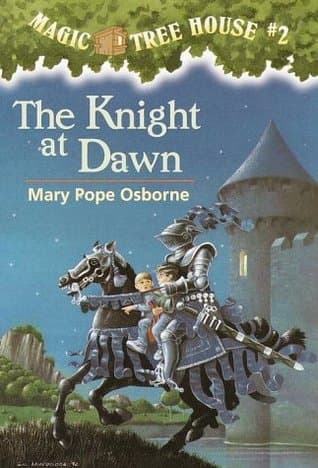
Mary Pope Osborne (1993)
Genre
Fantasy / Children's / Historical Fiction
Reading Time
45 min
Key Themes
See below
Sign in to track this book
Two siblings are whisked by a magic tree house into a medieval castle, where they must navigate a feast of peacocks and boys in skirts as unexpected, and unwelcome, guests.
Eight-year-old Jack and his seven-year-old sister Annie play in the woods near their home in Frog Creek, Pennsylvania. They find a tree house at the top of a tall oak tree. Annie, who is more adventurous, climbs up first and calls for Jack to follow. Inside, they find hundreds of books. Jack, who is cautious and studious, is amazed by the collection. Annie points to an open book with a picture of a castle and wishes they could go there, not knowing the tree house has magic.
As Annie points to the castle picture and makes her wish, the wind blows, and the tree house spins. Jack closes his eyes, feeling the speed. When it stops, they open their eyes to a new place. The woods are gone, replaced by a clearing next to a large, gray stone castle. They realize the tree house took them back in time to the Middle Ages, as they wished, based on the book's picture.
Jack and Annie leave the tree house and carefully approach the castle. Jack uses his backpack and notebook to write down what he sees: the drawbridge, moat, and high walls. They see a knight in armor riding a horse and a flag with a lion. Annie wants to go inside, but Jack warns her about the dangers and the chance of being unwelcome. They hide in the bushes, watching the activity, including a man in a tunic and tights and a woman in a long dress and pointy hat.
Hungry and curious, Annie sees an open door and sneaks into the castle. Jack reluctantly follows, fearing they will be caught. They find themselves in the Great Hall, where a feast is happening. Knights, ladies, and jesters fill the room. No one seems to notice them. A servant offers them food—roasted peacock, boar, and bread. Jack is unsure, but Annie eats eagerly, enjoying the strange meal, while Jack tries to fit in and watch the medieval customs.
After the feast, Jack and Annie explore more of the castle. They go down a dark, winding staircase, which makes Jack nervous. They find a dungeon, a dark and eerie place. Inside a cell, they find a knight, looking sad and messy. The knight is locked up. Annie feels bad for him and tries to comfort him. Jack realizes the knight is not a prisoner for a crime, but perhaps in a tournament. The knight tells them to leave, warning them of danger.
As Jack and Annie are still in the dungeon, they hear footsteps. Two strong castle guards with spears appear. The guards see Jack and Annie and chase them, shouting. Jack and Annie panic and run, scrambling back up the staircase and through the castle, trying to avoid being caught. Jack drops his notebook, but they stay ahead of their pursuers, their hearts beating fast as they run through the castle.
Trying to escape the guards, Jack and Annie find themselves trapped near a window overlooking the castle moat. Annie jumps into the water. Jack, after a moment of fear, follows her. They swim across the moat and get out on the other side. There, they find a small, hidden cave opening—a secret passage. They crawl through it, finding themselves outside the castle walls, safe from the guards, but still needing to reach the tree house.
As Jack and Annie walk back to the tree house, they see the knight from the dungeon standing outside the castle walls, looking up at them from a distance. The knight, having escaped or been released, holds up a small, folded piece of paper. He tells them to take it, then quickly disappears back into the castle shadows. Jack carefully takes the note, curious and a little confused by the knight's sudden appearance and message.
Jack unfolds the paper from the knight. It has a riddle: 'I have a head and a tail, but no body. What am I?' Jack knows it is a riddle. He thinks hard, trying to connect it to something they have seen in the castle. Annie, impatient, suggests they just go home. But Jack says they must solve it, believing it is how the tree house will take them back to Frog Creek, like the first time they traveled.
Jack realizes the answer to the riddle: a coin. He remembers seeing coins during the feast and in his history books. He pulls a coin from his pocket, a modern American quarter, which fits the description. As he says 'coin,' the tree house starts to spin again, the wind picks up, and they are whisked away. When they open their eyes, they are back in the Frog Creek woods. They climb down, happy to be home, but already thinking about their next adventure, and the knight and the magic of the tree house.
The Protagonist
Jack learns to balance his cautious nature with a sense of adventure, relying on his knowledge while also embracing the unknown.
The Protagonist
Annie continues to embrace her adventurous spirit, learning to trust her instincts while also appreciating Jack's careful approach.
The Supporting
His purpose is primarily to facilitate the plot, offering a mysterious challenge rather than undergoing personal development.
The Antagonist
They serve as a plot device to create urgency and do not have a character arc.
The Mentioned
They are static background elements that help build the world.
Jack and Annie's curiosity drives the plot. Annie's bold nature and Jack's intellectual curiosity make them explore the tree house and the medieval castle. This is clear when Annie first climbs into the tree house, when she insists on entering the castle's Great Hall, and when they go into the dungeon. Their wish to see and learn new things, despite dangers, moves their adventure and discovery.
“'Let's go look!' said Annie. 'No!' said Jack. But Annie was already scrambling down the rope ladder. 'Annie, wait!' Jack called. But Annie was gone.”
Books are important to the Magic Tree House series, and this book shows their power. The tree house is full of books, and a book about castles takes Jack and Annie to the Middle Ages. Jack often uses his own books and takes notes, using facts to understand and move through their new environment. His knowledge from books helps him solve the knight's riddle, showing that information and learning are important for survival and success.
“Jack pulled out the castle book. He opened it to the picture of the knight. He read, 'Many knights were imprisoned in dungeons beneath castles.'”
Jack and Annie show bravery in different ways. Annie is fearless, taking risks like jumping into the moat. Jack, though more careful and often scared, pushes past his fear to follow Annie and face challenges, such as going into the dark dungeon or escaping the guards. Their journey through the castle, from sneaking into the feast to running from capture, is a constant act of facing and overcoming their fears to reach their goals.
“Jack didn't want to go down. But Annie was already at the bottom. 'Come on, Jack!' she whispered. Jack sighed and followed her.”
The children face several problems during their adventure, which makes them think. They must quickly figure out how to navigate an unknown castle and escape the guards. The main example is Jack solving the knight's riddle ('I have a head and a tail, but no body. What am I?'). This challenge requires him to remember information and use logic, which directly affects their ability to return home and shows the value of intelligence.
“'Think, Jack, think,' he whispered. 'Head and tail, no body...'”
A magical vehicle that transports children through time and space.
The Magic Tree House is the central plot device that initiates and enables all the adventures. It is a mysterious tree house filled with books that, when pointed at a picture in a book, transports its occupants to the time and place depicted. In 'The Knight at Dawn,' it takes Jack and Annie to the Middle Ages. It serves as both the entry point to their adventures and the means of their return, making impossible journeys possible and driving the entire series premise.
A puzzle that acts as the key to returning home.
The riddle given by the mysterious knight ('I have a head and a tail, but no body. What am I?') functions as a critical plot device. It introduces a final challenge that Jack must solve for the tree house to take them back to Frog Creek. This creates suspense and provides a clear objective for the end of the story, allowing Jack to use his intellect to overcome a final obstacle and complete their journey. It also adds an element of mystery to the knight's character.
A historical setting that provides a backdrop for adventure and danger.
The medieval castle serves as a vivid and immersive setting, crucial to the story's atmosphere and challenges. Its elements—drawbridge, moat, Great Hall, dungeon, and guards—are integral to the plot. The castle provides both the initial wonder and the subsequent dangers, driving the narrative forward as Jack and Annie explore its secrets and evade its inhabitants. It introduces historical context and cultural details, enriching the children's learning experience within the adventure.
A symbol of Jack's intellectual approach to adventure.
Jack's notebook and pencil are recurrent symbols of his studious and analytical nature. He uses them to take notes, draw pictures, and record facts he learns from his books or observations. This device highlights his methodical approach to problem-solving and his role as the 'researcher' of the duo. It visually represents his reliance on knowledge and logic, contrasting with Annie's more impulsive style, and sometimes serves as a minor plot point, like when he drops it during their escape.
“The knight's armor glinted in the moonlight.”
— Jack and Annie see the knight for the first time in the castle courtyard.
“A book is like a magic carpet that can take you anywhere.”
— Jack reflects on the power of reading and imagination.
“We have to be brave, even when we're scared.”
— Annie encourages Jack as they explore the dark castle.
“The castle was huge and dark, with towers that reached up to the stars.”
— Description of the medieval castle they enter.
“Sometimes the best adventures are the ones you don't plan.”
— Jack realizes this after their unexpected journey.
“The knight bowed to them, his armor clanking softly.”
— The knight shows respect to the children.
“Annie's curiosity was like a key that opened every door.”
— Narration about Annie's adventurous spirit.
“In the moonlight, everything looked magical and mysterious.”
— Description of the nighttime setting in the book.
“They tiptoed through the castle, their hearts pounding.”
— Jack and Annie explore cautiously.
“The knight's horse was as white as snow.”
— Description of the knight's majestic steed.
“Jack wished he had a shield to protect them.”
— Jack feels responsible for keeping them safe.
“The drawbridge creaked as it lowered over the moat.”
— They enter the castle across the moat.
“Annie believed that every story had a secret waiting to be found.”
— Annie's optimistic view of their adventures.
“The knight rode away into the dawn, a silhouette against the rising sun.”
— The knight departs as morning comes.
Ready to see how well you understood this book? Take our interactive quiz with 10 questions.
Biography coming soon.







