“It was the day of the kite, and the day of my father's death.”
— The opening line, setting the scene for the protagonist's life-altering experience.

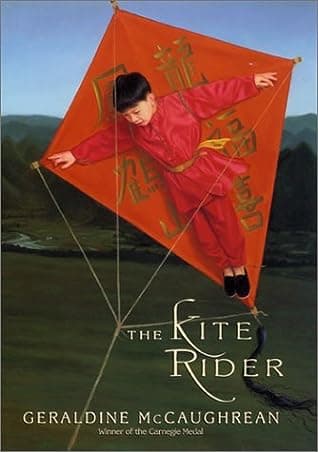
Geraldine McCaughrean (2001)
Genre
Children's / Historical Fiction / Young Adult
Reading Time
280 min
Key Themes
See below
Sign in to track this book
A grieving boy in 13th-century China finds perilous freedom and unexpected fame soaring as a human kite for a traveling circus, only to discover his aerial escape might be a pawn in a treacherous plot.
In 13th-century China, twelve-year-old Haoyou lives in poverty with his widowed mother, Little Ting, and his younger sister, Mian. After his father's death from a cough, Haoyou feels pressure to provide for his family, despite his age. He tries various odd jobs, like catching fish, but often fails, increasing their hunger. His mother, grieving and overwhelmed, is often harsh with him, reminding him of his father's dying wish for Haoyou to be a 'man.' This constant burden and the threat of starvation weigh heavily on Haoyou, making him desperate to escape their poor circumstances and fulfill his duty.
The Jade Circus arrives in Haoyou's village, bringing acrobats, musicians, and its charismatic master, Great Miao. Miao, seeing Haoyou's small size and agility, offers the boy a job as a kite rider. Haoyou is hesitant, but the promise of food, money, and a better life is too tempting. His mother, Little Ting, despite her worries about the danger, agrees, seeing it as their children's only chance to survive. Haoyou, though scared, is also excited by this new, adventurous life.
Haoyou's training begins, leading to his first terrifying flight. Strapped to a large, scarlet-and-gold kite, he launches into the sky. The initial terror is immense as he soars higher than he imagined, the world shrinking below. Yet, as he gains control and confidence, fear turns into exhilaration and freedom. He learns to guide the kite, riding wind currents with grace. This first successful flight changes him from a struggling village boy into the Jade Circus's star performer, the Kite Rider, captivating crowds with his daring aerial displays.
As the Jade Circus travels across the Chinese Empire, Haoyou embraces his new life. He enjoys regular meals, comfortable lodging, and the crowds' admiration. His fame grows, with villagers believing he can talk to the spirits of their dead loved ones in the sky. He performs stunts, becoming more skilled and daring. However, he also starts to notice Great Miao's manipulative and ruthless ambition. Miao often reminds Haoyou of his debt and the insecurity of his position, subtly controlling him. Haoyou also befriends a young acrobat, Miko, finding camaraderie in the circus's transient existence.
Villagers, seeking closure, approach Haoyou after his performances, convinced his flights bring him close to the spirit world. They ask him to deliver messages to their dead relatives or bring back words from them. Haoyou, at first uncomfortable with this reverence, finds himself caught between their sincere belief and his role as an entertainer. Great Miao, always an opportunist, uses this, charging extra for Haoyou to 'listen' for messages, further solidifying Haoyou's perceived divine connection and boosting the circus's income. This exploitation bothers Haoyou, creating a moral dilemma.
Little Ting, Haoyou's mother, makes a dangerous journey to visit him at the circus. She brings news that Mian, Haoyou's sister, is gravely ill. Little Ting needs money for medicine and food, reminding Haoyou of his ongoing responsibility. During her visit, Great Miao makes a surprising offer: he offers to buy Mian from Little Ting, promising her a better life in the circus. This offer deeply disturbs Haoyou, who sees it as Miao trying to fully control his family and ensure his loyalty. Little Ting, torn by Mian's illness and their poverty, struggles with the decision.
The Jade Circus receives an invitation to perform for Kublai Khan, the powerful Mongol emperor who rules China. This is a big opportunity for Great Miao to gain favor and wealth, but it also carries great risk, as the Khan is known for his unpredictable nature and harsh punishments for those who displease him. Haoyou is both awed and frightened by the thought of performing for such a formidable figure. The entire circus prepares carefully, knowing their future, and possibly their lives, depend on a perfect performance before the Khan.
As the circus travels toward the Khan's court, Haoyou's suspicions about Miao grow. He overhears quiet conversations and notices Miao's secret dealings. Eventually, Haoyou discovers Miao's true plan: to use the kite for aerial reconnaissance to map the Khan's palace and defenses, possibly for a rebel group or for his own ambitious schemes. The 'messages from the sky' were a cover for Haoyou's flights being used to gather strategic information. Haoyou realizes he has been an unwitting tool in a dangerous political game, and his loyalty to Miao is broken.
The day of the performance for Kublai Khan arrives. Haoyou, filled with dread and resolve, launches into the sky above the Khan's palace. As he soars, he is aware of Miao's expectation for him to observe and memorize the palace layout. However, Haoyou faces a moral choice: betray the Khan by fulfilling Miao's request or defy Miao and risk both their lives. The pressure is immense, with the Khan and his guards watching below, and his family's safety resting on his shoulders.
During his performance for Kublai Khan, Haoyou makes his choice. Instead of mapping the palace, he performs a spectacular, daring maneuver, focusing on entertainment rather than reconnaissance. He draws the Khan's attention with breathtaking aerial acrobatics, distracting him and his guards from any strategic observation. This defiance angers Miao, who realizes his plan has been stopped. Haoyou's decision is a brave act of rebellion against Miao's manipulation, asserting his own will and risking the wrath of both his master and the Khan. He understands the consequences will be severe, but he has chosen his own path.
After his defiance, Haoyou knows he cannot stay with the Jade Circus. He escapes, fearing Miao's revenge and the Khan's potential anger. He makes his way back to his village, desperate to warn his mother and Mian and to ensure their safety. The journey is hard and dangerous, filled with uncertainty. He arrives to find his family still struggling but safe. The fame and freedom he once had as the Kite Rider are gone, replaced by the need to rebuild a life for his family, free from Miao's control. He is no longer just a boy, but a young man who has made tough choices.
Back in his village, Haoyou finds a way to use his skills as a kite rider for good. Instead of performing for a manipulative master, he uses his knowledge of kites to help local farmers predict weather or assist in other practical ways. He also helps his mother and Mian, taking on more adult responsibilities. While the adventures of the Jade Circus are behind him, Haoyou finds a quieter, more honorable path. He is still the Kite Rider, but now he flies for his family and his community, having learned what true freedom and responsibility mean.
The Protagonist
Haoyou transforms from a fearful, burdened child into a courageous young man who asserts his own moral compass, choosing integrity and family over fame and manipulated power.
The Antagonist
Miao remains largely static in his ambition and ruthlessness, his schemes escalating until they are ultimately thwarted by Haoyou's defiance.
The Supporting
Little Ting's arc is one of resilience and a mother's enduring struggle, finding strength in her children's survival.
The Supporting
Mian's arc is tied to the family's survival, her health reflecting their fluctuating fortunes.
The Supporting
Miko serves as a loyal friend, providing support and perspective for Haoyou.
The Mentioned
Kublai Khan functions as a powerful external force, a test for Haoyou's integrity.
Haoyou constantly deals with the conflict between the freedom he feels in the sky as a kite rider and the heavy responsibility he has toward his poor family. His first flight offers a taste of true liberation from his earthly burdens, but his mother's visit and Mian's illness quickly remind him of his duties. Ultimately, his greatest act of freedom is choosing to defy Miao, even if it means losing his fame, to protect his family and his own honesty. He learns that true freedom is not just about escaping, but about making conscious, responsible choices.
“Up and up the wind drew him. Haoyou looked about him and saw the whole world beneath him. And it was his. He could breathe!”
The theme of exploitation is central, mainly through Great Miao. Miao takes advantage of Haoyou's poverty and desperation, offering an opportunity that slowly turns into a form of servitude. He manipulates the villagers' grief and spiritual beliefs for money, turning Haoyou into a 'spirit messenger.' The ultimate exploitation comes with Miao's plan to use Haoyou's flights for spying, making him an unwitting tool in a dangerous political game. Haoyou's journey is about recognizing and resisting this manipulation.
“He was a boy who could fly, and that made him special. But Great Miao never let him forget he was a boy who could be easily replaced.”
Haoyou's strong loyalty to his family drives the novel. His initial decision to join the circus is a direct sacrifice for their survival, and his ongoing concern for Little Ting and Mian shows in his actions and thoughts. The idea of Mian's potential sale to Miao highlights the extreme sacrifices families must consider in severe poverty. Ultimately, Haoyou's decision to defy Miao is motivated by his desire to protect his family from the dangerous outcomes of Miao's schemes, even if it means losing his new status and risking his life.
“His father had died of a cough, leaving Haoyou to be the man of the house. A man of twelve years.”
The novel explores how belief can shape and manipulate truth. The villagers genuinely believe Haoyou can talk to the dead, a belief Great Miao uses for financial gain. Haoyou himself is caught between knowing he is just an entertainer and seeing the comfort his 'messages' bring. This theme questions the line between genuine spiritual connection and theatrical illusion, and how people's need for hope can make them vulnerable to manufactured truths. Haoyou's struggle is to understand his true role and Miao's real intentions.
“It was just a kite. He was just a boy. But they believed. And their belief made him something more.”
A symbol of both freedom and entrapment, and a tool for both entertainment and espionage.
The scarlet-and-gold kite is the central plot device. Initially, it represents Haoyou's escape from poverty and the exhilarating freedom of flight. However, it quickly becomes a symbol of his entrapment under Great Miao's control, as he is literally strapped to it and used for Miao's purposes. Later, it transforms into a tool for espionage, as Miao intends for Haoyou to use his flights to map the Khan's palace. Ultimately, the kite becomes the stage for Haoyou's moral choice, where he reclaims its meaning by choosing to fly for himself and his family's safety rather than for Miao's treacherous goals.
A microcosm of society, offering both opportunity and danger, and a vehicle for the story's travels.
The Jade Circus serves as the setting for much of Haoyou's journey, representing a world of both dazzling spectacle and harsh realities. It is a place of opportunity for the desperate, offering a chance to escape poverty, but it is also a place of strict hierarchy and exploitation under the Great Miao. The circus's itinerant nature allows the narrative to traverse various parts of 13th-century China, exposing Haoyou to different cultures and the vastness of the empire, while also highlighting the transient and often precarious lives of its performers. It acts as a crucible for Haoyou's character development.
A narrative device that highlights superstition, grief, and Miao's manipulative nature.
The 'messages from the sky' are a crucial plot device that underscores the themes of superstition, grief, and exploitation. Villagers, desperate to connect with lost loved ones, project spiritual significance onto Haoyou's flights. This belief is capitalized upon by the Great Miao, who charges for Haoyou to 'listen' for spirits, thus enriching the circus and solidifying Haoyou's celebrity. This device forces Haoyou to confront the moral implications of his performances and the power of people's beliefs, ultimately making his defiance of Miao a stronger statement against deceit.
“It was the day of the kite, and the day of my father's death.”
— The opening line, setting the scene for the protagonist's life-altering experience.
“The wind was my father's spirit, carrying me, protecting me.”
— Hao's belief while riding the kite, connecting with his deceased father.
“A man who cannot control his own kite is no man at all.”
— A common sentiment or challenge in the kite-flying world, reflecting on skill and mastery.
“The earth was a patchwork quilt beneath me, stitched with rivers and mountains.”
— Hao's perspective from high above on the kite, appreciating the landscape.
“Fear is a cold wind, but courage is a warm one.”
— Hao's internal struggle and growth as he faces dangers and challenges.
“Some secrets are like kites; the higher they fly, the more likely they are to get caught in a storm.”
— A metaphorical reflection on the dangers of hidden truths.
“The sea always takes what it wants, eventually.”
— A philosophical observation about the power and inevitability of nature.
“A good story can make you forget your hunger, even if it doesn't fill your belly.”
— Highlighting the power of storytelling and imagination in difficult times.
“There are many ways to be brave, not all of them involve flying.”
— A realization by Hao that courage manifests in different forms.
“The world is bigger than any single village, bigger than any single life.”
— Hao's expanding worldview as he travels and experiences new places.
“Sometimes, the greatest strength is knowing when to let go.”
— A lesson learned about resilience and acceptance.
“The wind does not care for your plans, only for its own.”
— A reminder of the unpredictable and uncontrollable forces of nature.
“Even the smallest thread can hold a great kite.”
— A metaphor about the importance of seemingly insignificant things or people.
Ready to see how well you understood this book? Take our interactive quiz with 10 questions.

Biography coming soon.
Dan Gemeinhart
4.5
Kate O'Hearn
4.4

Jeanne Birdsall
4.4

Jen Wang
4.4
Wendelin Van Draanen
4.3

John Marsden
4.3

Chris Van Allsburg
4.3
Jennifer A. Nielsen
4.2