“It is not a good idea to tell the Attolian king what to do.”
— Eugenides reflecting on his own stubbornness and the nature of his rule.

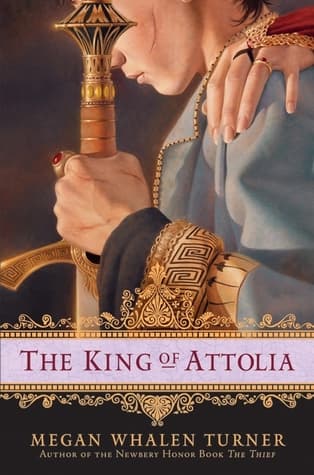
Megan Whalen Turner (2006)
Genre
Fantasy / Historical Fiction / Young Adult / Romance
Reading Time
450 min
Key Themes
See below
Sign in to track this book
A cunning thief, now king by his own machinations, must navigate a treacherous court and the unexpected loyalty of a naive guard while proving that his intellect is a sharper weapon than any sword.
Six months after his marriage to Queen Attolia, Eugenides, formerly Gen, the Thief of Eddis, is King of Attolia. The Attolian court sees him as a weak, unkingly figure, resenting his foreign origins and his lack of traditional regal manner. Costis, a young Attolian guard, is assigned to Eugenides and quickly develops deep contempt for the king, believing him to be foolish and cowardly. Eugenides, for his part, seems to actively provoke this disdain, often appearing clumsy, distracted, and uninterested in courtly affairs. This initial period has tension and a clear lack of respect from the Attolian nobility towards their new king.
Costis, while on duty, makes a disparaging remark about Eugenides's perceived weakness. The king overhears him and, in an unexpected display of authority, orders Costis to be flogged. This severe punishment, seemingly too much for the offense, shocks Costis and the other guards. Despite the pain and humiliation, Costis finds himself unable to fully hate the king, noticing a strange undercurrent to Eugenides's behavior. He begins to observe Eugenides more closely, trying to understand the king's motivations and the true nature of his personality beyond the public facade of incompetence.
During a court banquet, Eugenides is poisoned, an act clearly meant to remove him from power. Costis, witnessing the event, is surprised by the king's calm reaction despite his severe illness. The poisoning attempt is attributed to factions within the Attolian court who wish to see Eugenides replaced. This incident further complicates Costis's perception of the king; he sees not a weakling, but someone capable of enduring immense suffering and maintaining composure under extreme duress. The event highlights the dangerous political situation Eugenides navigates daily.
Following the poisoning, Eugenides pretends to be severely incapacitated, almost dying. This prolonged 'illness' is a strategic move. While seemingly bedridden and vulnerable, he subtly observes the reactions of the Attolian nobility, identifying those loyal to him and those who are actively plotting his downfall. Costis, now assigned to guard the king's chambers, sees these private moments and starts to realize that Eugenides's weakness is a carefully constructed illusion. He sees the king's sharp intellect at play, even in his supposed delirium.
Eugenides, with the help of his loyal Eddisian guards and a few trusted Attolians, stages a false coup. He appears to be kidnapped and taken to Eddis, leaving Attolia in chaos. This trick is designed to draw out the conspirators who believe they can now seize power. Costis, initially confused and fearful, begins to understand the elaborate deception as he witnesses the king's meticulous planning and the precise execution of the 'kidnapping.' This event is a turning point, as it reveals Eugenides's true capabilities as a master strategist and manipulator.
During the 'coup,' Costis must confront the reality that Eugenides is far from the inept figure he once believed him to be. He realizes that the king's clumsiness, his seemingly foolish remarks, and even his initial punishment of Costis were all part of a larger, intricate plan. Eugenides reveals his true strength, not through physical prowess, but through his intelligence, his ability to read people, and his strategic foresight. Costis's contempt transforms into awe and a deep, if still grudging, respect for his king.
While supposedly in Eddis, Eugenides is actually consolidating his power and ensuring the loyalty of his Eddisian allies. He uses this time to further unravel the complex web of Attolian political intrigue. The 'kidnapping' allows him to assess who among the Attolian nobility would rally to his wife, Queen Attolia, and who would actively work against them. Costis, now a reluctant participant in the king's schemes, sees firsthand the extensive network of spies and informants Eugenides commands, solidifying his understanding of the king's formidable reach.
Eugenides returns to Attolia, no longer pretending weakness. He arrives with the support of Eddis, demonstrating his solidified power. The conspirators, having revealed themselves during his absence, are now exposed. Eugenides, with Queen Attolia by his side, confronts them. He delivers justice with a calm authority that silences any remaining doubts about his competence. Costis watches as the king, once mocked and underestimated, decisively dismantles the opposition, showing his true nature as a formidable ruler who commands respect and fear.
With the traitors dealt with, Eugenides begins the process of re-establishing order and asserting his authority within the Attolian court. He surrounds himself with trusted individuals, including Costis, who has now become a loyal and respected member of his guard. The king shows his commitment to justice and fair rule, but also his willingness to be ruthless when necessary. The court, once dismissive, now regards him with a mix of fear and respect, understanding that their new king is a force to be reckoned with, far more dangerous than he ever let on.
In the aftermath, Costis reflects on all he has witnessed. He realizes that Eugenides's initial behavior, including the flogging, was not arbitrary cruelty but a calculated move to assess Costis's character and loyalty, and to teach him a lesson about judging appearances. Costis now sees the king for who he truly is: a brilliant, complex, and strategic individual who uses deception as a primary tool of governance. He has moved from unwilling subject to a devoted, if still sometimes bewildered, follower, understanding that the King of Attolia is a master of his own intricate game.
The Protagonist
Gen transforms from a seemingly weak and mocked figure into a powerful, respected, and feared ruler, revealing his true strategic genius to his court and ultimately to Costis.
The Supporting
Costis's journey is from prejudiced contempt to grudging respect, and finally to unwavering loyalty and understanding of his king's complex nature.
The Supporting
Attolia maintains her strong, regal presence, acting as a steadfast partner to Eugenides, her love and trust for him deepening as his plans unfold.
The Antagonist
The Mede remains a constant, looming threat, forcing Eugenides to consolidate power and prepare for future confrontations.
The Supporting
Pol remains a steadfast and crucial ally, his loyalty to Eugenides unwavering throughout the king's complex schemes.
The Supporting
Ornon transitions from a skeptical courtier to a loyal and understanding supporter of King Eugenides.
The Supporting
Erondites remains an antagonist throughout, ultimately exposed and dealt with by Eugenides.
The Supporting
Sejanus is exposed as a traitor and faces the consequences of his disloyalty.
This theme is central to the entire narrative. Eugenides deliberately cultivates an image of weakness, foolishness, and incompetence to mislead his enemies, both within the Attolian court and from the Mede. His 'clumsiness,' his apparent disinterest in governance, and even his initial punishment of Costis are all carefully constructed illusions designed to make his adversaries underestimate him. The entire plot, particularly the staged kidnapping, hinges on this theme, revealing that true power often lies not in overt strength, but in the ability to manipulate perceptions and exploit the expectations of others. It highlights how appearances can be profoundly misleading.
“He was the Thief. He was the King of Attolia. He was the master of his own fate. And he was very, very good at it.”
The novel explores what it truly means to be a king. Eugenides challenges traditional notions of kingship, demonstrating that leadership isn't solely about physical prowess or outward majesty, but about intelligence, strategic thinking, and the ability to inspire loyalty (even through unconventional means). His methods are often morally grey, but ultimately serve the greater good of his kingdom. The contrast between the Attolian court's expectations of a king and Eugenides's actual, effective leadership highlights this theme, showing that a true ruler might be a hidden, cunning force rather than an obvious figurehead. Costis's evolving understanding of Eugenides is key to this theme.
“A king's choices are not his own, but his country's.”
Costis's journey is a microcosm of the Attolian court's prejudice against Eugenides. Initially, Costis, like many Attolians, judges Eugenides based on his foreign origin, his perceived lack of regal bearing, and the rumors surrounding him. This prejudice blinds him to Eugenides's true capabilities. The novel carefully dismantles these preconceived notions, forcing Costis and the reader to re-evaluate their initial judgments. It demonstrates how easily people can be misled by appearances and how difficult it is to overcome ingrained biases, but also the transformative power of direct observation and experience.
“He knew, now, that the King of Attolia was not a fool. He was the opposite of a fool.”
The political dealings of the Attolian court are driven by shifting loyalties and widespread betrayal. Eugenides's primary task is to identify and neutralize those who are disloyal to him and Queen Attolia. The plot devices of the poisoning and the staged coup are specifically designed to expose these betrayals. Conversely, the unwavering loyalty of characters like Pol and, eventually, Costis, stands in contrast to the treachery. The novel examines the different forms loyalty can take – from the unquestioning devotion of a soldier to the strategic allegiance of a politician – and the devastating consequences of its absence.
“Loyalty is a weapon, to be used with care.”
The story is filtered through Costis's initially biased and limited understanding.
The narrative is primarily told from Costis's point of view, a young guard who initially despises King Eugenides. This makes Costis an unreliable lens through which the reader perceives Eugenides's actions. The king's true motives and intelligence are deliberately obscured, mirroring Costis's own confusion and prejudice. This device allows for a gradual reveal of Eugenides's true character, forcing the reader to re-evaluate their understanding of events alongside Costis, creating suspense and a deeper appreciation for the king's cunning when his true nature is revealed.
Eugenides deliberately projects an image of incompetence to deceive his enemies.
This is a core plot device. Eugenides actively cultivates an image of being a clumsy, foolish, and easily distracted king, much to the disdain of the Attolian court. This facade is a sophisticated form of misdirection, a strategic tool to make his adversaries underestimate him and reveal their true intentions. His seemingly arbitrary actions, like the flogging of Costis, are later understood to be part of this larger, intricate deception, allowing him to gather information and manipulate events from a position of perceived vulnerability.
A meticulously planned deception to expose traitors and consolidate power.
Eugenides orchestrates his own 'kidnapping' and apparent removal to Eddis. This elaborate deception is a crucial turning point, serving multiple purposes: it draws out the conspirators within the Attolian court who believe they can now seize power, it allows Eugenides to consolidate his alliances with Eddis, and it provides a dramatic reveal of his strategic genius. This device functions as a grand trap, allowing Eugenides to identify and deal with his enemies decisively upon his return, solidifying his reign.
An external empire whose looming presence drives internal political maneuvering.
While the Mede empire does not appear as a direct character, its constant presence as an expansionist and powerful external threat is a significant plot device. The Mede's ambition and the threat of invasion are the underlying reasons for Eugenides's complex political maneuvering to stabilize Attolia and secure its alliance with Eddis. The fear of Mede intervention forces the Attolian court to eventually accept Eugenides's rule, as internal division would make them vulnerable. It provides a constant, high-stakes backdrop to the internal power struggles.
“It is not a good idea to tell the Attolian king what to do.”
— Eugenides reflecting on his own stubbornness and the nature of his rule.
“The worst part of being a king is that you are always on display.”
— Eugenides lamenting the lack of privacy and constant scrutiny that comes with his position.
“You cannot make a good bargain with someone who is afraid to say no.”
— Eugenides explaining his strategy for dealing with foreign powers.
“It is always a mistake to underestimate your enemy, even if your enemy is yourself.”
— Eugenides contemplating his internal struggles and the challenges of self-governance.
“There are some things that cannot be bought, and loyalty is one of them.”
— Eugenides on the true nature of allegiance and its value.
“The hardest part of being a king is not making decisions, but living with their consequences.”
— Eugenides reflecting on the burden of leadership and responsibility.
“Sometimes the cleverest thing to do is to do nothing at all.”
— Eugenides demonstrating his strategic patience and understanding of timing.
“You cannot rule a country without knowing its people.”
— Eugenides emphasizing the importance of understanding his subjects.
“A king must be able to change his mind, but never his purpose.”
— Eugenides on the flexibility required in tactics versus the steadfastness in overall goals.
“It is a heavy crown, but it is mine.”
— Eugenides acknowledging the burdens of kingship but accepting his role.
“Love is not a weakness, it is a strength.”
— Eugenides expressing his deep feelings and how they empower him, particularly in relation to Attolia.
“The most dangerous thing in the world is a man with nothing to lose.”
— Eugenides contemplating the desperation of his enemies and the risks they pose.
“You cannot win a war if you are fighting on two fronts.”
— Eugenides discussing strategic limitations and the need for focus.
“Every man has his price, but it is not always gold.”
— Eugenides reflecting on the various motivations that drive people.
Ready to see how well you understood this book? Take our interactive quiz with 10 questions.

Biography coming soon.







