“It was a good, clean shot. But there's no such thing as a clean shot.”
— Lou Ford reflects on his first murder, highlighting his detached yet self-aware nature.

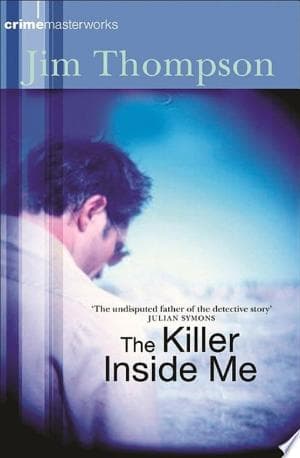
Jim Thompson (2010)
Genre
Thriller / Mystery
Reading Time
224 min
Key Themes
See below
Sign in to track this book
Deputy Sheriff Lou Ford hides a dormant 'sickness' that, once reawakened, shatters his placid facade with brutal consequences in a quiet Texas town.
Lou Ford, a deputy sheriff in the small town of Central City, Texas, appears to be a mild-mannered, slow-witted man. He begins an affair with Joyce Lakeland, a prostitute new to town. Their initial meetings are set up by Lou's boss, Sheriff Bob Maples, to get Joyce to leave town. However, Lou's interactions with Joyce quickly turn into a sadomasochistic dynamic, where he enjoys physically abusing her. This reawakens a dormant 'sickness' within him, a deep-seated psychopathy he has suppressed since a childhood incident involving his adopted brother, Mike, who took the blame for Lou's violent acts.
Lou continues his affair with Joyce, and his 'sickness' grows stronger. He plans to murder both Joyce and Elmer Conway, the son of a wealthy construction magnate, whom Lou has long resented. Lou beats Joyce to death with a baseball bat, making it seem as if Elmer was responsible. He then shoots Elmer, staging the scene to suggest a murder-suicide or a struggle between the two, with Elmer as the aggressor. Lou carefully plants evidence to incriminate Elmer, confident that his position as a deputy and his harmless demeanor will protect him from suspicion. He even injures himself to make the struggle look more convincing.
After the bodies are found, the official story is that Elmer killed Joyce and then himself. However, Sheriff Maples, a shrewd and experienced lawman, quickly finds inconsistencies in Lou's account and the crime scene. Maples subtly questions Lou, expressing doubts about the neatness of the murder-suicide theory. Other townspeople, like Lou's girlfriend Amy Stanton, also notice changes in Lou's behavior, especially his growing detachment and occasional breaks in his calm facade. Lou, despite the pressure, maintains his innocent act, using his reputation as a simple, honest deputy to deflect suspicion. He feels the net closing in.
As the investigation continues and the pressure on Lou intensifies, he realizes he needs a new scapegoat. He targets Johnnie Pappas, a young handyman who works for him and has a history of petty theft. Lou lures Johnnie to a secluded spot, brutally murders him, and then plants evidence to make it appear as though Johnnie was the true killer of Joyce and Elmer. He manipulates the scene to suggest Johnnie confessed to the initial murders before being killed by an unknown assailant, or perhaps even by Lou himself in a moment of 'justice.' This desperate act temporarily diverts suspicion from Lou, but it also further traps him in his web of lies and violence.
Amy Stanton, Lou's kind and devoted girlfriend, becomes increasingly disturbed by Lou's erratic behavior, his coldness, and his evasiveness about the murders. She tries to reconcile the man she loves with the dark currents she senses, but his explanations become less and less convincing. Amy confronts Lou about his past, particularly the incident involving his adopted brother Mike. She senses a deep darkness within him that she cannot understand or accept. Her growing unease and quiet questioning become another source of pressure for Lou, threatening to expose his true nature and unravel his carefully constructed life.
Lou's adopted brother, Mike, returns to Central City, released from prison where he served time for the childhood incident that was Lou's fault. Mike's presence is a constant, unsettling reminder of Lou's past and the 'sickness' that has defined his life. Mike knows the truth about Lou's early violence and holds a subtle power over him. Lou initially tries to control Mike, but Mike's return also brings back memories of their abusive childhood and the psychological trauma that shaped Lou. Mike's reappearance forces Lou to confront the origins of his pathology and the long-suppressed memories of his family's dark secrets.
Sheriff Maples, through diligent investigation and keen observation, eventually uncovers the truth about Lou's involvement in the murders. He confronts Lou, not with accusations, but with a series of leading questions and subtle hints that reveal his certainty of Lou's guilt. Maples, a seasoned and morally upright lawman, understands the depth of Lou's deception and the evil beneath his calm exterior. This confrontation is a psychological battle, with Lou trying to maintain his facade and Maples systematically dismantling it, forcing Lou to realize that his carefully constructed world is crumbling around him, and he is no longer above suspicion.
As the walls close in, Lou's mental state rapidly deteriorates. His carefully maintained composure shatters, replaced by intense paranoia, hallucinations, and uncontrollable urges to violence. He begins to see enemies everywhere, convinced that everyone is conspiring against him. His internal monologue, already dark and self-justifying, becomes increasingly fragmented and deranged. He lashes out at those around him, including Amy, showing his true, terrifying nature. The 'sickness' fully consumes him, stripping away any semblance of the mild-mannered deputy and revealing the monstrous killer beneath, driving him further down a path of self-destruction.
In a desperate and brutal attempt to cover his tracks and silence those who know too much, Lou commits two more heinous murders. First, he kills Amy Stanton, his girlfriend, who has become increasingly aware of his true nature and a potential threat to his freedom. He then lures Sheriff Maples into a trap and murders him as well, believing that by eliminating the key figures who suspect him, he can escape justice. These acts are born out of sheer panic and a complete surrender to his psychopathic impulses, marking his final, irreversible descent into an abyss of violence and depravity.
After the murders of Amy and Maples, Lou's carefully constructed world completely collapses. With no one left to trust and nowhere left to run, he orchestrates his own demise. He sets fire to his house, believing he can escape the consequences of his actions in a final, defiant act. However, the plan goes awry, and Lou is caught in the blaze. The novel ends with his agonizing death, an inevitable conclusion to his reign of terror. His internal monologue continues to the very end, a final, chilling glimpse into the mind of a killer who was consumed by his own 'sickness'.
The Protagonist/Antagonist
Lou's arc is a terrifying descent from a seemingly functional, albeit deeply disturbed, individual into full-blown, unbridled psychopathy, culminating in his self-destruction.
The Supporting/Victim
Joyce's arc is brief and tragic, serving as the initial spark that reignites Lou's violent impulses, leading directly to her demise.
The Supporting/Victim
Amy's arc shifts from an innocent, trusting girlfriend to a frightened woman who slowly realizes the monster she loves, culminating in her death.
The Supporting/Victim
Maples' arc is one of determined investigation, from initial suspicion to undeniable certainty of Lou's guilt, ultimately leading to his own murder.
The Supporting/Mentioned
Mike's arc is largely in the past, serving as a catalyst for Lou's pathology; his return acts as a tangible link to Lou's unpunished past crimes.
The Supporting/Victim
Elmer's arc is brief, serving as a victim and a convenient target for Lou's manipulative plot and long-held resentment.
The Supporting/Victim
Johnnie's arc is that of an innocent, albeit flawed, individual who becomes a pawn and then a victim in Lou's escalating murderous schemes.
The novel explores duality, especially the contrast between outward appearance and inner reality. Lou Ford embodies this, presenting himself as a slow, harmless deputy while harboring a monstrous psychopathic 'sickness' inside. This duality allows him to deceive everyone around him, from his girlfriend Amy to his boss Sheriff Maples. The quiet, conservative setting of Central City further highlights this, as the seemingly idyllic small town hides a deep darkness. Lou constantly reflects on this, often presenting his violent acts with a folksy, almost philosophical detachment, emphasizing the internal war he wages, or rather, embraces.
“A lot of people think I'm crazy. But I'm not. I'm just sick. I'm sick because I'm a man.”
Jim Thompson explores the psychology of a killer, presenting a chilling first-person account of psychopathy. Lou Ford's 'sickness' is not portrayed as sudden madness but as an inherent, deeply ingrained part of his being, made worse by childhood trauma and abuse. The novel shows how psychopathy manifests—through manipulation, lack of empathy, a twisted sense of justice, and a chilling ability to rationalize horrific acts. Lou's internal monologues are key here, offering a direct, unfiltered look into his twisted logic and the thrill he gets from violence and deception. The narrative suggests that evil can exist beneath the most ordinary exteriors, challenging common ideas of villainy.
“It was just a game. A game. And I was good at it. The best. It got to be a habit, like scratching yourself.”
The novel critiques the social hypocrisy in small-town America, where appearances are often more important than truth. Central City is a place where respectability can shield dark secrets, and where a seemingly harmless figure like Lou Ford can operate freely for a time. Lou masterfully exploits this, using his 'simple' persona and the town's expectations to manipulate situations and deflect suspicion. The ease with which he frames others, like Elmer Conway and Johnnie Pappas, highlights the town's willingness to accept convenient narratives, especially when they involve those already deemed 'undesirable.' This theme shows how societal norms and expectations can be twisted to serve malevolent ends.
“They all loved me, all of 'em. And they hated me, too. But they loved the idea of me, the idea of a good, simple man.”
A main question in the novel is about justice and whether true perpetrators can escape it. For much of the story, Lou Ford believes he is untouchable, using his position as a deputy and his manipulative intelligence to commit murders and frame others. The initial success of his schemes highlights the fragility of the justice system when confronted with a truly cunning and remorseless killer. However, the slow, methodical investigation by Sheriff Maples and the growing unease of Amy Stanton introduce the idea that impunity is not absolute. Ultimately, while Lou avoids formal legal justice for a time, his actions lead to his own self-destruction, suggesting a form of cosmic or psychological justice.
“I knew I couldn't be caught. Not by them. Not by anyone. I was too smart. Too careful.”
Lou Ford's internal monologue provides a chilling, biased, and self-justifying account of his crimes.
The entire novel is narrated from the first-person perspective of Lou Ford. This device is crucial as it allows the reader direct access to his twisted thought processes, his rationalizations, and his chilling lack of remorse. However, Lou is an unreliable narrator, constantly manipulating the truth, even in his own mind, to justify his actions and maintain his self-image as a victim or a misunderstood genius. This forces the reader to constantly question his account and piece together the true events, creating a deeply unsettling and immersive experience into the mind of a psychopath.
Subtle hints and ironic statements by Lou Ford often precede or comment on his violent acts.
Thompson uses extensive foreshadowing and dramatic irony throughout the narrative. Lou often makes seemingly innocent or folksy comments that, in retrospect, hint at his violent intentions or the dark events to come. For instance, his early reflections on 'sickness' or his seemingly casual observations about people's weaknesses often precede his murderous acts. The irony lies in the reader's knowledge of Lou's true nature, which makes his outwardly benign statements all the more chilling, creating a sense of dread and suspense as the reader anticipates his next move.
Lou's term for his psychopathy, used to rationalize and distance himself from his actions.
Lou Ford consistently refers to his psychopathic tendencies as his 'sickness.' This serves as a powerful metaphor for his inherent evil, but also as a psychological defense mechanism. By labeling it a 'sickness,' Lou attempts to distance himself from personal responsibility, framing his violence as an uncontrollable affliction rather than a conscious choice. This device allows Thompson to explore the nature of psychopathy without explicitly using clinical terms, making it more visceral and personal to Lou's internal struggle, or lack thereof, with his violent urges.
The seemingly idyllic backdrop of Central City, Texas, contrasts sharply with the horror unfolding within it.
The setting of Central City, a quiet, unassuming small town in Texas, is a crucial plot device. It provides a stark contrast to the horrific violence and psychological torment that Lou Ford inflicts. The perceived innocence and close-knit nature of the community initially allow Lou to hide in plain sight, as no one expects such depravity from a local deputy. This setting amplifies the shock and horror of Lou's crimes, highlighting how evil can fester undetected beneath a veneer of normalcy and respectability, making his eventual exposure more impactful.
“It was a good, clean shot. But there's no such thing as a clean shot.”
— Lou Ford reflects on his first murder, highlighting his detached yet self-aware nature.
“I'm a killer, I guess. I always have been. Only, I didn't know it until now.”
— Lou's chilling realization and acceptance of his true nature after committing murder.
“The world's full of nice people. If you can't find one, be one. But don't expect me to.”
— Lou's cynical and dismissive view of conventional morality and human kindness.
“I got to thinking that maybe I wasn't so crazy after all. Maybe it was just the world that was crazy.”
— Lou's distorted perception, where he rationalizes his actions by deeming the world insane.
“You can't fool me. I know what you are. And I know what I am. We're two of a kind.”
— Lou's internal monologue, recognizing a dark kinship with another character, or perhaps himself.
“I wasn't really a killer. I was just a guy who was trying to get along. And sometimes, getting along meant killing.”
— Lou's twisted justification for his violence, framing it as a means to an end.
“It's funny, the things you remember. And the things you forget. Or maybe you don't forget them. Maybe you just push them down.”
— Lou reflects on memory and repression, hinting at the psychological depth of his character.
“I was just a simple country boy. And simple country boys don't do things like that. Unless they do.”
— Lou's ironic self-description, playing on stereotypes while subverting them with his actions.
“You can't escape yourself. No matter how far you run, you're still there.”
— Lou's grim understanding of the inescapable nature of one's own character and past.
“Everything was going to be all right. It had to be. Because if it wasn't, then nothing was.”
— Lou's desperate attempt at reassurance, revealing a fragile hope amidst his dark deeds.
“It was just a game. A very dangerous game. And I was very good at it.”
— Lou's view of his manipulative and murderous acts as a skilled performance.
“The truth is, I don't know why I do the things I do. Maybe nobody does.”
— A rare moment of vulnerability or honest confusion from Lou regarding his motivations.
“You got to be tough in this world. Or you get eaten alive. And I wasn't about to get eaten.”
— Lou's brutal philosophy of survival, justifying his aggression as a defense mechanism.
“I was just trying to do what was right. Or what felt right. Which was usually the same thing for me.”
— Lou's twisted moral compass, where his subjective 'right' often aligns with his violent impulses.
Ready to see how well you understood this book? Take our interactive quiz with 10 questions.
James, Jim, Jimmy or Jamie Thompson may refer to:







