“It never changes, does it? The smell of it. The smell of death.”
— Chamberlain reflecting on the aftermath of battle.

Michael Shaara (2013)
Genre
Historical Fiction
Reading Time
9-10 hours
Key Themes
See below
Sign in to track this book
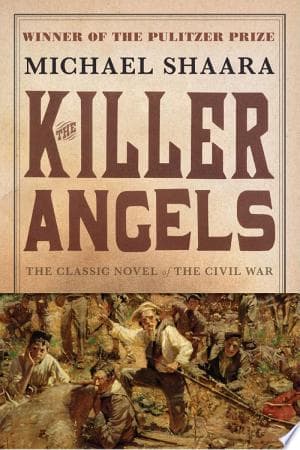
Shaara explores the hearts and minds of Lee, Longstreet, Chamberlain, and Buford during the four most crucial and bloody days of the American Civil War at Gettysburg, revealing the human cost and moral dilemmas that shaped the conflict.
In late June 1863, General Robert E. Lee's Confederate Army of Northern Virginia moves into Pennsylvania. Lee aims to draw the Union Army out and force a decisive battle. He feels confident after recent victories, but his corps commander, Lieutenant General James Longstreet, has significant strategic concerns. Longstreet believes the Confederates should take a defensive stance, forcing the Union to attack entrenched positions. He repeatedly tells Lee this, suggesting a flanking maneuver around Washington D.C. to cut off supplies. However, Lee wants a decisive victory and dismisses these cautious suggestions, preferring to seek out and destroy the Union Army in open battle. The Confederates also lack their cavalry commander, J.E.B. Stuart, whose location is unknown, leaving Lee unaware of Union movements.
On June 30th, Union Brigadier General John Buford, leading a cavalry division, arrives in Gettysburg, Pennsylvania. He immediately sees its importance as a hub of ten converging roads. His scouts soon report Confederate infantry approaching from the west, specifically General Henry Heth's division. Understanding the need to hold the high ground south of Gettysburg, Buford decides to dismount his cavalry and deploy them defensively on McPherson's Ridge, west of town. He knows his troopers cannot hold indefinitely against an infantry assault, but he plans to delay the Confederate advance long enough for Union I Corps infantry, under Major General John Reynolds, to arrive and secure Culp's Hill and Cemetery Hill. Buford sends urgent messages to Reynolds, emphasizing the need for infantry.
On July 1st, the Battle of Gettysburg begins. Confederate General Heth's division fights Buford's dismounted cavalry on McPherson's Ridge. The Union I Corps, led by Major General John Reynolds, arrives just in time to reinforce Buford, but Reynolds is killed early in the fighting. Despite strong resistance from Union Brigadier General John Gibbon's Iron Brigade, the Confederates' numerical superiority, especially after Lieutenant General Richard Ewell's corps arrives from the north, overwhelms the Union defenses. Union forces are pushed back through Gettysburg, suffering heavy casualties, including the capture of Major General Abner Doubleday's division. They retreat to strong defensive positions on Cemetery Hill and Culp's Hill south of town, establishing a critical line. Ewell, however, fails to press the attack on these hills, a decision later much discussed.
After the first day, General Longstreet repeats his strategic advice to General Lee. Standing on Seminary Ridge, looking at the Union positions on Cemetery Ridge, Longstreet argues for a tactical withdrawal around the Union left flank. This would force them to attack a prepared Confederate position. He believes a direct assault against the entrenched Union forces would be suicidal. Lee, however, remains set on a decisive battle. He believes the Union Army is demoralized and that a strong attack can break them. Lee orders Longstreet to attack the Union left flank on July 2nd, targeting the Emmitsburg Road and the high ground of Little Round Top and Big Round Top, despite Longstreet's doubts about the frontal assault strategy. Lee's confidence in his army overrides Longstreet's caution.
On the afternoon of July 2nd, the Confederates launch a large attack on the Union left flank. Major General Daniel Sickles, commanding the Union III Corps, controversially moves his corps to the Emmitsburg Road, creating a salient and leaving Little Round Top undefended. Union Brigadier General Gouverneur K. Warren discovers this vulnerability and urgently calls for troops. Colonel Joshua Lawrence Chamberlain and his 20th Maine Regiment rush to the summit of Little Round Top. They face repeated, desperate charges from Colonel William C. Oates's 15th Alabama Regiment. Low on ammunition and facing defeat, Chamberlain orders a bayonet charge down the hill, surprising and routing the exhausted Confederates. This defense secures the Union left flank, stopping the Confederates from outflanking the Union line.
At the same time as the fight for Little Round Top on July 2nd, intense and bloody fighting happens in Devil's Den, the Wheatfield, and the Peach Orchard. Confederate forces, including those under Major General John Bell Hood and Major General Lafayette McLaws, engage Union troops in brutal, close-quarters battles. The terrain, especially the large boulders of Devil's Den and the open fields, becomes a killing ground. Union forces, particularly Sickles's III Corps, suffer terrible casualties but hold their ground at a great cost. The fighting is chaotic and desperate, with both sides committing reserves and charging across the same blood-soaked ground. The Union line bends but does not break, solidifying the fishhook defense on Cemetery Ridge.
After two days of fierce fighting and heavy casualties, General Lee remains sure the Union line can be broken. He believes the Union flanks have been weakened enough for a massive frontal assault on the center of Cemetery Ridge to succeed. General Longstreet, however, feels increasingly despondent and openly objects to Lee's plan. He sees it as a suicidal mission, arguing that no troops could survive such an exposed charge across open ground against entrenched artillery and infantry. Longstreet expresses his deep reluctance, but Lee, believing he understands the enemy and the will of his men, orders the attack. He entrusts its command primarily to Major General George Pickett's division, which has not yet seen heavy action.
On the morning of July 3rd, the Confederates prepare for their grand assault. A massive artillery bombardment, meant to soften the Union defenses on Cemetery Ridge, begins around 1:00 PM. Over 150 Confederate cannons fire for nearly two hours, creating an inferno of sound and smoke. However, due to miscalculations and the Union's ability to protect their positions, much of the Confederate fire goes over its targets or is ineffective. The Union artillery, under Brigadier General Henry J. Hunt, initially responds strongly but then reduces its fire to save ammunition. This leads the Confederates to believe their barrage has been more successful than it was. Longstreet, watching the cannonade, still has deep reservations and struggles with the order to send his men forward.
Following the artillery barrage, General Longstreet, with immense reluctance and a heavy heart, gives the order for the infantry assault. About 12,500 Confederate soldiers, mainly from Major General George Pickett's division, along with divisions from Major General James Johnston Pettigrew and Major General Isaac Trimble, emerge from the woods on Seminary Ridge. They begin their mile-long march across open ground toward the Union center on Cemetery Ridge. They immediately face devastating artillery fire and then intense musketry from Union troops, including those of Major General Winfield Scott Hancock's II Corps. The Confederate lines are torn apart, but a small number manage to breach the Union line at the 'Angle' before being overwhelmed and driven back, suffering catastrophic casualties.
Pickett's Charge is a catastrophic failure for the Confederacy. The Union defenders, particularly those under Brigadier General Alexander S. Webb at the 'Angle,' hold firm, unleashing murderous fire into the advancing Confederates. Only a small number of Confederates, including Brigadier General Lewis Armistead, temporarily breach the Union line before being killed or captured. Survivors stream back across the field, leaving thousands dead, wounded, and captured. General Pickett is devastated by the loss of his division. General Lee rides out to meet the returning troops, taking full responsibility for the failure. The Battle of Gettysburg ends with a decisive Union victory, marking the high-water mark of the Confederacy and a turning point in the Civil War. Lee's invasion of the North has been decisively repelled.
The Confederate Commander
Lee begins overconfident and unwavering in his offensive strategy, but by the end, he is humbled by the defeat at Gettysburg, accepting full responsibility for the failure.
The Confederate Corps Commander
Longstreet struggles with his loyalty and strategic convictions, forced to execute orders he believes will lead to catastrophe, ending in profound grief and disillusionment.
The Union Colonel, 20th Maine
Chamberlain transforms from an intellectual soldier into a hardened, decisive combat leader, proving his mettle in the crucible of battle and making a crucial strategic contribution.
The Union Cavalry Commander
Buford begins the battle as a critical scout and delaying force, establishing the initial Union advantage by securing vital ground, though his direct role diminishes after the first day.
The Confederate Division Commander
Pickett starts eager for glory, but his arc culminates in the crushing defeat of his division, leaving him broken and disillusioned by the war.
The Confederate Cavalry Commander (Mentioned)
Stuart's physical absence from the crucial early days of the battle, due to his independent actions, creates a critical void in Confederate intelligence, directly impacting Lee's decision-making.
The Union Corps Commander (Supporting)
Hancock's consistent and effective leadership helps stabilize the Union line throughout the battle, particularly during the critical first day and the final Confederate assault.
The British Observer (Supporting)
Fremantle's initial optimism for the Confederate cause gradually gives way to a more sober understanding of the brutal realities of war and the Confederacy's ultimate failure.
The novel explores different leadership styles through Lee and Longstreet. Lee is the aggressive, confident commander willing to risk for victory, believing his army invincible. Longstreet is the cautious, pragmatic strategist who prioritizes defense and minimizing casualties. The struggle between these two views creates much of the narrative tension, showing the immense burden and moral dilemmas faced by generals in wartime. Chamberlain's leadership of the 20th Maine shows effective, empathetic command at the regimental level. It illustrates how individual leadership can change the course of critical moments, such as his bayonet charge on Little Round Top.
“''General, I have been a soldier all my life. I have been with you in every battle. I have never seen a man who could lead men like you. But if you attack that place, it will be the end of us.''”
Shaara portrays the brutal realities of combat through sensory details: screams, smoke, blood, and constant fear. The heavy casualties, especially during Pickett's Charge and the fighting in the Wheatfield, highlight war's destructive nature. The novel questions romantic notions of glory, instead presenting war as a grinder of men. Characters like Longstreet, haunted by personal loss, constantly advocate for strategies that minimize bloodshed. The senseless loss of life in frontal assaults shows the tragic folly of certain military decisions. Descriptions of the dead and wounded are direct, emphasizing the human cost.
“''There are times when a man has to choose. He has to choose between what he is and what he might be. And sometimes, if he is a soldier, he has to choose between what he believes is right and what he believes is his duty.''”
A main theme is the internal conflict characters face when reconciling personal beliefs with military duty. Longstreet is the prime example; he deeply believes in a defensive strategy but ultimately must execute a plan he knows is disastrous due to loyalty and orders. Chamberlain also grapples with the moral complexities of killing and leading men to their deaths, yet he is driven by a strong sense of duty to the Union cause. This theme shows the psychological toll of war on its leaders, forcing them to make choices with devastating consequences, often against their better judgment. It explores the tension between an individual's moral compass and the demands of military hierarchy.
“''It's not what you think, General. It's not what I think. It's what the men will do.''”
The novel examines the core ideologies driving the North and South. For Union soldiers, especially Chamberlain, the war is about preserving the nation and upholding freedom and equality, seeing it as a moral cause. For Confederates, it is about defending their homeland, way of life, and states' rights against what they see as Northern aggression, viewing themselves as heirs of the revolutionary spirit. The Battle of Gettysburg, as the turning point, is where these opposing ideals clash. The outcome shapes the nation's future, marking the beginning of the end for the Confederacy and setting the stage for a unified, though scarred, America. The book implicitly asks what was truly being fought for on those bloody fields.
“''We are an army of individuals. We are not a machine. We are not a mob. We are men, and we fight for what we believe.''”
The story is told through the eyes of several key characters from both sides.
Shaara employs a shifting third-person limited perspective, primarily focusing on the thoughts and experiences of General Lee, General Longstreet, Colonel Chamberlain, and General Buford. This device allows the reader to gain a comprehensive understanding of the strategic considerations, personal anxieties, and moral dilemmas faced by leaders on both sides of the conflict. It humanizes the 'enemy' and provides a richer, more nuanced portrayal of the battle than a single viewpoint could offer. By seeing the battle through different eyes, the reader experiences the chaos, the fear, and the determination from various angles, enhancing the dramatic tension and emotional depth.
Characters' inner thoughts and reflections drive much of the narrative.
Much of the narrative is conveyed through the detailed internal monologues of the main characters. Shaara delves deeply into their thoughts, fears, doubts, and motivations. This allows the reader to intimately understand Lee's confidence and strategic rationale, Longstreet's profound misgivings and personal grief, and Chamberlain's intellectual and moral struggles. This device is crucial for developing character depth and for explaining the strategic decisions and emotional toll of the war. It makes the historical figures feel remarkably human and relatable, allowing the reader to empathize with their difficult choices and the immense pressure they are under.
Longstreet's repeated strategic warnings predict the ultimate Confederate defeat.
Longstreet's constant and often desperate pleas to Lee for a defensive strategy, coupled with his prophetic statements about the futility of frontal assaults, serve as powerful foreshadowing. His warnings about the dangers of attacking entrenched Union positions directly prefigure the catastrophic failure of Pickett's Charge. This device builds dramatic tension, as the reader is aware of the impending doom through Longstreet's eyes, even as Lee presses forward with his aggressive plans. It highlights the theme of duty versus conscience and underscores the tragic inevitability of the Confederate defeat at Gettysburg, making the climax all the more poignant.
The critical absence of Confederate cavalry intelligence.
The absence of General J.E.B. Stuart and his cavalry, who are meant to be Lee's 'eyes' on the battlefield, serves as a significant plot device. Stuart's independent raid leaves Lee effectively blind to Union movements and dispositions, particularly in the crucial early days of the campaign. This lack of intelligence contributes directly to Lee's overconfidence and his decision to engage the Union Army without full knowledge of their strength or position. It creates an atmosphere of uncertainty and vulnerability for the Confederates, directly impacting their strategic decisions and ultimately contributing to their defeat, making Stuart's absence a silent but powerful antagonist to Lee's plans.
“It never changes, does it? The smell of it. The smell of death.”
— Chamberlain reflecting on the aftermath of battle.
“Man is a political animal. I'm not a political animal. I'm a soldier.”
— Longstreet expressing his disdain for politics and his focus on military duty.
“There are times when a leader must go out ahead of his men, when he must be the first to risk and the first to die.”
— Chamberlain leading his men during the defense of Little Round Top.
“If a man has to die, let him die for something that will make him a legend.”
— General Pickett contemplating his role in the upcoming charge.
“It's all right, boy. You done good. You done real good.”
— Colonel Fremantle's encouraging words to a young Confederate soldier.
“We're going to win this war. We're going to lose this war. We're going to win this war. It's a dance.”
— General Buford's internal monologue about the uncertainty of battle.
“The point is, gentlemen, that we are not fighting for slavery. We are fighting for our rights.”
— A Confederate officer attempting to justify the Southern cause.
“We're going to have to hold this ground. We're going to have to hold it against everything they can throw at us.”
— Chamberlain's determination on Little Round Top.
“It's a strange thing, isn't it? To hate the enemy so much, and yet to admire him.”
— Longstreet reflecting on his respect for certain Union commanders.
“There's a place where the sun don't shine, and that's where we're going.”
— A grim observation by a soldier about the likely outcome of a battle.
“You are a soldier, sir. You are not a politician. You are not a preacher. You are a soldier.”
— Longstreet's advice to a fellow officer to focus on military objectives.
“God will not forgive us for this. He will not forgive us.”
— General Lee's lament after the catastrophic losses of Pickett's Charge.
“This is a new kind of war, General. It's a war of machines and men, and the machines are winning.”
— Fremantle's observation on the changing nature of warfare.
“Some men are born to command. Some men are born to follow. And some men are born to die.”
— A general's fatalistic view of the roles in war.
Ready to see how well you understood this book? Take our interactive quiz with 10 questions.

Michael Shaara was an American author of science fiction, sports fiction, and historical fiction. He was born to an Italian immigrant father in Jersey City, New Jersey, graduated in 1951 from Rutgers University, where he joined Theta Chi, and served as a sergeant in the 82nd Airborne Division prior to the Korean War.







