“The past is a ghost, the future a dream, and all we ever have is now.”
— Gabriel Allon reflecting on the fleeting nature of time and his own haunted history.

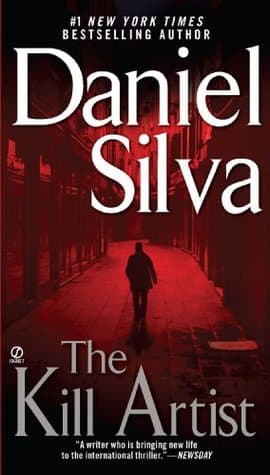
Daniel Silva (1996)
Genre
Thriller / Mystery
Reading Time
600 min
Key Themes
See below
Sign in to track this book
A retired Israeli assassin and art restorer, haunted by tragedy, must hunt down a Palestinian zealot from his past who threatens Middle East peace, in a story of vengeance and political intrigue across three continents.
Gabriel Allon, once Israel's most feared assassin, has left his violent past. He lives in a remote village on the Umbrian border, restoring Renaissance paintings as 'Mario Delvecchio.' His days are quiet, a contrast to his bloody past. Gabriel is broken by a car bomb that killed his son, Dani, and left his wife, Leah, in an institution. This tragedy, caused by Tariq al-Hourani, led Gabriel to leave the Office, vowing never to return. He believes his past has caught up to him, leaving him with only guilt and art to fill his life.
Gabriel's peace ends when Ari Shamron, the head of the Office, arrives. Shamron, a mentor to Gabriel, says a Palestinian terrorist plot is underway, threatening Middle East peace talks. The target is a high-ranking American diplomat, and the plot's leader is Tariq al-Hourani, the man who caused Gabriel's tragedy. Shamron knows Gabriel is the only one who can stop Tariq. He appeals to Gabriel's duty and his desire for revenge. Gabriel, at first unwilling, is swayed by the chance for vengeance and the knowledge that his past will always be with him. He agrees to one last mission for Israel.
Gabriel goes to Paris first. He must investigate Jacqueline Delacroix, a French-Jewish model. The Office thinks she might be involved, possibly unknowingly, with Tariq's network. Gabriel, pretending to be an art dealer, approaches Jacqueline. He is drawn to her quiet intensity and sadness. He learns she is the daughter of Holocaust survivors and wants justice. As he watches her, he suspects she is more than a pawn; she might be seeking her own revenge. Their first talks are careful, built on unspoken truths and shared past traumas, as Gabriel tries to find out her true loyalties and involvement.
Gabriel's investigation into Jacqueline shows she is actively involved with Tariq's network. He learns that Jacqueline, wanting revenge against those who escaped justice for wartime crimes, was recruited by Tariq, who used promises of retribution. She is a participant, but with complex morals. Gabriel confronts her, revealing his identity and the seriousness of Tariq's plans. Jacqueline, at first defiant, rethinks her choices as she realizes how big Tariq's attack will be and how many innocent lives are at risk. This changes their relationship from hunter and prey to a reluctant, uneasy team.
Following a lead, Gabriel and Jacqueline go to London to find Julian Isherwood, an eccentric art dealer. Isherwood, a long-time Office asset, is known for his contacts and art dealings. Gabriel uses their shared history and Isherwood's love for art to get information about a piece Tariq's network is interested in. Isherwood, at first unwilling to get involved in danger, is persuaded by Gabriel and the chance of a reward. His information is important, providing the next clue in tracking Tariq and understanding his methods. This strengthens the fragile alliance between Gabriel and Jacqueline.
The intelligence points to Rome as Tariq's next target. Gabriel and Jacqueline, now working together, arrive in Rome. They find that Tariq plans to use a diplomatic event at the Vatican to assassinate a high-profile American diplomat and stop the peace process. The target's symbolism shows Tariq's fanaticism. Gabriel, using his knowledge of covert operations and Tariq's mind, begins to predict his enemy's moves. Tension rises as they race against time, navigating Rome's streets and the eyes of various intelligence agencies, trying to stop a terrorist act.
To get closer to Tariq, Gabriel uses his skills of disguise and infiltration. He creates a new identity, allowing him to move unseen within Tariq's network. Jacqueline helps, using her connections and charm to create openings. Gabriel's artistic precision in restoring paintings helps him become someone else, blending into the shadows. He gathers important information about Tariq's exact plans, the attack's timing, and the specific target. The stakes are very high; any mistake could expose them and doom the mission, leading to bad consequences for peace talks and many innocent lives.
The moment of truth arrives at the Vatican. Gabriel, with Jacqueline's help, finds Tariq's exact position and his assassination method. A tense and brutal fight happens. Gabriel, driven by duty and revenge, fights Tariq in a deadly game within the historic area. The fight is not just physical; it is a battle of wills, years of hatred and loss. Gabriel uses every skill, his assassin training returning with brutal force. The encounter is a raw and emotional climax, forcing Gabriel to face his inner darkness and the man who shattered his life, as he fights to stop an act of terror.
With Tariq stopped and the attack averted, Gabriel deals with the aftermath. The mission is a success, but the cost is huge. He is again covered in blood, and the past is more vivid. He thinks about the line between justice and vengeance, and the toll his violent life has taken. Jacqueline, having found her own closure, leaves, leaving Gabriel with a lingering connection. Shamron, practical as always, acknowledges Gabriel's success but also the personal sacrifice. Gabriel returns to his quiet life, but the experience has changed him, showing him that art is a fragile shield against a world he cannot truly escape.
As Gabriel returns to his sanctuary in Italy, the world continues, and the threats he fought still exist. His encounter with Tariq has reopened old wounds and reminded him that peace is a short-lived idea. While he wants a life of quiet art, he knows the Office, and Shamron, will likely call him again. He is a man caught between two worlds: the beauty of art and the harsh reality of intelligence work. The novel ends with Gabriel's future uncertain, but it suggests his skills and duty will pull him back into the shadows, forever Israel's 'kill artist,' even as he wants redemption and peace.
The Protagonist
Gabriel is reluctantly drawn back into the world of espionage, confronting his past and seeking a measure of vengeance, ultimately accepting that his unique skills will always tie him to the shadows.
The Supporting
Shamron successfully brings Gabriel back into the fold, reaffirming his control and influence over his most valuable asset.
The Supporting
Jacqueline transitions from an unwitting pawn and accomplice to a crucial ally for Gabriel, finding a different path to justice and redemption.
The Antagonist
Tariq orchestrates a major terrorist plot but is ultimately thwarted and eliminated by Gabriel, his reign of terror brought to an end.
The Supporting
Isherwood provides key intelligence to Gabriel, reaffirming his role as a vital, if reluctant, asset to the Office.
The Supporting
Uzi effectively supports Shamron and Gabriel in the mission, solidifying his role as a reliable Office operative.
The Mentioned
Leah remains in a catatonic state, her tragedy serving as a powerful motivator for Gabriel's actions.
The Mentioned
Dani's death serves as the initial inciting incident for Gabriel's personal tragedy and his subsequent return to active duty.
The novel explores the blurry lines between personal revenge and official justice. Gabriel wants to avenge his son's death and his wife's injury by Tariq. Shamron, while calling the mission national security, uses Gabriel's personal vendetta. Jacqueline also seeks justice for her family's past, which Tariq uses. The story asks if Gabriel's actions are purely for Israel's safety or mainly for personal revenge, showing the moral questions in such a life.
“"He was a creature of the shadows, an artist of death, and he had come to collect a debt long overdue."”
Gabriel Allon shows the theme of dual identity. He is both the careful art restorer, Mario Delvecchio, seeking peace and beauty, and the assassin, Gabriel Allon, a master of violence and deceit. This duality is not just a cover; it is a conflict within him. The novel contrasts the calm world of art, where he restores beauty, with the brutal world of spying, where he destroys lives. His struggle to combine these two parts of himself, and his inability to escape his past, is a main psychological tension. Jacqueline also deals with a dual identity, caught between her public image and her hidden goals.
“"He was an artist, a restorer of the beautiful, but the shadows clung to him, a reminder of the other life he could never truly shed."”
The book shows the great personal cost and sacrifice of a life in intelligence. Gabriel has lost his family and peace of mind because of his duty to Israel. Leah and Dani's fates remind readers of this price. Shamron, effective, has clearly sacrificed much for his country, acting with cold practicality. The story shows that while these people protect their nation, they often pay a heavy personal price, living with trauma, loss, and constant threat of violence. It questions if the results justify such devastating means.
“"The Office devoured its children, leaving them hollowed-out vessels, filled with ghosts."”
Art is a strong metaphor and a refuge for Gabriel. His art restoration is not just a cover; it is a type of therapy, a careful process of bringing damaged beauty back to life. This mirrors his own desire for healing. The precision needed for art restoration also shows in his skills as an assassin. The contrast between the timeless beauty of Renaissance art and the brutal, short violence of his other life highlights his inner conflict and his desire for a world without bloodshed. Art represents the potential for peace and the lasting human spirit, a contrast to the destructive forces he fights.
“"He found solace in the slow, meticulous resurrection of beauty, a counterpoint to the death he had once dealt with such precision."”
The novel shows that political and ideological conflict, especially in the Middle East, is ongoing. Despite peace talks, deep hatreds and acts of terror continue, shown by Tariq's fanaticism. Gabriel's personal revenge mirrors the larger, seemingly endless cycle of violence between Israelis and Palestinians. The book suggests that even when one enemy is removed, the conflicts remain, implying that true peace is hard to reach. It also suggests that the 'kill artist' will always be needed as long as these old enmities exist, leaving little room for lasting personal or political calm.
“"The war never truly ended; it merely changed its battleground, its weapons, and its faces."”
Gabriel Allon's initial resistance to returning to his violent past.
This classic literary device is central to Gabriel Allon's character. He has actively chosen to leave his life as an assassin, seeking peace and atonement through art restoration. His reluctance to return to the Office is driven by profound personal loss and trauma. Shamron's manipulation and the personal nature of the threat (Tariq) force his hand. This reluctance makes his eventual re-engagement more impactful and highlights his internal conflict, making him a more sympathetic and complex protagonist than a gung-ho action hero. It emphasizes the immense personal cost of his profession.
Tariq's responsibility for Gabriel's family tragedy drives the plot.
The car bombing that killed Gabriel's son and incapacitated his wife, perpetrated by Tariq, provides a powerful and deeply personal motivation for Gabriel's actions. This transforms the mission from a purely professional assignment into a quest for personal vengeance. It adds a layer of emotional intensity and high stakes to the narrative, making the confrontation between Gabriel and Tariq not just a battle for national security but also a deeply cathartic and personal showdown. This device ensures the reader is invested in Gabriel's emotional journey alongside the geopolitical thriller aspects.
Gabriel's profession symbolizes his desire for healing and bringing order.
Gabriel's work as an art restorer is a powerful symbolic device. It serves as a stark contrast to his life as an assassin, representing his yearning for peace, beauty, and the restoration of what is broken. The meticulous process of repairing damaged masterpieces mirrors his internal struggle to heal his own fractured soul and bring order to a chaotic world. It also highlights his precision and attention to detail, qualities that are equally crucial in his espionage work, creating a thematic link between his two disparate lives.
Ari Shamron's cunning and strategic influence on Gabriel.
Ari Shamron functions as a master manipulator, pulling strings from the shadows to achieve his objectives. He understands Gabriel deeply and expertly exploits his sense of duty, loyalty, and personal pain to draw him back into the field. Shamron's methods are often morally ambiguous, prioritizing national security above individual well-being. This device highlights the ruthless pragmatism of intelligence agencies and creates a complex dynamic between mentor and protégé, where love and manipulation are intertwined, ensuring Gabriel is always subtly guided towards Shamron's will.
“The past is a ghost, the future a dream, and all we ever have is now.”
— Gabriel Allon reflecting on the fleeting nature of time and his own haunted history.
“In our business, there are no accidents, only operations that have gone wrong.”
— Ari Shamron explaining the ruthless logic of intelligence work to Gabriel.
“A painter sees the world in colors and shapes; an assassin sees it in targets and exits.”
— Gabriel contemplating the duality of his life as both an artist and a spy.
“Peace is not the absence of conflict, but the presence of justice.”
— A character discussing the Israeli-Palestinian conflict and the elusive nature of peace.
“The truth is like a diamond; it has many facets, and all of them are sharp.”
— Gabriel musing on the complexity and danger of uncovering secrets.
“We are all prisoners of our past, but some of us have longer sentences than others.”
— Reflection on how personal history shapes and confines the characters' lives.
“In the shadows, loyalty is the only currency that never depreciates.”
— Emphasizing the value of trust and allegiance in the world of espionage.
“Art restores what time destroys; vengeance destroys what time cannot touch.”
— Contrasting Gabriel's work as an art restorer with his missions of revenge.
“Fear is a weapon, but only if your enemy knows you possess it.”
— A tactical insight into psychological warfare and intimidation.
“The line between hunter and prey is often just a matter of perspective.”
— Observing the shifting dynamics of power and pursuit in spycraft.
“Memory is a landscape we can never leave, no matter how far we travel.”
— Gabriel grappling with the inescapable memories of his past actions.
“In silence, there is strength; in noise, there is only distraction.”
— A lesson on the importance of stealth and focus in dangerous situations.
“Every ending is a beginning in disguise, especially in the world of secrets.”
— Commenting on the cyclical nature of espionage and personal journeys.
Ready to see how well you understood this book? Take our interactive quiz with 10 questions.

Daniel Silva is a globally acclaimed author celebrated for his thrilling espionage novels. He is best known for his Gabriel Allon series, which includes international bestsellers like "Portrait of a Spy," "The English Assassin," and "The Unlikely Spy." Silva's meticulous research and complex plots have cemented his reputation as a master of the spy thriller genre.







