“The wind was picking up, whipping sand into stinging clouds. He squinted, trying to make out the details of the camp, but the desert was already blurring them.”
— Alex Wolff observing the British camp in the desert, early in his mission.

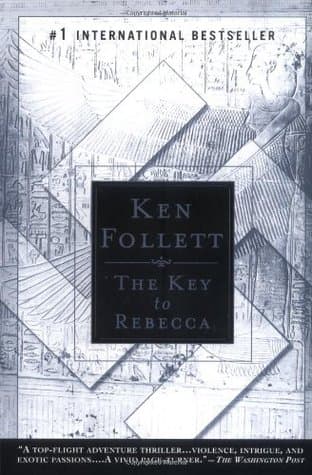
Ken Follett (1980)
Genre
Thriller / Historical Fiction / Mystery
Reading Time
390 min
Key Themes
See below
Sign in to track this book
In World War II Cairo, a desperate British major and a courageous young Jewish girl must outwit a cunning Nazi spy whose coded messages, transmitted through a belly dancer, threaten to open the city to Rommel's advancing army.
In 1942, during the North African Campaign, German Abwehr agent Alex Wolff, a half-German, half-Arab orphan raised in Egypt, parachutes into the Western Desert. He quickly makes his way to Cairo, taking the identity of a British officer he previously ambushed and killed. Wolff's mission is to gather intelligence on British troop movements and fortifications around Cairo. He must transmit this to General Rommel's Afrika Korps, who are advancing from the west. He carries a sophisticated codebook based on the novel 'Rebecca' by Daphne du Maurier, which he plans to use for his transmissions. His resourcefulness and ruthlessness are clear as he navigates the city's complex social and political world.
Major William Vandam, a British intelligence officer of modest rank with a somewhat tarnished reputation from a past scandal, grows concerned by the inexplicable British defeats and an unusually high number of supply convoy ambushes in the desert. He notices a pattern: British intelligence seems compromised, particularly regarding troop deployments and defensive strategies. His superiors largely dismiss him, attributing the losses to Rommel's tactical genius. But Vandam's instincts tell him a spy is operating within Cairo. He begins to meticulously review reports and piece together clues, working mostly outside official channels due to his lack of credibility.
Alex Wolff, using his charm, ruthlessness, and knowledge of Cairo's underworld, quickly builds a network of informants. He targets vulnerable individuals, including prostitutes, disgruntled local officials, and collaborators. He manipulates Abd el-Grem, a local merchant, who helps him acquire a radio transmitter. Wolff's primary methods are blackmail and intimidation, exploiting people's secrets and desires. He infiltrates a British officers' club, where he gathers crucial information by overhearing conversations and observing movements, showing his exceptional ability to blend in and get intelligence from seemingly innocent sources.
Through diligent, often solitary investigation, Major Vandam starts to connect seemingly unrelated incidents. He notices a peculiar detail in intercepted German radio transmissions: a recurring, seemingly random sequence of numbers. Remembering a conversation about a new code based on a book, he begins to suspect the spy is using a literary cipher. After a painstaking search, he and his small, unofficial team, including Captain Harry Frost, identify Daphne du Maurier's novel 'Rebecca' as the key to the German code. This breakthrough confirms his belief in a sophisticated spy and gives him his first real lead.
Elene Fontana is a beautiful, intelligent young Jewish dancer working in Cairo. She first meets Alex Wolff, who is drawn to her beauty and sharp mind. Wolff, posing as a British officer, seduces Elene. He uses her to gain access to social circles and to get information, though she is initially unaware of his true identity or intentions. Her vulnerability and desire for a better life make her susceptible to Wolff's manipulations. Later, she will meet Major Vandam, who sees in her a potential asset and a victim of Wolff's schemes, leading to a complex and dangerous relationship.
Alex Wolff periodically ventures into the Western Desert for secret meetings with German operatives. During one such meeting, he receives new orders directly from German intelligence, along with fresh supplies, including advanced radio equipment and funds. These meetings are dangerous, as British patrols constantly sweep the desert. Wolff's ability to navigate the treacherous terrain and avoid detection highlights his exceptional training and survival skills. This allows him to maintain his operational effectiveness and continue his vital transmissions to Rommel's forces, directly impacting the battle for North Africa.
As Vandam and his team, now including the resourceful Captain Harry Frost and local police, decipher more of Wolff's transmissions, they begin to narrow down his possible locations. They realize the spy is operating from within Cairo itself, making the search even more urgent and dangerous. Vandam's relentless investigation leads to several close calls. Wolff narrowly escapes capture multiple times, often due to his quick thinking and ruthless elimination of anyone who might expose him. The stakes rise as Rommel's army draws closer, making Wolff's intelligence increasingly critical.
Elene Fontana, through observations and overheard conversations, slowly pieces together the truth about Alex Wolff. She discovers his German identity and his mission as a spy, realizing she has been manipulated and used. Her initial shock turns to fear, as Wolff makes it clear that her life, and potentially her family's lives, are at risk if she exposes him. Trapped and terrified, Elene is forced to assist Wolff, providing him with information and cover. This makes her an unwilling accomplice in his espionage activities, putting her in an incredibly dangerous and morally compromising position.
The climax of the pursuit sees Major Vandam and his team closing in on Alex Wolff. Vandam, now fully aware of Wolff's identity and methods, engages in a desperate cat-and-mouse chase across the bustling streets and hidden alleys of Cairo. Wolff, cornered but still incredibly resourceful, uses every trick to avoid capture, employing disguises, misdirection, and violence. The chase becomes a personal duel between the determined British officer and the cunning Nazi spy. The fate of Cairo, and potentially the North African campaign, hangs in the balance as Rommel's forces prepare their final assault.
In a climactic confrontation, Major Vandam finally corners Alex Wolff. The battle of wits turns into a physical struggle, resulting in Wolff's death. Elene Fontana, having played a crucial, though unwilling, role, is left to deal with the trauma of her involvement. While Cairo is saved from Rommel's immediate threat, the events leave a lasting impact on Vandam. He is hailed as a hero but deeply affected by the moral ambiguities and personal sacrifices made. The novel concludes with the immediate threat neutralized, but the psychological scars of espionage and war remain on the characters.
The Antagonist
Wolff begins as an unassailable, almost mythical spy, successfully infiltrating Cairo and transmitting vital intelligence. His arc is one of gradual exposure and increasing pressure, leading to his ultimate downfall.
The Protagonist
Vandam starts as a marginalized figure, dismissed by his peers, but through his relentless pursuit, he proves his competence and ultimately saves Cairo, restoring his reputation.
The Supporting
Elene evolves from an unwitting pawn to a terrified accomplice, ultimately making a courageous choice that aids Vandam, highlighting her resilience and moral compass.
The Supporting
Frost remains a steadfast and reliable ally throughout the investigation, growing in his understanding of the spy's cunning and the high stakes involved.
The Supporting
El-Grem's arc is one of increasing entanglement and fear as he realizes the danger of his association with Wolff, leading to his inevitable demise.
The Mentioned
Rommel's arc is external to the narrative, representing the relentless, advancing threat that dictates the pace and stakes of the internal conflict.
The Supporting
Smith's arc is one of gradual realization and acceptance as Vandam's evidence becomes undeniable, forcing him to acknowledge the threat.
The Mentioned
Fitzherbert's arc is entirely in the past, serving as a backstory element that explains Vandam's initial lack of support.
The novel explores the world of espionage, focusing on constant deception, manipulation, and psychological warfare. Alex Wolff embodies this theme, using stolen identities, charm, blackmail, and violence to achieve his goals. His ability to blend into British society and exploit personal weaknesses shows how widespread deceit can be. Major Vandam's struggle to uncover Wolff's identity highlights the difficulty of distinguishing truth from lies in wartime, where appearances are often misleading. The 'Rebecca' code itself is a clever form of deception, hiding critical information in plain sight.
“A good spy is like a ghost, a whisper, never seen, never truly heard, but always there.”
The story looks at the unclear ethical lines of war, where characters must make morally difficult decisions. Elene Fontana, in particular, faces an impossible choice between self-preservation and betraying her country, showing the tragic sacrifices conflict demands. Major Vandam, while fighting for the 'right' side, also uses questionable tactics and manipulates others to achieve his goals. The novel suggests that in war, clear morality often gives way to shades of grey. Here, heroes and villains are not always distinct, and even good intentions can lead to terrible consequences for innocent people.
“In war, there are no good choices, only the least bad ones.”
A central theme is the struggle of an individual, Major William Vandam, against a rigid and often complacent military bureaucracy. Vandam's initial theories about a spy are dismissed due to his past record and the prevailing belief in Rommel's invincibility. He is forced to work mostly outside official channels, relying on his intuition and a small, dedicated team. This shows the dangers of institutional inertia and the courage needed to challenge established norms. Wolff, too, acts as a highly effective individual, often outmaneuvering the larger, slower British intelligence apparatus.
“They preferred to believe in genius than in treason.”
The personal relationships in the novel are closely tied to the larger conflict, showing how war distorts human connections. Alex Wolff's seduction of Elene Fontana is a calculated act of betrayal, exploiting her vulnerability and trust for his espionage. Elene's subsequent forced cooperation highlights the ultimate betrayal of self and country under duress. Even Vandam's growing protective feelings for Elene are complicated by his need to use her as an informant. The theme explores how love can be a weapon, a shield, or a devastating casualty in the brutal context of war.
“In wartime, even love could be a weapon, or a cage.”
The entire plot revolves around getting and sending vital intelligence. Wolff's success depends on his ability to gather precise information about British troop movements and defenses, which he then transmits using the 'Rebecca' code. Vandam's mission is to intercept and decipher this information, understanding that knowledge is power in warfare. The novel demonstrates how a single piece of intelligence, or the lack of it, can dramatically change the course of battles and even entire campaigns, making spies like Wolff incredibly valuable and dangerous. The codebook itself is the literal 'key' to this power.
“Information was the currency of war, and Wolff was a master counterfeiter.”
A literary cipher based on Daphne du Maurier's novel.
The 'Rebecca Code' is the central plot device, serving as the method by which Alex Wolff transmits his intelligence to Rommel. It's a highly sophisticated cipher using specific words and page numbers from Daphne du Maurier's novel 'Rebecca' to encrypt messages. This device not only provides a clever and challenging puzzle for Major Vandam to solve but also grounds the espionage in a tangible, literary element. Its unique nature makes it difficult to crack and provides a distinctive signature for Wolff's transmissions, ultimately leading Vandam to its discovery.
Wolff's primary method of infiltration and deception.
Alex Wolff's ability to assume and maintain the identity of a deceased British officer is a crucial plot device. This allows him to move freely within British-controlled Cairo, access sensitive locations, and gather intelligence directly from unsuspecting British personnel. The device highlights Wolff's cunning and mastery of deception, making him a formidable and elusive enemy. It also creates dramatic irony, as the audience is aware of his true identity while the characters in the story are not, raising the stakes of Vandam's investigation.
Rommel's advancing army creates immense urgency.
Rommel's relentless advance across the North African desert towards Cairo serves as a powerful 'ticking clock' device. The closer Rommel's forces get, the more critical Wolff's intelligence becomes, and the more urgent Vandam's mission to stop him. This external threat creates immense tension and pressure throughout the narrative, driving the pace of the plot and raising the stakes of every action taken by the characters. It ensures that the reader feels the immediate consequences of both Wolff's successes and Vandam's failures.
Elene Fontana as a seductive figure who is also a victim.
Elene Fontana initially appears to function as a classic femme fatale, drawing in Alex Wolff with her beauty and exotic allure. However, the device is subverted as she quickly becomes a victim of Wolff's manipulation and blackmail, rather than a willing participant in his schemes. She is a woman caught in dangerous circumstances, forced to make impossible choices. This twist adds depth to her character and explores the vulnerabilities of individuals caught in the brutal realities of wartime espionage, moving beyond a simple seductive archetype.
“The wind was picking up, whipping sand into stinging clouds. He squinted, trying to make out the details of the camp, but the desert was already blurring them.”
— Alex Wolff observing the British camp in the desert, early in his mission.
“He lived by his wits, and his wits told him that the rules were for other people.”
— Describing Alex Wolff's amoral and self-reliant nature.
“The desert taught you patience, or it killed you.”
— Alex Wolff reflecting on the harsh realities of his environment.
“Information was the most valuable commodity in the war.”
— Major Vandam's understanding of the importance of intelligence.
“He was a ghost in the machine, and the machine was the British Army.”
— Describing Alex Wolff's undetected presence within British territory.
“Fear was a cold, constant companion, but it also sharpened the mind.”
— Alex Wolff dealing with the pressures and dangers of his mission.
“The truth was a weapon, if you knew how to use it.”
— Major Vandam considering how to exploit information.
“Every lie was a debt, and eventually, it had to be paid.”
— A general reflection on the consequences of deception.
“Cairo was a city of secrets, whispered in the shadows, traded in the bazaars.”
— Setting the scene in wartime Cairo, a hub of espionage.
“He didn't believe in luck, only in preparation and opportunity.”
— Alex Wolff's pragmatic approach to his work.
“The war had a way of bringing out the best and the worst in people.”
— A broader observation about human nature during conflict.
“Rebecca was more than just a code; she was a symbol of his past, and his future.”
— Alex Wolff's personal connection to his codebook, 'Rebecca'.
“In the desert, every shadow held a potential enemy.”
— The constant threat and paranoia faced by those in the desert war.
“He knew he was playing a dangerous game, but he wouldn't have it any other way.”
— Alex Wolff embracing the high stakes of his espionage mission.
Ready to see how well you understood this book? Take our interactive quiz with 10 questions.

Kenneth Martin Follett, is a British author of thrillers and historical novels who has sold more than 160 million copies of his works.







