“My life was a lie, and I swallowed it whole.”
— Violet reflects on her upbringing in the Outer Districts and the harsh reality of the Jewel.

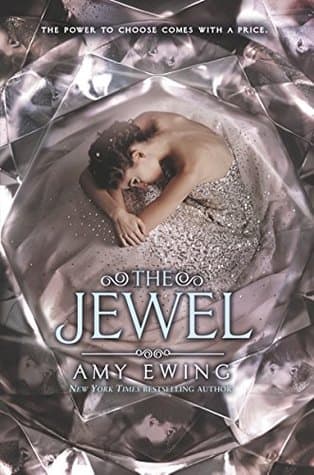
Amy Ewing (2014)
Genre
Fantasy / Science Fiction / Young Adult / Romance
Reading Time
7-8 hours
Key Themes
See below
Sign in to track this book
Violet Lasting is sold into opulent servitude in the brutal Jewel, forced to bear an heir for a ruthless Duchess while fighting to keep her identity and forbidden love.
Violet Lasting, a sixteen-year-old from the Marsh, is one of several girls trained as 'Surrogates' in the Nursery. These girls have rare Auguries—special abilities—and are meant to bear children for the royal families of the Jewel, as the nobility are infertile. The story opens with the 'Auction,' where Violet, Lot 197, is sold for six million diamantes to the Duchess of the Lake. This event marks her forced entry into servitude, stripped of her identity. She is separated from her best friend, Raven, who is sold to another House, and feels immense fear about her future.
At the House of the Lake, Violet is immediately immersed in the lavish but restrictive world of the nobility. She is given a new wardrobe and a personal maid, Ann, who is initially cold but eventually becomes a confidante. The Duchess of the Lake is a cruel woman, making it clear that Violet's purpose is to produce a healthy heir. Violet also meets the Duchess's nephew, Ash, a handsome but aloof boy. The grandeur of her surroundings contrasts sharply with her emotional and physical imprisonment.
Violet's Augury is the ability to grow plants and manipulate nature. She, along with the other Surrogates, undergoes rigorous training with Madam, a stern but knowledgeable woman responsible for honing their abilities. These sessions prepare their bodies for pregnancy. Violet finds solace in practicing her Augury in secret, nurturing a small plant in her room, a symbol of her dwindling connection to her past. She learns to use her power without drawing too much attention from the Duchess.
As Violet spends more time in the House, she slowly builds trust with Ann. Ann reveals information about the House's workings and the Duchess's past, including the fate of previous Surrogates, which increases Violet's dread. Violet also sees the Duchess's casual cruelty towards her staff and other Surrogates, reinforcing the oppressive atmosphere. She notices the Duchess's intense scrutiny, and a sense of unease fills her daily life, making her constantly wary of surveillance and punishment.
Violet learns that Ash is not merely the Duchess's nephew, but a Royal 'Companion' assigned to the Duchess, tasked with fathering the heir. Despite his initial coldness, Ash begins to show kindness towards Violet, expressing his dissatisfaction with his role. They start meeting in secret, sharing their frustrations and fears. During these clandestine encounters, a romantic connection develops, offering Violet hope in her bleak existence. These meetings are dangerous, as discovery would mean severe punishment for both.
The Duchess uses various tactics to ensure Violet's compliance, including psychological manipulation and strict monitoring of her diet and activities. She often reminds Violet of her low status and the importance of producing an heir. Violet, however, secretly resists by holding onto her memories, practicing her Augury, and nurturing her feelings for Ash. She learns to mask her true emotions and thoughts, presenting a facade of obedience while internally rebelling against the dehumanizing system. Her defiance is subtle but persistent.
Through her conversations with Ash and Ann, Violet uncovers disturbing truths about the Jewel's society, including that Royals are infertile due to genetic manipulation and Surrogates are bred for their Auguries. She also learns about the harsh fates of failed Surrogates. Ash reveals he is part of a resistance movement aiming to overthrow the corrupt system. Together, they begin to formulate a dangerous escape plan, fueled by their love and a desire for freedom. The stakes are incredibly high, as failure would mean certain death.
Violet undergoes the conception process, which is clinical and emotionless, a stark reminder of her role as a vessel. Despite the stress, she remains composed, knowing her escape depends on appearing compliant. The Duchess becomes increasingly suspicious of Violet, intensifying her surveillance. Pressure mounts as Violet and Ash finalize their escape plans, aware that time is running out. The House feels like a cage, and every interaction with the Duchess tests Violet's ability to deceive.
The night of the planned escape arrives, filled with tension and danger. Violet, aided by Ash and Ann, navigates the House's corridors, using her Augury to create distractions. However, their plan is compromised. They encounter unexpected resistance, and Violet realizes there might be a traitor within their small circle. During the escape, Violet must make difficult decisions, relying on her wits and her Augury to survive. The escape is chaotic and violent, pushing her to her limits.
Violet successfully escapes the House of the Lake, though with significant losses and close calls. She makes her way out of the Jewel, finding herself in the treacherous Outer Rings. She reunites with Raven, her best friend, who has also escaped her own House. Their reunion is emotional and bittersweet; they are now fugitives but together. The novel ends with Violet and Raven facing an uncertain future outside the Jewel, determined to fight for their freedom and expose the truth about the corrupt society. They are now part of a larger resistance movement, ready for the battles ahead.
The Protagonist
Violet transforms from a terrified, captive girl into a resourceful and defiant leader, embracing her power and fighting for liberation.
The Love Interest/Supporting
Ash moves from a seemingly detached Royal to an active rebel, risking everything for love and freedom.
The Antagonist
The Duchess remains a static antagonist, her cruelty and ambition unwavering throughout the narrative.
The Supporting
Raven endures her own hardships as a Surrogate, eventually reuniting with Violet as a strong, independent ally.
The Supporting
Ann evolves from a dutiful servant to a courageous ally, risking her life for Violet's freedom.
The Supporting
Madam remains a largely static character, serving as an enforcer of the Jewel's system.
The Supporting
Garret acts as a steadfast helper in the resistance, facilitating the escape.
The novel explores how Surrogates are stripped of their names, families, and autonomy, becoming mere 'Lots' or 'vessels.' Violet's struggle to hold onto her memories, her original name, and her connection to nature (her Augury) is central to this theme. The system reduces individuals to their reproductive and magical utility, denying their humanity. This is shown when Violet is forced to wear elaborate gowns and makeup, transforming her outward appearance while her inner self rebels against the artifice, as well as the clinical and emotionless 'conception' process.
“Today is my last day as Violet Lasting. Tomorrow I become Lot 197.”
The Jewel's society is built on the oppression of the Outer Rings by the infertile nobility. Surrogates are the most visible victims of this system. However, resistance emerges through Violet's defiance, her forbidden relationship with Ash, and the secret rebellion he is part of. Even subservient characters like Ann contribute to this resistance. The story highlights that even in controlled environments, the human spirit will seek freedom and fight against injustice, no matter how small the act of defiance.
“Freedom. That was the word that kept me going.”
In a world designed to isolate and control, the bonds of friendship and romantic love become powerful forces for survival and rebellion. Violet's connection to Raven, despite their separation, provides an emotional anchor. Her forbidden love with Ash blossoms in dangerous circumstances, offering solace, hope, and a shared purpose. These connections give the characters the strength and motivation to fight for a better future, showing that human relationships can transcend systemic oppression and become catalysts for change.
“He was my anchor in this swirling, dangerous world.”
The contrast between the natural, fertile world of the Marsh and the sterile, artificial opulence of the Jewel is a recurring motif. Violet's Augury of manipulating plants embodies the natural world, and her secret act of growing a plant in her room symbolizes her resistance and her desire to reconnect with her roots. The Royals' infertility and their reliance on Surrogates highlight their disconnect from natural processes, creating a society that tries to control what it has lost. This theme shows that true life and vitality cannot be manufactured or contained.
“The Jewel was beautiful, but it was a gilded cage, built on lies and stolen life.”
The novel details the rigid social stratification of the Jewel, where wealthy, infertile Royals live in the opulent inner city, while 'lesser' citizens, like the Surrogates and their families, are relegated to the impoverished Outer Rings and Marsh. This hierarchy dictates every aspect of life, from living conditions to personal freedom. The auction of Surrogates, treated as property, is the ultimate manifestation of this inequality, revealing a society where human lives are commodities to be bought and sold for the elite.
“We were property, bought and sold, our lives not our own.”
Supernatural abilities possessed by Surrogates.
The Auguries are special magical powers, such as manipulating plants (Violet) or water (Raven), that are rare among the general population but common among Surrogates. These abilities are the primary reason the Surrogates are sought after by the infertile nobility, as they are believed to be essential for conceiving and bearing healthy heirs. The Auguries serve as both a blessing and a curse for the Surrogates, making them valuable but also enslaving them. They also provide a means of resistance and an element of fantasy within the dystopian setting.
A public event where Surrogates are sold to noble Houses.
The Auction is a pivotal plot device that immediately establishes the dehumanizing nature of the Jewel's society. It is a public spectacle where young girls, trained as Surrogates, are displayed and sold to the highest-bidding noble families. This event strips the girls of their identities, transforming them into 'Lots' and property. It serves to highlight the immense power disparity between the nobility and the Surrogates, setting the stage for Violet's subsequent struggle for freedom and identity.
The romantic relationship between Violet and Ash, a Surrogate and a Royal.
The forbidden romance between Violet and Ash is a central plot device that provides emotional depth and drives much of the narrative's tension. Their relationship is dangerous due to their societal roles (Surrogate and Royal 'Companion') and the Duchess's constant surveillance. It offers Violet a source of hope, love, and a reason to fight, while also serving as a catalyst for Ash's active involvement in the resistance. This romance directly challenges the dehumanizing system by asserting individual desire and connection.
The facility where prospective Surrogates are trained.
The Nursery is the initial setting where girls like Violet and Raven are taken from their families and trained to become Surrogates. It functions as a preparatory prison, conditioning them for their future roles as reproductive vessels. While not explicitly shown in detail during Violet's main narrative, its existence and the memories associated with it underscore the systematic nature of the Surrogates' oppression and the loss of their childhoods. It's where they learn to hone their Auguries and the 'rules' of their new existence.
“My life was a lie, and I swallowed it whole.”
— Violet reflects on her upbringing in the Outer Districts and the harsh reality of the Jewel.
“In the Jewel, nothing was truly yours, not even your own body.”
— Violet comes to terms with the lack of autonomy as a surrogate.
“Hope was a dangerous thing in a place like this, a flicker that could easily be snuffed out.”
— Violet considers the risks of harboring hope for a better future.
“Love was a weakness, a vulnerability that could be exploited.”
— Violet is warned about the perils of forming emotional attachments in the Jewel.
“The gilded cage was still a cage, no matter how beautiful the bars.”
— Violet observes the luxurious but restrictive environment of the royal estates.
“Sometimes the greatest rebellion is simply to exist, to breathe, to refuse to be erased.”
— Violet finds strength in her defiance against the system.
“Every smile was a mask, every kind word a potential trap.”
— Violet learns to navigate the treacherous social landscape of the aristocracy.
“They wanted our bodies, but they could never have our spirits.”
— Violet finds inner strength and resilience despite her circumstances.
“Even in the darkest corners, a spark of defiance could ignite a flame.”
— Violet witnesses acts of subtle rebellion among the surrogates.
“The future was a blank canvas, and for the first time, I felt I had a brush in my hand.”
— Violet begins to envision a life beyond the confines of the Jewel.
“To truly live, one must first be free.”
— Violet reflects on the ultimate desire for freedom.
“The greatest power lies not in what you possess, but in what you are willing to risk.”
— Violet considers the sacrifices needed to fight for change.
“Secrets were currency, and everyone in the Jewel was rich.”
— Violet observes the pervasive nature of secrets and hidden agendas.
“Sometimes, the smallest act of kindness can be the most dangerous.”
— Violet experiences unexpected compassion and its potential consequences.
Ready to see how well you understood this book? Take our interactive quiz with 10 questions.

Amy Ewing is a "New York Times" bestselling author known for her young adult fantasy novels. Her most notable work, "The Jewel," is the first book in "The Jewel" series, captivating readers with its intricate world-building and compelling characters. Ewing's writing often explores themes of identity and rebellion within fantastical settings.







