“He was a pale, flaxen-haired man, with a slight stoop, and a restless, furtive eye. I remember him as a man of great nervous energy and quick, precise gestures.”
— Description of Montgomery as narrated by Prendick.

Genre
Fantasy / Science Fiction
Reading Time
153 min
Key Themes
See below
Sign in to track this book
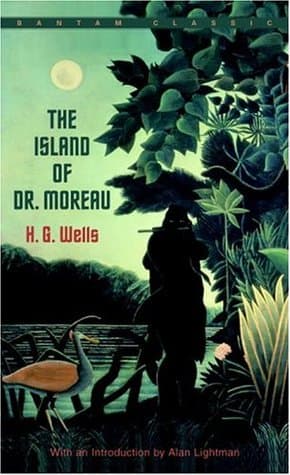
On a remote Pacific island, a shipwrecked man finds a doctor's horrifying experiments in vivisection, blurring the lines between man and beast and forcing a terrifying confrontation with the dark side of science.
Edward Prendick, a man with scientific interests, is the only survivor of a shipwreck in the Pacific Ocean. After days adrift, he is rescued by a schooner, the *Ipecacuanha*. On board, he meets Montgomery, the first mate and a former medical student, who is rough and ape-like. Prendick also sees a strange crew and many caged animals, including a puma. He overhears troubling talks and sees Montgomery treat the animals cruelly. After Prendick recovers, Montgomery offers him alcohol, and they talk about the island they are nearing, which Montgomery calls 'the island of Dr. Moreau'.
When they reach the island, the *Ipecacuanha*'s captain refuses to take Prendick further, saying Montgomery wants privacy. Montgomery tries to bring Prendick ashore, but Dr. Moreau, from the island, strongly denies Prendick permission to land. After a heated argument between Montgomery and Moreau, Prendick is thrown back into the dinghy. Montgomery, feeling some pity, returns for Prendick and brings him to the island's compound, a fenced area housing Moreau, Montgomery, and others. Prendick gets a room and is told not to go outside the compound.
Soon after arriving, Prendick hears terrible screams from a locked building in the compound, which Montgomery says is Moreau's laboratory. Montgomery dismisses Prendick's worry, saying the sounds are from a puma Moreau is experimenting on. Later, Prendick starts meeting the island's other residents: grotesque, half-human, half-animal creatures. He sees a Satyr-like being, a Swine-man, and others, all following strict rules. These meetings deeply disturb Prendick, making him question the island and its inhabitants.
Curiosity and fear drive Prendick to leave the compound. He sees Moreau and Montgomery chasing a rabbit, which makes him more uneasy. He then finds Moreau's laboratory, which he calls 'The House of Pain,' and through a half-open door, he sees Moreau vivisecting what looks like a man. Horrified, Prendick runs into the jungle, believing Moreau tortures humans. He is eventually cornered by the puma-like creature, which Moreau and Montgomery capture and return to the laboratory.
Prendick, sure he will be vivisected next, tries to escape Moreau's compound. Moreau and Montgomery pursue him and eventually corner him. Moreau, frustrated by Prendick's misunderstanding, explains his work. He says he is a disgraced physiologist who fled England after his vivisection experiments became too controversial. On the island, he continues his work, changing animals into grotesque, bipedal 'Beast Folk' through surgery, grafting, and intense pain. His goal is to perfect the human form, driven by scientific curiosity and no regard for suffering.
Moreau introduces Prendick to 'the Law,' rules and rituals taught to the Beast Folk through hypnosis and pain. The Law forbids them from walking on all fours, eating flesh, or hunting, and orders them to worship Moreau and obey him. Prendick sees a gathering where the Beast Folk chant the Law, led by the Sayer of the Law, a grey, ape-like creature. He observes their struggle to keep their human-like appearance, constantly fighting their animal instincts. Prendick is horrified by their existence, caught between humanity and animality, and fears their animal nature returning.
The island's fragile order breaks when a Leopard-Man, one of Moreau's creations, breaks the Law by killing and eating a rabbit. This act causes panic among the Beast Folk, and Moreau, with Montgomery and Prendick, hunts the renegade. Moreau sees this as a challenge to his authority and his 'society's' stability. After a long chase, the Leopard-Man is cornered and brutally killed, not by Moreau, but by other Beast Folk who fear Moreau's anger and the collapse of their enforced 'humanity.' This event shows how precarious Moreau's control is.
One day, a puma, one of Moreau's recent subjects, escapes the laboratory. Moreau, proud of his science and wanting to recapture his creation, chases it alone. Prendick and Montgomery hear a terrible fight and find Moreau's mangled body, killed by the escaped puma. The puma is also found dead nearby, fatally wounded by Moreau. Moreau's death shocks the island. Without their 'god' and enforcer, the Beast Folk start to show signs of returning to their animal instincts, and Moreau's fragile society begins to fall apart.
Moreau's death makes Montgomery deeply sad. He had found purpose on the island, helping Moreau and guiding the Beast Folk. Without Moreau, Montgomery loses hope and starts drinking heavily. He tries to win the Beast Folk's loyalty by giving them alcohol, but this only makes them regress more. In a drunken rage, Montgomery confronts some Beast Folk and, in an accident, is killed when a fire he started detonates the compound's explosives. Prendick is left alone, the only human survivor.
Prendick is now the only human on the island, surrounded by the increasingly wild Beast Folk. He tries to assert some authority, but their regression speeds up. The Beast Folk abandon the Law, their language worsens, and their bodies become more animalistic. Prendick lives in constant fear, struggling to survive and stay sane amidst the growing savagery. After several months, he finds a derelict boat with two dead sailors. He repairs it and, after a difficult journey, is picked up by a passing ship. He is rescued, but the trauma of his experience changes him deeply.
Prendick is eventually rescued and returns to England. However, his experiences on Moreau's island have left him deeply scarred. He finds it hard to rejoin human society, seeing animalistic traits and potential savagery in everyone. He avoids crowds and finds peace in solitude, observing stars and pursuing abstract scientific studies. He is haunted by the Beast Folk and the dark implications of Moreau's experiments, forever changed by his encounter with raw human and animal nature.
The Protagonist
Prendick begins as an observer, horrified by Moreau's work, and ends as a traumatized survivor who views humanity with a profound sense of disillusionment and alienation.
The Antagonist
Moreau remains static in his amoral scientific pursuit, ultimately dying as a direct consequence of his hubris.
The Supporting
Montgomery descends into deeper despair and alcoholism after Moreau's death, ultimately leading to his own tragic demise.
The Supporting
The Sayer of the Law steadily loses his authority as the Beast Folk regress, eventually becoming just another animalistic creature.
The Mentioned
His brief appearance marks a pivotal moment in the breakdown of Moreau's order, demonstrating the inevitable failure of Moreau's experiments.
The Supporting
M'ling remains loyal to Montgomery until the end, embodying the tragic, dependent nature of the Beast Folk.
Moreau's endless pursuit of science without moral limits is a main idea. He represents the Victorian fear of out-of-control science, creating life without respect for its nature or suffering. His experiments come from intellectual curiosity, without compassion, leading to grotesque, tormented creations. This theme is clear in Moreau's 'House of Pain,' where he vivisects animals into human-like forms, and his dismissal of the Beast Folk's pain as just 'pain' instead of suffering. The island itself shows scientific ambition unchecked, leading to chaos and destruction.
“''The study of animal psychology was my province, but I had made a step in the wrong direction; I had gone too far; I had lost my way. I found myself in a blind alley, and I could not turn back. I had to go on.'”
The novel constantly blurs the lines between human and animal, asking what truly makes someone human. The Beast Folk, despite their changes and forced rules, constantly fight their animal instincts, showing how thin civilization is. Prendick's own return to primal fear and suspicion on the island, and his later inability to fully rejoin human society, suggests that humanity is always close to animality. The Beast Folk's eventual regression shows that human traits are not easily forced or kept.
“''You see, Prendick, this island is a laboratory, a physiological laboratory. I am trying to make a man.'”
Moreau's island can be seen as a symbol for colonial power. Moreau, the European scientist, imposes his 'civilization' (the Law) on the 'savages' (the Beast Folk), making them abandon their natural ways and adopt his rules. He acts as their 'god' and 'creator,' holding absolute power and enforcing obedience through fear and pain. The Beast Folk's struggle to maintain this imposed order, and their eventual rebellion and regression, reflect the often unstable nature of colonial rule when the dominant power leaves. Prendick's initial disgust and later fear of the Beast Folk also mirror common colonial views of indigenous people.
“''They have to fear me. I am God to them. I have to be God to them.'”
Pain is a constant and central theme, both physical and mental. Moreau's vivisection experiments cause immense physical pain to his subjects, which he sees as a necessary part of his science. The Beast Folk live in constant mental suffering, trapped between their animal instincts and the human mind forced upon them, enduring the agony of ongoing change. Prendick himself experiences intense fear and mental distress, especially when alone on the island. The novel explores the ethics of causing pain for science and the deep, lasting effect of suffering on identity and existence.
“''The study of Nature is the study of pain.'”
Prendick's journey begins with isolation after a shipwreck and ends with a deep feeling of being disconnected from humanity. On the island, he is cut off from civilization and faces unimaginable horrors, causing deep psychological trauma. Even after his rescue, he struggles to connect with society, seeing animalistic tendencies in everyone. This theme shows how extreme experiences can permanently change how someone sees the world and their place in it, leading to a lasting feeling of being an outsider.
“''I was a man, an intellectual man, and I was alone on a jungle island surrounded by half-human beasts.'”
The story is told entirely from Edward Prendick's perspective.
The use of first-person narration places the reader directly into Prendick's terrifying experience, allowing for immediate access to his thoughts, fears, and observations. This subjective viewpoint heightens the sense of suspense and horror, as the reader discovers the island's secrets alongside Prendick. It also emphasizes his psychological journey and the profound impact of the events on his sanity, making his alienation upon returning to society more poignant and believable. The reader experiences his confusion, disbelief, and eventual trauma firsthand.
A set of strict, ritualistic prohibitions and commands imposed on the Beast Folk.
The Law functions as a central plot device for exploring themes of control, civilization, and the struggle between instinct and imposed order. It is Moreau's attempt to instill a rudimentary 'humanity' and social structure in his creations. The chanting of the Law by the Sayer of the Law and the Beast Folk underscores their forced obedience and the precariousness of their 'humanity.' The breaking of the Law, as demonstrated by the Leopard-Man, serves as a catalyst for conflict and highlights the inherent failure of Moreau's experiments to truly transform his subjects.
Moreau's laboratory, where vivisection experiments are conducted.
The 'House of Pain' is a symbolic and literal plot device representing the horrific core of Moreau's scientific hubris and the suffering he inflicts. It is the source of the screams that initially terrify Prendick and the place where the Beast Folk are created and 'educated' through torment. Its name itself encapsulates the novel's pervasive theme of pain and its role in Moreau's amoral pursuit of knowledge. It serves as a constant, looming threat and a reminder of the island's dark secrets.
The remote, uncharted nature of Moreau's island.
The island's extreme isolation is crucial. It allows Moreau to conduct his unethical experiments without interference from society or legal repercussions. This physical isolation mirrors the moral and ethical isolation of Moreau himself. For Prendick, the island's remoteness amplifies his terror and helplessness, cutting him off from any hope of rescue or justice. The confined setting intensifies the psychological horror, as there is no escape from the grotesque reality Moreau has created, emphasizing the vulnerability of human morality when removed from societal constraints.
“He was a pale, flaxen-haired man, with a slight stoop, and a restless, furtive eye. I remember him as a man of great nervous energy and quick, precise gestures.”
— Description of Montgomery as narrated by Prendick.
“The study of nature is the study of the devil. The world is a graveyard.”
— Moreau's cynical view on nature and life.
“To this day I have a peculiarly vivid memory of my first glimpse of Doctor Moreau. He was a powerfully built man, with a large, square head, and a face of a singularly intellectual cast. His eyes were deep-set and piercing, and his mouth was thin-set and cruel.”
— Prendick's initial observation of Doctor Moreau.
“The Law is a memory. The Law is a memory. The Law is a memory.”
— The Beast Folk chanting the Law, emphasizing its fragility.
“Are we not men?”
— The Beast Folk's desperate and repeated question, highlighting their struggle for humanity.
“I was a scientific investigator, as I am still. My aim was to discover the secrets of life, to probe into the very structure of being. I had no other motive.”
— Moreau explaining his scientific drive to Prendick.
“The thing is to be a man, and not a beast.”
— A central tenet of the Law, constantly reinforced to the Beast Folk.
“Pain and fear. They are the only spurs to action, the only teachers.”
— Moreau's belief in the necessity of suffering for progress and control.
“It is not the Law to go on all-fours.”
— A specific command from the Law, dictating human-like posture.
“I felt a peculiar sense of revulsion, as if I were in the presence of something unclean.”
— Prendick's reaction to the Beast Folk, reflecting his disgust and fear.
“The world is not for you. You are a beast.”
— A harsh reminder from the Law, stripping the Beast Folk of their aspirations.
“He was a man of science, a man of power, a man of intellect. But he had forgotten the meaning of humanity.”
— Prendick's final assessment of Moreau after his death.
“I have been through a trauma. I have seen things that no human being should ever see.”
— Prendick reflecting on his experiences on the island after his escape.
“The Law has been broken! The Law has been broken!”
— The Beast Folk's cry as the strictures of Moreau's control begin to crumble.
Ready to see how well you understood this book? Take our interactive quiz with 10 questions.

Herbert George Wells was an English writer. Prolific in many genres, he wrote more than fifty novels and dozens of short stories. His non-fiction output included works of social commentary, politics, history, popular science, satire, biography, and autobiography. Wells' science fiction novels are so well regarded that he has been called the "father of science fiction".







